Every month, our production lines ship thousands of aluminum furniture handles to Vietnam professional Vietnamese translator 1. Yet we still see buyers struggle with one recurring problem: their goods get held at Vietnamese customs because the packaging lacks proper Vietnamese labeling. This delay costs money, damages relationships with local distributors, and slows market entry pre-shipment inspection (PSI) 2. The frustrating part? It is entirely preventable.
To ensure your aluminum furniture handle packaging includes Vietnamese product information and precautions, you should formalize the requirement in your Purchase Order, provide professionally translated Vietnamese text directly to the supplier, request digital mockups for approval before mass production, and conduct pre-shipment inspections to verify label accuracy and placement.
Vietnamese labeling is not a nice-to-have. It is a legal mandate under Decree No. 43/2017/ND-CP 3. Below, we break down the exact steps to get this right, from translation accuracy to quality verification, so your next shipment clears customs without a hitch.
How Can I Ensure My Chinese Supplier Accurately Translates Aluminum Handle Specifications into Vietnamese?
Over the years, our export team has processed hundreds of Vietnamese packaging requests. The single biggest mistake buyers make is assuming their Chinese supplier can handle the translation independently. Most factories do not have Vietnamese linguists on staff. The result is often garbled text that confuses buyers and customs officers alike.
To ensure accurate Vietnamese translation, you should never rely on the supplier's translation. Instead, hire a professional Vietnamese translator yourself, provide the finalized text to the supplier, and require a digital proof for review before any printing begins.

Why Machine Translation Fails for Technical Content
Many suppliers default to Google Translate or similar tools. For everyday phrases, this works. For technical aluminum product specifications, it fails badly. Vietnamese is a tonal language 4 with diacritical marks that change meaning entirely. The word "nhôm" means aluminum. Without the correct diacritics, it becomes meaningless or, worse, a different word. Technical terms like "anodized finish 5," "alloy grade 6063," or "installation torque" have specific Vietnamese equivalents that machine tools often miss or mistranslate.
In our experience shipping to distributors in Ho Chi Minh City and Hanoi, we have seen packaging returned because "mạ anode" (anodized coating) was mistranslated as a generic "coating" term that did not satisfy the inspector. These small errors create big problems.
The Best Workflow for Translation Accuracy
Here is the workflow we recommend to every buyer:
- You provide the English source text. List every specification, warning, and instruction you need on the packaging.
- A professional Vietnamese translator converts it. Use a translator who understands industrial or hardware terminology.
- A second native Vietnamese speaker reviews it. This catches subtle errors the first translator might miss.
- You send the finalized Vietnamese text to the supplier. Provide it in an editable digital format (Word or PDF) with the exact font files if your brand uses a specific typeface.
- The supplier creates a digital mockup. You review and approve it before printing starts.
Common Translation Errors to Watch For
| English Term | Correct Vietnamese | Common Mistake | Why It Matters |
|---|---|---|---|
| Aluminum alloy 6063 | Hợp kim nhôm 6063 | Nhôm 6063 (missing "hợp kim") | Omits "alloy," which is a required material detail |
| Anodized finish | Bề mặt mạ anode | Bề mặt phủ (generic "coated") | Misrepresents the actual surface treatment process |
| Maximum load capacity | Tải trọng tối đa | Sức chịu tối đa (informal) | Sounds unprofessional and may confuse end-users |
| Country of Origin 6: China | Xuất xứ: Trung Quốc | Sản xuất: Trung Quốc | "Sản xuất" means "manufactured," not "origin" — different legal meaning |
| Caution: Sharp edges | Cẩn thận: Cạnh sắc | Chú ý: Sắc (incomplete) | Missing "cạnh" (edge) makes the warning vague |
Formalizing the Translation Requirement in Your PO
Do not leave this to a verbal agreement or a casual email. Your Purchase Order 7 should include a clause like:
"Buyer shall provide the finalized Vietnamese text for all packaging labels. Supplier shall print the text exactly as provided, without modification. Any deviation requires written approval from the buyer."
This removes ambiguity. It puts the translation responsibility on you (where it belongs for accuracy) and the printing responsibility on the supplier (where it belongs for execution).
What Specific Technical Details and Precautions Should I Include on My Vietnamese Product Labels?
When our team prepares packaging for the Vietnamese market, we work from a detailed checklist that covers both legal requirements and practical user needs. Many buyers only think about the product name and origin. That is not enough. Vietnamese regulations under Decree 43/2017/ND-CP require a comprehensive set of information for imported consumer goods.
Your Vietnamese product labels must include the product name, material composition (aluminum alloy type), manufacturer details, country of origin, batch number, installation instructions, safety warnings about sharp edges or weight, and maintenance guidelines — all in clear, legible Vietnamese text.
Mandatory Information: The Legal Checklist
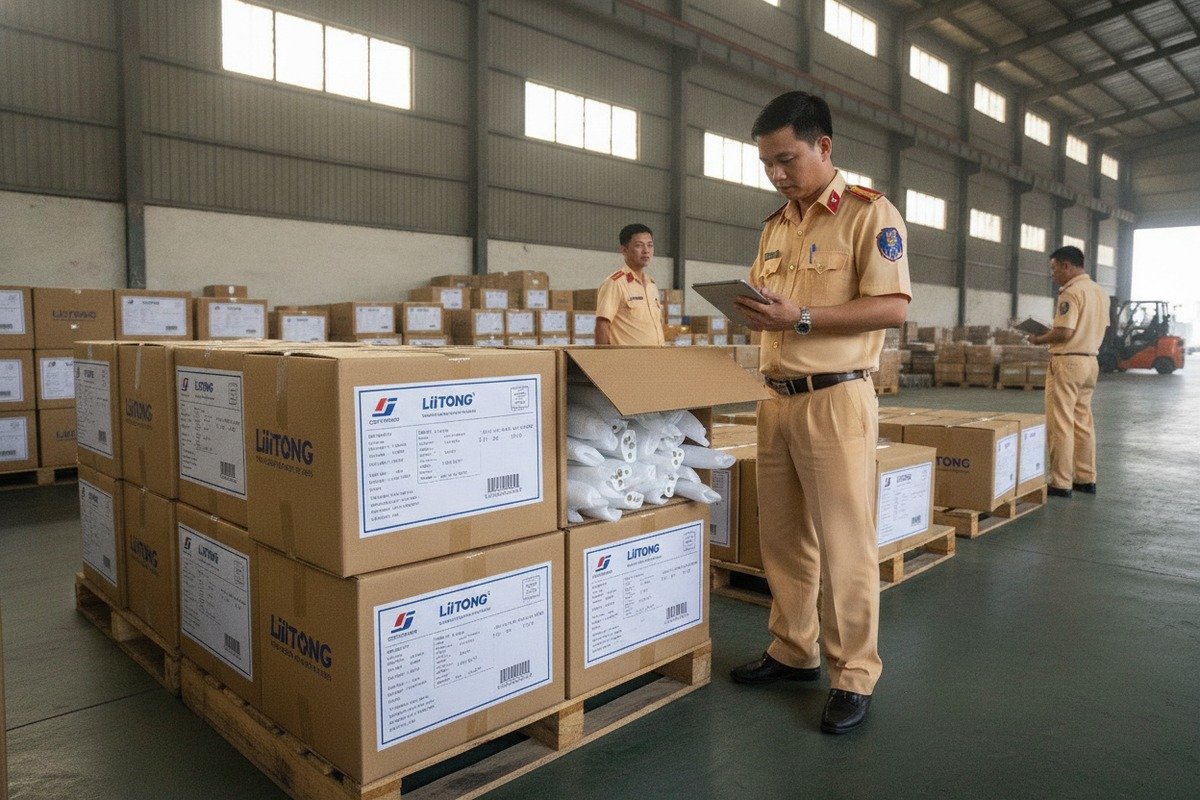
Vietnamese customs officers check labels against a defined list. If any required element is missing, your shipment can be held, fined, or forced through costly re-labeling at the port. Here is what must appear:
| Required Element | Vietnamese Term | Example for Aluminum Handles |
|---|---|---|
| Product Name | Tên sản phẩm | Tay nắm tủ nhôm (Aluminum Cabinet Handle) |
| Material Composition 8 | Thành phần vật liệu | Hợp kim nhôm 6063 |
| Manufacturer Name & Address | Tên và địa chỉ nhà sản xuất | [Factory name], Foshan, Trung Quốc |
| Country of Origin | Xuất xứ | Trung Quốc |
| Production Date | Ngày sản xuất | 06/2025 |
| Batch/Serial Number | Số lô | LOT-20250601 |
| Net Quantity | Số lượng | 1 chiếc (1 piece) |
Safety Precautions: Protecting End-Users
Aluminum furniture handles, especially the recessed and minimalist designs we produce with deep geometric channels and sharp clean edges, can pose risks during installation. Your Vietnamese labels should include clear warnings:
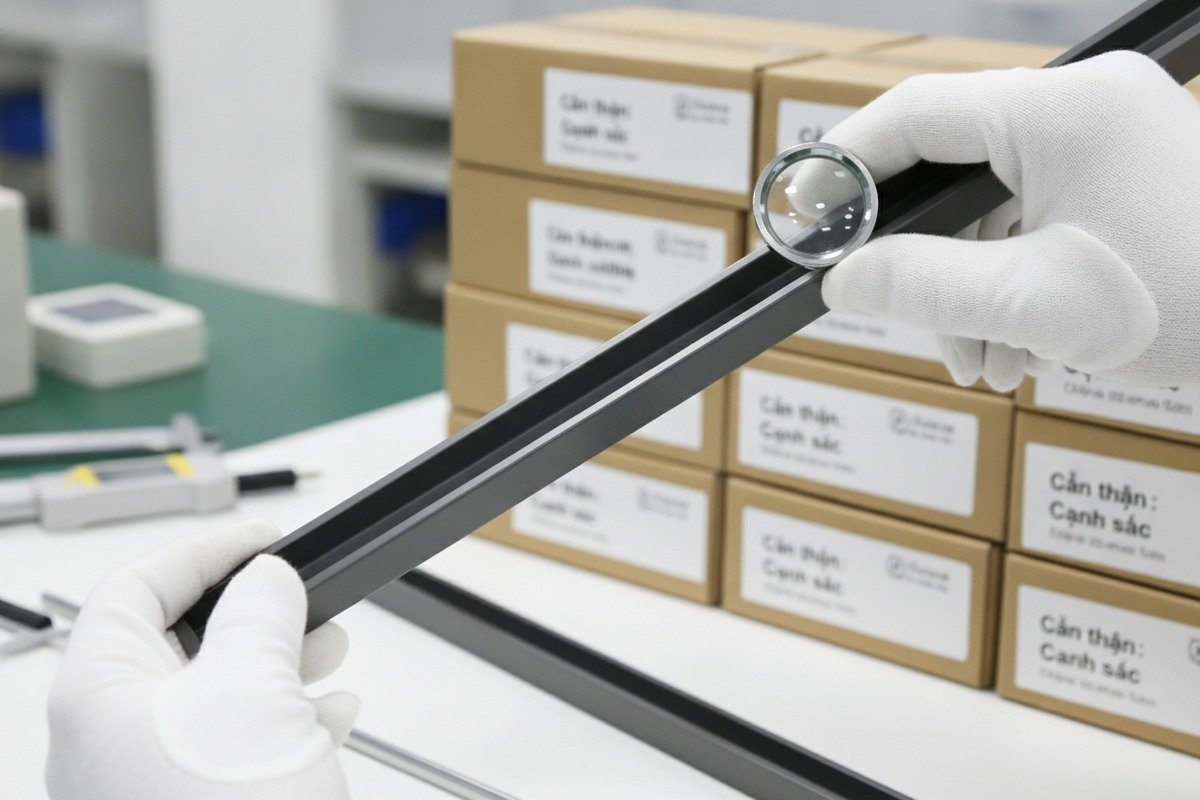
- "Cẩn thận: Cạnh sắc. Đeo găng tay khi lắp đặt." (Caution: Sharp edges. Wear gloves during installation.)
- "Chỉ dành cho người lớn lắp đặt." (Installation by adults only.)
- "Sử dụng ốc vít phù hợp với kích thước lỗ." (Use screws that match the hole size.)
- "Không siết quá chặt để tránh biến dạng tay nắm." (Do not over-tighten to avoid deforming the handle.)
These are not optional extras. If someone gets injured and the packaging had no Vietnamese warning, the importer carries liability.
Maintenance Instructions
Aluminum handles with anodized or matte finishes require specific care. Include a short maintenance note:
- "Lau bằng khăn mềm ẩm. Tránh sử dụng chất tẩy rửa có tính axit hoặc kiềm mạnh." (Wipe with a soft damp cloth. Avoid strong acidic or alkaline cleaners.)
This protects the product's finish and reduces warranty complaints from end-users who might otherwise damage the champagne gold or matte black surfaces with harsh chemicals.
Formatting Rules That Matter
Vietnamese law specifies that label text must be legible. The minimum character height is typically 2mm for standard information and larger for warnings. Use high contrast — black text on a white or light silver background works best. The label must be on the visible face of the packaging, not hidden under a fold or on the bottom of the box.
For our recessed handle packaging, we typically place the Vietnamese label on the front panel of the blister pack or on the top face of the box. This makes inspection easy at customs and in the warehouse.
Can I Request Custom Vietnamese Packaging for My Wholesale Aluminum Profile Orders to Meet Local Regulations?
Our factory handles custom packaging requests regularly. In fact, for the Vietnamese market specifically, about 70% of our buyers now request fully customized Vietnamese packaging rather than generic international labels. The shift happened because several high-profile customs seizures in 2022 and 2023 made it clear that English-only packaging is a liability.
Yes, you can and should request custom Vietnamese packaging for wholesale aluminum profile and handle orders. Most established suppliers offer this service, either through direct printing on packaging or through pre-printed adhesive labels, typically for a small additional cost that is far less than the penalty for non-compliance.
Direct Print vs. Adhesive Labels
You have two main options for getting Vietnamese text onto your packaging. Each has trade-offs.
| Feature | Direct Print on Packaging | Pre-Printed Adhesive Labels |
|---|---|---|
| Cost per unit | Lower for large orders (5,000+) | Lower for small orders (<2,000) |
| Setup cost | Higher (new plate or screen) | Lower (digital label printing) |
| Flexibility | Hard to change once printed | Easy to update or correct |
| Durability | Permanent, part of the box | Can peel or smudge if low quality |
| Lead time | Adds 3-5 days to production | Can be printed in parallel |
| Best for | Repeat orders with stable text | First orders or frequently updated info |
For first-time buyers, we almost always recommend adhesive labels. If there is a typo or a regulation change, you only reprint the labels, not the entire box. Once the text is confirmed and stable across several orders, switch to direct printing for a cleaner look and lower per-unit cost.
How to Structure the Request in Your PO
Include a dedicated packaging section in your Purchase Order. Here is a sample framework:
Packaging Requirements:
- All packaging shall include Vietnamese text as per attached document "VN_Label_v1.2.pdf."
- Vietnamese text shall appear on the front-facing panel of the individual product box.
- Font: [Specified font name] or equivalent sans-serif supporting full Vietnamese Unicode.
- Minimum text height: 2mm for standard info, 3mm for safety warnings.
- Color: Black text on white label background.
- Barcode and QR code placement shall not be obstructed by the Vietnamese label.
Integrating QR Codes for Extended Content
Small handle packaging often lacks space for lengthy instructions. A practical solution is a QR code that links to a Vietnamese-language webpage with full installation guides, video tutorials, and maintenance tips. QR codes for Extended Content 9 We have helped several Vietnamese distributors set this up. The physical label carries the legally required minimum text, and the QR code provides the extended content. This satisfies both the law and the end-user's need for detailed guidance.
Cost Expectations
Custom Vietnamese packaging typically adds between $0.02 and $0.08 per unit for adhesive labels, or $50–$150 in one-time plate setup fees for direct printing. Compare this to the potential fine of up to 20% of your shipment value for non-compliant labeling, and the math is obvious. It is one of the cheapest investments you can make in market compliance.
Our team builds this cost into the quotation when buyers mention Vietnam as their target market. We encourage you to raise this topic during the RFQ stage so there are no surprises later.
How Do I Verify the Quality of the Vietnamese Printing on My Furniture Handle Packaging Before Shipment?
In our years of exporting aluminum handles, we have learned that even the best translation and the best intentions can fall apart on the production floor. A machine operator might load the wrong label roll. A printer might drop a diacritical mark. The ink might smudge on a glossy surface. Verification is not paranoia — it is standard practice.
To verify Vietnamese printing quality, establish a Golden Sample with approved packaging, require the supplier to send photos of production packaging for comparison, and conduct a pre-shipment inspection (PSI) that includes a specific checklist item for label accuracy, legibility, placement, and print durability.

The Golden Sample Method
Before mass production begins, ask your supplier to produce one complete package with the approved Vietnamese label. This is your Golden Sample. Inspect it yourself or have your Vietnamese partner inspect it. Check every word, every diacritical mark, every line of text. Once approved, the supplier keeps this sample on the production floor as the reference standard. Every packaged unit must match it exactly.
At our facility, we photograph the Golden Sample from multiple angles and attach these photos to the internal production order. Our QC team compares random units against these photos throughout the packaging run.
Pre-Shipment Inspection Checklist
Whether you use your own inspector or a third-party agency like SGS or Bureau Veritas, your PSI must include these label-specific checkpoints:
- Presence: Is the Vietnamese label on every unit? Check a statistically valid sample (AQL 2.5 10 is standard).
- Accuracy: Does the text match the approved version exactly? Compare character by character against the Golden Sample photo.
- Legibility: Can you read the text easily from arm's length? Check font size, contrast, and print sharpness.
- Placement: Is the label on the correct panel? Is it straight, not crooked or wrinkled?
- Durability: Rub the label lightly with a damp cloth. Does the ink smear or the label peel? It must survive shipping and handling.
- Barcode integrity: Is the Vietnamese label blocking or overlapping any barcode or QR code?
What to Do When Errors Are Found
If the inspector finds errors, issue an immediate stop-ship order. Do not accept partial compliance. Common remedies include:
- Minor typo on labels: Supplier reprints and re-applies correct labels before shipping.
- Wrong label on product: Supplier sorts and re-labels affected units.
- Systemic error (wrong text on all units): Full re-packaging required. Apply the contractual penalty clause.
We recommend including a penalty clause in your contract: "Labeling errors that require re-work shall be corrected at the supplier's expense. Delays caused by labeling non-compliance shall incur a penalty of [X]% of the affected order value." This gives the supplier a financial incentive to get it right the first time.
Photo Documentation
Before any shipment leaves the warehouse, require the supplier to send clear, high-resolution photos of the actual production packaging (not the sample — the real units off the line). These photos should show the Vietnamese label in full, the barcode area, and the overall package. Compare these against your Golden Sample. If anything looks off, hold the shipment until you get clarification.
This step takes five minutes but can save you weeks of customs delays and thousands of dollars in re-labeling costs at the port.
Conclusion
Getting Vietnamese labeling right on your aluminum furniture handle packaging is a legal requirement, a brand-building opportunity, and a shipment-saving precaution all in one. Provide the translation yourself, formalize everything in your PO, approve a Golden Sample, and inspect before shipment. Your goods will clear customs smoothly, and your Vietnamese customers will trust your brand from the first unboxing.
Footnotes
1. Authoritative source from the American Translators Association on Vietnamese language professionals. ↩︎
2. Explains the definition, procedure, and importance of pre-shipment inspection in quality control. ↩︎
3. Official US government guide referencing Vietnam’s goods labeling decree. ↩︎
4. Explains the linguistic characteristic of Vietnamese as a tonal language. ↩︎
5. Provides a technical explanation of the anodizing process for aluminum. ↩︎
6. U.S. Department of Commerce guide on Vietnam’s labeling requirements, including country of origin. ↩︎
7. Defines and explains the function of a Purchase Order in business transactions. ↩︎
8. SGS article summarizing Vietnam’s Decree 43/2017/ND-CP, which includes material composition requirements. ↩︎
9. Discusses how QR codes provide additional product information on labels. ↩︎
10. Details the meaning and application of AQL 2.5 as a quality inspection standard. ↩︎