
Over the past 18 years, our production lines have shipped thousands of aluminum handle orders to furniture factories across Vietnam OEM/ODM customization 1. One lesson we learned early: a handle that looks great in a catalog can fail completely once mounted on solid teak in Ho Chi Minh City’s humidity.
To determine if a supplier’s aluminum handles suit popular Vietnamese solid wood furniture, verify five things: mechanical fit with your wood thickness and hole spacing, finish durability against tropical humidity, corrosion resistance, customization flexibility, and the supplier’s ability to deliver fast with low MOQs.
This guide walks you through a practical, step-by-step evaluation framework. Whether you run a furniture factory or distribute building materials in Vietnam, the checklist below will help you avoid costly mistakes and find handles that truly match your solid wood products.
How do I choose aluminum handle finishes that perfectly match the aesthetic of popular Vietnamese solid wood furniture?
Choosing the right finish is where many buyers stumble. When we develop new handle finishes for the Vietnamese market aluminum handle finishes 2, our color-matching team always starts with actual wood samples, not digital swatches.
Select aluminum handle finishes by matching undertones to your specific wood species. For Vietnamese teak and acacia, champagne gold, matte black, and warm bronze anodized finishes pair best. Always request physical samples and test them against your actual stained or oiled wood panels before committing to a bulk order.
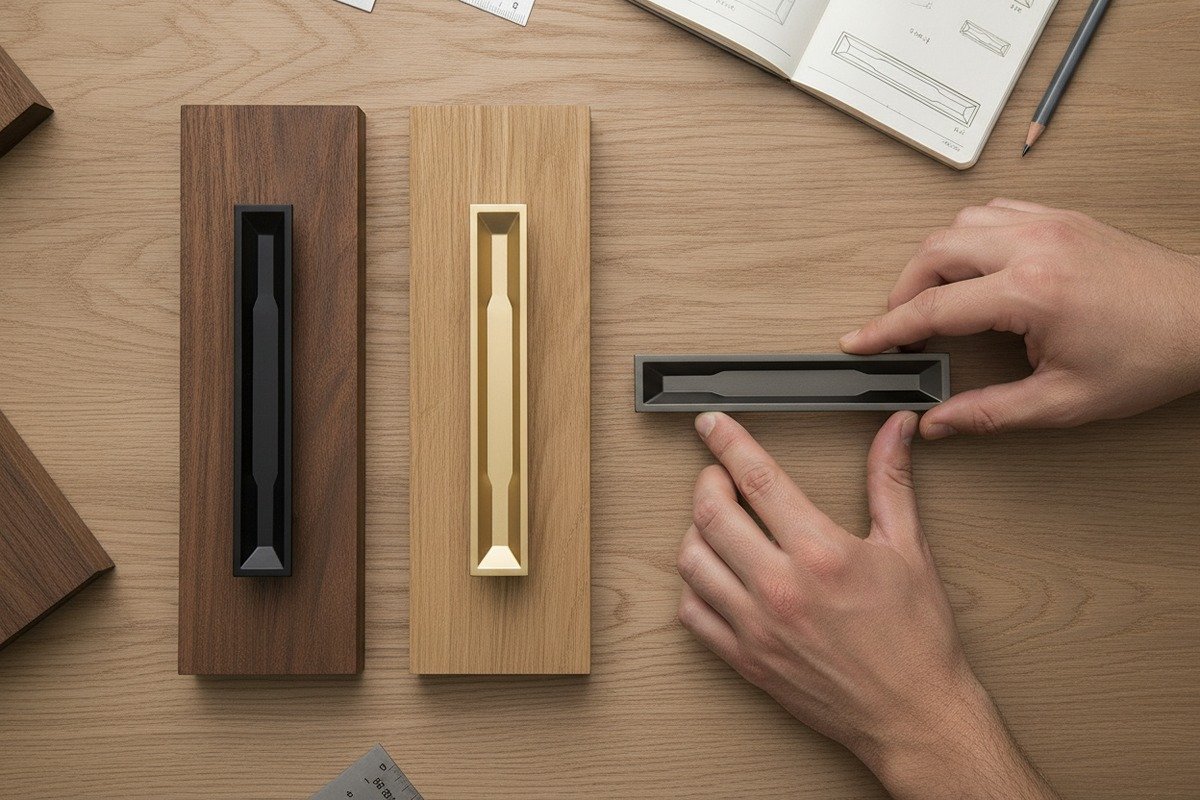
Why Wood Species Dictates Your Finish Choice
Vietnamese solid wood furniture 3 typically uses teak, acacia, walnut, and rubberwood. Each species has a distinct color temperature. Teak leans warm golden-brown. Acacia ranges from light honey to deep chocolate. Walnut is cool and dark. Rubberwood is pale and neutral.
A matte champagne gold handle looks stunning on warm-toned teak. But place that same handle on dark walnut, and it can look washed out. For walnut or dark-stained acacia, matte black or gunmetal grey creates a sharper contrast that feels intentional.
Common Finish Types and Their Best Wood Pairings
| Finish Type | Best Wood Pairing | Typical Use Case | Climate Suitability |
|---|---|---|---|
| Champagne Gold Anodized | Teak, Light Acacia | Residential cabinets, wardrobes | Excellent in humidity |
| Matte Black Powder Coat | Walnut, Dark Stained Oak | Modern kitchens, hotel casegoods | Excellent in humidity |
| Light Bronze Anodized | Medium Teak, Rubberwood | Mid-range residential furniture | Excellent in humidity |
| Charcoal Grey Powder Coat | All dark-toned woods | Hospitality furniture, offices | Excellent in humidity |
| White Powder Coat | Light rubberwood, painted MDF | Scandinavian-style furniture | Good, needs quality coat |
Avoid Relying on Screen Colors
This is a mistake we see constantly. A buyer picks a finish from a website photo, places a 2,000-piece order, and then realizes the handle clashes with their wood. Screens distort color temperature. Lighting in your factory is different from lighting in a showroom.
The fix is simple: request physical samples. At our facility, we ship sample sets within 48 hours from stock. If you need a custom finish, our turnaround is 3 to 7 days. Always mount the sample on your actual wood panel under the lighting conditions where the furniture will be used.
Texture Matters as Much as Color
Solid wood furniture in Vietnam often features natural oil finishes or matte lacquers. These create a tactile, organic feel. A glossy chrome handle on a matte-oiled teak door feels wrong, even if the color sort of matches. Stick with matte or satin finishes on the handle to echo the wood's surface texture. Our recessed channel handles with smooth, non-reflective surfaces work particularly well here because they maintain a minimalist look without visual competition.
Consider the End User's Market
If your furniture targets Vietnamese domestic buyers, warm and understated finishes sell best. If you export to Middle Eastern or European hospitality projects, bolder contrasts like matte black on light wood are trending. Knowing the end market helps you narrow down finishes before you even contact a supplier.
What technical specifications should I check to ensure these handles are durable enough for Vietnam's humid climate?
Vietnam's tropical climate is brutally hard on furniture hardware. When we run accelerated corrosion tests in our lab, we simulate exactly these conditions because our largest export market demands it.
Check the aluminum alloy grade (6063-T5 is ideal), surface treatment type (anodizing or powder coating), coating thickness (minimum 60 microns for powder coat), salt spray test results (≥500 hours), and pull strength rating (≥100N). These specs determine whether a handle will survive Vietnam's humidity, temperature swings, and daily heavy use.

The Alloy Grade Tells You Everything About Base Strength
Not all aluminum is the same. Furniture handles should use 6063-T5 or 6061-T6 extruded aluminum aluminum alloy grade 5. The "T5" or "T6" refers to the temper, which indicates how the metal was heat-treated. T5 is artificially aged after extrusion. T6 is solution heat-treated and then artificially aged, making it stronger but also more expensive.
For furniture handles, 6063-T5 offers the best balance of strength, corrosion resistance, and formability. It extrudes cleanly into the slim, recessed profiles popular in modern Vietnamese furniture. If a supplier cannot tell you the alloy grade, that is a red flag.
Surface Treatment Is Your Humidity Shield
In Foshan, we use two primary surface treatments for handles destined for Vietnam: anodizing and powder coating 6. Here is how they compare:
| Specification | Anodizing | Powder Coating |
|---|---|---|
| Coating Thickness | 10–25 microns | 60–120 microns |
| Salt Spray Resistance | 300–500 hours | 500–1000+ hours |
| Color Range | Limited metallic tones | Wide range including matte, textured |
| Scratch Resistance | Very high | High |
| UV Resistance | Excellent | Good to excellent |
| Best For | Champagne, bronze, natural aluminum looks | Black, white, grey, custom RAL colors |
| Cost | Higher per unit | Moderate |
For most Vietnamese furniture applications, powder coating at 60 microns minimum offers the best value. It handles humidity well, resists scratches during shipping and installation, and comes in more colors. Anodizing is better when you need that premium metallic look anodized finishes 7, like our champagne gold recessed handles.
Key Tests to Request from Your Supplier
Ask for documented test results. A reputable supplier will have these ready:
- Salt spray test (ASTM B117): Minimum 500 hours without visible corrosion.
- Cross-cut adhesion test (ASTM D3359): Coating should not peel or flake.
- Pull strength test: The handle should withstand at least 100 Newtons of direct pull force.
- Cycle test: For drawer handles, 50,000 open-close cycles without loosening.
Thermal Expansion Between Aluminum and Wood
This is a detail most buyers overlook. Aluminum and solid wood expand at different rates when temperatures change thermal expansion 8. In Vietnam, indoor temperatures can swing from 20°C to 38°C depending on air conditioning and season. If a handle is rigidly mounted with no tolerance, repeated expansion and contraction can loosen screws or even crack the wood around mounting holes.
The solution is proper mounting design. Slightly oversized pilot holes in the wood, combined with rubber or nylon washers, absorb differential movement. Our engineering team specifies these details in the installation guides we ship with every order.
Moisture Ingress at Mounting Points
Every screw hole in solid wood is a potential entry point for moisture. In Vietnam's humidity, this can cause localized swelling, discoloration, or even rot over years. Handles with flat, flush mounting plates distribute load better and create a tighter seal against the wood surface. Our recessed L-shaped profile handles are designed to sit flat against the door edge, minimizing exposed gaps where moisture could enter.
Can I customize the dimensions and hole spacing of aluminum handles to fit my specific solid wood cabinet designs?
Every furniture factory has its own standards. When we receive drawings from Vietnamese clients, the hole spacing varies almost every time. That is exactly why our production setup prioritizes flexibility over rigid molds.
Yes, reputable aluminum handle suppliers offer full OEM/ODM customization including length, projection depth, hole spacing, cross-section profile, and finish. To ensure a perfect fit, provide your supplier with detailed drawings specifying wood thickness, bore diameter, center-to-center distance, and handle projection. Expect custom samples within 3 to 7 days from experienced manufacturers.

What Dimensions You Need to Specify
Before contacting any supplier, measure and document these parameters from your furniture:
- Center-to-center (C-C) distance: The spacing between mounting holes. Common standards are 96mm, 128mm, 160mm, 192mm, and 256mm, but Vietnamese cabinet makers often use non-standard spacing.
- Overall length: The total handle length including any overhang beyond the mounting holes.
- Projection depth: How far the handle sticks out from the cabinet surface. For recessed or edge-mounted handles, this can be as little as 10–15mm.
- Cross-section profile: The shape of the handle when cut perpendicular to its length. Our popular recessed handles have an L-shaped cross-section that wraps over the door edge.
- Bore diameter: The size of the mounting screw hole in the handle. Standard is M4 (4mm), but some designs use M5 or M6.
- Wood thickness compatibility: Your handle's mounting system must work with your door or drawer front thickness, typically 16mm, 18mm, or 22mm for solid wood.
Standard vs. Custom: A Quick Comparison
| Feature | Standard Stock Handle | Custom OEM Handle |
|---|---|---|
| Lead Time | 48 hours (from inventory) | 3–7 days production |
| Hole Spacing | Fixed (96, 128, 160mm etc.) | Any spacing per your drawing |
| Length Options | Pre-set sizes | Any length up to 1200mm+ |
| Finish | Available stock colors | Custom RAL or anodize tone |
| MOQ | As low as 1 carton | Typically 200–500 pieces |
| Cost per Unit | Lower | Slightly higher |
| Tooling Fee | None | Usually none for profile cuts |
One advantage of extruded aluminum handles is that customization does not always require new tooling. If you want a different length or hole spacing using an existing profile shape, we simply cut and drill to your specs. New tooling is only needed if you want a completely new cross-section shape.
Fastening Methods for Solid Wood
This is critical. Solid wood is not MDF. It splits more easily, especially hardwoods like teak when screws are driven near the edge. Here are the fastening options we recommend:
- Machine screws with threaded inserts: Best for repeated assembly and disassembly. The insert is pre-installed in the wood, and the handle bolts into it. This protects the wood threads.
- Wood screws from the back: Simple and effective for permanent installation. Use pilot holes slightly smaller than the screw shank.
- Concealed fasteners with adhesive backup: For recessed handles that wrap over a door edge, some designs use a combination of small screws and construction adhesive for a clean, hidden mount.
Always ask your handle supplier what fasteners are included. Some suppliers ship handles without screws, assuming you will source your own. Others provide matched screws in the correct length for your specified wood thickness. We include screws matched to the buyer's stated panel thickness with every shipment.
Prototyping Before Production
Never skip the sample step. Even if the dimensions look correct on paper, the real test is mounting the handle on your actual cabinet door. Check that the handle sits flush, the screws engage properly, the projection feels comfortable, and the visual proportion is right. We encourage every buyer to order 3 to 5 samples first, test them in production, and then confirm the bulk order.
How do I confirm if a supplier can provide the fast shipping and low MOQs my furniture factory requires?
Speed and flexibility can make or break a supplier relationship 10. Our warehouse in Foshan holds over 300 tons of finished aluminum profiles and handles precisely because Vietnamese and Middle Eastern buyers told us that waiting 30 days for handles was holding up entire furniture shipments.
Confirm fast shipping and low MOQs by asking three questions: Does the supplier maintain ready stock inventory? What is the minimum order for stock items versus custom items? Can they ship within 48 hours for standard products? Verify answers by requesting warehouse photos, stock lists, and references from existing furniture factory clients in Vietnam.
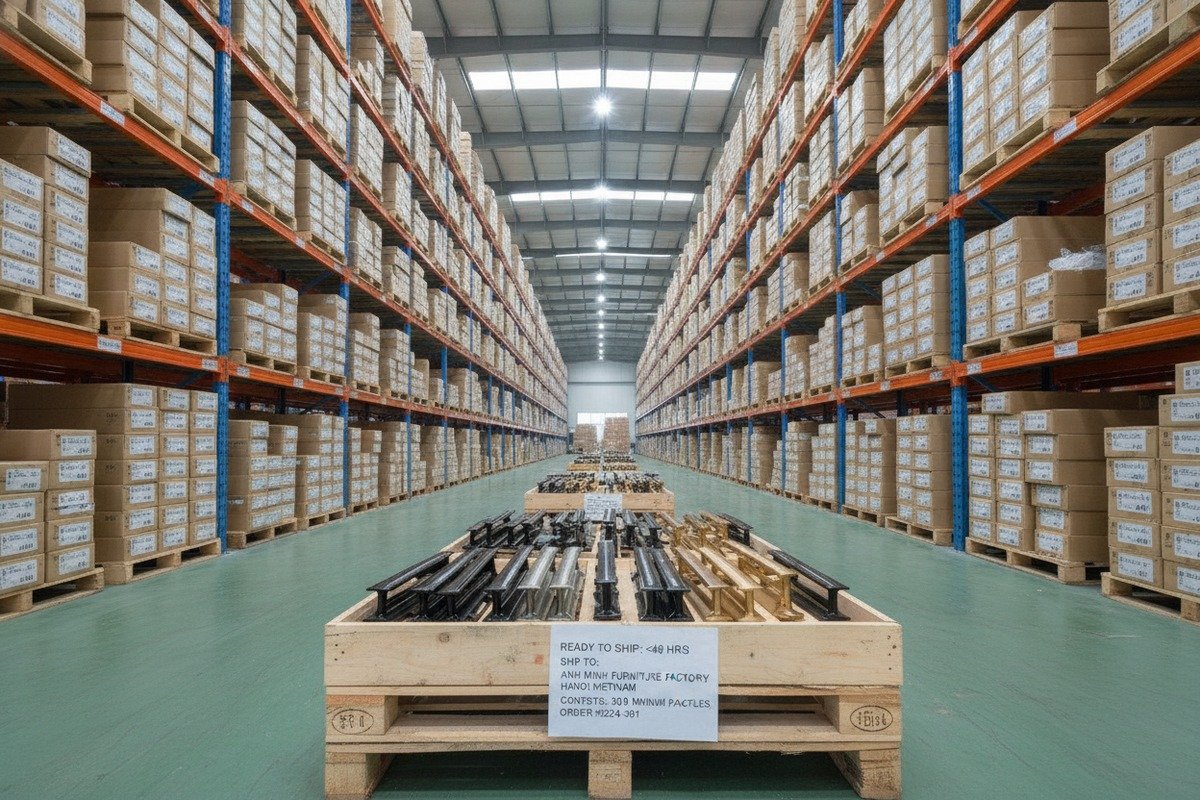
Why Lead Time Matters More Than Price
In the furniture manufacturing business, especially for Vietnamese factories filling hospitality or export orders, a delayed handle shipment can halt an entire production line. Doors and drawers sit unfinished. Assembly workers wait. Delivery deadlines slip. The cost of that delay far exceeds any savings from choosing a cheaper but slower supplier.
When evaluating a supplier, ask for their lead time breakdown:
- Order confirmation to production start: Should be same day or next day.
- Production time for stock items: Should be zero; items ship from inventory.
- Production time for custom items: 3 to 7 days is competitive. Anything over 15 days is slow for aluminum handles.
- Packing and dispatch: Should be within 24 hours after production completion.
- Transit time to Vietnam: From Southern China (Foshan, Guangzhou), sea freight to Ho Chi Minh City takes approximately 3 to 5 days. Air freight is 1 to 2 days.
MOQ Reality Check
Many aluminum handle suppliers advertise low MOQs but apply surcharges or refuse custom finishes at small quantities. Here is what to ask:
- What is the MOQ for stock items in standard finishes?
- What is the MOQ for custom hole spacing or length using an existing profile?
- What is the MOQ for a fully custom finish (new RAL color, special texture)?
- Are there setup fees or surcharges below a certain quantity?
A good supplier will be transparent. For stock handles, MOQs can be as low as one carton, typically 50 to 200 pieces depending on handle size. For custom work, 200 to 500 pieces per specification is reasonable.
How to Verify Supplier Claims
Do not take a supplier's word at face value. Use these verification steps:
- Request dated warehouse photos showing inventory with your product category visible.
- Ask for a current stock list with SKUs, quantities, and available finishes.
- Order a small trial batch and measure the actual lead time from payment to delivery.
- Ask for references from furniture factories in Vietnam. Contact those references.
- Check their export history through customs data platforms or request shipping records.
Packaging and Transit Protection
A handle that arrives scratched is useless. For solid wood furniture factories, every visible hardware piece must be pristine at installation. Ask how the supplier packages handles for export:
- Individual PE bag or foam wrap per handle?
- Carton with internal dividers?
- Corner protection for long handles?
- Moisture-absorbing packets inside cartons for ocean freight?
We use individual PE bags, foam-padded carton dividers, and silica gel packets as standard for all Vietnam-bound shipments. Scratches during transit are not just cosmetic defects; they compromise the protective coating and expose the aluminum to corrosion.
Building a Long-Term Supply Relationship
The best supplier is not the one who gives you the lowest price on a single order. It is the one who consistently delivers the right product, on time, with minimal defects, order after order. After your first trial order, evaluate:
- Did the handles match the approved sample?
- Was the delivery on time?
- Were there any quality issues?
- How responsive was the supplier when you had questions?
- Did they proactively flag any potential problems?
If a supplier passes these tests, invest in that relationship. Share your production schedule, upcoming projects, and feedback. A supplier who understands your business can pre-stock your most-used items and prioritize your custom orders.
Conclusion
Determining if an aluminum handle supplier suits your Vietnamese solid wood furniture comes down to five verifiable factors: mechanical fit, finish compatibility, climate durability, customization capability, and supply reliability. Test samples on real wood, demand documented specs, and start with a small trial order before scaling up.
Footnotes
1. Clarifies the concepts of Original Equipment/Design Manufacturing. ↩︎
2. Provides an overview of common aluminum finishing techniques. ↩︎
3. Defines what constitutes solid wood furniture. ↩︎
4. Lists and describes different types of wood used in furniture. ↩︎
5. Provides details on the specific aluminum alloy used for handles. ↩︎
6. Describes the powder coating method and its performance. ↩︎
7. Details the anodizing process and its protective qualities. ↩︎
8. Replaced HTTP unknown with a working, authoritative Wikipedia page explaining thermal expansion. ↩︎
9. Defines the standard method for evaluating corrosion resistance. ↩︎
10. Highlights the benefits of fostering long-term supplier partnerships. ↩︎