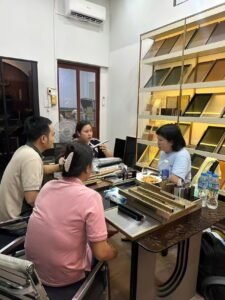
Every week, our sales team in Foshan receives inquiries from Vietnamese buyers who share the same frustration: they ordered handles that looked great in a catalog, only to discover the style clashed with the furniture once installed extrusion tooling 1. The wrong handle can make a premium cabinet look cheap — and that mismatch costs real money in returns, lost clients, and damaged reputation.
To choose the right aluminum furniture handles for the Vietnamese market, start by matching the handle’s design language to the furniture style — modern minimalist, neo-classic, Scandinavian, or hospitality — then narrow your selection by finish, size, and durability requirements for Vietnam’s humid climate.
This guide walks you through a practical, style-first approach to sourcing aluminum handles. We will cover the most common furniture segments in Vietnam, recommend handle profiles and finishes for each, and share sourcing tips that save you time and money. Let’s get into it.
How do I select the best aluminum handle styles to match the modern minimalist furniture trends in Vietnam?
When we ship containers to Ho Chi Minh City and Hanoi, roughly 70% of the orders are for clean-line, slim-profile handles. Vietnamese apartment projects and condo furniture overwhelmingly favor modern minimalist aesthetics 2, yet many buyers still pick handles that are too bulky or too ornate for flat-panel doors.
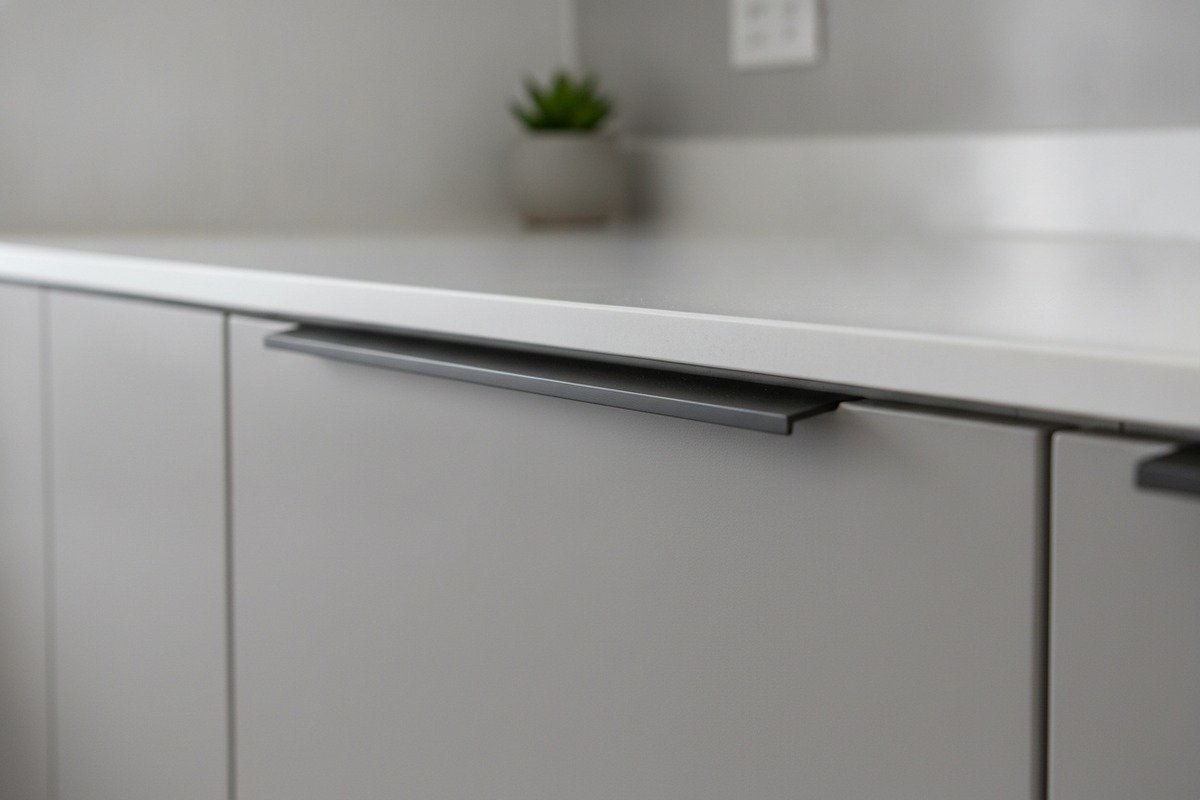
For modern minimalist furniture in Vietnam, choose slim extruded aluminum bar pulls or recessed channel handles in matte or brushed finishes. Keep the profile low, the lines straight, and the surface non-reflective to maintain the clean, quiet look that defines this style.
Why Modern Minimalist Dominates Vietnam's Urban Furniture Market
Vietnam's urban housing boom centers on compact apartments in cities like Ho Chi Minh City, Da Nang, and Hanoi. Floor plans are tight. Furniture must be efficient and visually light. That means flat-panel cabinet doors, integrated storage, and hardware that does not scream for attention. The handle's job here is to serve the hand, not decorate the door.
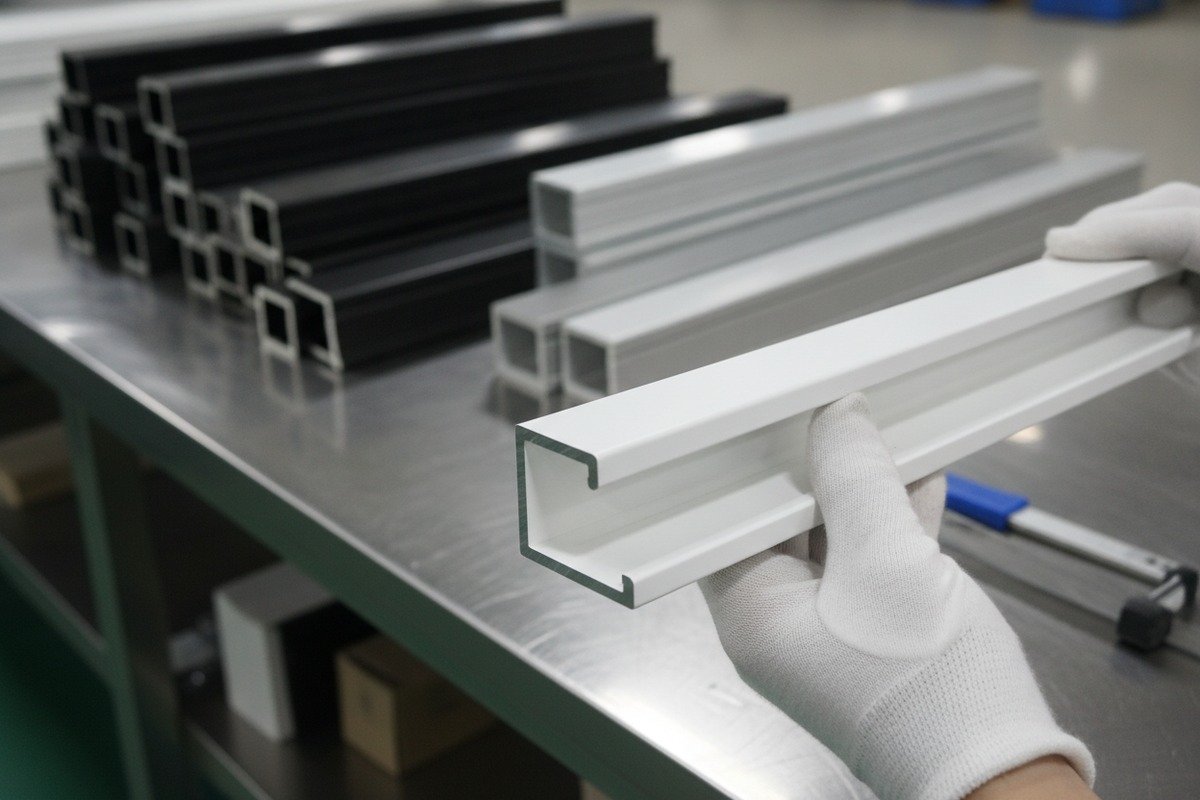
Extruded aluminum 3 is the natural material for this segment. The extrusion process creates long, consistent profiles at low cost. It produces the straight lines and slim cross-sections that modern furniture demands. Our production line runs dozens of minimalist handle profiles — from simple T-bars to recessed L-channel pulls — and they remain our best sellers for Vietnamese projects.
Style-by-Style Handle Recommendations
Not all "modern" furniture is the same. Here is how to fine-tune your handle choice within the broader modern category:
| Furniture Sub-Style | Recommended Handle Profile | Best Finish Options | Typical Use in Vietnam |
|---|---|---|---|
| Modern Minimalist | Slim bar pull, recessed channel handle | Brushed silver, matte black | Apartment kitchens, wardrobes |
| Scandinavian / Japandi | Soft-edged slim handle, rounded bar | Light brushed silver, matte white | Condo living rooms, bedrooms |
| Contemporary Premium | Longer pulls (300mm+), refined texture | Dark anodized, champagne gold | High-end villa cabinetry |
| Industrial Modern | Squared-off bar, exposed fastener look | Matte black, raw anodized | Café furniture, loft-style interiors |
Common Mistakes to Avoid
One mistake we see often: buyers choose a handle with a mirror-polished finish for a matte laminate cabinet. The shiny handle cheapens the whole piece. Another mistake is using oversized handles on compact urban storage units. A 400mm pull on a 500mm-wide door looks awkward. Keep the handle length proportional — generally 1/3 to 2/3 of the door width for bar pulls, or use a recessed channel that runs the full edge for a truly seamless look.
Also, avoid ornate or curved handles on flat-panel modern doors. The style languages conflict. If the cabinet face is quiet, the handle should be quiet too.
The Invisible Handle Debate
Some designers argue handles should be completely hidden — push-to-open mechanisms 4 or routed finger pulls integrated into the door edge. Others believe a visible handle is a design opportunity. Our recommendation for Vietnamese buyers: use concealed or recessed handles on wardrobes and utility cabinets, but allow a visible slim pull on kitchen fronts and vanities where users need a comfortable grip dozens of times a day. Function and style both matter.
What are the most popular surface finishes for aluminum furniture handles in the Vietnamese mid-to-high-end market?
Our finishing workshop runs six anodizing 5 lines, and the color requests from Vietnamese customers have shifted noticeably over the past three years. Buyers who once ordered mostly brushed silver now ask for champagne, matte black, and even wood-look finishes. Choosing the wrong finish is just as damaging as choosing the wrong profile.
In Vietnam's mid-to-high-end market, the most popular aluminum handle finishes are brushed silver, matte black, champagne gold, anodized natural aluminum, and wood-look or mixed-material options. Brushed silver remains the safest universal choice, while matte black and champagne are growing fast.

Finish-by-Finish Breakdown
Each finish carries a different visual message. Here is what works and where:
| Finish | Visual Character | Best Furniture Pairing | Durability Notes |
|---|---|---|---|
| Brushed Silver | Neutral, modern, clean | White/grey kitchen cabinets, office casegoods | Excellent scratch concealment |
| Matte Black | Bold, contemporary, urban | Dark-toned or two-tone cabinetry, industrial style | Shows fingerprints less than gloss black |
| Champagne Gold | Warm, premium, elegant | Neo-classic villas, premium bedroom furniture | Adds perceived value without looking flashy |
| Anodized Natural | Technical, minimal, honest | Japandi interiors, Scandinavian designs | Very durable; hard oxide layer resists corrosion |
| Wood-Look / Mixed Material | Warm, organic, Asian-inspired | Rattan-accented furniture, bamboo-themed interiors | Coating quality varies — request UV-resistance testing |
Why Finish Quality Matters More in Vietnam
Vietnam's climate is humid, especially in the south. A low-grade surface treatment can degrade within months — peeling, discoloration, or white oxidation spots. We always recommend anodizing over simple paint or electroplating for aluminum handles destined for Vietnamese kitchens and bathrooms. Anodizing creates a hard, integral oxide layer on the aluminum surface. It does not peel. It resists moisture. It holds color consistently across thousands of pieces.
For wood-look finishes, the quality gap between suppliers is wide. Some use heat-transfer film that lifts in humidity. Others use sublimation printing under a clear anodized layer, which lasts far longer. Always ask your supplier which process they use, and request a humidity test sample before committing to a large order.
Color Matching Across Batches
Mid-to-high-end furniture factories in Vietnam care about color consistency. If a factory orders 5,000 champagne gold handles in January and reorders 5,000 in April, those two batches must match. This is where many small suppliers fail. Our approach is to maintain master color samples and control anodizing parameters — bath temperature, dye concentration, immersion time — to keep ΔE (color difference) 6 within 1.0 across production runs. When you evaluate a supplier, ask them about their batch-to-batch color control process. If they cannot explain it, that is a red flag.
Matching Finish to Price Tier
A common error is putting an expensive finish on a budget-tier product, or the reverse. Here is a simple guideline:
- Budget tier: Anodized natural or brushed silver. Cost-effective, durable, universally acceptable.
- Mid tier: Matte black or champagne. Adds perceived value. Works well in retail-facing furniture.
- High tier: Champagne gold, custom-toned anodizing, or wood-look mixed material. Signals luxury without being garish.
The finish should support the price position. A champagne gold handle on a $30 melamine cabinet creates a disconnect. A brushed silver handle on a $2,000 lacquered vanity undersells the piece.
Can I customize aluminum handle lengths and profiles to fit my factory's specific cabinet door requirements?
We get this question almost daily. A furniture factory in Binh Duong might need a 192mm center-to-center handle for their standard kitchen doors, but the same factory also produces a custom vanity line that requires a 256mm pull with a specific cross-section. Off-the-shelf handles often do not fit both needs.
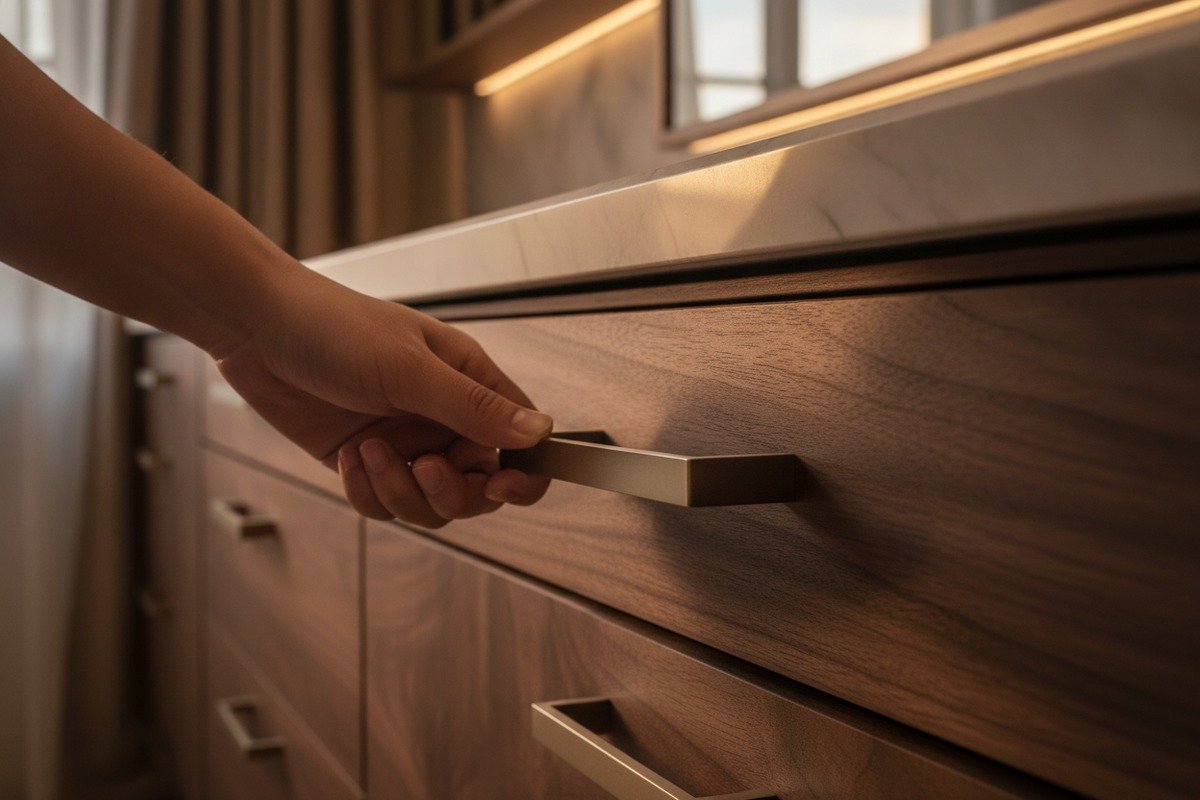
Yes, aluminum handle lengths and profiles can be fully customized. Extrusion tooling allows you to create unique cross-section shapes, and handles can be cut to any length. Custom molds typically take 3–7 days, and small-batch production is feasible when you work with a supplier that holds diverse base profiles in stock.
How Extrusion Customization Works
Aluminum extrusion starts with a steel die 8 — a disk with a shaped opening. Heated aluminum is forced through that opening to create a continuous profile. To customize a handle's cross-section, we design a new die. Die design takes 1–2 days. Die manufacturing takes 3–5 days. Once the die is ready, we can extrude your custom profile in any length.
The cost of a custom extrusion die is modest — typically between $150 and $500 USD depending on complexity. This is a one-time cost. After that, your profile can be reproduced in any quantity at standard production pricing.
What Can Be Customized?
| Customization Parameter | Range / Options | Lead Time Impact |
|---|---|---|
| Handle length | Any length from 50mm to 1200mm+ | No impact — cut from extruded bar |
| Center-to-center distance | 64mm, 96mm, 128mm, 160mm, 192mm, 256mm, 320mm, or custom | No impact if using standard end-cap drilling |
| Cross-section profile | Any shape achievable by extrusion (L-channel, T-bar, D-shape, custom) | 3–7 days for new die |
| Surface finish | Brushed, anodized (multiple colors), powder-coated, wood-look transfer | 1–2 days added for special finishes |
| End-cap style | Rounded, squared, angled, or open-ended | Standard caps in stock; custom caps 3–5 days |
| Mounting method | Screw-fixed, adhesive-backed, clip-on | Depends on design; discuss with supplier |
Practical Tips for Vietnamese Furniture Factories
If you run a furniture factory, here is what we recommend:
First, standardize your center-to-center dimensions as much as possible. Every unique drill spacing adds a setup step at your assembly line. If you can use 128mm or 192mm across most of your product range, your drilling jigs stay consistent and your handle inventory stays simple.
Second, request a production sample — not just a finish sample — mounted on a piece of your actual cabinet material. Check the grip comfort, the edge clearance behind the handle, and how the handle looks in your factory's lighting. Catalog photos are never enough.
Third, if you need multiple lengths but the same cross-section, order them from one die. This keeps the profile identical and the finish matched. We often produce 3–4 length variants from a single extrusion run, cut and drilled to each customer's specifications.
Edge Safety and Grip Comfort
In our experience, Vietnamese buyers for the hospitality segment are especially careful about edge safety. Hotel guests should never feel a sharp edge when pulling a drawer. We chamfer or round all exposed edges on our handles as a default. If your target market includes hotels, serviced apartments, or children's furniture, specify a minimum edge radius in your order — 0.5mm radius is a good baseline for safety without changing the visual sharpness of the handle's design.
How can I find a reliable Chinese supplier that provides fast shipping and low MOQs for my Vietnamese distribution business?
Running a distribution business in Vietnam means you need to respond fast to your own customers. When a furniture factory in Hanoi calls you on Monday needing 500 handles by Friday, you cannot wait 30 days for production. We built our entire logistics system around this reality — 300 tons of ready-to-ship inventory and 48-hour dispatch for stock items — because we know what Vietnamese distributors actually face.
To find a reliable Chinese supplier for your Vietnamese distribution business, prioritize suppliers with ready stock inventories, proven export experience to Southeast Asia, low MOQs starting at 200–500 pieces, and 48-hour dispatch capability. Verify their quality consistency through production samples, not just catalog images.
What to Look for in a Supplier
The Chinese hardware manufacturing base is concentrated in Foshan, Guangdong 9. Hundreds of factories produce aluminum handles here. But not all of them serve the Vietnamese market well. Here is what separates a good supplier from a frustrating one:
Stock availability. A supplier with deep ready-stock inventory can ship your standard handles within 48 hours. This matters enormously when your Vietnamese customers place urgent reorders. Ask any potential supplier: how many SKUs do you keep in stock? How many tons of finished inventory do you hold at any time?
Low MOQs. Large factories often set MOQs at 5,000 or 10,000 pieces. That makes sense for their production efficiency, but it kills a distributor's cash flow. Look for suppliers who accept 200–500 piece orders for stock items and 500–1,000 pieces for custom items.
Shipping speed and route familiarity. Foshan to Ho Chi Minh City by sea takes roughly 3–5 days. A supplier experienced in Vietnam shipping knows the freight routes, the documentation requirements, and the packaging standards that clear Vietnamese customs without delays.
Supplier Evaluation Checklist
Here is a practical checklist you can use when evaluating a new Chinese supplier:
- ✅ Can they provide a physical sample within 3 days?
- ✅ Do they hold at least 100 tons of ready stock?
- ✅ Is their MOQ 500 pieces or below for standard items?
- ✅ Can they show batch-to-batch color consistency evidence?
- ✅ Do they have existing Vietnamese clients you can contact?
- ✅ Can they provide corrosion and scratch test reports?
- ✅ Do they offer OEM/ODM with custom die development?
- ✅ Is their response time under 12 hours on WhatsApp?
If a supplier checks fewer than five of these boxes, keep looking.
Avoiding the Sample-to-Bulk Gap
The biggest complaint we hear from Vietnamese buyers about Chinese suppliers is this: "The sample was perfect, but the bulk order looked different." This happens when a supplier hand-finishes the sample but runs bulk production on a different line or with looser tolerances.
To protect yourself, request a pre-production sample from the actual bulk production run — not a separately prepared showroom piece. Ask for photos of the production line during your order. And specify acceptable tolerance ranges in writing: surface finish consistency (ΔE < 1.5), dimensional tolerance 10 (±0.2mm on length, ±0.1mm on cross-section), and edge finish quality.
Building a Long-Term Partnership
The best supplier relationships are not transactional. When you find a Chinese supplier who understands the Vietnamese market, invest in that relationship. Share your sales data so they can pre-stock your best-selling SKUs. Collaborate on new designs for upcoming furniture trends. Let them know your peak seasons so they can allocate production capacity for you.
In our business, our most successful Vietnamese partners are the ones who treat us as an extension of their own supply chain. They send us their cabinet door samples. They invite us to review new furniture designs. They give us 30-day forecasts. In return, they get priority production slots, faster shipping, and first access to new handle profiles.
Conclusion
Choosing aluminum furniture handles for the Vietnamese market comes down to one principle: match the handle to the furniture's style language first, then refine by finish, size, and durability. The right handle looks intentional, supports the price tier, and performs in Vietnam's humid conditions.
Footnotes
1. Details the components and function of tooling used in the aluminum extrusion process. ↩︎
2. Replaced HTTP 404 with a relevant guide on modern minimalist interior design. ↩︎
3. Defines extruded aluminum and explains the manufacturing process and benefits. ↩︎
4. Describes how push-to-open mechanisms work for handleless cabinet doors. ↩︎
5. Provides a comprehensive definition and explanation of the anodizing process for aluminum. ↩︎
6. Defines Delta E as a metric for measuring the visible difference between two colors. ↩︎
7. Explains the properties and formation of the protective aluminum oxide layer. ↩︎
8. Explains what a steel die is and its role in shaping aluminum during extrusion. ↩︎
9. Replaced HTTP unknown with an authoritative Wikipedia page providing comprehensive information about Foshan, Guangdong. ↩︎
10. Defines dimensional tolerance and its importance in manufacturing for part fit and function. ↩︎