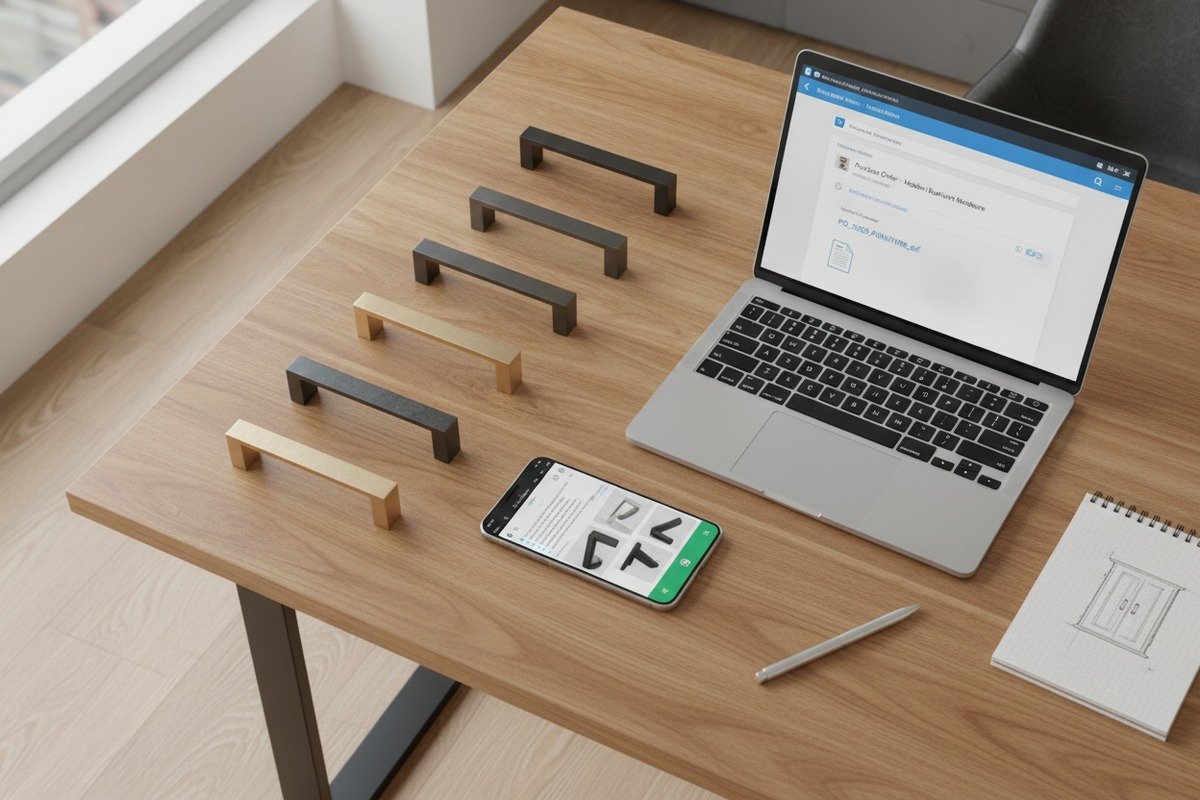
Every week, our sales team at LiliTONG handles hundreds of messages from furniture wholesalers and factory owners across Vietnam, the Middle East, and beyond — and the tool they use to reach us often determines how fast their orders move forward.
The most common instant messaging tools for communicating with Chinese aluminum furniture handle suppliers are WeChat, WhatsApp, and AliWangWang. Use WeChat or WhatsApp for fast daily exchanges like finish approvals and quantity confirmations, but always move final purchase orders and pricing agreements to email for a traceable record.
Choosing the right communication channel is not just about convenience end-to-end encryption 1. It directly affects how quickly you get sample photos, how clearly your custom dimensions are understood, and whether your bulk order arrives exactly as expected. Below, we break down each tool, when to use it, and the habits that keep your aluminum handle orders on track.
Which instant messaging apps are most effective for tracking my aluminum furniture handle production in real-time?
When our production floor is running a custom champagne gold anodized handle order, buyers who use the right chat app get photo updates the same hour — while those relying only on email sometimes wait days Alibaba platform 2.
WeChat, WhatsApp, and AliWangWang are the three most effective instant messaging apps for tracking aluminum furniture handle production in real-time. WeChat is the default tool inside China, WhatsApp is preferred by most overseas buyers, and AliWangWang is useful when sourcing through the Alibaba platform.

WeChat: The Default Business Tool in China
WeChat 3 has over 1.2 billion monthly active users. Almost every Chinese supplier — from large factories to small workshops — uses WeChat daily. It supports text, voice messages, photos, short videos, file sharing, and even payments. For production tracking, this means your supplier can snap a photo on the factory floor and send it to you within seconds.
At our Foshan facility, our project coordinators keep WeChat open all day. When a buyer asks "How is my matte black recessed handle order going?", we can walk to the anodizing line and send a 15-second video showing the current batch. This level of immediacy is hard to match with email.
WhatsApp: The Bridge for International Buyers
Many buyers in Vietnam, the UAE, and Saudi Arabia prefer WhatsApp 4. It works well across borders, supports end-to-end encryption, and does not require a Chinese phone number. Suppliers who export regularly — like our team — keep WhatsApp active alongside WeChat specifically to serve overseas clients.
AliWangWang: Platform-Specific but Useful
If you found your supplier on Alibaba, AliWangWang 5 (also called TradeManager or Alichat) is built into that ecosystem. One advantage: conversation records on AliWangWang can serve as evidence in Alibaba disputes. However, most suppliers prefer to move off-platform once the relationship is established.
When to Use Each App
| Scenario | Best App | Why |
|---|---|---|
| Quick production photo request | Fastest response inside China | |
| Sharing a revised CAD drawing from overseas | Easy cross-border file sharing | |
| Initial inquiry on Alibaba | AliWangWang | Keeps records on-platform |
| Formal purchase order confirmation | Creates a legal paper trail | |
| Sample review with visual detail | WeChat or WhatsApp video call | Real-time visual confirmation |
A Practical Tip
Ask your supplier on the first call: "Which messaging app do you prefer?" This one question can cut your average response time in half. Some factories have dedicated WeChat accounts for export sales, while others assign a WhatsApp-only coordinator for overseas clients. Matching their preference reduces friction immediately.
Our design team receives WhatsApp messages at all hours — a furniture factory owner in Dubai sends a sketch at midnight his time, and by the time he wakes up, our engineers have already annotated it and sent back a revised drawing.
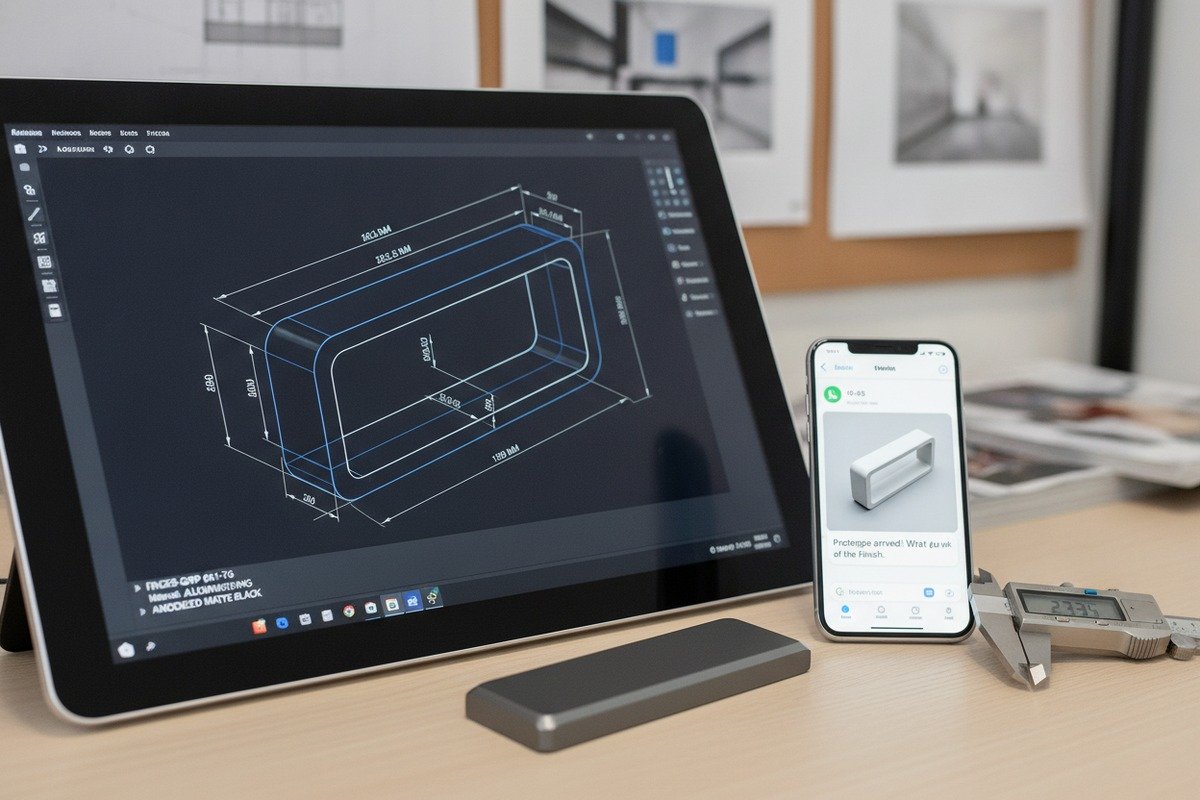
To share custom aluminum handle designs via WhatsApp, send high-resolution PDF or DWG drawings directly in the chat, include key dimensions in the message text, and request a marked-up reply. Use WhatsApp voice notes or video calls to clarify complex details like finger-grip depth, anodizing color codes, and screw hole spacing.
Why WhatsApp Works Well for Design Communication
WhatsApp supports files up to 2 GB per attachment. This means you can send full CAD files 7, high-resolution photos, and even short production videos without compression issues. For aluminum furniture handles — where a 0.5 mm difference in channel depth changes the feel entirely — this clarity matters.
Step-by-Step: Sharing a Custom Handle Drawing
- Prepare your file. Export your design as a PDF or DWG. Include a dimensioned front view, side view, and cross-section.
- Write a clear message. State the handle model, material (e.g., 6063 aluminum alloy 8), finish (e.g., champagne gold anodized), length, and quantity.
- Send the file. Attach it directly in WhatsApp. Avoid sending screenshots of drawings — they lose detail.
- Request specific feedback. Ask: "Can you confirm the finger-grip channel is 12 mm deep and 18 mm wide? Please mark any changes on the drawing and send it back."
- Follow up with a voice note or video call. If the supplier's reply is unclear, a 60-second voice note explaining your concern is faster than typing a long message.
What to Include in Your Design Message
| Detail | Example | Why It Matters |
|---|---|---|
| Handle length | 256 mm center-to-center | Determines mold and cutting setup |
| Profile cross-section | L-shaped, 35 mm × 20 mm | Affects extrusion die selection |
| Finish type | Matte champagne gold anodized | Anodizing parameters differ by color |
| Screw hole spacing | 128 mm or 160 mm | Must match cabinet pre-drilled holes |
| Material grade | 6063-T5 aluminum | Impacts strength and surface quality |
| Quantity | 5,000 pieces | Affects MOQ pricing and lead time |
Common Mistakes When Sharing Drawings
Many buyers send a rough sketch with no dimensions. This forces the supplier to guess, and guesses lead to costly errors. Another mistake is sending a photo of a competitor's handle with no written specs. Our engineering team can reverse-engineer from a photo, but the result is always more accurate when you provide at least basic measurements and finish preferences.
Also, avoid sending multiple revised drawings in the same chat thread without labeling them. Use file names like "Handle_V3_Final_2024-06-10.pdf" so both sides know which version is current.
Why should I prefer WeChat or WhatsApp over email when discussing bulk pricing for my aluminum profiles?
During a recent negotiation with a furniture hardware distributor in Riyadh, we finalized a 10,000-piece handle pricing agreement in two hours on WhatsApp — a conversation that would have taken five days over email.
WeChat and WhatsApp are faster than email for bulk pricing discussions because they allow real-time back-and-forth on quantities, finishes, packaging options, and delivery terms. Suppliers can instantly share updated price lists, MOQ breakdowns, and freight estimates, then move the final agreed terms to email for formal documentation.

The Speed Advantage Is Real
Email has a built-in delay. You send a message, wait for the supplier to open it, draft a response, and hit send. In bulk pricing discussions, you often need five to ten exchanges just to settle on a unit price — factoring in quantity tiers, finish complexity, packaging type, and shipping method. On WeChat or WhatsApp, these exchanges happen in minutes instead of days.
What Happens in a Typical Pricing Chat
Here is a realistic example of how a pricing conversation flows on WhatsApp:
- Buyer: "Hi Mia, we need 8,000 pcs of the 256 mm matte black recessed handle. What is your best FOB price 9?"
- Supplier: "For 8,000 pcs in matte black anodized, FOB Foshan is $1.45/pc. If you increase to 10,000, it drops to $1.32/pc."
- Buyer: "Can you include individual polybag packaging at that price?"
- Supplier: "Polybag + foam insert adds $0.03/pc. Total $1.35/pc for 10,000."
- Buyer: "Deal. Please send the PI to my email."
This entire exchange takes about 15 minutes on chat. By email, the same negotiation might stretch across three business days — especially with time zone differences.
When to Move Pricing to Email
Chat is perfect for the negotiation phase. But once both sides agree, the final pricing must go into a proforma invoice (PI) 10 or purchase order sent by email. This protects both buyer and seller. If a dispute arises later, a signed PI in an email thread is far stronger evidence than a WhatsApp screenshot.
Pricing Discussion: Chat vs. Email Comparison
| Factor | WeChat / WhatsApp | |
|---|---|---|
| Speed of response | Minutes | Hours to days |
| Ability to negotiate in real-time | Excellent | Poor |
| Record-keeping for disputes | Weak (screenshots only) | Strong (timestamped thread) |
| Sharing price lists or catalogs | Good (file attachment) | Good (file attachment) |
| Formal purchase order | Not recommended | Essential |
| Multi-party discussion | Possible via group chat | Possible via CC |
A Balanced Approach
The smartest buyers we work with use a two-channel system. They negotiate on WhatsApp or WeChat, then confirm everything in email. This gives them speed without sacrificing traceability. One of our long-term partners in Ho Chi Minh City calls this his "chat to negotiate, email to lock" rule. It works.
What communication habits will help me avoid quality discrepancies when ordering furniture handles from China?
Over 18 years of exporting aluminum handles from our Foshan factory, we have learned that most quality complaints trace back not to bad materials or careless workers — but to unclear communication at the ordering stage.
To avoid quality discrepancies, always send detailed written specifications alongside photos or drawings, confirm finish samples via video call before mass production, use numbered checklists for every order, designate a single point of contact on each side, and reconfirm all critical details in email after discussing them in chat.

Habit 1: Use a Numbered Checklist for Every Order
A checklist forces both buyer and supplier to confirm each detail explicitly. Here is the checklist our team recommends for every aluminum furniture handle order:
- Handle model or reference number
- Material grade (e.g., 6063-T5)
- Length and cross-section dimensions
- Finish type and color code
- Screw hole spacing and diameter
- Quantity per SKU
- Packaging method (polybag, box, custom)
- Labeling or branding requirements
- Delivery deadline
- Shipping terms (FOB, CIF, etc.)
Send this checklist in the chat. Ask the supplier to reply with a "confirmed" next to each item. Then copy the confirmed list into an email. This simple habit eliminates most misunderstandings.
Habit 2: Confirm Finishes Visually
Aluminum furniture handles come in many finishes — matte black, champagne gold, charcoal grey, light beige, brushed silver. Color names mean different things to different people. The word "champagne" alone could describe ten different shades.
The solution: request a short video of the finish sample under natural light. On WeChat or WhatsApp, the supplier can record a 10-second clip showing the handle from multiple angles. This is far more accurate than a photo, which can shift color depending on the camera and screen.
Habit 3: One Point of Contact on Each Side
When multiple people on the buyer's side send messages to multiple people at the factory, information gets lost. Assign one person on your team to communicate with one designated contact at the supplier. All order-related messages flow through this single channel.
Habit 4: Use Simple Language and Specific Numbers
Avoid vague requests like "make it smoother" or "ship it fast." Instead, say: "Surface roughness must be below Ra 0.8" or "Ship by June 15 at the latest." Specific numbers leave no room for interpretation.
Habit 5: Escalation Matrix
Set up a clear escalation path before problems happen. Here is a sample matrix:
| Issue Type | First Contact | Escalation Contact | Channel |
|---|---|---|---|
| Design clarification | Sales coordinator | Engineering manager | WeChat / WhatsApp |
| Production delay | Sales coordinator | Factory manager | WhatsApp + Email |
| Quality defect found | QC inspector | General manager | Email with photos |
| Shipping or logistics | Logistics coordinator | Sales coordinator | |
| Payment or invoice | Finance | General manager | Email only |
Habit 6: Leverage Video Calls for Complex Details
When words and photos are not enough, jump on a video call. We regularly do this when a buyer needs to approve a new extrusion die or verify that the finger-grip channel depth on a recessed handle matches their specification. A two-minute video call can prevent a $5,000 mistake.
Habit 7: Always Reconfirm in Email
This is the golden rule. Chat is for speed. Email is for records. After any important decision — price change, spec revision, delivery date shift — send a summary email. Start it with: "Per our WhatsApp discussion today, please confirm the following changes…" This creates a paper trail that protects both sides.
Conclusion
Efficient communication with your Chinese aluminum furniture handle supplier comes down to using the right tool at the right stage — chat for speed, email for records, and video for visual clarity. Build these habits into your sourcing workflow, and your orders will arrive closer to spec, on time, and without costly surprises.
Footnotes
1. Explains end-to-end encryption as a secure communication process. ↩︎
2. Official website of Alibaba Group, providing an overview of its global e-commerce platforms. ↩︎
3. Official website for WeChat, providing general information about the app. ↩︎
4. Official website for WhatsApp, detailing its features and business solutions. ↩︎
5. Provides an overview of Taobao, including its integrated communication tool AliWangWang. ↩︎
6. Reference 4. ↩︎
7. Reference 7. ↩︎
8. Reference 8. ↩︎
9. Reference 10. ↩︎
10. Reference 9. ↩︎