
Over the past 18 years on our production line in Foshan, we have seen the same problem repeat itself hundreds of times physical pre-production samples 1. A buyer orders aluminum furniture handles expecting a sleek champagne gold finish with a specific center-to-center spacing 2, and what arrives looks slightly bronze, measures 2mm off, or simply does not fit the cabinet. The frustration is real. The cost of returns, rework, and delayed projects is even more real tolerance ranges 3. The root cause is almost never a bad product. It is a breakdown in communication between the buyer and the supplier before the order was confirmed.
To avoid specification or color errors when purchasing aluminum furniture handles, use detailed technical drawings with exact dimensions, request physical samples before bulk production, standardize finish language with codes rather than descriptive words, and confirm every detail in a single written order document signed off by both parties.
This article walks through the exact steps you can take at each stage of the ordering process to prevent costly mistakes. Whether you run a furniture factory, manage procurement for a distributor, or source handles for custom cabinetry projects, these protocols will save you time, money, and headaches.
How can I use physical samples to ensure my bulk aluminum handle order matches my color expectations?
When we ship sample sets to wholesalers in Vietnam and the Middle East, the single most common feedback loop that prevents errors starts with one thing: touching and seeing the real product. Screens lie. Warehouse lighting distorts. Even the best product photo cannot capture how a champagne gold anodized handle 4 looks next to a walnut-toned cabinet door.
Request physical pre-production samples and evaluate them under the same lighting conditions where the handles will be installed. Compare samples directly against your cabinetry, countertops, and other visible hardware to confirm the color, sheen, and texture match your project requirements before approving bulk production.

Why Photos Alone Are Not Enough
A smartphone photo of an aluminum handle can shift color temperature depending on the phone model, the ambient light, and even the background surface. A matte champagne gold handle can look warm beige on one screen and pale silver on another. When our team sends product images to buyers, we always attach a note: this photo is for reference only, not for final color approval.
The real danger comes when a buyer approves a bulk order based on a digital image. If the delivered handles look slightly different from the screen, both sides can argue they were right. There is no objective benchmark. A physical sample eliminates that argument entirely.
How to Run a Sample Approval Process
Here is a simple process that works for most B2B orders 5:
| Step | Action | Purpose |
|---|---|---|
| 1 | Request 2–3 sample pieces in your desired finish | See and touch the actual product |
| 2 | Place samples against real cabinet panels under room lighting | Check color harmony in the actual environment |
| 3 | Photograph the sample next to the cabinet and send to your designer or client | Get stakeholder approval with visual proof |
| 4 | Sign off on the sample in writing with the supplier | Create a binding reference for bulk production |
| 5 | Keep one approved sample as a benchmark | Use it to inspect the bulk shipment on arrival |
What to Look for When Evaluating a Sample
Do not just glance at the sample on your desk. Place it where it will live. A recessed pull handle for a kitchen drawer should be tested on the actual drawer front. Check these details:
- Color tone: Does the champagne gold lean warm or cool? Does the charcoal grey match or clash with your cabinet finish?
- Sheen level: Is the matte truly matte, or does it have a slight satin reflectivity?
- Texture: Is the surface smooth, brushed, or slightly grainy? Run your finger along it.
- Edge quality: Are the edges sharp and clean, or do they show tooling marks?
Lighting Changes Everything
A handle that looks perfect under cool white LED warehouse lighting may appear yellowish under warm incandescent bulbs in a showroom. If your end customer installs these handles in a kitchen with under-cabinet LED strips, that is the lighting condition that matters. Always test the sample in the intended environment.
Some of our buyers in the UAE have told us they evaluate samples in three lighting conditions: natural daylight, warm showroom light, and cool fluorescent office light. This extra step takes five minutes but prevents weeks of dispute.
What technical drawing details should I verify to prevent dimension errors in my custom furniture handles?
Our engineering team processes dozens of custom handle drawings every month, and the errors we catch before production almost always fall into the same few categories. A missing tolerance, an assumed screw length, or a center-to-center measurement taken from the wrong reference point can turn a perfect design into a useless batch of handles.
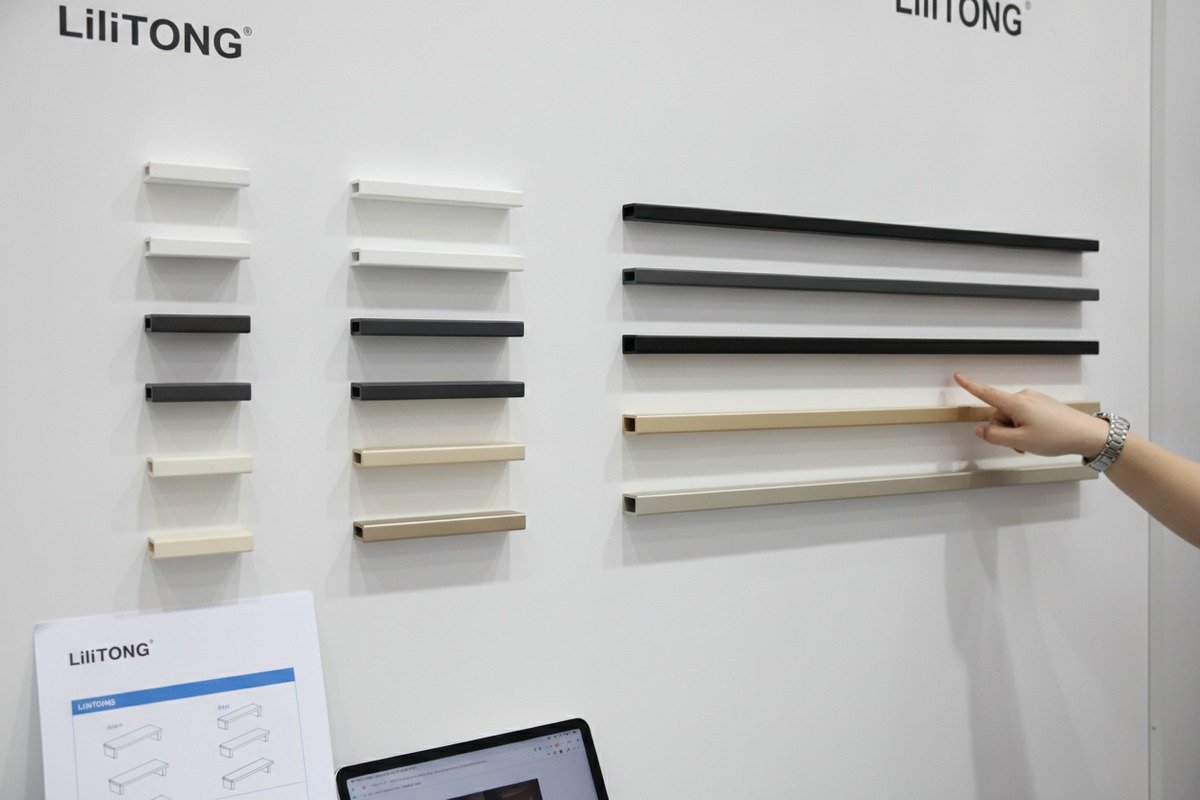
Verify center-to-center hole spacing, overall length, handle projection, cross-section profile, screw hole diameter, screw length, and mounting surface thickness on every technical drawing. Include tolerance ranges and confirm all dimensions in millimeters to prevent unit conversion errors and ensure the handles fit your cabinets precisely.
The Dimensions That Matter Most
Not all measurements carry equal risk. Here are the critical dimensions for aluminum furniture handles and why each one matters:
| Dimension | What It Controls | Common Error |
|---|---|---|
| Center-to-center spacing | Alignment with existing or planned drill holes | Measured from outer edge instead of hole center |
| Overall length | Visual proportion and coverage of the handle | Confused with center-to-center spacing |
| Projection (depth from surface) | Finger clearance and ergonomic grip | Overlooked entirely on flat or recessed pulls |
| Cross-section width | Visual weight and grip comfort | Assumed rather than specified |
| Screw hole diameter | Compatibility with mounting screws | Not checked against actual screw gauge |
| Required screw length | Secure mounting through cabinet panel | Ignoring cabinet panel thickness and backer panels |
Why Millimeters Matter
One issue we see regularly is unit confusion. A buyer in one market works in inches. Our factory works in millimeters. A center-to-center spacing of 128mm is not the same as 5 inches (which is 127mm). That 1mm difference may seem trivial, but across a production run of 5,000 handles, some will not align with pre-drilled cabinets. Always confirm the unit of measurement in writing, and convert to millimeters for the factory.
Replacement Handles Need Extra Attention
If you are sourcing handles to replace existing hardware, measure the old hole spacing before ordering. Do not rely on the old product listing or catalog specs. Drill holes in cabinets shift over time, and the original manufacturer may have used slightly non-standard spacing. Measure the actual installed holes with a caliper or ruler, and report that number to your supplier.
Also consider whether the new handle will cover the old screw holes completely. A recessed pull with a wide footprint can hide old holes. A slim bar pull may leave them visible. This is not a manufacturing error, but it becomes one in the buyer's eyes if no one discussed it beforehand.
Tolerances: The Hidden Detail
Even a perfectly specified drawing needs tolerance information. Aluminum extrusion 6 and machining involve physical processes that produce slight variation. A reasonable tolerance for most furniture handle dimensions is ±0.3mm to ±0.5mm. For anodized finishes, the coating itself adds a thin layer (typically 5–25 microns) that can affect tight-fitting parts.
Ask your supplier: what is your standard tolerance for this dimension? If your project requires all handles in a kitchen to line up perfectly, tighter tolerances may be needed, and they may cost more. But knowing this upfront is far cheaper than discovering misalignment after installation.
The Drawing Approval Step
Before any production run, require a formal drawing approval. This means the supplier sends you a final production drawing with all dimensions, materials, finish specifications, and tolerances clearly marked. You review it, mark any corrections, and sign off. This signed drawing becomes the contract standard. If the delivered product does not match the signed drawing, there is a clear basis for resolution.
How do I ensure my Chinese supplier maintains color consistency across different production batches?
When our factory runs a second or third production batch of the same champagne gold anodized handle for a repeat customer, we know the stakes. If batch two looks even slightly different from batch one, the buyer cannot mix them on the same project. The handles that looked perfect individually suddenly look mismatched side by side. This is not a quality defect in the traditional sense. It is a process control issue, and preventing it requires specific actions from both sides.
To ensure color consistency across batches, require your supplier to use fixed anodizing or coating process parameters, reference an approved master sample for each production run, conduct color measurement with spectrophotometer data or Delta E values, and whenever possible consolidate your order into a single production batch.

What Causes Batch-to-Batch Color Variation
Aluminum handles are finished using anodizing, powder coating, or painting. Each process involves chemical or thermal variables that can shift slightly between runs. For anodizing, the bath temperature, current density, immersion time, and even the aluminum alloy composition 7 influence the final color. For powder coating, the oven temperature profile and powder lot can cause subtle differences.
Even the raw aluminum itself matters. Different alloy grades or different production lots of the same grade can react differently to the same anodizing bath. This is why specifying the exact alloy, not just "aluminum," is important.
How to Specify Color Objectively
Subjective color names are the enemy of consistency. "Champagne gold" means one thing to you and something slightly different to the anodizing operator. Here is how to make it objective:
| Method | How It Works | Reliability |
|---|---|---|
| Descriptive name only ("champagne gold") | Supplier interprets the name based on experience | Low — highly subjective |
| Reference photo | Supplier matches visually to a digital image | Low to medium — screen-dependent |
| Physical master sample | Supplier compares each batch to an approved sample | High — tangible benchmark |
| RAL or Pantone code 8 | Standardized color system with universal reference | Medium to high — good for powder coat, less precise for anodizing |
| Spectrophotometer data 9 (Lab* / Delta E) | Objective numerical color measurement | Highest — removes all subjectivity |
For critical projects, ask your supplier to measure each batch using a spectrophotometer and report the Delta E value compared to the master sample. Delta E values 10 A Delta E below 1.0 is generally imperceptible to the human eye. A Delta E above 2.0 is usually visible and may be unacceptable for handles installed side by side.
Consolidate Orders When Possible
The simplest way to ensure batch consistency is to avoid multiple batches entirely. If you know your annual demand, placing one larger order instead of three smaller ones eliminates inter-batch variation. At our facility, we advise repeat buyers to forecast their needs and consolidate. With 300 tons of ready inventory, we can often fulfill large orders quickly and from a single production run.
Request Material and Process Records
For large or ongoing orders, ask your supplier to document the aluminum alloy lot number, anodizing parameters, and coating batch for each shipment. If you need to reorder later, these records allow the factory to replicate the exact conditions. Without them, the factory is guessing, and guessing leads to variation.
Surface Preparation Is Often Overlooked
Before anodizing or coating, the aluminum surface must be cleaned, etched, or blasted to a consistent standard. If one batch is polished slightly more than another, the final color will differ even if the anodizing process is identical. Ask whether your supplier uses a standardized surface preparation procedure, and whether they inspect it before finishing.
What communication protocols can I establish to confirm my OEM specifications are correctly implemented?
In our experience exporting custom aluminum handles to distributors and furniture factories across Southeast Asia and the Middle East, the orders that go smoothly all share one thing in common: a clear, written communication protocol established before the first production run. The orders that fail usually relied on phone calls, informal chat messages, or verbal confirmations that left room for interpretation.
Establish a written order confirmation protocol that includes a single specification document covering model, dimensions, finish code, quantity, screw details, and mounting requirements. Require formal supplier sign-off on this document and an approved sample before releasing production. Use email or a shared document rather than verbal agreements to create a traceable record.

The Single Specification Document
Every OEM order should have one master document that contains all critical details. This is not a purchase order with just a price and quantity. It is a specification sheet. Here is what it should include:
- Product type (e.g., recessed pull, bar pull, edge pull, knob)
- Model number or drawing reference
- Material and alloy grade
- Finish type (anodized, powder coated, painted, raw)
- Finish code or master sample reference
- Overall dimensions with tolerances
- Center-to-center hole spacing
- Projection from mounting surface
- Screw hole diameter and screw length
- Cabinet panel thickness
- Quantity per finish and size
- Packaging and labeling requirements
- Delivery date and shipping method
Send this document to the supplier and ask them to reply with a confirmed version. Any changes or questions should be resolved in writing before production starts.
The Confirmation Loop
A simple but powerful protocol is the three-step confirmation loop:
- Buyer sends specification document — includes all details above
- Supplier returns confirmed specification — with any clarifications, questions, or corrections highlighted
- Buyer approves final version — this becomes the production standard
This takes a few extra days but eliminates the "I thought you meant…" conversations after delivery.
Common Questions Suppliers Should Ask
A good supplier will ask clarifying questions. If they do not, that may be a warning sign. Here are questions we routinely ask our buyers before confirming an order:
- Is this for new cabinets or replacing existing hardware?
- What is the cabinet panel thickness including any backer?
- Do you need screws included, and if so, what length?
- Will all handles be installed in the same room or across multiple projects?
- Do you have a master sample or color code, or should we send options?
These questions are not signs of inexperience. They are signs that the factory is trying to prevent errors.
Use Visual References Alongside Text
Even a detailed specification document benefits from visual support. Attach a dimensioned drawing, a photo of the approved sample, and if possible a photo showing the intended installation context. When our team sees where the handle will go, we can flag potential issues like insufficient projection for a thick drawer front or a finish that might clash with visible appliance hardware.
Create a Paper Trail for Disputes
Miscommunication disputes are difficult to resolve when there is no written record. Keep all specification documents, sample approvals, email confirmations, and shipping records in one file per order. If a problem arises, you can point to the exact document that was agreed upon. This protects both buyer and supplier and encourages both sides to be more careful at the approval stage.
What About Ongoing Orders?
For repeat orders, do not assume the supplier remembers every detail from last time. Reissue the specification document with each new purchase order. Reference the previous batch number and master sample. If anything has changed, even slightly, highlight it clearly. Ongoing relationships thrive on consistency, and consistency comes from repeating the same disciplined process every time.
Conclusion
Specification and color errors in aluminum furniture handle orders are preventable. Use physical samples, detailed drawings, objective color standards, and written confirmation protocols. Every minute spent on clear communication before production saves hours of rework, returns, and frustration after delivery.
Footnotes
1. Highlights the role of samples in verifying product quality before bulk production. ↩︎
2. Explains the importance of accurate measurement for handle installation. ↩︎
3. Explains the necessity of specifying acceptable variations in dimensions for manufacturing. ↩︎
4. Provides background on the electrochemical finishing process for aluminum handles. ↩︎
5. Defines the context of business-to-business transactions in procurement. ↩︎
6. Describes a key manufacturing process for shaping aluminum components. ↩︎
7. Discusses how material properties, specifically alloy composition, influence the final anodized color. ↩︎
8. Introduces standardized color systems for consistent color specification in industrial applications. ↩︎
9. Details an objective method for precise color measurement and consistency in manufacturing. ↩︎
10. Explains the metric used to quantify color differences, crucial for color consistency. ↩︎