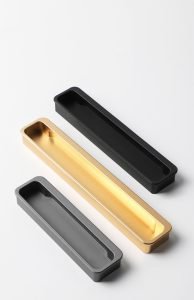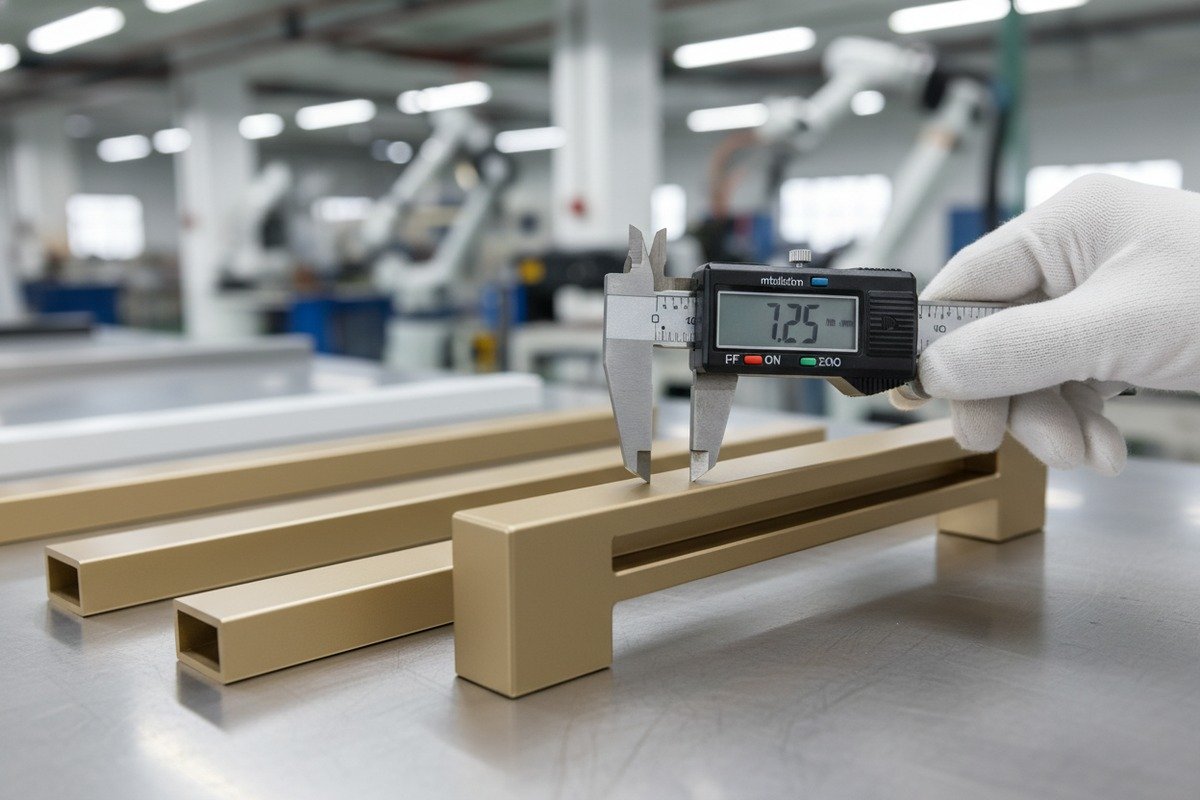
Every week, our production team in Foshan fields calls from furniture factories and distributors who ordered handles elsewhere—only to find warped profiles, mismatched hole spacing, or finishes that peel within months 6063-T5 aluminum alloy 1. The frustration is real. When you source aluminum cabinet handles without locking down the right technical specifications upfront, you gamble with your production schedule, your product quality, and ultimately your reputation with end customers.
When sourcing aluminum furniture cabinet handles, the technical specifications that matter most include alloy grade (6063-T5 or 6061-T6), surface finish type (anodized, powder-coated, or brushed), hole spacing and dimensional tolerances, handle thickness, weight, and load-bearing capacity—all of which directly affect durability, aesthetics, and factory compatibility.
Below, we break down each critical specification in detail aluminum extrusion process 2. Whether you run a furniture factory in Southeast Asia or distribute building materials across the Middle East, this guide gives you the exact parameters to check before placing your next order.
How do I choose the right aluminum alloy grade to ensure my furniture handles are durable?
Over 18 years of supplying handles to furniture factories, our engineering team has seen firsthand how the wrong alloy choice leads to cracking, bending, and premature failure salt spray test 3. It is a costly mistake that most buyers only discover after installation.
Choose 6063-T5 aluminum alloy for standard cabinet handles due to its excellent extrudability, corrosion resistance, and smooth finish. For heavy-duty applications requiring greater tensile strength, upgrade to 6061-T6. Both alloys resist rust in humid kitchens and bathrooms, making them ideal for furniture hardware.
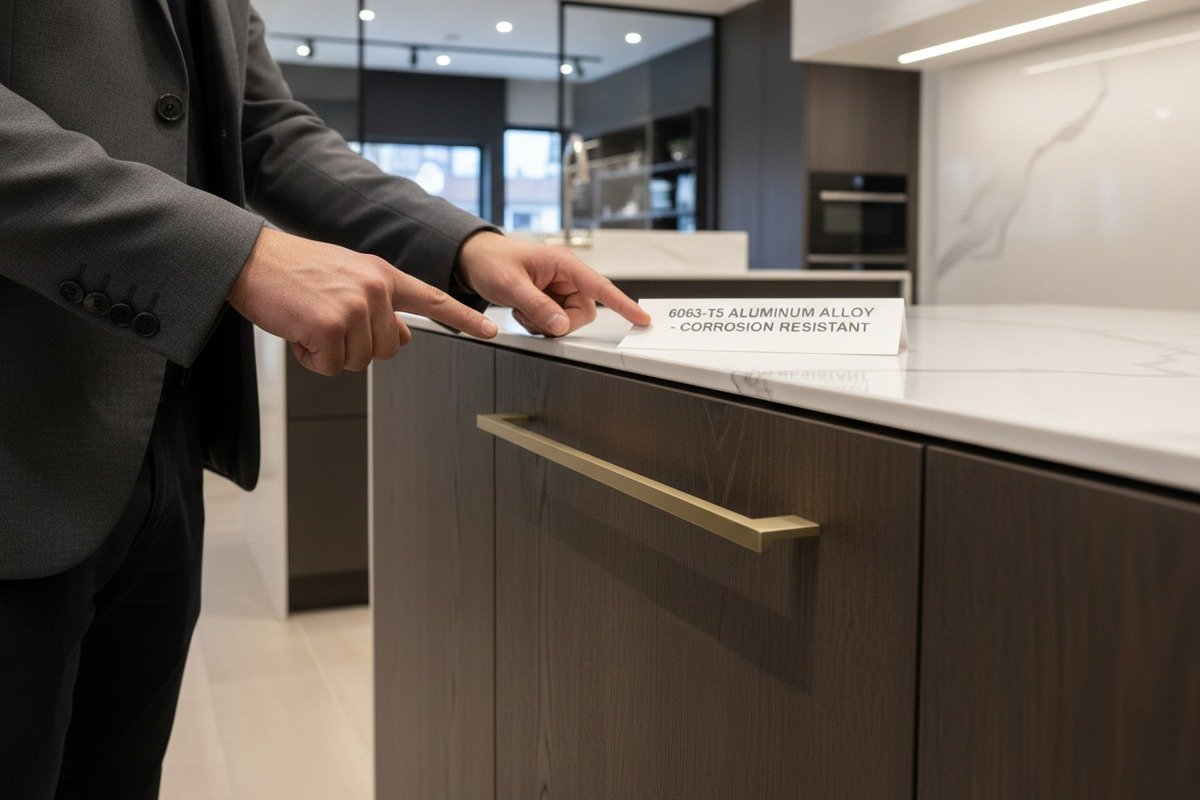
Understanding Alloy Families
Not all aluminum is the same. The 6000 series alloys dominate furniture handle production because they balance strength, workability, and corrosion resistance RoHS compliance 4. Within this series, two grades stand out:
- 6063-T5 — Often called "architectural aluminum." It extrudes beautifully into sleek, minimalist profiles. Our factory uses this alloy for most linear finger pulls and edge-mount designs. It offers a tensile strength 5 of around 186 MPa, which is more than enough for daily cabinet use.
- 6061-T6 — A stronger option with tensile strength near 310 MPa. We recommend this for oversized handles, heavy drawer pulls, or commercial-grade applications where loads exceed normal residential use.
The "T5" and "T6" designations refer to temper. T5 means the alloy was cooled from extrusion and then artificially aged. T6 means it was solution heat-treated and then artificially aged, producing a harder, stronger result.
Alloy Comparison Table
| Specification | 6063-T5 | 6061-T6 6 |
|---|---|---|
| Tensile Strength | ~186 MPa | ~310 MPa |
| Yield Strength | ~145 MPa | ~276 MPa |
| Corrosion Resistance | Excellent | Very Good |
| Extrudability | Excellent | Good |
| Surface Finish Quality | Superior (smooth) | Good (may need extra polishing) |
| Best Use Case | Standard cabinet handles, finger pulls | Heavy-duty handles, commercial hardware |
| Cost | Lower | Higher |
Die-Cast vs. Extruded: A Process Decision
The alloy grade is only half the story. How the handle is manufactured matters just as much.
Die-cast handles use molten aluminum forced into a mold. This process works well for ergonomic U-handles with finger recesses and complex 3D shapes. Die-cast handles offer excellent dimensional stability. However, they limit you to fixed sizes—customizing length after casting is not practical.
Extruded handles push heated aluminum through a die to create continuous profiles. This is how we produce most of our minimalist linear pulls and edge-mount designs. Extrusion shines when you need custom lengths. We can cut profiles from 78mm all the way up to 3000mm from a single extrusion run. For buyers who need flexibility in sizing, extruded 6063-T5 is the clear winner.
One thing we tell every new client: always request the alloy certificate from your supplier. A reputable manufacturer will provide mill test certificates showing the exact alloy composition. If your supplier cannot produce this document, consider it a red flag.
When to Upgrade Your Alloy
If your handles will be installed on heavy sliding doors, oversized drawers, or in high-traffic commercial settings, invest in 6061-T6. The price difference per handle is marginal—often less than $0.50—but the performance gap is significant. For standard kitchen and bathroom cabinets, 6063-T5 delivers the perfect balance of cost, finish quality, and durability.
When we first started exporting handles to Southeast Asian markets, the number one complaint from distributors was not about shape or size—it was about finish inconsistency. A handle that looks luxurious in a photo but feels cheap in hand loses the sale instantly.
Require anodized (10–15 μm thickness), powder-coated (60–80 μm, RAL color matched), or brushed finishes depending on your design needs. Always specify coating thickness, adhesion grade (ASTM D3359 Class 4B+), salt spray resistance hours, and RoHS compliance to guarantee a durable, premium appearance on your cabinets.
The Three Main Finish Categories
Each surface treatment serves a different purpose. Here is how they compare on our production line:
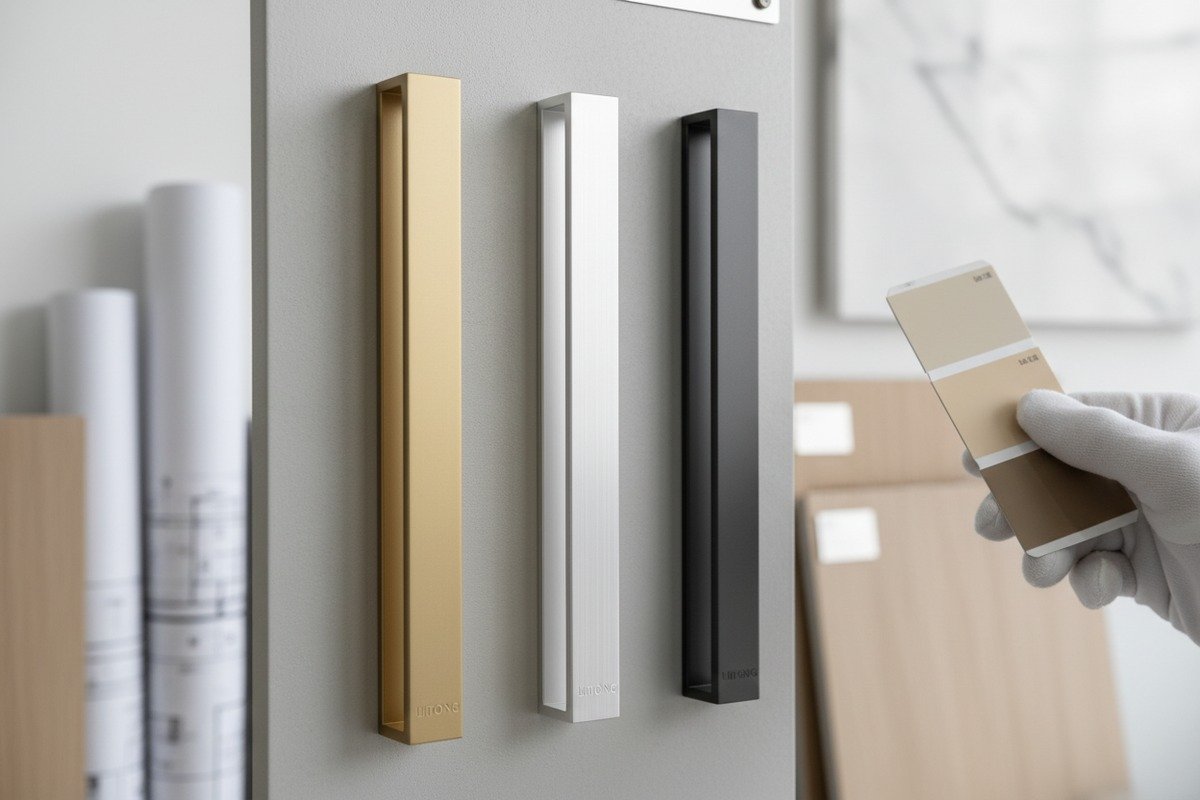
Anodizing creates an oxide layer on the aluminum surface. This is not paint—it is part of the metal itself. Anodized handles resist scratching, do not peel, and maintain color uniformity for years. We typically anodize to 10–15 μm for interior furniture handles. Common colors include champagne gold, silver, and black. The champagne gold handles from our latest catalog use this exact process.
Powder coating electrostatically applies dry paint powder, which is then cured in an oven at around 200°C. This creates a thick, uniform layer (60–80 μm) that resists chipping, fading, and moisture. RAL 9005 (textured black) and RAL 9006 (silver) are the two most requested colors by our Middle Eastern and Southeast Asian clients. Powder coating 8 also allows matte, semi-gloss, and textured finishes.
Brushing uses abrasive belts to create fine parallel lines on the aluminum surface. This gives handles an industrial, modern aesthetic. Brushed finishes hide fingerprints and minor scratches better than polished surfaces. We often combine brushing with a clear anodized topcoat for extra protection.
Surface Finish Comparison Table
| Finish Type | Coating Thickness | Scratch Resistance | Fingerprint Visibility | Color Options | Best For |
|---|---|---|---|---|---|
| Anodized | 10–15 μm | High | Low | Limited (metallic tones) | Modern minimalist, champagne/silver |
| Powder-Coated | 60–80 μm | Very High | Medium | Unlimited (RAL colors) | Custom color matching, textured looks |
| Brushed | N/A (mechanical) | Medium | Very Low | Natural aluminum | Industrial, contemporary kitchens |
| Brushed + Clear Anodized | 5–10 μm | High | Very Low | Natural aluminum | Premium residential |
| Polished | N/A (mechanical) | Low | Very High | Mirror chrome | Luxury, low-traffic applications |
Key Tests to Specify
Do not accept vague promises like "good quality finish." Instead, require your supplier to meet these measurable standards:
- Adhesion test (ASTM D3359): Class 4B or higher. This cross-hatch tape test ensures the coating bonds properly to the aluminum substrate.
- Salt spray test (ASTM B117): Minimum 200 hours for interior handles. For bathroom or coastal environments, request 500+ hours.
- UV resistance: If handles will be exposed to sunlight (e.g., balcony cabinetry), require 1000+ hours of accelerated UV testing without significant color fade.
- RoHS compliance: Essential for export markets. Confirms the finish contains no harmful substances like lead, cadmium, or hexavalent chromium.
A Word on Trending Finishes
The 2025–2026 market is leaning heavily toward matte brushed finishes and textured powder coats over high-gloss or polished looks. Our clients report that brushed champagne gold and matte black are outselling all other options by a wide margin. If you are building inventory for wholesale, stock these two finishes first. They move fastest across kitchens, bathrooms, and wardrobe applications.
One caution: powder-coated finishes, while extremely durable, can chip on sharp edges if the pre-treatment (degreasing, chromate conversion) is poorly done. Always ask your supplier about their pre-treatment process. At our facility, we use a five-stage chemical pre-treatment line before powder application. This step alone cuts field failures by over 80%.
How can I verify that the hole spacing and dimensions will fit my factory's production standards?
Nothing stalls a furniture production line faster than handles that do not align with pre-drilled holes. Our quality control team has rejected shipments from sub-suppliers for as little as a 0.5mm deviation in hole center distance—because that 0.5mm means rework for the factory receiving the goods.
Verify hole spacing by requesting a dimensioned engineering drawing with tolerances (±0.2mm for center-to-center distance), then cross-check against your drilling templates. Confirm total handle length, projection depth, screw thread size (typically M4 or 8-32), and bore diameter before approving samples to ensure seamless integration with your production line.
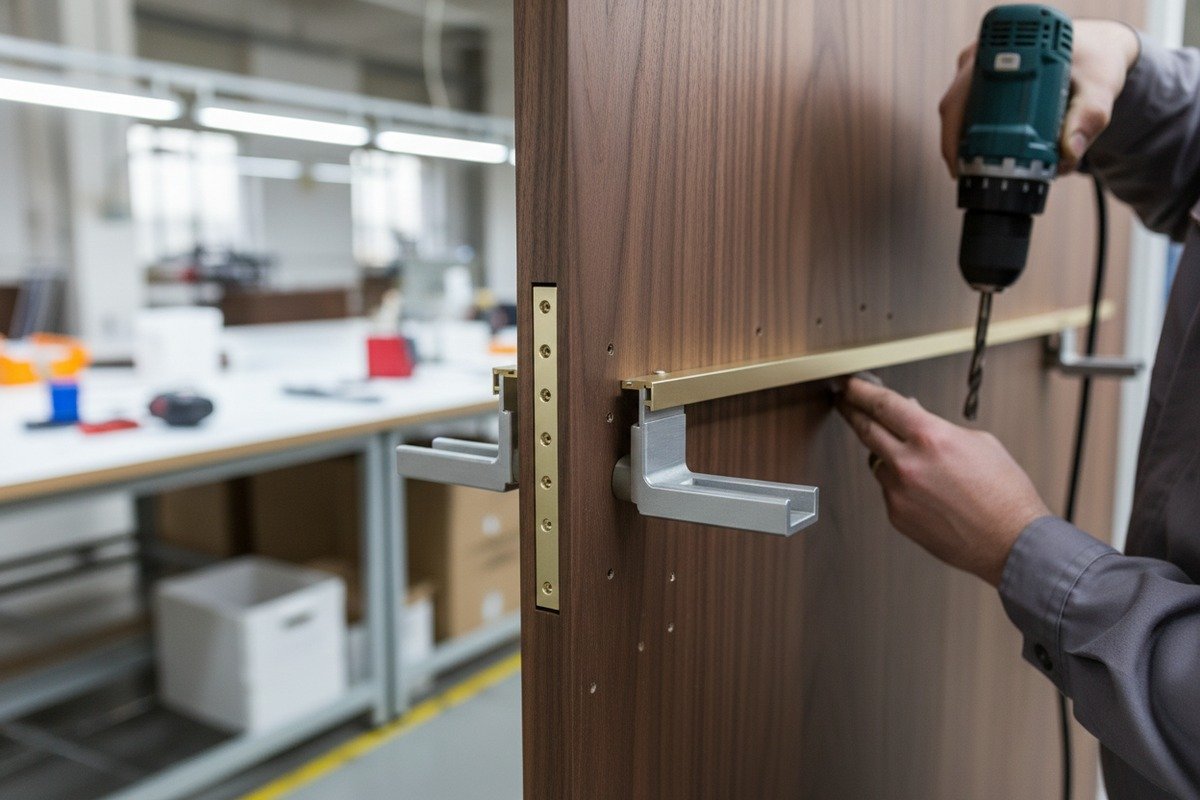
Critical Dimensions to Specify
When you source aluminum handles, you must define at least six dimensional parameters clearly:
-
Center-to-center (C-C) hole spacing — This is the distance between mounting hole centers. Common standards include 64mm, 96mm, 128mm, 160mm, 192mm, and 256mm. Always specify your required C-C distance with a tolerance of ±0.2mm or tighter.
-
Overall length — The total length of the handle from end to end. This can range from 78mm for small knob-style pulls up to 340mm for standard bars, and even 3000mm for continuous extruded profiles.
-
Projection (standoff depth) — How far the handle sticks out from the cabinet face. Common projections range from 15mm to 35mm. Deeper projections improve grip comfort but may interfere with adjacent doors.
-
Profile height and width — For edge-mount and finger pull designs, the profile cross-section matters. Typical heights range from 18mm to 45mm. Widths range from 18mm to 67mm depending on the style.
-
Screw thread and length — Most furniture handles use M4 screws 10 (metric) or 8-32 screws (imperial). The screw length must match your panel thickness. For standard 18mm panels, a 5×32mm screw works well. For thicker panels (25mm+), specify longer fasteners.
-
Bore diameter and countersink — The mounting hole in the handle must accept your screw cleanly. A bore diameter of 4.2mm for M4 screws with a countersink depth of 3–4mm is standard.
How to Cross-Check Before Ordering
Here is the process we recommend to every client:
Step 1: Request a 2D engineering drawing (DWG or PDF) from your supplier with all dimensions and tolerances clearly marked.
Step 2: Compare the drawing against your factory's CNC drilling program or manual drilling jig template. Pay special attention to C-C distance.
Step 3: Order 5–10 pre-production samples. Physically test-fit them on your panels using your standard screws and drilling pattern.
Step 4: Measure samples with calipers. Check overall length, C-C distance, projection, and bore diameter. Log any deviations.
Step 5: Approve or request corrections before bulk production begins.
Dimensional Standards Quick Reference
| Dimension | Standard Range | Typical Tolerance | Notes |
|---|---|---|---|
| Center-to-Center | 64–256mm | ±0.2mm | Must match factory drilling template exactly |
| Overall Length | 78–340mm (up to 3000mm for profiles) | ±0.5mm | Custom lengths available via extrusion |
| Projection Depth | 15–35mm | ±0.3mm | Deeper = better grip, check door clearance |
| Profile Height | 18–45mm | ±0.2mm | Affects visual proportion on cabinet face |
| Screw Thread | M4 / 8-32 | Per ISO 898 or ASME B18.6 | Confirm metric vs. imperial with buyer |
| Bore Diameter | 4.2mm (for M4) | ±0.1mm | Countersink depth 3–4mm |
| Panel Thickness Compatibility | 16–25mm | — | Screw length must match panel thickness |
No-Screw and Hidden Mounting Systems
Modern minimalist design is pushing toward no-screw installations. These designs use slotted channels that clip directly onto the cabinet panel edge—typically calibrated for 18mm thick panels. Our edge-mount finger pulls use this exact system. The advantage is a completely clean interior with no visible screw heads. The trade-off is strict panel thickness requirements. If your panels vary between 17mm and 19mm, discuss tolerance with your supplier before committing to a hidden-mount design.
We always advise sending us a sample panel from your production. This way, our team can verify the fit in our factory before shipping thousands of handles to yours.
Can I customize the thickness and weight of the handles to meet my specific design requirements?
Some of our best-selling handle designs started as a client sketch on a WhatsApp message. A furniture factory owner in Vietnam once sent us a rough drawing asking for a handle that was 20% thinner than our standard profile but still strong enough for heavy kitchen drawers. Our R&D team made it work within two weeks.
Yes, handle thickness and weight are fully customizable through extrusion die design and wall thickness adjustments. Thinner walls reduce weight and material cost; thicker walls increase rigidity and load-bearing capacity. Work with your supplier to define wall thickness (typically 1.0–2.5mm), overall weight targets, and minimum strength requirements based on your specific application.
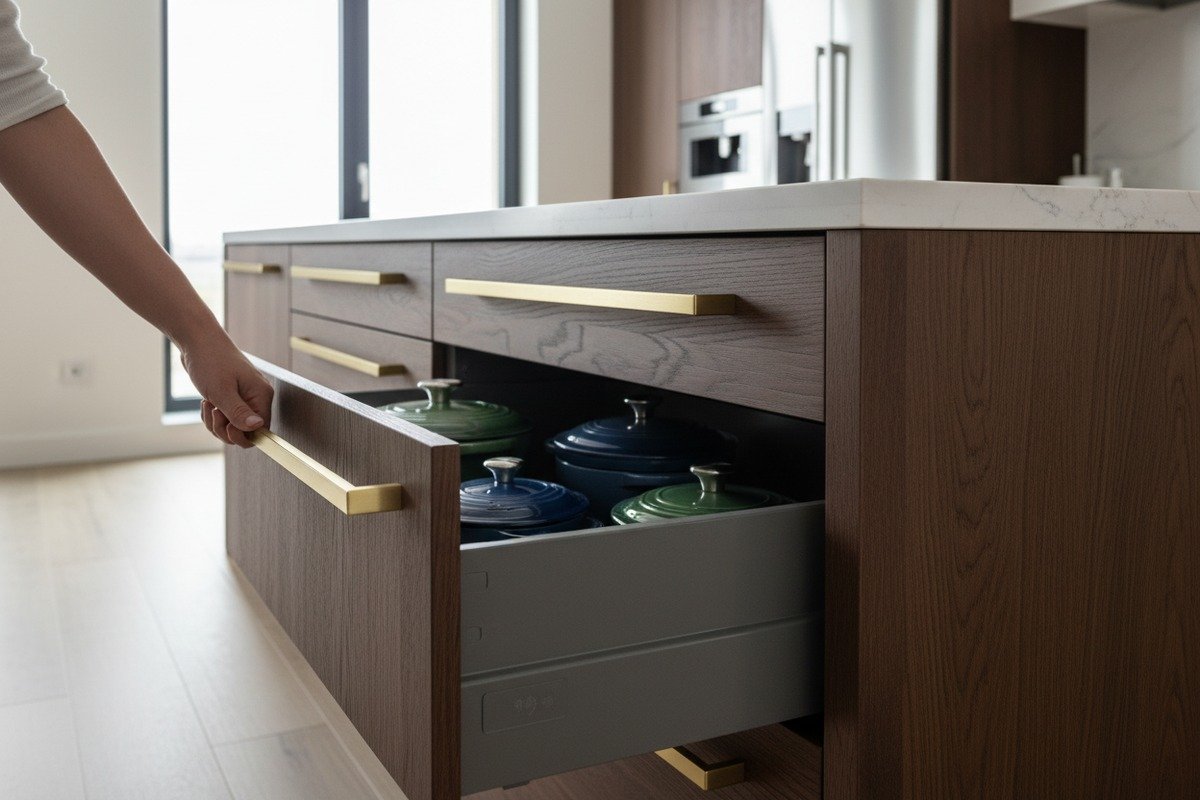
Why Thickness and Weight Matter
Thickness is not just about feel—it directly impacts three things:
-
Structural integrity. A handle with 1.0mm wall thickness feels light and modern but may flex under heavy loads. A 2.0mm wall feels solid and supports heavier drawers without bending.
-
Perceived quality. End consumers judge handles by weight. A handle that feels substantial signals quality. Distributors in the Middle East, for example, consistently prefer heavier handles because their customers associate weight with durability.
-
Shipping cost. Aluminum is sold by weight. Thicker handles cost more per unit and more to ship. For high-volume wholesale orders, even a 10-gram difference per handle adds up across thousands of pieces.
How Customization Works
When we develop a custom handle, the process follows this path:
Design brief → Cross-section drawing → Extrusion die creation → Sample extrusion → Surface treatment → Sample approval → Bulk production
The extrusion die is the key tool. It defines the cross-sectional profile of the handle, including wall thickness, channel depth, and overall dimensions. A new die typically costs between $200–$500 depending on complexity. This is a one-time investment. Once the die exists, we can produce handles in any length from the same profile.
Wall Thickness Guidelines
For furniture handles, we recommend the following wall thickness ranges based on application:
- Light-duty (small drawer pulls, decorative): 1.0–1.2mm
- Standard-duty (kitchen and bathroom cabinets): 1.2–1.8mm
- Heavy-duty (large drawers, sliding doors, commercial): 1.8–2.5mm
Weight Optimization Strategies
Reducing weight without sacrificing strength is possible through smart profile design. Internal ribs, hollow channels, and optimized cross-sections allow us to maintain rigidity while cutting material by 15–30%. Our recessed-channel finger pulls, for example, use a hollow core with reinforcing ribs that keep the handle rigid at just 45 grams per 128mm length.
For buyers managing large inventories, lighter handles also mean lower warehousing costs and cheaper freight. We had a distributor in the Philippines switch from solid-bar handles to our hollow-profile design and save nearly 18% on annual shipping costs—without any change in perceived quality.
Balancing Customization with MOQ
Custom thickness and weight require a new extrusion die, which means a minimum order quantity to justify the tooling cost. Our standard MOQ for custom profiles starts at 500 pieces. For very simple modifications (adjusting cut length only, no new die), we can work with smaller quantities from existing stock profiles. Always discuss your volume expectations early so your supplier can advise on the most cost-effective path.
Load and Weight Reference
| Handle Type | Typical Wall Thickness | Weight (per 128mm) | Load Capacity | Application |
|---|---|---|---|---|
| Slim finger pull | 1.0–1.2mm | 25–35g | Up to 25 lbs | Decorative, light drawers |
| Standard bar pull | 1.2–1.8mm | 40–65g | Up to 50 lbs | Kitchen/bathroom cabinets |
| Heavy-duty pull | 1.8–2.5mm | 70–110g | Up to 110 lbs | Large drawers, sliding doors |
| Continuous profile (per meter) | 1.5–2.0mm | 150–280g | Distributed load | Wardrobe doors, long runs |
Eco and Cost Considerations
Thinner, lighter handles use less raw aluminum. This is not just a cost advantage—it is also an environmental one. Aluminum is infinitely recyclable, and many of our clients now request handles made with a minimum of 30% post-consumer recycled content. We can certify this upon request. Using recycled aluminum reduces energy consumption by up to 95% compared to primary smelting, making your product line more sustainable without compromising on performance.
Conclusion
Getting the technical specifications right before you place your order saves time, money, and production headaches. Define your alloy grade, surface finish, hole spacing, and thickness requirements clearly—and always verify with samples before bulk production.
Footnotes
1. Replaced with Wikipedia page for 6063 aluminium alloy, specifically mentioning T5 temper. ↩︎
2. Replaced with a comprehensive guide to the aluminum extrusion process. ↩︎
3. Describes the ASTM B117 standard for evaluating corrosion resistance through salt spray testing. ↩︎
4. Replaced with the official European Commission page on the RoHS Directive. ↩︎
5. Replaced with Britannica’s definition of tensile strength. ↩︎
6. Offers comprehensive data on the mechanical properties and applications of 6061-T6 aluminum. ↩︎
7. Details the electrochemical process of anodizing aluminum and its resulting properties. ↩︎
8. Replaced with Wikipedia page explaining powder coating. ↩︎
9. Replaced with the official ASTM International page for the D3359 standard. ↩︎
10. Replaced with Wikipedia page on ISO metric screw threads, which includes M4 specifications. ↩︎