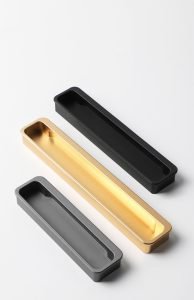
Sourcing aluminum cabinet handles 1 from overseas sounds simple until the first shipment arrives and nothing matches the sample. Over 18 years on our production floor in Foshan, we have seen countless buyers struggle with miscommunication, delayed orders, and quality gaps that erode profit margins quality control process 2. The root cause is almost always the same: no structured communication plan and no regular business reviews with the supplier.
To establish effective communication and business reviews with aluminum cabinet handle suppliers, define a single point of contact, set clear KPIs for quality and delivery, use digital tools for real-time order tracking, and schedule quarterly performance reviews that align supplier output with your business goals.
This guide walks you through every step, from your first design brief 3 to annual supplier audits. Whether you run a building material wholesale business or a furniture factory, these practices will help you reduce lead times, catch quality issues early, and build a supplier relationship that actually grows your bottom line.
How can I effectively communicate my custom design requirements to an aluminum handle manufacturer?
When our engineering team receives a new handle brief, the biggest delays come from incomplete specs or vague finish descriptions Key Performance Indicators 4. Buyers often assume the manufacturer will "just know" what they want, and that assumption costs weeks.
To communicate custom design requirements effectively, provide detailed technical drawings with dimensions, specify the exact surface finish and color code, share physical or photo references, and confirm material grade and tolerance standards before production begins.

Start with a Complete Design Brief
A design brief is your blueprint for getting the right handle. It should include handle length, width, depth, mounting hole spacing, and edge radius. For aluminum cabinet handles, common lengths range from 4 to 12 inches, and the profile matters greatly. A sleek, low-profile edge-mount pull requires very different tooling than a recessed channel handle with a rounded bottom edge. If you skip any of these details, the manufacturer fills in the blanks with their own assumptions.
At our facility, we ask every new client to fill out a standardized specification form. This form captures not just dimensions but also the intended application. A handle for a kitchen cabinet door faces moisture and grease. A handle for a bedroom dresser does not. That context changes the anodizing process 5 and the finish we recommend.
Use Visual References and Samples
Words alone cannot describe a champagne gold matte finish. Send photos taken under neutral lighting. If you have a physical sample from a competitor or a previous order, mail it to the factory. Our team in Foshan can match color and texture far more accurately from a physical sample than from a screen image. Digital screens vary in color rendering, and what looks warm gold on your monitor may look pale yellow on ours.
Specify Tolerances and Standards
Aluminum extrusion handles 6 require tight tolerances, especially on mounting holes. A 0.5mm deviation can make a handle wobble on a cabinet face. State your tolerance clearly, for example ±0.2mm on hole spacing.
| Specification Item | What to Provide | Common Mistake |
|---|---|---|
| Handle Length | Exact mm or inches (e.g., 160mm center-to-center) | Giving only approximate range |
| Surface Finish | Finish type + color code (e.g., anodized champagne gold, RAL 1015 7) | Saying "gold color" without a code |
| Material Grade | Aluminum alloy number (e.g., 6063-T5 8) | Assuming all aluminum is the same |
| Mounting Holes | Diameter, spacing, and depth in mm | Omitting screw size compatibility |
| Edge Profile | CAD file or cross-section drawing | Describing shape in words only |
| Tolerance | ±0.2mm or specific standard (ISO 2768-m 9) | Not specifying any tolerance |
Confirm Everything in Writing
After verbal discussions over WhatsApp or a video call, always follow up with a written summary. Email the agreed specs, attach the drawings, and ask for written confirmation. This creates a reference document both sides can check during production. Verbal agreements are forgotten. Written ones are not.
One more tip from our experience: assign one person on your team to handle all communication with the supplier. When multiple people send conflicting instructions, the factory gets confused and defaults to the safest interpretation, which may not be what you wanted.
What steps should I take to review sample quality and avoid discrepancies in my bulk handle orders?
We ship pre-production samples to clients in over a dozen countries, and the ones who inspect samples carefully almost never have bulk order problems. The ones who glance at the sample and say "looks good" are the ones who call us upset three months later.
To review sample quality and prevent bulk order discrepancies, inspect dimensions against your spec sheet, test the surface finish under different lighting, verify mounting fit on an actual cabinet, and document your approval with photos and written sign-off before mass production starts.
Build a Sample Inspection Checklist
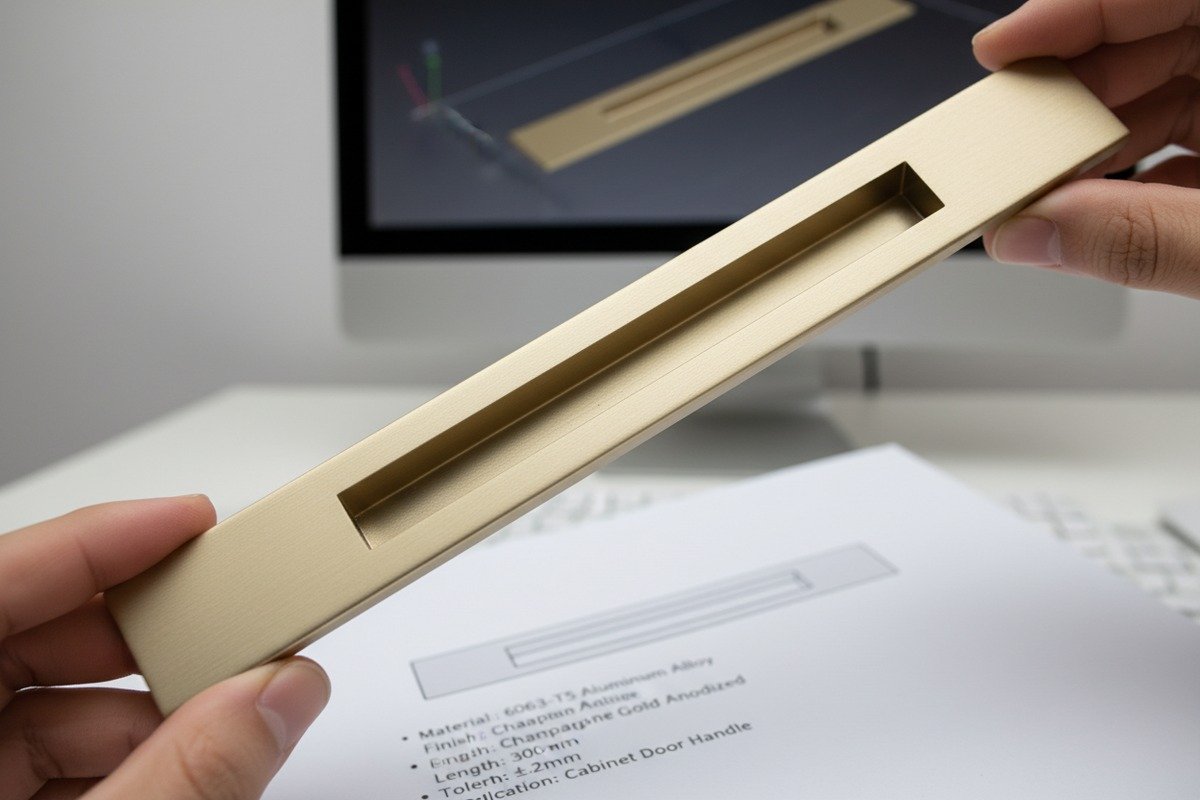
Do not rely on gut feeling. Use a structured checklist every time a sample arrives. Measure every dimension with calipers. Check the finish for scratches, uneven anodizing, or color variation. Mount the handle on a real cabinet door or drawer to confirm fit and feel. Pull it, push it, and twist it. Aluminum handles should feel solid with zero play in the screws.
Here is a checklist framework we recommend to our wholesale partners:
| Inspection Point | Method | Accept / Reject Criteria |
|---|---|---|
| Overall Length | Digital caliper | Within ±0.3mm of spec |
| Hole Spacing | Digital caliper | Within ±0.2mm of spec |
| Surface Finish | Visual under daylight + LED | No scratches, uniform color, matches approved code |
| Edge Smoothness | Touch + visual | No burrs, no sharp edges |
| Mounting Test | Install on cabinet panel | Flush fit, no wobble, screws tighten fully |
| Weight | Digital scale | Within ±5% of spec (confirms alloy consistency) |
| Packaging Condition | Visual | No dents from shipping, proper protection |
Request Multiple Samples
Ask for at least three to five samples, not just one. A single sample can be a hand-picked best piece. Multiple samples reveal consistency. If three out of five have a slight color difference, that tells you the anodizing process needs calibration before bulk runs.
Document Your Approval
When you approve a sample, photograph it from multiple angles. Store one sample as a reference master. Send one back to the factory so they keep an identical reference on the production line. This "golden sample" method is standard practice on our floor, and it catches drift during long production runs.
What Happens After Approval
Once you sign off, the factory locks the tooling and process parameters. Any change you request after this point may cost extra or add lead time. So be thorough during the sample stage. It is far cheaper to reject a sample than to reject a container of finished handles.
If you notice a problem during bulk inspection, refer back to the approved sample and written specs. Clear documentation protects both sides and makes resolution faster. In our experience, disputes that have documented references get resolved in days. Those without documentation drag on for weeks.
How do I set up a communication schedule with my supplier to track order status and manage lead times?
On our production floor, we manage dozens of active orders at any given time. The buyers who get the smoothest deliveries are the ones who agreed on a communication rhythm from day one. The ones who only reach out when something goes wrong are always caught off guard.
Set up a communication schedule by agreeing on a weekly status update format, choosing a primary channel like WhatsApp or email, designating one contact person on each side, and establishing escalation protocols for delays or quality issues that need immediate attention.

Define Your Communication Cadence
Not every order needs daily updates. But every order needs a rhythm. For a standard aluminum handle order with a 25-to-35-day lead time, here is a communication schedule that works well:
| Timeline | Communication Type | Content | Channel |
|---|---|---|---|
| Order Confirmation (Day 1) | Written confirmation | Full specs, quantities, price, delivery date | |
| Week 1 | Status update | Raw material procurement, tooling status | WhatsApp message |
| Week 2 | Production update + photos | Extrusion progress, surface treatment status | WhatsApp + email with photos |
| Week 3 | Pre-shipment sample or QC report | Inspection results, packaging readiness | Email with attached report |
| Week 4 | Shipping notification | Bill of lading, tracking number, ETA | |
| Post-Delivery | Feedback call | Quality check results, any issues | WhatsApp voice or video call |
This schedule keeps both sides aligned without creating unnecessary noise. Adjust the frequency based on order size and complexity. A large custom order with a new finish may need twice-weekly updates. A repeat stock order may need only a confirmation and a shipping notice.
Choose the Right Channel
Our clients in Southeast Asia and the Middle East overwhelmingly prefer WhatsApp for quick updates and email for formal documents. That works well. Use WhatsApp for day-to-day questions, photo sharing, and urgent flags. Use email for specs, contracts, invoices, and anything that needs a searchable record.
Avoid scattering conversations across too many platforms. If your supplier uses WeChat and you use WhatsApp, agree on one shared platform early. Miscommunication often happens when messages are lost across channels.
Assign a Single Point of Contact
On your side, assign one procurement lead who owns the supplier relationship. On the supplier side, request one dedicated account manager. When multiple people email the same factory with different questions, responses get delayed and contradicted. Our team assigns a dedicated project coordinator to each major client, and it cuts response time significantly.
Set Escalation Rules
Define what counts as an urgent issue. A two-day delay in raw material delivery is worth flagging early but is not an emergency. A defect found during mid-production inspection is urgent and needs a same-day call. Agree on these thresholds upfront so no one hesitates to raise a red flag.
Also agree on response time expectations. For example, routine questions get a reply within 24 hours. Urgent quality issues get a reply within 4 hours. Writing this into your purchase agreement sets clear expectations.
Use Digital Tools for Transparency
If your order volume justifies it, ask your supplier about digital tracking tools. Some factories offer shared dashboards or simple shared spreadsheets where order status is updated in real time. Even a shared Google Sheet with columns for order number, production stage, expected completion, and notes can eliminate dozens of "where is my order?" messages.
How can I evaluate my supplier's performance during annual business reviews to ensure my business stays competitive?
Every January, our key accounts sit down with us, either in person in Foshan or over a video call, to review the past year. These meetings are not formalities. They are where we renegotiate terms, address pain points, and plan new product lines. The buyers who prepare for these reviews with data walk away with better deals.
Evaluate supplier performance during annual business reviews by scoring KPIs like on-time delivery rate, defect rate, response time, and pricing competitiveness, then comparing results against your targets and discussing improvement plans for the coming year.

Build a Supplier Scorecard
A scorecard turns subjective feelings into objective numbers. Score your aluminum handle supplier on five to seven KPIs each quarter, then aggregate the scores for the annual review. Here is a scorecard template we have seen work well with our distributor partners:
| KPI | Target | Weight | How to Measure |
|---|---|---|---|
| On-Time Delivery Rate | ≥ 95% | 25% | Orders delivered by agreed date ÷ total orders |
| Defect Rate | ≤ 1% | 25% | Defective units ÷ total units received |
| Response Time | ≤ 24 hours for routine queries | 15% | Average reply time tracked over quarter |
| Pricing Competitiveness | Within 5% of market benchmark | 15% | Compare with 2–3 alternative supplier quotes |
| Customization Flexibility | Accepts MOQ ≤ 500 pcs for new designs | 10% | Number of custom requests accepted vs. declined |
| Documentation Accuracy | ≥ 98% error-free invoices and packing lists | 10% | Errors found ÷ total documents received |
Weight the KPIs based on what matters most to your business. If you sell to high-end interior designers, defect rate might carry 35% weight. If you compete on speed for renovation projects, on-time delivery might be 30%.
Prepare with Data, Not Complaints
Before the review meeting, compile your data. Pull your purchase orders, delivery records, inspection reports, and any complaint logs. Present facts, not feelings. "We had three late shipments in Q3" is actionable. "You are always late" is not.
Bring a list of specific incidents with dates and order numbers. This shows the supplier you take the relationship seriously and gives them clear items to investigate and improve.
Discuss Forward-Looking Topics
An annual review is not just about grading the past. It is about planning the future. Discuss these topics:
- New product trends: Are minimalist edge-mount pulls gaining traction in your market? Share that insight so the supplier can prepare tooling.
- Volume forecasts: Give the supplier a realistic projection of your order volume for the next 12 months. This helps them allocate production capacity and may unlock volume discounts.
- Sustainability goals: If your end customers are asking about eco-friendly sourcing, discuss recycled aluminum options or reduced packaging waste.
- Lead time improvements: If 30-day lead times are hurting your competitiveness, ask what changes could bring it to 20 days. Maybe stocking semi-finished extrusions or pre-approved finishes would help.
Create a Joint Action Plan
End every review with a written action plan. List each improvement item, assign an owner, and set a deadline. For example: "Supplier to reduce average lead time from 30 to 25 days by Q2. Buyer to provide rolling 3-month forecasts by the 5th of each month." This creates mutual accountability.
Review progress against this plan at quarterly check-ins. An annual review without follow-up is just a conversation. An annual review with quarterly tracking is a performance management system.
Know When to Diversify
If a supplier consistently scores below your targets despite multiple reviews and action plans, it may be time to qualify a second source. This does not mean abandoning the relationship. It means reducing risk. Having two qualified suppliers for your core aluminum handle SKUs ensures that one factory's problems do not shut down your entire supply chain 10.
Conclusion
Strong supplier relationships are built on clear specs, structured communication, honest sample reviews, and data-driven annual evaluations. Apply these practices consistently, and your aluminum cabinet handle supply chain becomes a competitive advantage rather than a source of stress.
Footnotes
1. Explains the manufacturing process and popularity of aluminum handles. ↩︎
2. Replaced with an article providing an overview and best practices for quality control in manufacturing. ↩︎
3. Replaced with an authoritative definition and explanation of a design brief from Interaction Design Foundation. ↩︎
4. Replaced with the Wikipedia entry for Performance Indicator, which comprehensively covers Key Performance Indicators (KPIs). ↩︎
5. Details the electrochemical process of anodizing aluminum for durability and appearance. ↩︎
6. Replaced with a manufacturer’s page detailing extruded aluminum handles and their applications. ↩︎
7. Found a dedicated page for RAL 1015 Light Ivory on a RAL color chart website. ↩︎
8. Replaced with a Wikipedia entry for 6063 aluminum alloy, specifically linking to the 6063-T5 section for authoritative information. ↩︎
9. Describes the ISO standard for general tolerances, including the ‘medium’ grade. ↩︎
10. Provides a comprehensive overview and definition of supply chain management. ↩︎