Sourcing reliable honeycomb panel suppliers for large-scale infrastructure projects has never been more complex — or more critical to get right.
The top 10 honeycomb panel suppliers in the world for 2026 include Plascore (USA), 3A Composites (Switzerland), The Gill Corporation (USA), Corex Honeycomb (UK), SHOWA AIRCRAFT USA, Foshan Liming (China), Guangdong Huitang (China), Guangzhou Aluloyal (China), Zhongshan Fude (China), and Morishin (Japan), spanning aerospace, architectural, and industrial applications.
Below, I break down how to evaluate these suppliers, what quality benchmarks matter, how customization works, and how to handle global logistics — all from the perspective of someone who manages complex international supply chains every day.
How do I choose the right honeycomb panel supplier for my large-scale project?
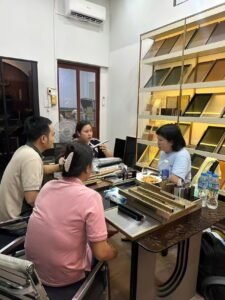
A few months back, one of our regular EPC partners in Southeast Asia asked me to help vet a honeycomb panel vendor for a curtain wall project — the stakes were high, and the wrong choice would cost months dimensional tolerances 1.
Choose a honeycomb panel supplier by evaluating their production capacity, international certifications, customization flexibility, export experience to your region, and track record with projects of similar scale — prioritize suppliers with at least five years of proven delivery history.
Start With Application Fit
Not every supplier serves every market. The global honeycomb panel landscape in 2026 is clearly split Incoterms 2. Chinese manufacturers dominate architectural cladding 3 and lightweight construction for buildings. Western and Japanese firms lead in aerospace applications 4, satellites, and defense. You need to match the supplier to your end use.
If your project involves building facades, interior ceilings, or transportation industry panels, Chinese suppliers like Foshan Liming, Guangzhou Aluloyal, or Zhongshan Fude offer high volume, cost efficiency, and strong export logistics. If you need Nomex honeycomb 5 or ultra-precision aluminum honeycomb cores for aircraft or satellite structures, Plascore, SHOWA AIRCRAFT, or Morishin are better fits.
Map Supplier Strengths to Your Needs
Here is a comparison table of the top 10 suppliers segmented by their primary strengths:
| Supplier | Country | Primary Application | Customization | Min. Order Flexibility |
|---|---|---|---|---|
| Plascore, Inc. | USA | Aerospace, Industrial | Yes | Medium lots |
| 3A Composites | Switzerland | Premium sandwich panels | Yes | Medium–large lots |
| The Gill Corporation | USA | Industrial, Aerospace | Yes | Medium lots |
| Corex Honeycomb | UK | Honeycomb core distribution | Yes | Medium lots |
| SHOWA AIRCRAFT USA | USA | Aerospace | Yes | Medium lots |
| Foshan Liming | China | Architectural, Industrial | Yes | Flexible |
| Guangdong Huitang | China | Architectural | Yes | From 1 unit |
| Guangzhou Aluloyal | China | Architectural cladding | Yes | Flexible |
| Zhongshan Fude | China | Architectural, Export | Yes | Flexible |
| Morishin | Japan | Satellite, Aerospace | Yes | From 1 unit |
Verify Certifications and Track Record
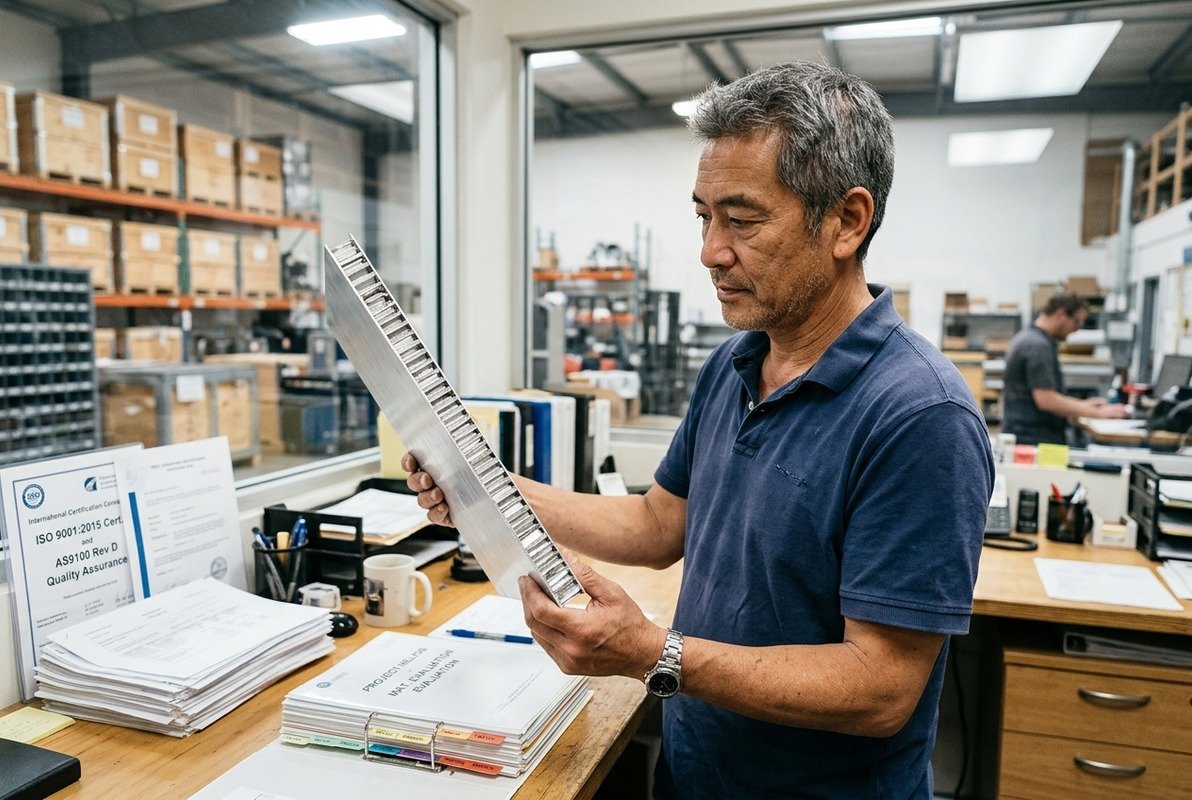
I always tell our procurement partners: never skip the certification check. Reliable suppliers hold internationally recognized quality certifications — ISO 9001 6 at minimum, plus fire-resistance and environmental compliance certificates relevant to your market. Zhongshan Fude and Foshan Liming, for example, are known for maintaining full documentation for export. In our own cable management supply chain, we learned the hard way that missing a single certificate can delay customs clearance by weeks.
Evaluate Communication and Responsiveness
For large-scale projects, your supplier must respond quickly and clearly. In my experience exporting to Africa and South America, a supplier who takes three days to answer a technical question will cause bigger delays downstream. Ask for a dedicated project contact. Request a sample before committing to bulk.
What quality benchmarks should I expect from the world's top manufacturers?
When we run quality control on our own cable tray production lines, we follow a strict checklist — and I apply the same thinking when advising partners who source composite materials like honeycomb panels.
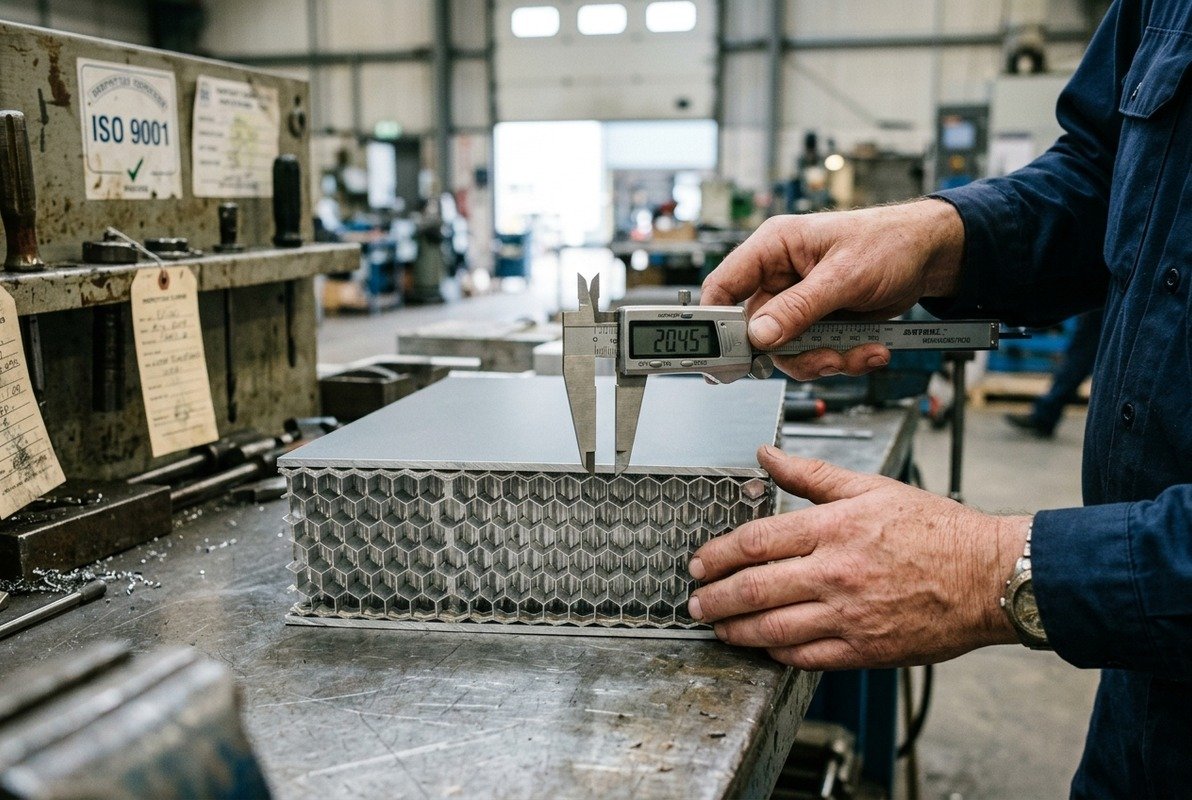
Expect top honeycomb panel manufacturers to meet ISO 9001 quality management, provide fire-resistance ratings (Class A or B1), guarantee dimensional tolerances within ±0.5 mm, offer material traceability, and deliver consistent cell geometry across every batch for reliable high strength-to-weight ratio performance.
Core Quality Metrics
Quality in honeycomb panels comes down to a few measurable benchmarks. The honeycomb core must have uniform cell size and wall thickness. The bonding between the core and the face sheets must be flawless — delamination 7 is the most common failure mode in sandwich panels. Surface finish must be free of dents, scratches, and color variation.
Here is a table summarizing the key quality benchmarks by application:
| Quality Benchmark | Architectural Panels | Aerospace Panels | Industrial Panels |
|---|---|---|---|
| Dimensional Tolerance | ±0.5 mm | ±0.1 mm | ±0.3 mm |
| Fire Resistance | Class A / B1 required | Varies by spec | Often required |
| Cell Size Uniformity | ≤5% deviation | ≤2% deviation | ≤5% deviation |
| Bonding Peel Strength | ≥1.0 N/mm | ≥2.0 N/mm | ≥1.0 N/mm |
| Surface Finish | Cosmetic grade | Functional grade | Functional grade |
| Material Traceability | Recommended | Mandatory | Recommended |
| Certification | ISO 9001 | AS9100 / NADCAP | ISO 9001 |
Fire Resistance and Safety
Fire-resistant innovations are a major trend in 2026. For construction and transportation industry use, thermal insulation panels with non-combustible honeycomb cores are increasingly required by building codes worldwide. Suppliers like Guangzhou Aluloyal and Foshan Liming focus heavily on fireproof and weather-resistant products. In high-density urban environments, this is not optional — it is a legal requirement.
The Panel Manufacturing Process Matters
How a panel is made tells you a lot about its quality. The best manufacturers use continuous lamination lines with precise temperature and pressure control. They test samples from every production run. They document every step — from raw aluminum coil receipt to final panel inspection.
I have seen cases where a supplier's panels looked perfect visually but failed under load because the honeycomb core was expanded unevenly. This is why I recommend visiting the factory — or at minimum, requesting a detailed process flow diagram and QC reports before placing a large order.
Incoming Material Inspection
Top suppliers do not just check finished products. They inspect raw materials on arrival. Aluminum foil thickness, adhesive viscosity, surface treatment quality — all are checked before production starts. This upstream control is what separates a reliable partner from a risky one.
Can I customize my order to meet specific engineering and design needs?
Last quarter, a project contractor in South America reached out because their facade design required non-standard panel dimensions and a custom wood-grain finish — they needed to know which suppliers could actually deliver.
Yes, most leading honeycomb panel suppliers offer extensive customization including panel thickness, honeycomb core density, cell size, face sheet material, surface finish (PVDF, PE, wood grain, stone texture), and cut-to-size dimensions — some even accept orders starting from a single unit.
What Can Be Customized?
Customization is a decisive competitive advantage in the 2026 market. The best suppliers let you specify nearly every parameter of the panel. Here is what is typically configurable:
- Core material: Aluminum honeycomb, paper honeycomb, Nomex honeycomb, or thermoplastic cores
- Core cell size: Ranging from 3 mm for aerospace to 12 mm or larger for architectural use
- Core density: Adjusted by changing foil thickness and cell size
- Face sheet material: Aluminum, stainless steel, HPL, fiberglass, or composite materials
- Surface finish: PVDF coating 8, PE coating, anodized, wood grain, stone pattern, solid color
- Panel dimensions: Length, width, and thickness cut to project specifications
- Edge treatment: Folded edges, exposed core, sealed edges, or tongue-and-groove
Supplier Customization Comparison
Not all suppliers are equally flexible. Here is a comparison:
| Supplier | Custom Dimensions | Custom Finishes | Small-Lot Orders | Core Material Options |
|---|---|---|---|---|
| Plascore | Yes | Limited | No | Aluminum, Nomex, thermoplastic |
| 3A Composites | Yes | Yes | No | Aluminum, polymer |
| Foshan Liming | Yes | Yes | Yes | Aluminum, paper |
| Guangdong Huitang | Yes | Yes | From 1 unit | Aluminum |
| Guangzhou Aluloyal | Yes | Yes | Yes | Aluminum |
| Zhongshan Fude | Yes | Yes | Yes | Aluminum |
| Morishin | Yes | Limited | From 1 unit | Aluminum |
One important lesson I have learned from managing OEM orders in our own production: customization capability is meaningless without clear communication. You need detailed drawings, agreed tolerances, and a written specification sheet before production starts. I always recommend creating a mutual sign-off document that both sides approve.
When Customization Is Not Available
Some manufacturers — like Zhongshan Haitian, a large Chinese producer — do not support customization at all. They focus on standard products at scale. This can be a problem if your project calls for non-standard sizes or special coatings. Always confirm customization support before entering negotiations.
The Role of Prototyping
For critical projects, I advise requesting a prototype or sample panel first. This lets you verify color, texture, dimensional accuracy, and structural performance before committing to thousands of square meters. Suppliers like Guangdong Huitang and Morishin are known for supporting small-lot and prototype orders, which is a huge advantage for project directors managing risk.
How do I manage international shipping and lead times with these global suppliers?
One of the biggest headaches our EPC partners face is not product quality — it is logistics. A perfect panel sitting in a factory 8,000 km away does nothing for a project deadline.
Manage international shipping by confirming production lead times upfront (typically 15–45 days), selecting suppliers with proven export experience to your region, negotiating Incoterms clearly (FOB or CIF), pre-arranging freight forwarding, and building a 2–3 week buffer into your project timeline for customs and last-mile delivery.
Understanding Lead Times
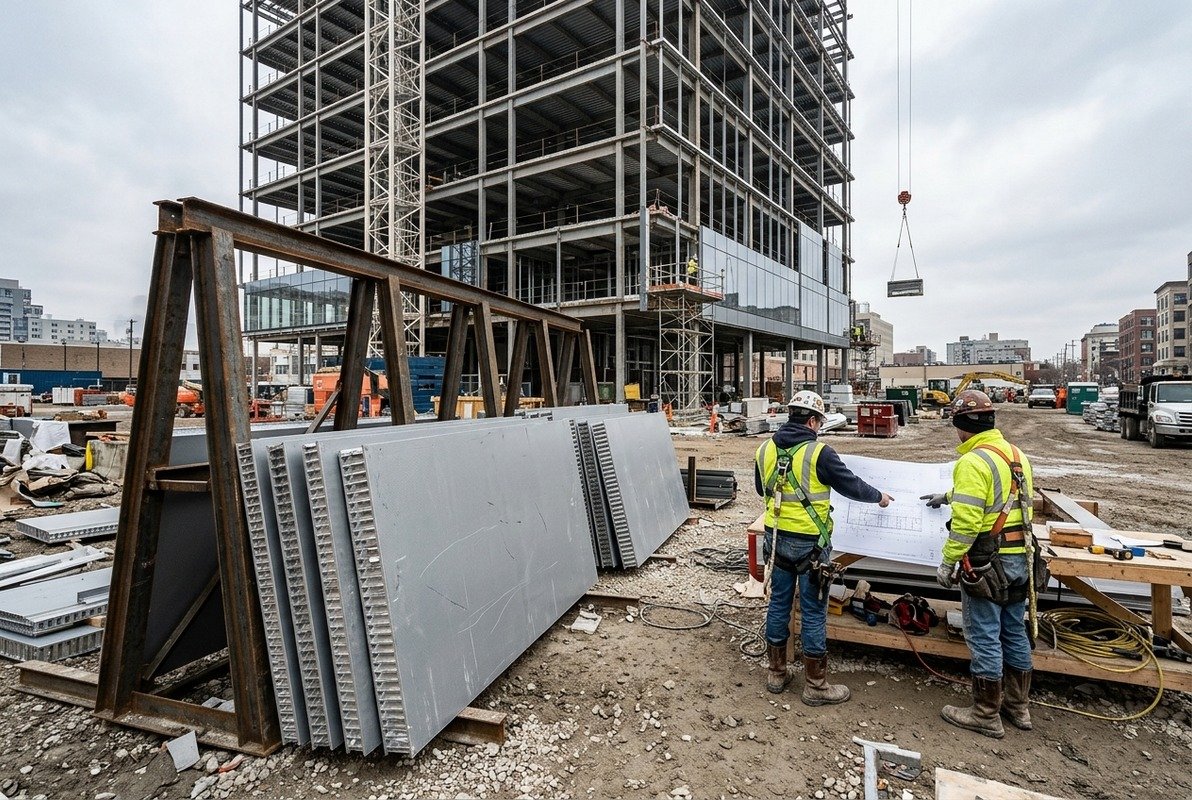
Lead times vary dramatically across the top 10 suppliers. Chinese architectural panel makers often deliver in 15–30 days for standard orders. Aerospace-grade suppliers like Plascore or SHOWA may require 45–90 days due to tighter tolerances and specialized composite materials. Morishin in Japan offers surprisingly short delivery times, even for small lots.
In our own business shipping cable trays to Southeast Asia and Africa, we have found that the production time is only part of the equation. You must also account for:
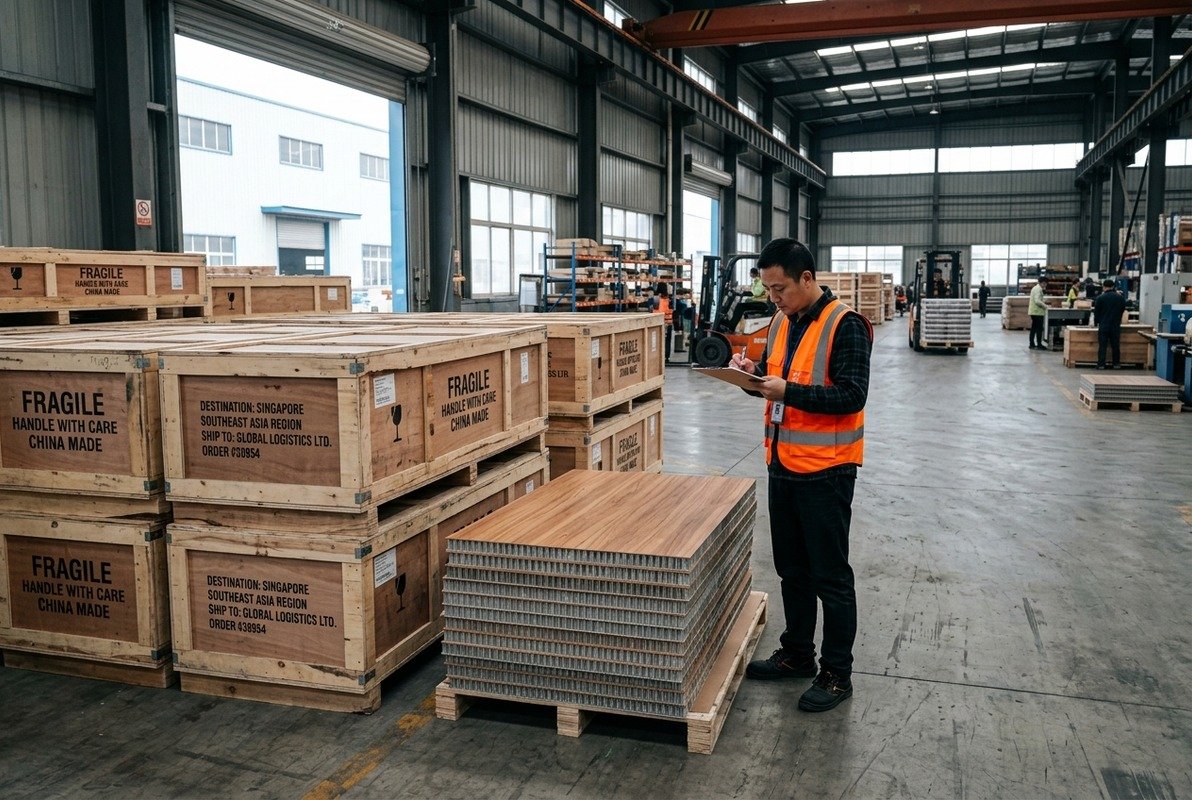
- Packaging and palletizing: Honeycomb panels are fragile during transport. Proper crating is essential.
- Port handling: Panels shipped as oversized cargo may incur extra fees.
- Customs clearance: Missing certificates of origin, test reports, or fumigation stamps can hold shipments for weeks.
- Last-mile delivery: In some African and South American markets, inland transport is the slowest link.
Practical Shipping Checklist
Here is a step-by-step process I recommend:
- Lock production schedule with the supplier in writing.
- Agree on Incoterms — FOB for experienced importers, CIF if you want the supplier to handle freight.
- Request pre-shipment inspection photos of packed goods.
- Confirm all documents: commercial invoice, packing list, certificate of origin, material test certificates, bill of lading.
- Arrange freight forwarding early — do not wait until production is done.
- Build buffer time of at least two to three weeks beyond the supplier's quoted lead time.
Regional Considerations
If you are importing to Southeast Asia, Chinese suppliers have a massive advantage: short shipping distances (5–10 days by sea), established trade lanes, and familiarity with regional customs requirements. For projects in Africa or South America, lead times extend to 30–45 days by sea, and you should choose suppliers who have already exported to these regions successfully.
Supply chain resilience is a strategic priority in 2026. Geopolitical risks, port congestion, and container shortages can all disrupt timelines. The best approach is to work with a supplier who has a dedicated export team and can provide real-time shipment tracking.
Lightweight Construction Reduces Freight Cost
One often-overlooked advantage of honeycomb panels is their lightweight construction. A standard aluminum honeycomb sandwich panel weighs far less per square meter than solid aluminum or stone. This directly reduces freight cost, especially for large-volume orders shipped by sea. It also simplifies on-site handling, reducing labor costs during installation.
Conclusion
The right honeycomb panel supplier balances application expertise, quality certifications, customization depth, and proven export logistics — choose carefully, verify thoroughly, and always build buffer into your timeline.
Footnotes
1. Replaced with a working URL from Wikipedia, an authoritative source providing a comprehensive definition of engineering tolerance, including dimensional tolerance. ↩︎
2. Provides an overview of Incoterms rules and their importance in international trade. ↩︎
3. Details how aluminum honeycomb is used in modern architectural cladding and facades. ↩︎
4. Explains the use and benefits of aluminum honeycomb panels in the aviation industry. ↩︎
5. Explains the structure, properties, and applications of Nomex honeycomb materials in detail. ↩︎
6. Provides an official overview of the ISO 9001 standard for quality management systems. ↩︎
7. Describes delamination as a failure mode in composite materials and its causes. ↩︎
8. Explains the properties and applications of PVDF as a coating material. ↩︎