Every year, our quality team reviews dozens of supplier audit requests from overseas buyers who have been burned before. A single batch of defective aluminum cabinet handles can trigger costly recalls, damage brand trust, and stall production lines for weeks.
To verify ISO quality systems for aluminum furniture cabinet handle suppliers, request their ISO 9001 certificate, confirm the issuing body’s accreditation through IAF or ILAC directories, review audit reports and corrective action logs, and cross-check that the certification scope specifically covers aluminum handle manufacturing processes.
Below, we break down each step in detail. Whether you are a building material distributor or a furniture factory buyer sourcing from China, this guide gives you practical tools to separate reliable suppliers from risky ones.
How can I verify the authenticity of an ISO certificate from a Chinese aluminum handle factory?
We have seen more than a few cases where buyers placed large orders based on certificates that turned out to be expired or issued by unaccredited bodies. The cost of trusting a fake certificate is always higher than the cost of checking it first.
To verify authenticity, cross-reference the certificate number with the issuing body's online database, confirm the accreditation body through IAF CertSearch or national accreditor directories like CNAS in China, and check that the scope, validity dates, and company name match exactly.

Start With the Certificate Itself
When a supplier sends you their ISO 9001 certificate 1, look at it closely. Every legitimate certificate includes several key data points. Here is what to check first:
| Certificate Element | What to Look For | Red Flag |
|---|---|---|
| Issuing Body Name | Recognized body (e.g., SGS, TÜV, BV, BSI) | Unknown or generic-sounding name |
| Accreditation Mark | Logo of CNAS, UKAS, ANAB, or similar | No accreditation mark at all |
| Certificate Number | Unique, searchable in issuer's database | Number returns no results online |
| Scope Description | Must mention aluminum handles or hardware | Vague terms like "general manufacturing" |
| Validity Dates | Current and within 3-year cycle | Expired or approaching expiry without renewal |
| Company Name & Address | Matches your supplier exactly | Slight name variations or different address |
Use Public Verification Tools
Do not rely on your supplier's word alone. Several free tools exist for verification:
- IAF CertSearch (iafcertsearch.org): This global database lets you search certificates issued by accredited certification bodies that are members of the International Accreditation Forum.
- CNAS Directory (cnas.org.cn): Since most Chinese factories get accredited through CNAS (China National Accreditation Service), this is essential for verifying the certifying body's legitimacy.
- Certification Body Website: Visit the actual website of the issuing body and search the certificate number directly.
Accredited vs. Unaccredited Certificates
This is a critical distinction. An accredited certification body operates under oversight from a national accreditation authority that follows ISO/IEC 17021 standards 2. An unaccredited body has no such oversight. In our experience shipping aluminum profiles and handles to Southeast Asia and the Middle East, buyers who accept unaccredited certificates face higher risks of quality inconsistency.
Some suppliers choose unaccredited certifiers because they are cheaper. The audit may be less rigorous. The certificate looks similar, but it carries far less weight. Always ask: "Who accredits your certification body?" If the supplier cannot answer, treat it as a warning sign.
Watch for Scope Mismatches
A factory might hold a valid ISO 9001 certificate for plastic injection molding 3, but that does not cover their aluminum extrusion line. The scope must explicitly include the products you are buying. If it says "metal hardware manufacturing" or "aluminum profile production," that is relevant. If it says "office furniture assembly," it is not.
What specific quality management documents should I ask my cabinet handle supplier to provide?
When our overseas clients request documentation before placing a bulk order, we see it as a sign of professionalism. The right documents reveal whether a factory truly follows its quality system or just keeps a certificate on the wall.
Request the supplier's quality manual, process control plans, incoming material inspection records, in-process and final inspection reports, calibration certificates for measuring equipment, corrective action logs, and internal audit reports to assess whether their QMS is genuinely operational.

Core Documents Every Buyer Should Request
Not all documents carry the same weight. Here is a prioritized list based on what matters most for aluminum handle procurement:
| Document | Why It Matters | What to Look For |
|---|---|---|
| Quality Manual | Outlines the entire QMS structure | Specific references to aluminum processing |
| Process Control Plan | Details controls at each production stage | Steps for extrusion, CNC machining, anodizing |
| Incoming Material Inspection Records | Proves raw aluminum is tested | Alloy grade verification (e.g., 6063-T5) |
| In-Process Inspection Reports | Catches defects during production | Dimensional checks, surface finish measurements |
| Final Inspection Reports | Confirms finished goods meet specs | AQL sampling results, defect classification |
| Calibration Certificates | Ensures measuring tools are accurate | Current calibration dates, certified lab stamps |
| Corrective Action Reports (CARs) | Shows how problems get fixed | Root cause analysis, follow-up verification |
| Internal Audit Reports | Proves self-monitoring is active | Audit frequency, findings, closure status |
| Management Review Minutes | Demonstrates leadership involvement | Quality objectives, trend analysis, decisions |
Dig Into Material Traceability
For aluminum cabinet handles, raw material quality is everything. The alloy grade affects strength, corrosion resistance, and anodizing quality. Ask your supplier for mill certificates 4 (also called material test certificates or MTCs) from their aluminum billet supplier. These certificates should show the chemical composition and mechanical properties of each batch.
On our production floor in Foshan, we maintain batch-level traceability from raw billet to finished handle. Each production run links back to a specific material lot. If your supplier cannot provide this chain of traceability, their QMS has a gap.
Surface Treatment Records
Aluminum handles for furniture often require anodizing, powder coating, or electrophoretic finishing. Each process has measurable parameters. For anodizing, look for records showing oxide layer thickness 5 (typically 10-25 microns for decorative applications), seal quality test results, and color consistency data. For powder coating, ask for adhesion test results and film thickness records.
Do Not Forget Customer Complaint Logs
A supplier who claims zero complaints is either very new or not being honest. Healthy QMS documentation includes a log of customer feedback and complaints, along with corrective actions taken. This shows the factory learns from mistakes rather than hiding them.
How does a supplier's ISO 9001 certification ensure the consistency of my bulk aluminum profile orders?
Running production for 18 years has taught our team one lesson above all others: consistency is harder than quality. Making one perfect handle is easy. Making ten thousand identical ones requires a system.
ISO 9001 ensures bulk order consistency by requiring documented process controls, standardized work instructions, statistical monitoring, calibrated equipment, trained operators, and systematic corrective actions—all working together to minimize variation across every production batch of aluminum handles.

How ISO 9001 Clauses Drive Consistency
ISO 9001:2015 6 has clauses numbered 4 through 10. Several directly impact whether your bulk aluminum handle orders come out the same every time.
| ISO 9001 Clause | Relevant Requirement | Impact on Aluminum Handle Consistency |
|---|---|---|
| Clause 7 (Support) | Competence, training, equipment | Trained operators produce fewer defects |
| Clause 8 (Operation) | Process planning, control of production | Standardized extrusion and machining parameters |
| Clause 8.4 (External Providers) | Supplier management | Consistent raw aluminum quality from vetted mills |
| Clause 9 (Performance Evaluation) | Monitoring, measurement, analysis | SPC data catches drift before defects occur |
| Clause 10 (Improvement) | Corrective actions, continual improvement | Systematic fixes prevent recurring batch issues |
Process Control in Practice
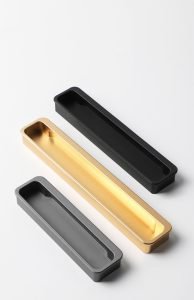
For aluminum furniture handles like the sleek, linear finger pulls and edge-mount cabinet pulls we produce, consistency depends on controlling several variables:
- Extrusion temperature and speed: Even a 10°C deviation can change the profile dimensions.
- CNC machining tolerances: Cutting tools wear over time. Without regular measurement and tool replacement schedules, the 500th piece differs from the 1st.
- Anodizing bath chemistry: Electrolyte concentration, temperature, and current density must stay within tight ranges. Otherwise, color shifts appear across batches.
- Packaging and handling: Scratches during packing destroy the matte finish on champagne gold or brushed aluminum handles.
ISO 9001 requires the factory to document control limits for each of these variables. It also requires monitoring and recording actual values. When values drift, the system triggers corrective action before the entire batch is compromised.
The Role of Surveillance Audits
ISO 9001 certification runs on a 3-year cycle. The initial certification audit happens in year one. Then, surveillance audits 7 occur annually in years two and three. These check whether the factory maintains its system. If a supplier skips surveillance audits or fails them, their certificate becomes invalid.
For buyers, this means you should ask not just for the certificate but also for the most recent surveillance audit report. A clean surveillance report from the past 12 months is a stronger indicator than a certificate issued two years ago with no follow-up.
Beyond Certification: What Buyers Should Monitor
Certification is not a guarantee. It is a foundation. Smart buyers also track their own metrics: defect rates per shipment, dimensional deviation reports, and on-time delivery. Over time, these data points tell you more about consistency than any certificate. The best approach combines verified ISO 9001 certification with your own incoming quality checks.
What steps can I take to audit my supplier's quality system without visiting their facility in person?
Many of our clients in Southeast Asia and the Middle East cannot fly to Foshan for every order. Travel costs and time constraints make on-site visits impractical, especially for mid-sized distributors managing multiple suppliers.
To audit remotely, use video-call factory walkthroughs, request documented evidence packages, verify ISO certificates through online databases, commission third-party inspection agencies for on-site checks, and establish ongoing performance tracking with KPIs like defect rates, delivery accuracy, and complaint resolution times.

Build a Remote Audit Toolkit
Remote auditing is not perfect, but it is far better than blind trust. Here are the key tools and methods:
Video Factory Walkthrough: Schedule a live video call where the supplier's quality manager walks you through the production floor. Ask to see specific machines, inspection stations, and storage areas. Watch how workers handle raw aluminum billets and finished handles. A factory that refuses a video tour is a red flag.
Document Review Package: Request a structured set of documents before the call. This includes the quality manual, recent internal audit reports, calibration logs, material test certificates, and final inspection records for recent shipments. Review them ahead of time and prepare questions.
Third-Party Inspection Services: Companies like SGS, Bureau Veritas, Intertek, and Asia Inspection offer pre-shipment inspections, during-production inspections, and even full factory audits in China. Third-Party Inspection Services 8 You do not need to be there. They send trained auditors who follow your checklist and report back with photos, measurements, and findings.
Create a Supplier Scorecard
Track performance over time with a simple scorecard. Here is a template:
| KPI | Target | How to Measure | Frequency |
|---|---|---|---|
| Defect Rate | < 1% | Incoming inspection of each shipment | Per shipment |
| Dimensional Accuracy | Within ±0.1 mm | Caliper/CMM measurements on samples | Per shipment |
| On-Time Delivery | > 95% | Actual vs. promised ship dates | Monthly |
| Complaint Resolution | < 7 days | Time from complaint to corrective action | Per incident |
| Document Responsiveness | < 48 hours | Time to provide requested QMS documents | Per request |
| Certificate Validity | Current | Annual check via IAF CertSearch 9 | Annually |
Leverage Digital Tools
Some forward-thinking suppliers now offer real-time production dashboards or shared quality data through cloud platforms. While this is still uncommon among small and mid-sized Chinese factories, it is worth asking. Even simple tools like shared photo albums of production stages, WeChat or WhatsApp video updates, and emailed daily production reports add transparency.
Commission a Second-Party Audit Remotely
You can hire an independent auditor in China to conduct a full second-party audit on your behalf. Provide them with a checklist based on ISO 9001 clauses relevant to aluminum handle production. Key areas to cover include:
- Raw material storage and identification
- Extrusion and CNC machining process controls
- Surface treatment (anodizing, powder coating) parameter records
- Final inspection and testing procedures
- Packaging and labeling accuracy
- Nonconformity handling and corrective action system
The auditor sends you a detailed report with photographic evidence. This is the closest alternative to being there yourself.
Set Expectations Early
The most effective remote auditing happens when you set clear quality expectations before placing the first order. Share your specifications, tolerances, surface finish requirements, and packaging standards in writing. Ask the supplier to confirm they can meet each requirement and provide evidence. This creates a documented baseline you can audit against remotely for every future shipment.
Conclusion
Verifying a supplier's ISO quality system takes effort, but it protects your business from costly defects and inconsistent batches. Use the checklists, verification tools, and remote audit strategies above to build confidence in your aluminum cabinet handle supply chain.
Footnotes
1. Explains ISO 9001 certification importance, benefits, and how it demonstrates commitment to quality. ↩︎
2. Provides requirements for competence, consistency, and impartiality of bodies certifying management systems. ↩︎
3. Explains the manufacturing process of plastic injection molding, its principles, and applications. ↩︎
4. Replaced with a Wikipedia page providing a comprehensive and authoritative explanation of mill test reports/certificates in the metals industry. ↩︎
5. Replaced with a direct link to the ISO 10074 standard, an authoritative source for hard anodizing and oxide layer thickness. ↩︎
6. Provides an overview of the ISO 9001:2015 standard, its requirements, and importance for QMS. ↩︎
7. Explains surveillance audits as periodic reviews to verify ongoing ISO 9001 compliance and QMS effectiveness. ↩︎
8. Describes independent third-party inspection services for validating product specifications, quality, and compliance throughout the supply chain. ↩︎
9. Official global database for verifying accredited management system certifications and their validity. ↩︎