Every year, our team at LiliTong ships thousands of aluminum handles across Southeast Asia, and we hear the same worry from buyers exploring Indonesian suppliers: “How do I know the quality is real before it lands at my warehouse?” It is a valid concern. A single shipment of handles with peeling anodizing 1 or wrong alloy grades can stall a furniture project for weeks and cost thousands in returns. The problem grows when you source from a new country and lack boots on the ground.
To select the best inspection agency for sourcing aluminum cabinet handles from Indonesia, evaluate their metal hardware expertise, local presence in Java’s manufacturing clusters, accreditation status such as ISO 17020, range of inspection services from pre-production to loading, and their ability to test specific finishes like anodizing and powder coating against your specifications.
This guide breaks down the exact criteria, costs, and insider tips you need ISO 9001 accreditation 2. Whether you are a building material wholesaler or a furniture factory buyer, the four sections below will help you hire the right inspector and protect every order.
What criteria should I use to evaluate an inspection agency's expertise in aluminum cabinet hardware?
When we evaluate new inspection partners for our own export orders, the first thing we check is whether they have ever held an aluminum pull in their hands and known what to look for. Not every quality control firm understands metal hardware. Many agencies specialize in textiles or electronics and lack the tooling knowledge that aluminum handles demand.
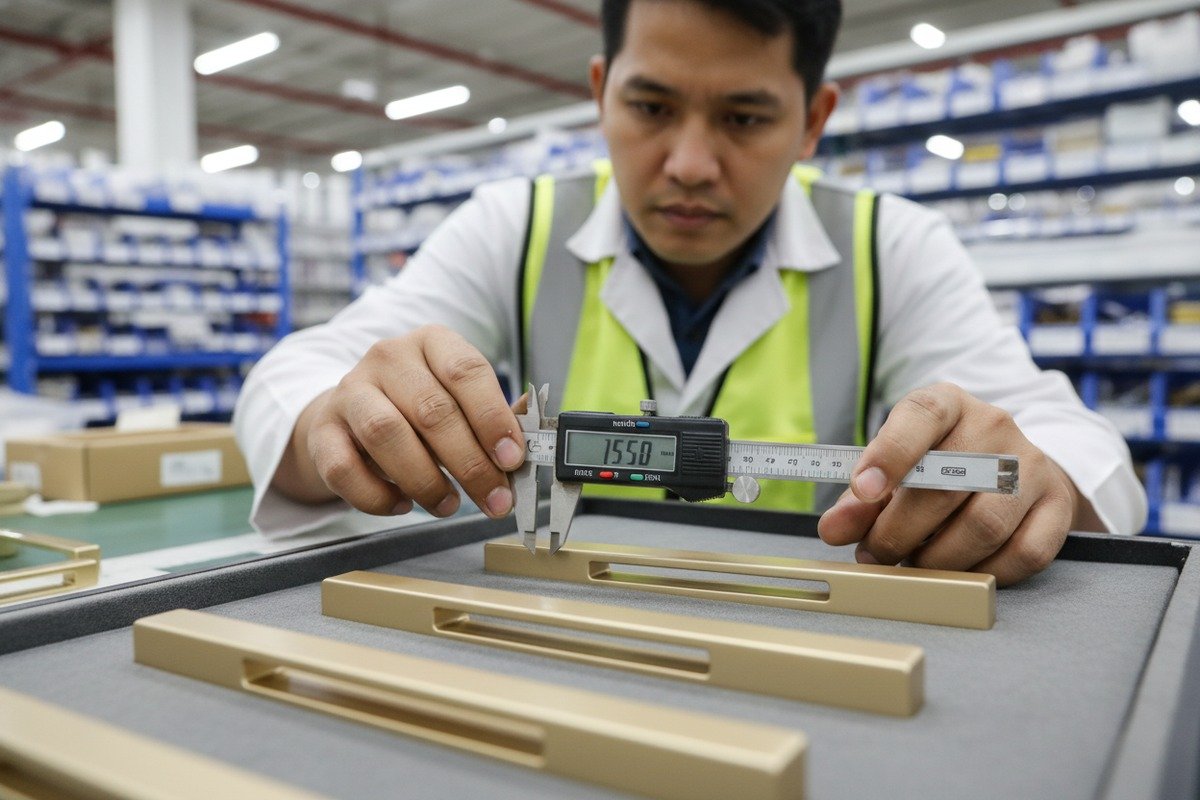
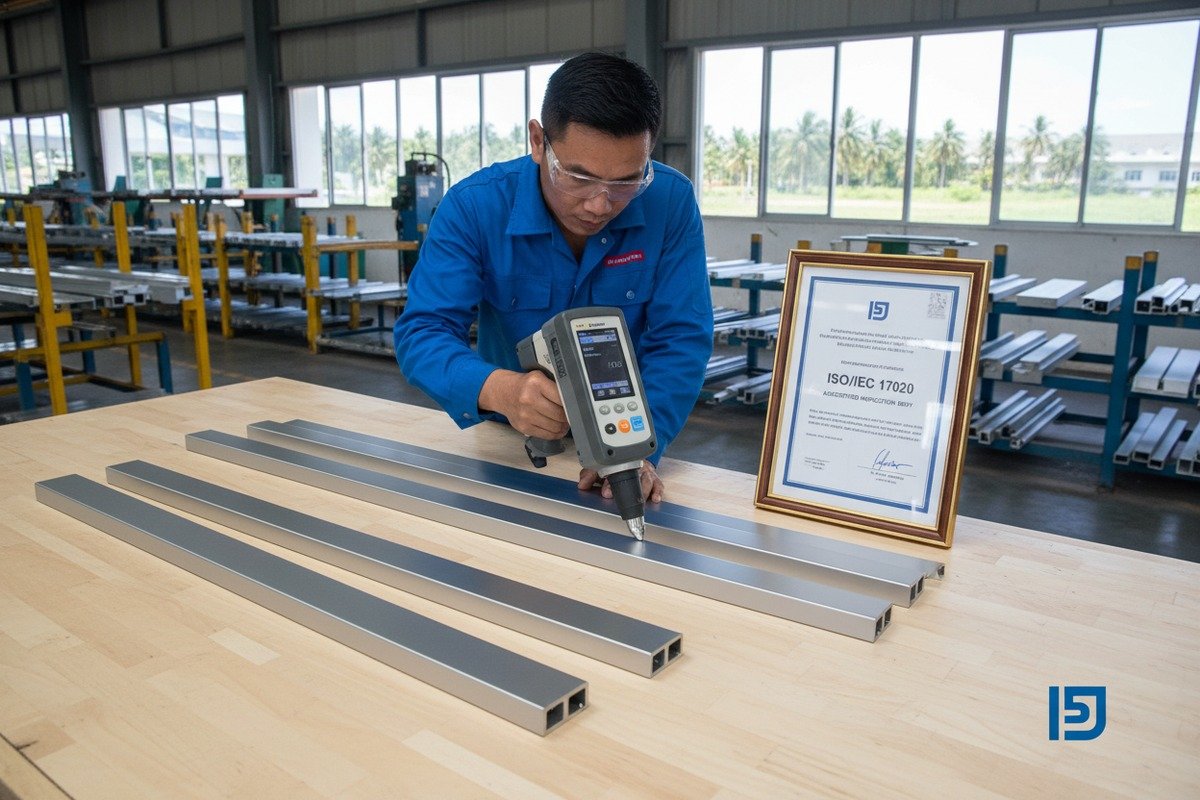
Evaluate an inspection agency by confirming their direct experience with aluminum or metal hardware, checking for ISO 17020 or ISO 9001 accreditation, reviewing sample reports for dimensional and finish checks, and verifying they can test alloy grades like 6063 or 6061 with proper equipment.
Why Metal-Specific Experience Matters
Aluminum cabinet handles 3 go through extrusion, die-casting, CNC machining, and surface finishing. Each step introduces unique defect risks. An agency that mainly inspects garments will not catch a subtle die line on an extruded profile or know that a salt spray test 4 should last 1,000 hours for anodized handles. You need inspectors trained on metal parts.
Ask every candidate agency these questions before signing a contract:
- How many aluminum or metal hardware inspections have you completed in the past 12 months?
- Can you share a redacted sample report for a similar product?
- Do you own or rent portable XRF analyzers 5 for alloy verification?
Key Accreditation and Certification Checks
Accreditation is not just a badge. It means the agency follows documented procedures and gets audited regularly. Here is a quick comparison of common accreditations:
| Accreditation | What It Covers | Why It Matters for Handle Sourcing |
|---|---|---|
| ISO 17020 6 | Inspection body competence | Confirms systematic, unbiased inspection methods |
| ISO 9001 | Quality management system | Shows the agency has repeatable internal processes |
| AQSIQ Registration | China/Indonesia export compliance | Relevant if re-exporting or cross-border sourcing |
| ILAC MRA Signatory | International lab recognition | Test results accepted globally without retesting |
Reporting Quality and Tools
A good report is not just "pass" or "fail." It should include high-resolution photos of every defect, precise measurements against your spec sheet, AQL sampling details 7, and a clear summary table. Our procurement team always requests a demo report before onboarding any agency. If the report lacks photos of the handle's recessed channel or rounded edge details, the agency does not understand the product.
Also confirm the agency uses digital platforms. Modern firms offer real-time dashboards where you can track inspection progress, download reports instantly, and compare historical data across shipments. This is especially useful when you run repeat orders from Indonesian factories in Tangerang or Cibitung.
How can I ensure my chosen inspector understands the specific finishing requirements for my furniture handles?
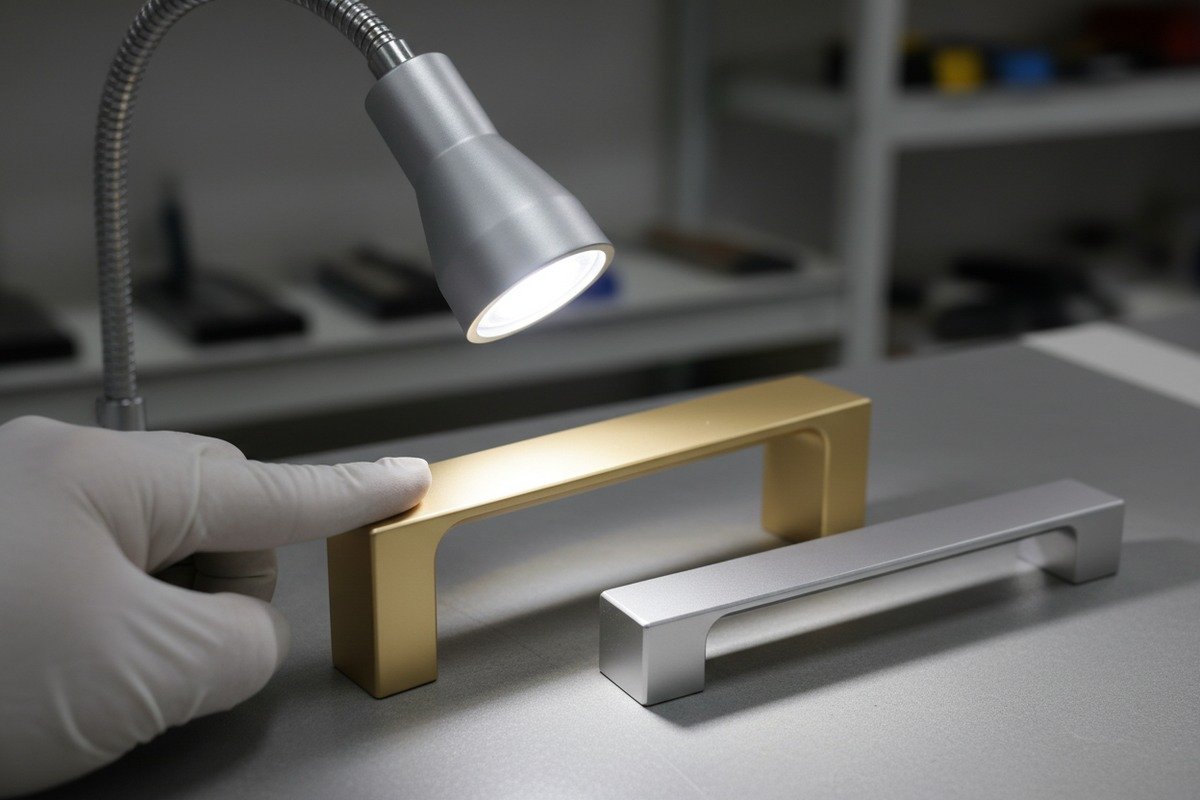
Our production floor runs anodizing, powder coating, and electrophoresis lines daily, so we know firsthand how many ways a finish can fail. Micro-pitting, color drift between batches, adhesion loss after six months—these are invisible to untrained eyes during a quick warehouse walk-through. Your inspector must know exactly what "champagne gold" or "blasted silver" means in measurable terms.
Ensure your inspector understands finishing requirements by providing a detailed specification sheet with color codes, gloss levels, coating thickness ranges, and adhesion test standards, then verifying the agency can perform cross-cut adhesion, gloss meter readings, and salt spray testing on-site or through partner labs.
Common Finishes and Their Inspection Points
Aluminum cabinet handles from Indonesia come in many finishes. Each one has different failure modes. Here is a breakdown:
| Finish Type | Critical Test | Common Defect | Acceptable Standard |
|---|---|---|---|
| Anodized (clear/colored) | Salt spray 1,000 hrs, coating thickness 15–25 µm | Peeling, uneven color, white spots | ASTM B117, ISO 7599 |
| Powder Coated | Cross-cut adhesion 8 (ASTM D3359), 60° gloss meter | Orange peel texture, chipping | Coating thickness 60–80 µm |
| Brushed/Blasted | Visual comparison to approved sample | Inconsistent grain direction, deep scratches | Limit sample agreed by buyer |
| Electrophoresis | MEK rub test, pencil hardness | Yellowing, thin spots | Hardness ≥ 2H |
How to Write a Finish Specification Your Inspector Can Use
Many sourcing problems start with vague specs. Saying "matte silver" is not enough. Instead, provide:
- RAL or Pantone color code with tolerance (ΔE ≤ 1.5)
- Gloss range in GU (e.g., 15–25 GU for matte)
- Coating thickness in microns with min/max
- Adhesion standard (e.g., ASTM D3359 Class 4B minimum)
- A sealed golden sample shipped to both the factory and the inspection agency
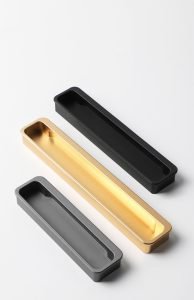
When we prepare shipments for our Southeast Asian distributors, we always include a golden sample in the first carton. This lets the inspector do a side-by-side comparison right at the factory. If your Indonesian supplier offers finishes like champagne gold or blasted black—popular on minimalist edge-mount pulls—a golden sample eliminates subjective judgment.
Ask for a Pre-Inspection Calibration Meeting
Before the first inspection, schedule a video call between your team, the factory, and the inspection agency. Walk through the spec sheet line by line. Clarify which defects are critical, major, or minor. For example, a small scratch on the hidden mounting surface might be acceptable, but a scratch on the visible recessed channel of the handle is a critical reject. This alignment step takes 30 minutes and can prevent thousands of dollars in disputes.
Why is local Indonesian experience critical for my third-party quality control process?
Over the past 18 years, we have guided clients through sourcing across multiple Southeast Asian countries. One lesson stands out clearly: an inspector who has never navigated an Indonesian industrial park will waste half the day just finding the factory gate. Local experience is not a luxury. It is a practical necessity that directly affects inspection speed, accuracy, and cost.
Local Indonesian experience is critical because it ensures the inspector can navigate factory clusters in Tangerang and Cibitung efficiently, communicate in Bahasa Indonesia with floor workers, understand regional business customs, and respond quickly to schedule changes without costly travel delays from overseas offices.

Indonesia's Key Manufacturing Hubs for Aluminum Hardware
Indonesia's aluminum cabinet handle production concentrates in specific areas of West Java. Approximately 70% of the country's furniture hardware output comes from these clusters. Knowing the geography matters because it determines how fast your inspector can reach the factory.
| Manufacturing Hub | Location | Key Companies | Specialization |
|---|---|---|---|
| Tangerang | Banten, Greater Jakarta | Mass Metalindo, Furnindo | Cabinet pulls, furniture accessories |
| Cibitung | West Java | Alcomex Indo (9Ha facility) | Aluminum extrusion, custom profiles |
| Bekasi-Karawang | West Java | Various SMEs | Die-cast handles, zinc alloy hardware |
| Semarang | Central Java | Smaller workshops | Budget aluminum pulls |
An inspector based in Jakarta or Tangerang can visit factories in Cibitung and Bekasi within the same day. An inspector flying in from Singapore or Hong Kong adds flight costs, hotel expenses, and at least one lost day to travel.
Cultural and Communication Advantages
Indonesian factory floors operate differently from Chinese or Vietnamese ones. Workers and supervisors respond better to inspectors who speak Bahasa Indonesia 9 and understand local hierarchies. A foreign inspector who barks orders in English may face passive resistance—workers will nod politely but not open the problem cartons.
Local agencies also understand Indonesian business norms. For instance, inspections during Ramadan require adjusted schedules. Factories near Tangerang may shut down entirely during Lebaran holidays. A local agency builds these variables into the inspection calendar automatically.
Local vs. International Agencies: A Balanced View
Some buyers assume that only global names like SGS or Bureau Veritas deliver reliable results. These firms are excellent but charge 2–3 times more than competent local agencies like Sucofindo or Surveyor Indonesia. The trade-off is real:
- Local agencies cost 20–50% less and offer same-week scheduling. However, you must verify their independence from the supplier.
- International agencies carry globally recognized accreditation and cross-border credibility. They are ideal for large orders or when your end-client requires a brand-name inspection certificate.
The smart approach is to start with a local agency for routine during-production inspections and use an international firm for the final pre-shipment inspection on critical orders. This hybrid model keeps costs down without sacrificing trust.
How do I balance the cost of professional inspection against the risk of receiving defective handle shipments?
We have seen buyers skip inspection to save $300 on a $5,000 order, then lose $2,000 replacing handles with peeling finishes after they arrived at a furniture factory in the Middle East. The math never works in favor of skipping quality control. But that does not mean you should overspend on inspection either. The key is matching your inspection investment to the real risk level of each order.
Balance inspection costs against defect risk by budgeting 1–2% of total order value for quality control, using AQL sampling for large orders, reserving 100% inspection for first-time suppliers or high-value finishes, and calculating the full cost of a rejected shipment including freight, delays, and lost customer trust.

The True Cost of a Defective Shipment
When a container of aluminum cabinet handles arrives with defects, the direct costs are only the beginning. Let us break down a realistic scenario for a mid-size order:
| Cost Category | Estimated Loss (USD) | Notes |
|---|---|---|
| Return freight to Indonesia | $800–$1,500 | If supplier agrees to take product back |
| Replacement production | $1,500–$3,000 | 4–6 week delay minimum |
| Warehousing of defective stock | $200–$500 | While awaiting resolution |
| Lost customer order | $3,000–$10,000+ | Your buyer moves to a competitor |
| Reputation damage | Unquantifiable | Future orders at risk |
| Total potential loss | $5,500–$15,000+ | On an order worth $5,000–$15,000 |
Now compare that to the cost of a pre-shipment inspection, which typically runs $250–$500 per man-day in Indonesia. Even two inspection visits on a single order cost less than the cheapest defect scenario.
When to Invest More vs. Less in Inspection
Not every order needs the same level of scrutiny. Here is a practical framework:
High inspection investment (2–3% of order value):
- First order from a new Indonesian supplier
- Premium finishes like champagne gold anodizing or custom colors
- Orders destined for brand-name furniture clients with strict QC standards
Standard inspection investment (1–2% of order value):
- Repeat orders from a proven supplier with good track record
- Standard finishes like clear anodized or blasted silver
- Medium-size orders ($5,000–$20,000)
Minimal inspection (spot check or self-inspection):
- Very small orders under $2,000 with well-established suppliers
- Commodity handles with simple finishes
- When you have your own staff visiting the factory
ROI of Inspection: A Simple Calculation
Think of it this way. If your order is worth $10,000 and the historical defect rate for uninspected Southeast Asian metal shipments hovers around 15%, your expected loss without inspection is $1,500. A professional pre-shipment inspection costs $350–$500. That is a 3:1 to 4:1 return on your inspection investment, even before accounting for reputation and relationship costs.
For buyers sourcing aluminum handles priced competitively—some Indonesian cabinet pulls start at Rp. 888 per piece from factories like Mass Metalindo—the margin per handle is thin. A single defective batch can wipe out the profit from three good shipments. Professional inspection is not an expense. It is insurance with a measurable payoff.
Negotiating Inspection Costs Down
You can reduce inspection fees without reducing quality. Bundle multiple factory visits into one trip. Schedule inspections during production (DPI) to catch problems before finishing, which is cheaper to fix than post-finishing rejects. Use local Indonesian agencies for routine checks and reserve expensive international firms for final sign-off. Some agencies offer annual contracts with volume discounts if you source regularly from the same region.
Conclusion
Selecting the right inspection agency protects your investment, your timeline, and your reputation with end customers. Prioritize metal hardware expertise, local Indonesian presence, proper accreditation, and a clear cost-benefit approach. If you need aluminum cabinet handles with consistent quality and ready stock, reach out to our team at LiliTong—we have 18 years of experience delivering to Southeast Asia and the Middle East.
Footnotes
1. Explains common reasons why paint peels off anodized aluminum surfaces. ↩︎
2. Provides an overview of ISO 9001, an international standard for quality management systems. ↩︎
3. Provides information on the benefits and types of aluminum cabinet hardware. ↩︎
4. Replaced with a comprehensive and authoritative Wikipedia article on salt spray testing, including references to ASTM B117. ↩︎
5. Explains how handheld XRF analyzers are used for rapid, accurate elemental analysis and alloy identification. ↩︎
6. Replaced with a working and relevant page about ISO/IEC 17020 from the same authoritative domain (ANAB) as the original failed URL. ↩︎
7. Explains AQL sampling as a statistical tool in quality control to determine acceptable defect levels. ↩︎
8. Details ASTM D3359, a visual adhesion test for evaluating coating strength on metallic substrates. ↩︎
9. Provides an overview of Bahasa Indonesia as the official and national language of Indonesia. ↩︎