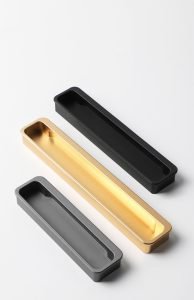
Every week, our sales team in Foshan gets calls from first-time buyers who feel overwhelmed by choices Business license and export license 1. They stare at catalogs full of finishes, sizes, and styles. They worry about tying up cash in handles that won’t sell extrusion die cost 2. The fear of a warehouse full of dead stock is real — and so is the cost of empty shelves when customers come looking.
Novice hardware buyers should start with 8–12 carefully selected aluminum handle SKUs across two or three popular finishes and sizes, maintaining a conservative inventory depth of 50–200 units per SKU. Use local customer preferences and your own capital strength to guide decisions, then scale based on 90-day sales velocity data.
This guide breaks down the process step by step. We will cover how to find trustworthy suppliers 3, verify quality, manage stock levels, and unlock customization — even on a tight budget. Let’s dive in.
How do I find a reliable Chinese supplier for my custom aluminum furniture handle needs?
Sourcing handles from China sounds simple until you actually start. Our export team has watched many new buyers fall into traps — paying deposits to ghost factories, receiving products nothing like the photos, or waiting months for shipments that never arrive.
To find a reliable Chinese supplier, verify factory credentials through on-site audits or third-party inspections, request production samples before committing, check export experience to your region, and prioritize suppliers with ready stock and transparent communication via WhatsApp or email.
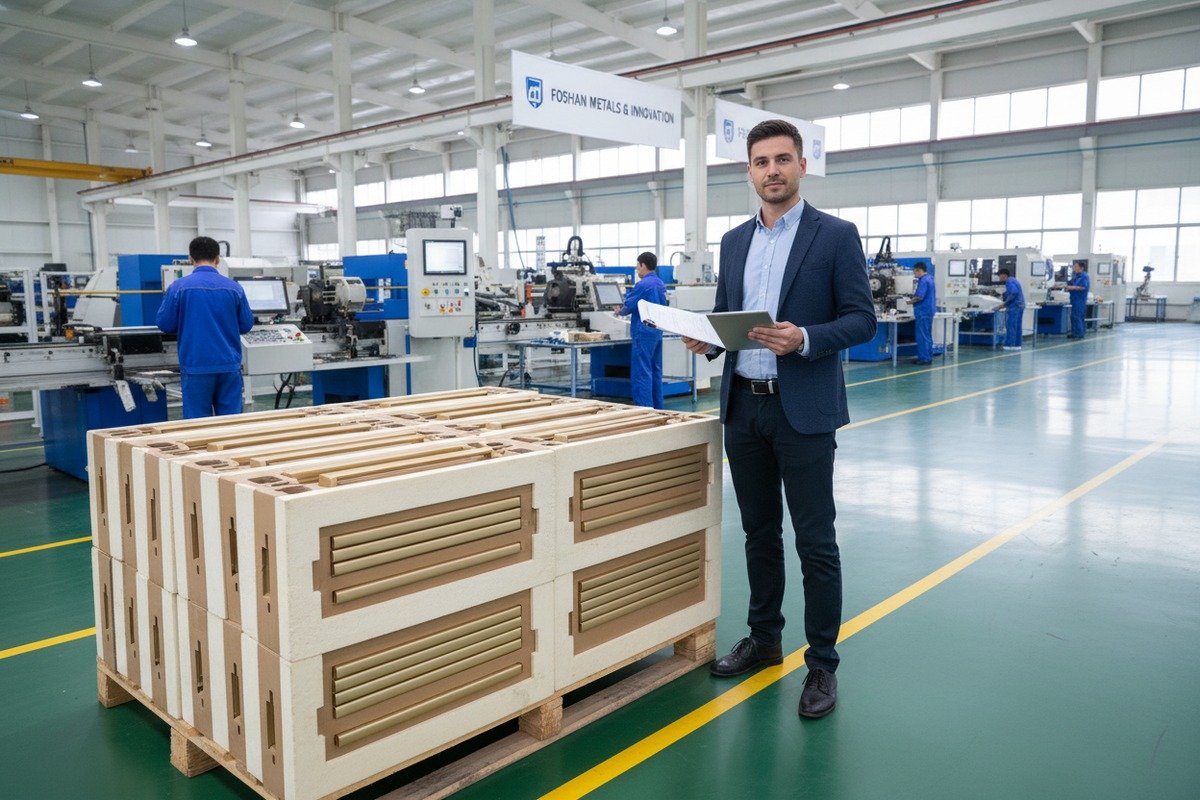
Start with Verification, Not Price
The biggest mistake novice buyers make is sorting suppliers by price alone. Price matters, but reliability matters more. A handle that costs $0.50 less per unit is worthless if it arrives three months late or fails quality checks. Here is what to look for first:
- Business license and export license. Any legitimate Chinese manufacturer will provide these without hesitation.
- Factory photos and videos. Real factories show production lines, not just showrooms. When we give tours of our Foshan facility, buyers can see raw aluminum extrusion, anodizing tanks, and packing stations all under one roof.
- Trade references. Ask for contact details of two or three existing clients in your region. A supplier with 18 years of experience, like our team, will have a long list.
Use the Right Platforms and Channels
Google is the primary sourcing channel for most building material distributors. But don't stop there. Cross-reference suppliers on Alibaba, Made-in-China, and Global Sources 4. Check if they have a standalone website — this shows long-term commitment.
| Verification Step | What to Check | Red Flag |
|---|---|---|
| Business License | Valid registration in Foshan, Guangdong or other hardware hubs | Refuses to share or provides blurry copies |
| Factory Audit | On-site visit or third-party inspection (SGS, TÜV) | "We only have a showroom" |
| Sample Request | Willing to send paid samples within 7 days | Demands full order before any samples |
| Communication | Responds within 24 hours on WhatsApp/email | Disappears for days, vague answers |
| Export History | Proven shipments to Southeast Asia, Middle East, etc. | No container photos, no bill of lading references |
Ask the Right Questions Early
Before you send a single dollar, ask: What is your MOQ? Do you hold ready stock? Can you do OEM packaging? What is your lead time for a 500-piece order? A trustworthy supplier answers these quickly and clearly. In our experience exporting to Southeast Asia and the Middle East, buyers who ask detailed questions upfront avoid 90% of common sourcing headaches.
Build the Relationship Before the Big Order
Place a small trial order first — 100 to 200 pieces across two or three SKUs. Evaluate packaging, labeling accuracy, surface finish, and delivery time. If everything checks out, scale up. This phased approach protects your capital and gives you real data about supplier performance.
How can I ensure the quality of my bulk hardware orders matches the initial samples?
This question keeps furniture factory buyers and distributors awake at night. We have seen it from our side of the production line — a buyer approves a beautiful champagne gold sample, then receives 5,000 pieces in a slightly different shade. The gap between samples and bulk production is one of the biggest pain points in hardware sourcing.
Ensure bulk quality matches samples by establishing a sealed sample agreement, specifying measurable standards for finish, dimensions, and color in your purchase order, and arranging pre-shipment inspections. Clear written specs eliminate ambiguity and protect both buyer and manufacturer.
The Sealed Sample System
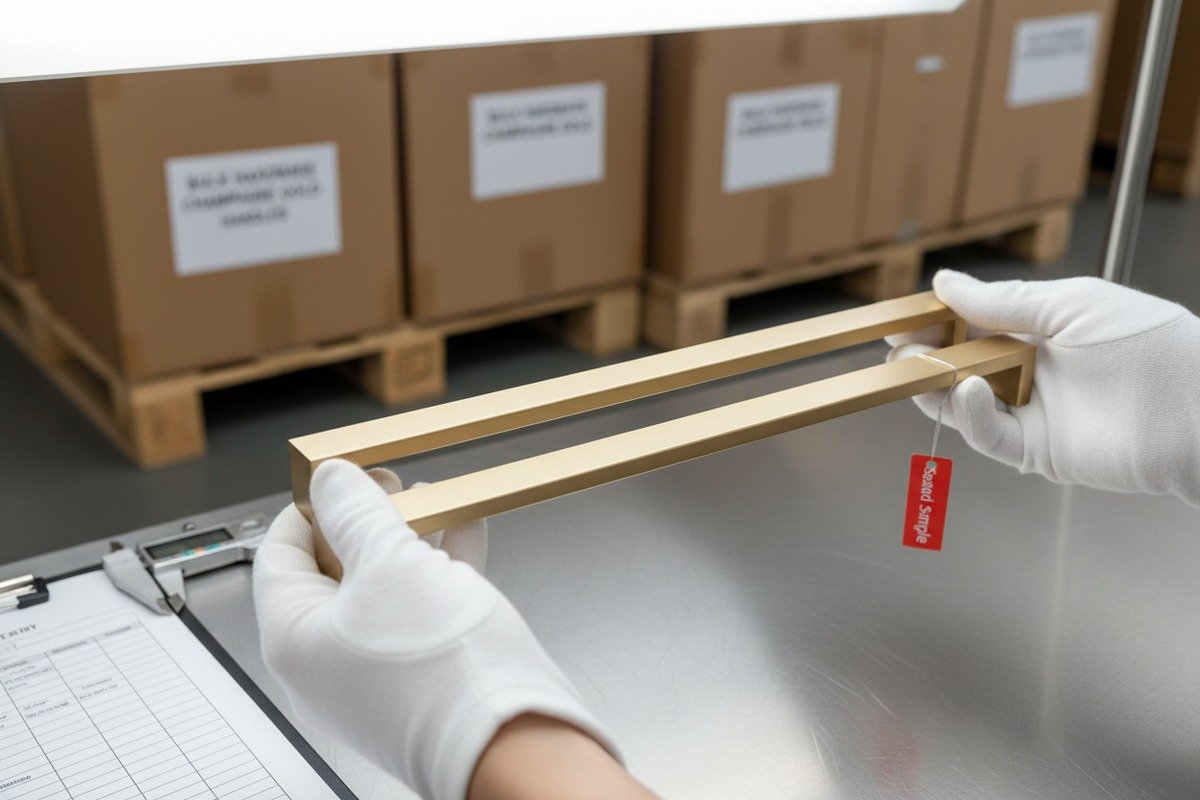
A sealed sample 5 is a physical reference piece agreed upon by both buyer and supplier. Both parties keep one. Every production run is compared against it. When we run a batch of sleek edge-mount cabinet pulls in matte black, our QC team pulls units from the line and holds them next to the sealed sample under standardized lighting. Any deviation triggers a hold.
Here is how to set this up:
- Order 3–5 samples of each SKU you plan to buy.
- Keep one sample at your office. Send one back to the factory marked "SEALED — DO NOT OPEN."
- Reference the sealed sample number in every purchase order.
Define Measurable Standards
"Good quality" means different things to different people. Remove the guesswork. Specify numbers.
| Quality Parameter | What to Specify | Example Standard |
|---|---|---|
| Handle Length | Total length in mm ± tolerance | 128mm ± 0.5mm |
| Hole Center Distance | Center-to-center in mm | 96mm or 128mm |
| Surface Finish | Type + thickness of coating | Anodized, 10–15 microns |
| Color | RAL or Pantone code | RAL 1035 (pearl beige) |
| Weight per Unit | Grams ± tolerance | 85g ± 3g |
| Screw Compatibility | Thread size and length | M4 × 25mm |
When these numbers are in your purchase order, there is no room for "I thought you meant…" conversations. Our engineering team in Foshan actually recommends buyers send a simple one-page spec sheet. It saves everyone time.
Pre-Shipment Inspection
Never skip this step. Hire a third-party inspector 6 — or ask a local contact in China — to visit the factory before the container is sealed. A standard AQL 2.5 inspection 7 covers:
- Visual defects (scratches, uneven coating, burrs)
- Dimensional checks with calipers
- Color comparison against the sealed sample
- Packaging integrity
The cost is typically $200–$350 per inspection. Compare that to the cost of receiving 3,000 defective handles. The math is obvious.
What If Something Goes Wrong?
Establish a return and rework policy before you order. Good suppliers — and we include ourselves here — will offer a replacement or credit for verified defects. Put the defect resolution process in writing. This protects your inventory depth plan because you can reorder replacements quickly instead of scrambling for a new supplier mid-season.
What are the best strategies for managing my inventory of glass door aluminum profiles?
Aluminum profiles for glass doors are a different beast than small cabinet handles. They are longer, heavier, and harder to store. When we load containers with our extruded glass door profiles — those sleek linear pieces designed for minimalist frameless cabinets — every centimeter of warehouse space matters on your end.
The best inventory strategies for glass door aluminum profiles include ABC classification to prioritize high-velocity SKUs, maintaining 1–3 months of supply based on lead times, using reorder point formulas tied to demand data, and negotiating ready-stock arrangements with your supplier to reduce holding costs.

ABC Classification for Profiles
Not all profiles sell equally. Sort your SKUs into three tiers:
- A-SKUs (top 20%): These generate roughly 70% of your revenue. Keep deep stock — 2 to 3 months of supply.
- B-SKUs (next 30%): Moderate sellers. Keep 1 to 2 months of supply.
- C-SKUs (bottom 50%): Slow movers. Keep minimal stock or order on demand.
This approach ties your capital to the products that actually move. A common failure we see among new distributors in Southeast Asia is stocking equal quantities of every profile length and finish. That leads to cash trapped in C-SKUs while A-SKUs run out.
Calculate Your Reorder Point
The reorder point formula 8 is simple:
Reorder Point = (Average Daily Sales × Lead Time in Days) + Safety Stock
For aluminum profiles shipped from China, lead time is typically 4 to 8 weeks (28–56 days). If you sell 5 units per day of a popular 3-meter anodized profile and your lead time is 35 days, your base reorder point is 175 units. Add safety stock 9 of 20% (35 units) for demand spikes. So you reorder when stock hits 210 units.
| Profile Type | Avg. Daily Sales | Lead Time (Days) | Safety Stock (20%) | Reorder Point |
|---|---|---|---|---|
| 3m Anodized Silver | 5 | 35 | 35 | 210 |
| 2.4m Matte Black | 3 | 35 | 21 | 126 |
| 3m Champagne Gold | 2 | 42 | 17 | 101 |
| 1.8m Brushed Bronze | 1 | 42 | 9 | 51 |
Leverage Ready-Stock Suppliers
One of the strongest strategies is working with a supplier that maintains ready stock. Our Foshan warehouse keeps popular profile specifications on hand. This means your effective lead time drops from 6 weeks to as little as 7–10 days for in-stock items. Shorter lead times let you carry less safety stock, freeing up cash for variety expansion.
Storage and Handling Tips
Aluminum profiles are long and can scratch easily. Store them horizontally on padded racks. Keep different finishes separated — a brushed profile rubbing against a polished one will damage both. Label rack positions by SKU. These simple steps reduce damage-related write-offs, which directly protect your inventory depth.
Seasonal Demand Planning
Home renovation peaks in Q4 in many markets — that's a 20% bump in demand. Plan your reorders in Q3 to arrive before the rush. If you wait until October to order, your profiles will arrive in December when the peak is over. We remind our clients every August: place your Q4 orders now.
How can I customize my aluminum glass door profiles without meeting high MOQ requirements?
High MOQs are the wall that stops many small buyers from getting exactly what they need. A furniture factory owner in Vietnam wants a specific champagne gold finish on a 2.7-meter profile — but the factory demands 5,000 pieces minimum. That order could be a full year of sales. The capital risk feels too big. We understand this deeply because our team has spent years designing flexible solutions for exactly this situation.
Customize aluminum glass door profiles at low MOQs by choosing from a supplier's existing extrusion dies and modifying only the surface finish or color, using ready-stock base profiles for custom cutting, and partnering with manufacturers who offer collaborative OEM/ODM development with MOQs as low as 200–500 pieces.
Understand What Drives MOQ
MOQ is not arbitrary. It comes from real production economics:
- Extrusion die cost: A new die costs $300–$1,500. The supplier spreads this cost across units. Fewer units = higher per-piece cost.
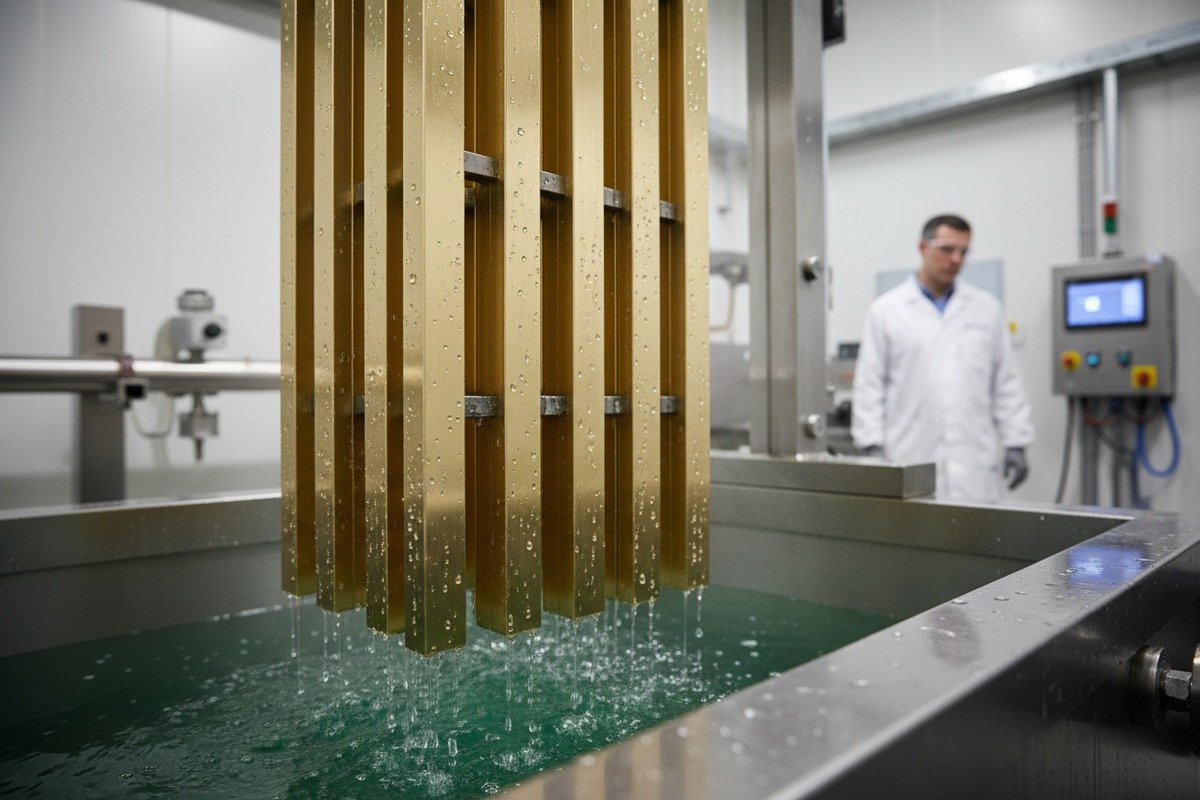
- Anodizing/powder coating setup: Changing the color in a coating line takes time and materials. A minimum batch makes the changeover worthwhile.
- Packaging and labeling: Custom boxes and labels have their own print minimums.
When you understand these cost drivers, you can negotiate smarter. You don't need to accept a blanket "5,000 piece MOQ" answer.
Strategy 1: Modify the Finish, Not the Shape
The most expensive part of customization is the extrusion die. If you pick a profile shape that already exists in the supplier's catalog — say, our popular recessed-channel finger pull profile — you skip the die cost entirely. Then you customize only the surface treatment: a specific RAL color, a brushed texture, or an anodized shade. This approach can bring MOQs down to 200–500 pieces.
Strategy 2: Custom Cutting from Ready Stock
Many suppliers, including our team, keep long-bar stock in standard finishes. We can cut these to your specified lengths — 1.8m, 2.4m, 3m, or any custom measurement — without requiring a large order. The base profile is already made. You just define the cut list. This works especially well for furniture factories that need precise lengths for specific cabinet designs.
Strategy 3: Collaborative OEM/ODM Development
If you truly need a unique profile shape, look for a supplier who offers OEM/ODM collaboration. Here is how it typically works:
- You provide a sketch or CAD drawing of the profile cross-section.
- The supplier engineers the die and quotes the tooling cost separately.
- You own the die (or share ownership) after paying for it.
- First production run MOQ is negotiated — often 500–1,000 pieces, not 5,000.
- Reorders can be as low as 200 pieces since the die already exists.
We have done this dozens of times for designers who want a truly unique edge-mount pull or a frameless glass door channel that nobody else carries. The die becomes your competitive moat.
Compare Your Options
| Customization Level | What Changes | Typical MOQ | Tooling Cost | Lead Time |
|---|---|---|---|---|
| Finish only (existing die) | Color, texture, coating | 200–500 pcs | $0 | 2–3 weeks |
| Custom cut (ready stock) | Length only | 50–100 pcs | $0 | 1–2 weeks |
| New die + custom finish | Shape, color, texture | 500–1,000 pcs | $300–$1,500 | 4–6 weeks |
| Full OEM/ODM (new design) | Everything | 500–2,000 pcs | $500–$2,000 | 6–8 weeks |
Protect Your Design
If you invest in a custom die, make sure your agreement states that the die is exclusive to you. Some suppliers reuse dies for other clients unless you specify otherwise. Get this in writing. Your custom profile is your product differentiation — don't let it become someone else's catalog item.
Start Small, Prove Demand, Then Scale
The smartest novice buyers we work with follow a simple loop. They order 300 pieces of a custom-finished profile. They test it with their top five clients. If it sells, they reorder 1,000. If it doesn't, they've lost very little. This iterative approach to customization mirrors the lean inventory strategy we discussed earlier. It keeps your risk low and your learning fast.
Conclusion
Planning SKU variety and inventory depth does not have to be overwhelming. Start with a small, data-informed selection. Verify your supplier thoroughly. Lock in quality with sealed samples and inspections. Manage stock with ABC tiers and reorder formulas. And customize smartly by leveraging existing dies and ready stock.
Footnotes
1. Explains the importance of verifying legal documentation for manufacturers. ↩︎
2. Explains a key cost factor in aluminum profile customization. ↩︎
3. Provides general guidance on finding reliable business partners. ↩︎
4. Lists major B2B platforms for sourcing products from China. ↩︎
5. Explains the concept of a physical reference for quality control. ↩︎
6. Explains the role and benefits of external quality control. ↩︎
7. Provides details on a common quality inspection standard. ↩︎
8. Provides the mathematical calculation for determining when to reorder inventory. ↩︎
9. Defines safety stock, its importance, and its role in inventory management. ↩︎
10. Explains an inventory management technique for prioritizing stock. ↩︎