Choosing the wrong OEM partner for aluminum cabinet handles can cost you months of delays, rejected shipments, and frustrated customers ISO 9227 1. Over 18 years on our production floor in Foshan, we have seen buyers make the same costly mistakes repeatedly. The good news is that a clear evaluation framework can protect your investment and your brand reputation.
To evaluate OEM capabilities for aluminum furniture cabinet handles, assess five core areas: material quality and alloy certification, customization and design expertise, quality control systems from sample to mass production, production capacity and lead time reliability, and flexible MOQ policies that match your order scale.
In this guide, I will walk you through each of these areas with practical checklists, tables, and real-world insights ANSI/BHMA A156.9 2. Whether you are a building material wholesaler, a furniture factory buyer, or a designer sourcing from China, this article gives you a clear roadmap to find the right manufacturing partner.
How can I verify if an aluminum handle manufacturer can maintain consistent quality from sample to mass production?
One issue that keeps coming up in conversations with our Southeast Asian distributors is the gap between a beautiful sample and a disappointing bulk delivery ASTM B209/B209M 3. We have invested heavily in closing that gap on our own lines, and I can tell you exactly what to look for.
Verify quality consistency by requesting pilot production runs, checking for ISO 9001 certification, demanding documented inspection reports at raw material, in-process, and pre-shipment stages, and comparing sample specifications against random mass-production pulls using precise dimensional and coating thickness measurements.
Why Samples Can Be Misleading
A sample is often made with extra care. A skilled worker may hand-finish the surface. The alloy used might come from a premium batch. But when production scales to 5,000 or 50,000 pieces, different operators, machines, and material lots come into play. This is where inconsistency creeps in.
The key question is not "Can you make a good sample?" Every factory can. The real question is: "What systems do you have to make every piece match that sample?"
The Three-Stage Inspection Framework
A reliable manufacturer inspects at three critical points. Here is what to look for:
| Inspection Stage | What to Check | Red Flag If Missing |
|---|---|---|
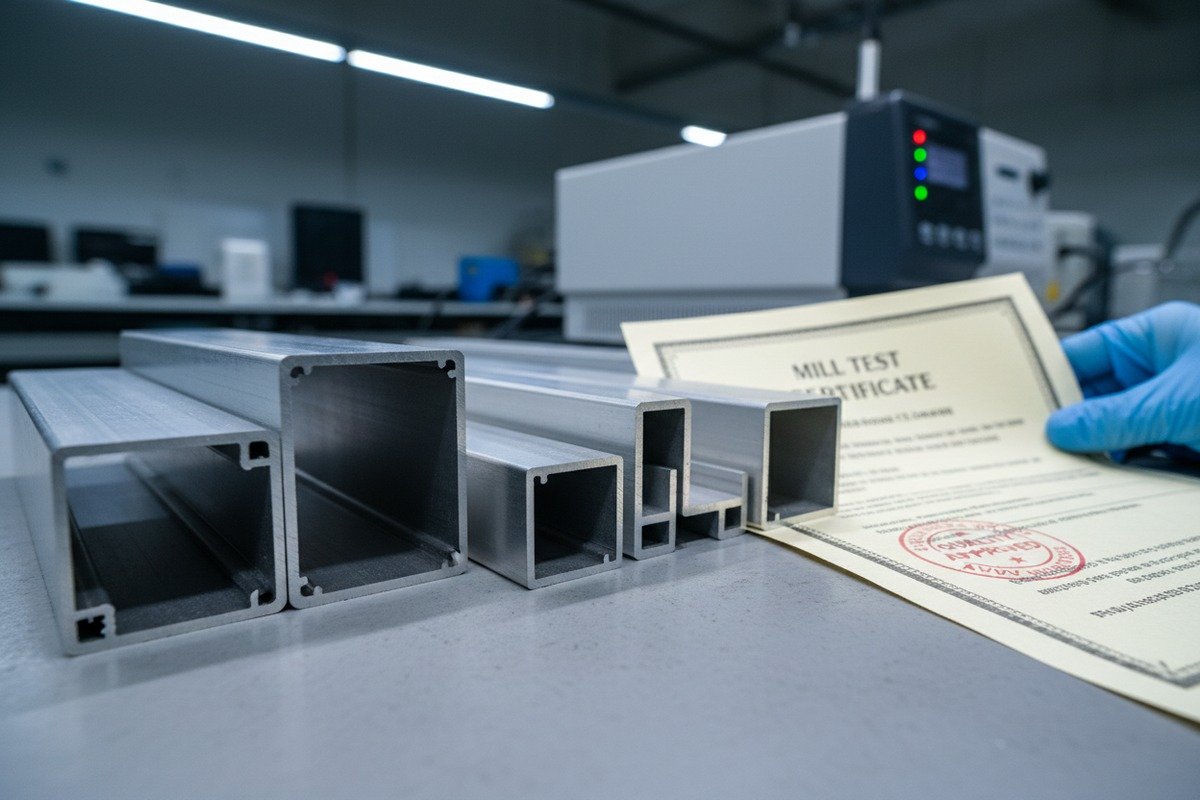
| Raw Material Inspection | Alloy grade certificate (6063-T5 4 or 6061-T6), surface defects, dimensional accuracy of extrusion billets | No mill certificates or unclear alloy sourcing |
| In-Process Inspection | Extrusion tolerances (±0.1mm), anodizing 5 thickness (8–12μm), powder coat thickness (60–100μm), color matching against Pantone or RAL reference | No in-line quality checkpoints documented |
| Pre-Shipment Inspection | Random sampling per AQL standards 6, salt spray test results (ISO 9227), packing integrity, labeling accuracy | Refusal to allow third-party inspection |
Ask the manufacturer to show you their inspection records from recent orders. If they cannot produce them, that is a serious warning sign.
Request a Pilot Production Run
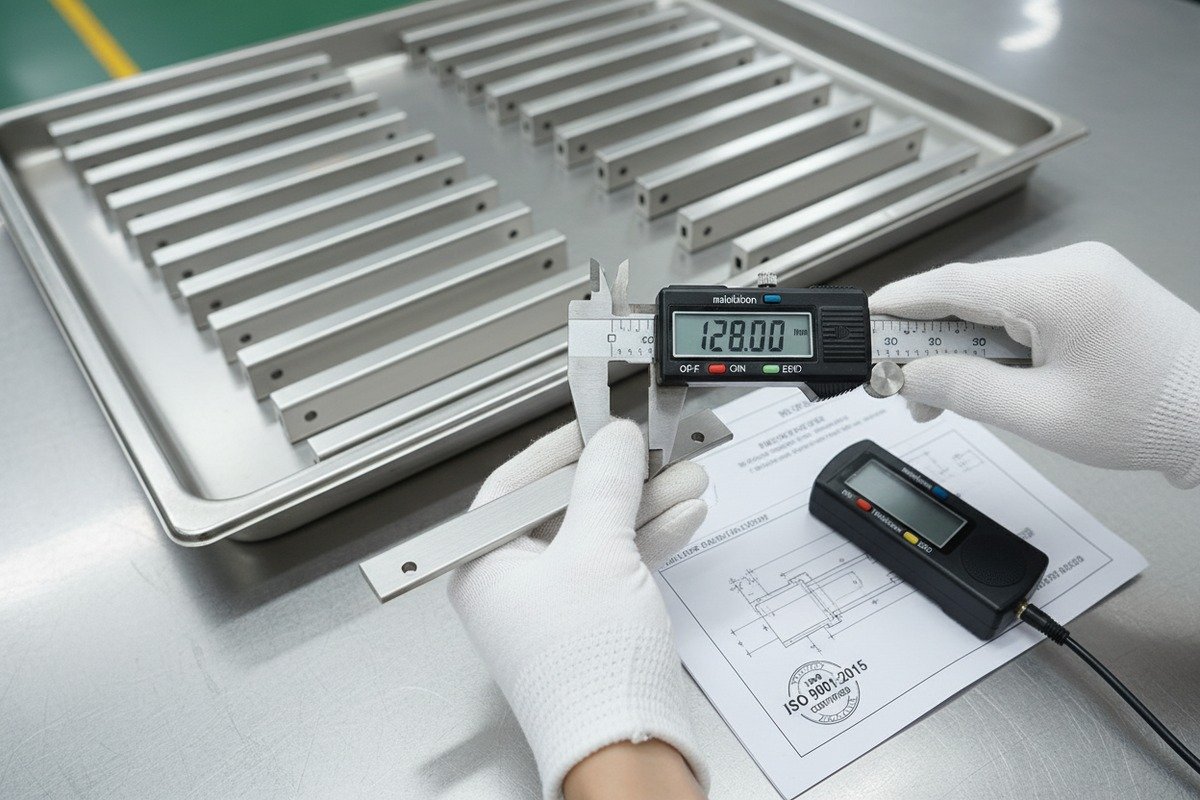
Before committing to a large order, I always recommend placing a small pilot run of 200 to 500 pieces. This is something we encourage on our own production lines because it benefits both sides. The pilot run uses the same machines, the same workers, and the same material lots that the full production will use. Compare the pilot pieces against the original approved sample. Measure the handle length, hole spacing, profile thickness, and coating thickness with calipers and a coating gauge.
Certifications That Actually Matter
Look for ISO 9001:2015 as a baseline. This means the factory has a documented quality management system. ISO 9001 certification 7 Beyond that, check if they comply with ANSI/BHMA A156.9 for cabinet hardware or EN 1906 8 for lever handles. Compliance with ASTM B209/B209M for aluminum sheet and plate indicates they take material standards seriously.
A factory that invests in these certifications is signaling that consistency is part of their culture, not just a one-time effort for a sample.
Traceability Is Non-Negotiable
Modern quality systems should support full traceability. That means every batch of handles can be traced back to the raw aluminum lot, the extrusion date, the surface treatment batch, and the operator who ran the line. When we set up our traceability system, it immediately reduced customer complaints because we could identify and isolate any issue within hours.
What technical expertise should I look for when I need custom OEM designs for my furniture handles?
When our design team sits down with a new client from the Middle East or Southeast Asia, the first thing we do is assess their functional requirements, not just their aesthetic preferences. True technical expertise goes far beyond making a handle look good in a catalog render.
Look for manufacturers with in-house design teams skilled in CAD/CAM software, experience with multiple aluminum alloys (6063-T5 and 6061-T6), capability to produce advanced prototypes via 3D printing or CNC machining, mastery of diverse surface finishes, and the ability to advise on structural optimization using Finite Element Analysis.
Alloy Selection Expertise
Not all aluminum is the same. Your OEM partner should be able to explain the difference between alloy grades and recommend the right one for your specific application. Here is a quick comparison:
| Property | 6063-T5 | 6061-T6 |
|---|---|---|
| Typical Use | Decorative handles, slim profiles | Heavy-duty handles, structural applications |
| Tensile Strength | ~185 MPa | ~310 MPa |
| Surface Finish Quality | Excellent (smooth anodizing) | Good (may show grain) |
| Extrudability | Very high | Moderate |
| Corrosion Resistance | Very good | Good |
| Best For | Kitchen cabinets, wardrobes | Commercial furniture, high-traffic areas |
If a manufacturer cannot articulate why they recommend one alloy over another, they lack the technical depth you need.
Design-to-Production Workflow
A capable OEM partner follows a structured workflow:
- Concept discussion — Understanding your brand style, ergonomic needs, and installation constraints.
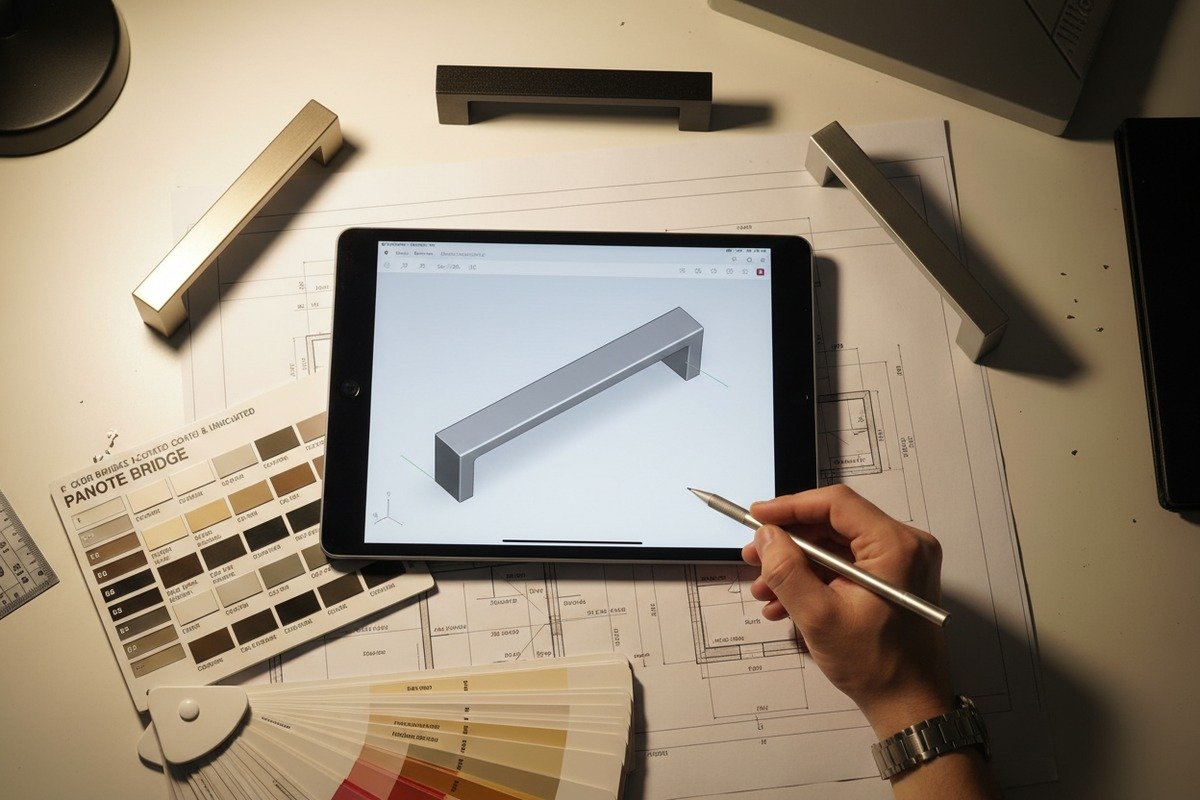
- Technical drawing review — Producing 2D and 3D CAD files with precise dimensions, tolerances, and material callouts.
- Prototype development — Using CNC machining or 3D printing for rapid iteration. This saves weeks compared to cutting extrusion dies prematurely.
- Die design and fabrication — Custom extrusion dies for the final approved profile.
- Surface treatment specification — Selecting from anodizing, powder coating 9, electroplating, brushing, sandblasting, or PVDF coating based on the end environment.
- Sample approval — Producing golden samples for client sign-off before mass production begins.
Surface Treatment Depth
A manufacturer's finish options tell you a lot about their capability. Our facility, for example, offers over eight distinct finishes. Each one serves a different purpose:
- Anodizing (8–12μm) — Best for corrosion resistance and a clean metallic look. Works beautifully for champagne gold and matte black tones.
- Powder coating (60–100μm) — Ideal for custom RAL colors and textured finishes. More durable than paint.
- Electroplating — Multi-layer processes for chrome, nickel, or antique brass effects. Enhances wear resistance.
- Brushed finish — Creates a contemporary linear texture popular in minimalist designs.
- Sandblasting — Produces a uniform matte surface that hides fingerprints.
Ask your potential partner to send you finish samples on the actual alloy they will use. Finishes look different on 6063 versus 6061 due to grain structure differences.
Ergonomic and Structural Optimization
Advanced manufacturers use Finite Element Analysis 10 (FEA) software to simulate stress distribution on a handle design before cutting any tooling. This is especially important for edge-mount pulls and finger pulls with low-profile designs, where the material is thin and the leverage forces are concentrated. FEA can identify weak points and allow the engineer to add material where it is needed without increasing overall weight.
For the sleek, recessed-channel handles and slim edge-mount pulls that are trending in modern furniture, this kind of simulation is not a luxury. It is a necessity. A handle that bends or snaps after a few months of use damages your brand permanently.
How do I assess if a supplier's production capacity can handle my large-scale wholesale orders without delays?
Late deliveries are one of the top three pain points we hear about from new clients switching to our factory. When a furniture factory or distributor misses their delivery window because their handle supplier was late, the downstream consequences are severe — delayed installations, lost contracts, and damaged relationships.
Assess production capacity by verifying the factory's monthly output volume, number of extrusion and CNC lines, workforce size, current order backlog, historical on-time delivery rate, and their ability to provide a detailed production schedule with milestone checkpoints for your specific order.
Key Capacity Metrics to Request
Do not just ask "Can you handle 50,000 pieces?" Every factory will say yes. Instead, ask for specific data:
| Capacity Metric | What to Ask | Why It Matters |
|---|---|---|
| Monthly extrusion output | Tons of aluminum extruded per month | Determines raw throughput |
| Number of CNC machines | How many CNC centers for drilling and machining | Bottleneck for handles requiring precise hole patterns |
| Surface treatment lines | Anodizing tank capacity, powder coating booth count | Finishing is often the slowest stage |
| Workforce size | Total production workers and shifts per day | Single-shift factories have half the capacity of dual-shift ones |
| Current backlog | Orders in queue and expected completion dates | Reveals if your order will compete for resources |
| On-time delivery rate | Percentage of orders shipped on or before deadline (last 12 months) | The single best predictor of future reliability |
Our team of 30 runs a streamlined operation in Foshan, and we maintain a ready-to-ship stock program specifically to buffer against demand spikes. This is something you should ask about — does the supplier keep safety stock for popular profiles?
Production Timeline Breakdown
A typical order for custom aluminum cabinet handles follows this timeline:
- Die fabrication (if new design): 7–15 days
- Extrusion: 3–5 days for standard volumes
- CNC machining: 3–7 days depending on complexity
- Surface treatment: 5–10 days (anodizing is faster; multi-layer electroplating takes longer)
- Quality inspection and packing: 2–3 days
- Total lead time for custom orders: 20–40 days
For repeat orders using existing dies, the timeline drops to 15–25 days. Suppliers who maintain your die in good condition and keep your profile specifications on file can turn orders around much faster.
Scalability and Flexibility
A factory that operates at 95% capacity has no room for your urgent reorder. Look for suppliers operating at 60–75% capacity utilization. They have the headroom to absorb your peak-season orders without pushing your delivery date.
Also ask about their subcontracting policy. Some factories outsource surface treatment or packaging during peak periods. This is not inherently bad, but you need to know about it because it introduces additional quality control variables.
The Ready-Stock Advantage
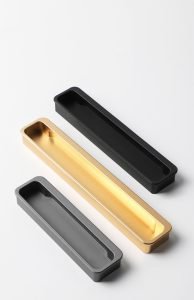
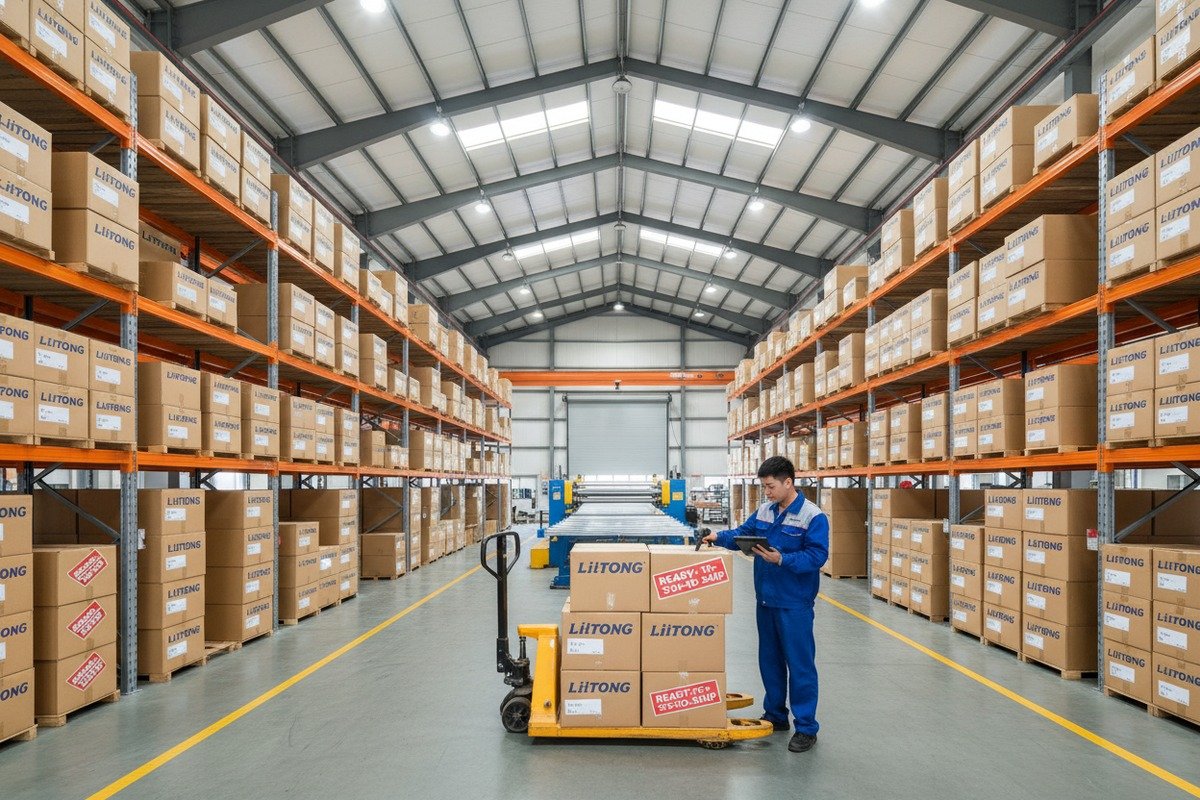
One approach that has worked well for our Southeast Asian distributors is our ready-stock program. We keep the most popular handle profiles — including minimalist edge-mount pulls and elongated rectangular channel handles — in common finishes like champagne gold, matte black, and brushed silver. This means distributors can place smaller replenishment orders that ship within days, not weeks. When evaluating a supplier, ask if they offer anything similar. It dramatically reduces your inventory risk.
Can I find a reliable China-based partner that offers flexible MOQs for my specific cabinet handle requirements?
High MOQs are a deal-breaker for many of the furniture factory owners and mid-size distributors we work with. When a factory demands 10,000 pieces per SKU, it locks up your cash in inventory and limits your ability to test new designs in your market. This is a problem we solved early on because our core customers in Southeast Asia and the Middle East need variety, not just volume.
Yes, reliable China-based partners with flexible MOQs exist. Look for manufacturers who maintain ready-stock inventories of popular profiles, offer lower MOQs for standard finishes, and provide tiered pricing that rewards volume without punishing smaller test orders — typically starting from 200 to 500 pieces per SKU.
Why MOQs Vary So Much
MOQs are driven by production economics. Every custom handle requires an extrusion die, which costs money to make and set up. Surface treatment lines need minimum batch sizes to run efficiently. Packaging customization adds another layer. Understanding these cost drivers helps you negotiate better.
Here is a general MOQ framework:
- Fully custom design (new die + custom finish): MOQ 1,000–3,000 pieces. The die cost is amortized across the order.
- Existing profile with custom finish: MOQ 500–1,000 pieces. No new die needed, but the finishing line needs a minimum run.
- Standard profile with standard finish (from stock): MOQ 200–500 pieces. Essentially a pick-and-pack operation.
How to Negotiate Flexible Terms
My personal advice, drawn from years of working with first-time importers, is to start with a small pilot order. Place 200 to 500 pieces across two or three SKUs. This lets you test the product quality, the supplier's communication, the packaging, and the shipping reliability — all with minimal financial exposure.
Once you are confident, scale up. A good supplier will offer tiered pricing that rewards loyalty. For example:
- 200–499 pieces: Base price
- 500–999 pieces: 5–8% discount
- 1,000–4,999 pieces: 10–15% discount
- 5,000+ pieces: Custom quote with best pricing
Evaluating the Partner Beyond Price
Price and MOQ matter, but reliability matters more. A partner who ships on time, communicates proactively about any issues, and maintains consistent quality is worth a small premium. Here are the qualities I recommend checking:
- Communication responsiveness: Do they reply within 24 hours on WhatsApp or email? During our working hours, our team aims to respond within a few hours.
- Technical support: Can they advise you on which alloy and finish work best for your specific climate and use case?
- Export experience: Have they shipped to your region before? Familiarity with your country's import regulations and labeling requirements saves time.
- Sample policy: Do they offer free or low-cost samples for evaluation? A manufacturer confident in their product will invest in samples.
- On-site guidance: With 18 years of on-site technical guidance experience, we have learned that hands-on support during the first order builds trust that lasts for years.
Sustainability and Ethical Sourcing
Increasingly, our clients ask about sustainability. Aluminum is inherently recyclable — it can be remelted and reused without losing its properties. But sustainability goes beyond the material. Ask your potential partner about:
- Energy-efficient extrusion processes
- Waste reduction in surface treatment (closed-loop water systems for anodizing)
- Ethical labor practices and factory audit reports
- Compliance with REACH or RoHS if you sell into markets that require them
A factory that invests in sustainability is typically a factory that thinks long-term — and that is exactly the kind of partner you want.
The Foshan Advantage
Foshan, where our factory is based, is the aluminum capital of China. The concentration of aluminum suppliers, surface treatment specialists, tooling shops, and logistics providers in this region creates a competitive ecosystem that benefits buyers. Lead times are shorter because the entire supply chain is within a 30-kilometer radius. Quality is higher because factories compete fiercely for business. And pricing is more transparent because buyers can easily compare options.
If you are sourcing aluminum cabinet handles from China, Foshan should be on your shortlist of manufacturing hubs to evaluate.
Conclusion
Evaluating an OEM partner for aluminum furniture cabinet handles comes down to five things: quality systems, technical expertise, production capacity, flexible MOQs, and honest communication. Start small, verify everything, and scale with confidence.
Footnotes
1. Details the ISO 9227 standard for salt spray and corrosion resistance testing. ↩︎
2. Overview of the ANSI/BHMA A156.9 standard for cabinet hardware requirements. ↩︎
3. Provides information on the ASTM B209/B209M standard for aluminum sheet and plate. ↩︎
4. Details the mechanical and thermal properties of 6063-T5 aluminum alloy. ↩︎
5. Replaced with a Wikipedia page offering a general and authoritative explanation of anodizing. ↩︎
6. Replaced with a Wikipedia page providing a comprehensive overview of AQL standards. ↩︎
7. Official ISO page explaining the ISO 9001 quality management system standard. ↩︎
8. Describes the European standard EN 1906 for lever handles and knob furniture. ↩︎
9. Describes the powder coating process, including surface preparation and curing. ↩︎
10. Explains Finite Element Analysis (FEA) as a method for predicting product behavior. ↩︎