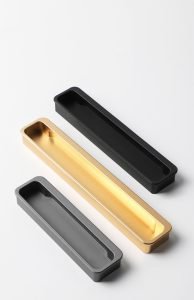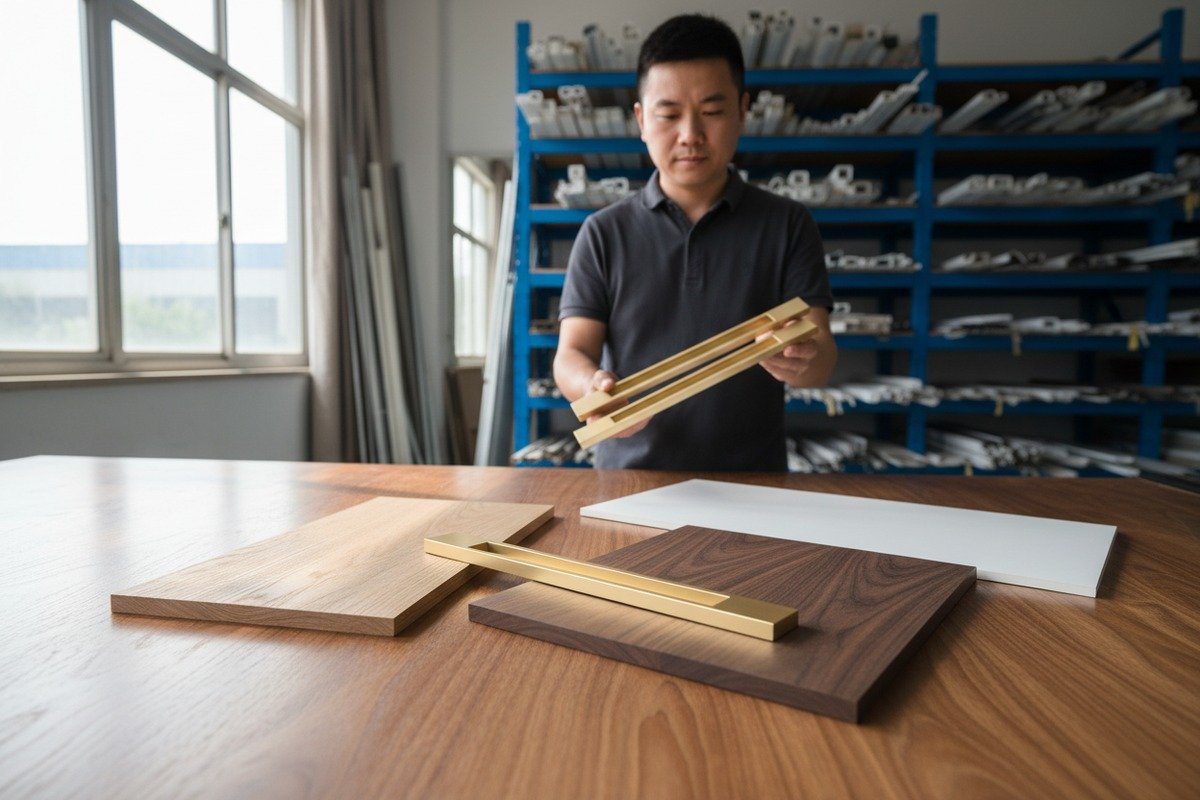
Choosing the wrong handle for a cabinet door is a mistake that shows up instantly on the finished product aluminum handle styles 1. A mismatched finish screams “afterthought,” and flimsy hardware undermines even the best woodwork. Over 18 years on our production floor in Foshan, we have seen furniture factories lose repeat orders simply because their handle selection did not align with the cabinet materials they used.
To match aluminum handle styles with cabinet door materials, furniture factories should pair specific aluminum finishes—brushed, anodized, matte, or polished—with corresponding wood grains, laminates, or glass panels, while selecting the correct alloy grade and handle profile to ensure both visual harmony and long-term durability.
This guide walks you through finish selection, customization options, coating durability, and supplier sourcing so you can confidently specify handles that elevate every cabinet you build.
Which aluminum handle finishes will best complement the specific wood grains and glass panels I use in my furniture factory?
When our design team works with factory clients in Southeast Asia, one question comes up more than any other: "Which finish won't clash with my cabinet doors?" The pain is real—a champagne gold handle that looks stunning on a sample board can fall flat against the wrong oak veneer Electrophoretic (e-coat) finishes 2.
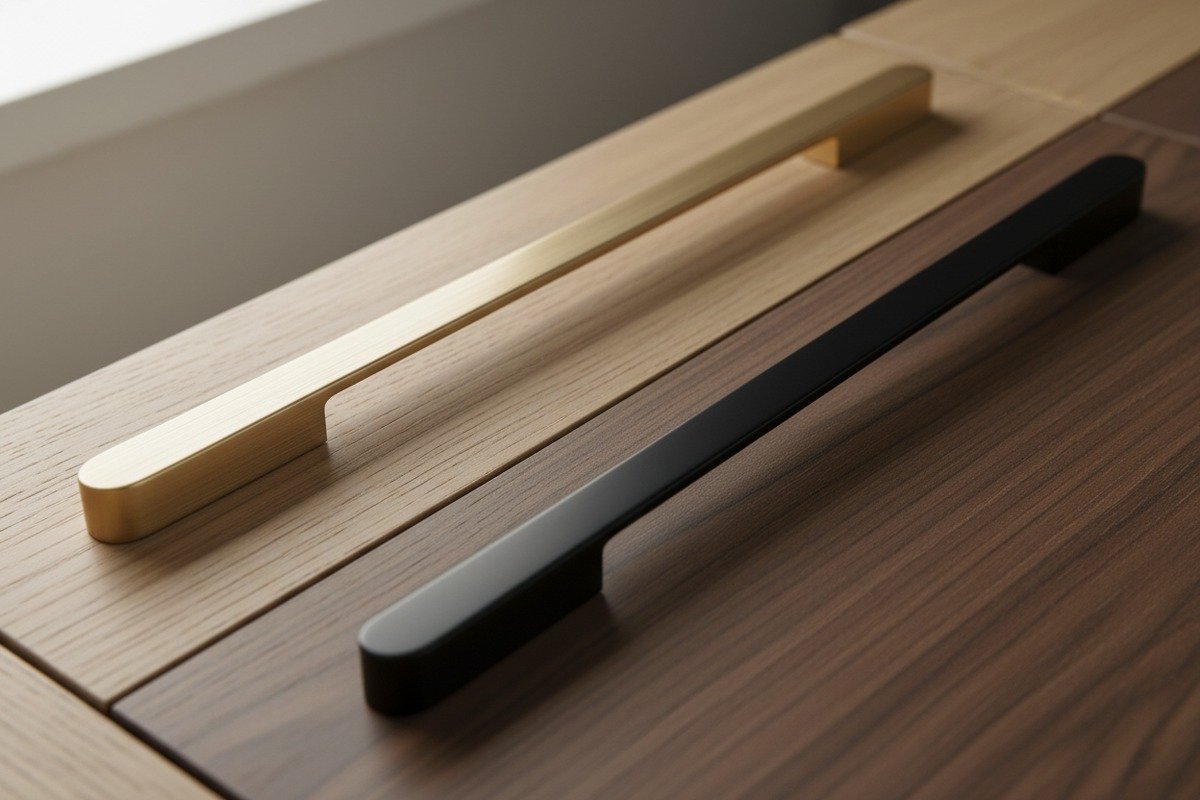
Brushed aluminum finishes pair best with light wood grains and matte laminates, while polished or anodized finishes complement glass panels and high-gloss surfaces. Champagne gold and matte black work across most wood species, making them the most versatile choices for mixed-material production lines.
Understanding How Finish Interacts With Material
The surface texture of an aluminum handle creates a visual dialogue with the cabinet door it sits on. A brushed finish has fine, directional lines that echo the natural grain patterns in wood. This is why brushed aluminum is the go-to pairing for oak, walnut, and ash veneers. The subtle texture prevents the handle from looking too "techy" against an organic material.
Polished aluminum, on the other hand, has a mirror-like surface. It works well with glass panels and glossy lacquered doors because both materials reflect light in similar ways. Placing a polished handle on a matte wood surface often creates a jarring contrast that cheapens the look.
Anodized finishes 3 deserve special attention. Anodizing adds a thin oxide layer that can be dyed in various colors—champagne gold, bronze, and black are the most popular in our catalog. These finishes provide excellent scratch resistance while offering color consistency across large batches, which is critical for factory-scale production.
Finish-to-Material Pairing Matrix
| Cabinet Door Material | Best Aluminum Finish | Why It Works |
|---|---|---|
| Light oak / birch veneer | Brushed silver or champagne gold | Subtle texture mirrors wood grain; warm tones blend naturally |
| Dark walnut / espresso | Matte black or anodized bronze | High contrast creates a premium, defined look |
| White lacquered / painted MDF | Polished chrome or brushed silver | Clean, modern aesthetic; reflective surfaces complement each other |
| Clear or frosted glass panels | Polished aluminum or anodized black | Mirror finish echoes glass clarity; black frames the panel |
| Laminate / melamine (solid color) | Anodized champagne gold or matte silver | Neutral metallic tones avoid clashing with solid backgrounds |
| Natural bamboo / rattan | Brushed gold or matte bronze | Warm metal tones harmonize with natural fibers |
Edge Pulls and Recessed Profiles for Glass Doors
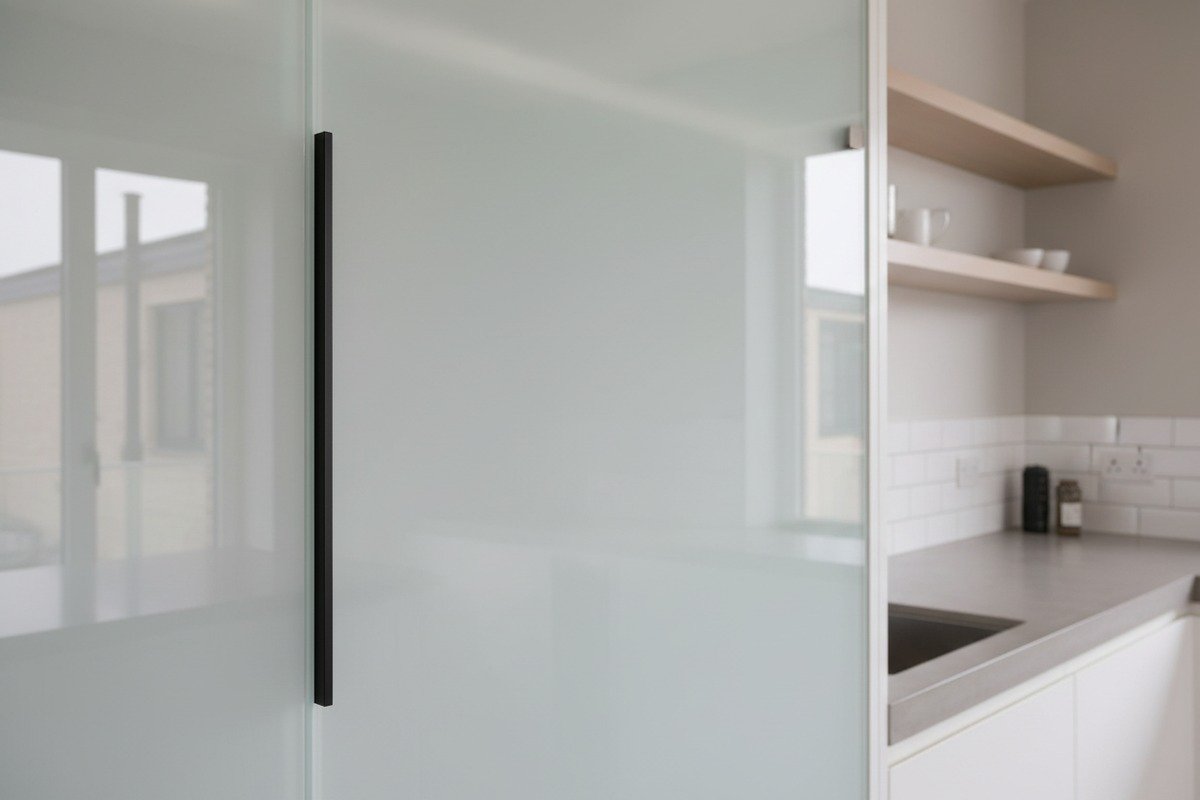
Glass panel cabinet doors require special consideration. Bulky handles can overwhelm a transparent surface and block the view of items inside. We often recommend our low-profile edge-mount pulls or Gola-style finger pulls for glass applications. These minimalist profiles sit flush against the door edge, preserving the clean sightlines that glass doors are designed to offer.
For frosted glass, anodized black handles create an elegant frame effect. For clear glass, brushed silver or polished aluminum keeps the look airy and light. The key is to let the glass remain the visual focus while the handle serves as a quiet, functional accent.
A Word on Mixed-Material Cabinets
Many furniture factories produce kitchen sets that combine wood, glass, and composite materials in a single run. In these cases, we recommend choosing one versatile finish—champagne gold or matte silver—and using it across all handle types. This creates a cohesive design language even when the door materials vary from cabinet to cabinet.
How can I customize aluminum profile handles to match the unique dimensions and styles of my cabinet doors?
Standard catalog handles do not always fit. When our factory receives specifications from a furniture buyer in Vietnam or the Philippines, the door thickness, mounting hole spacing, or profile height often falls outside of what stock products can cover. That mismatch delays production and frustrates everyone involved.
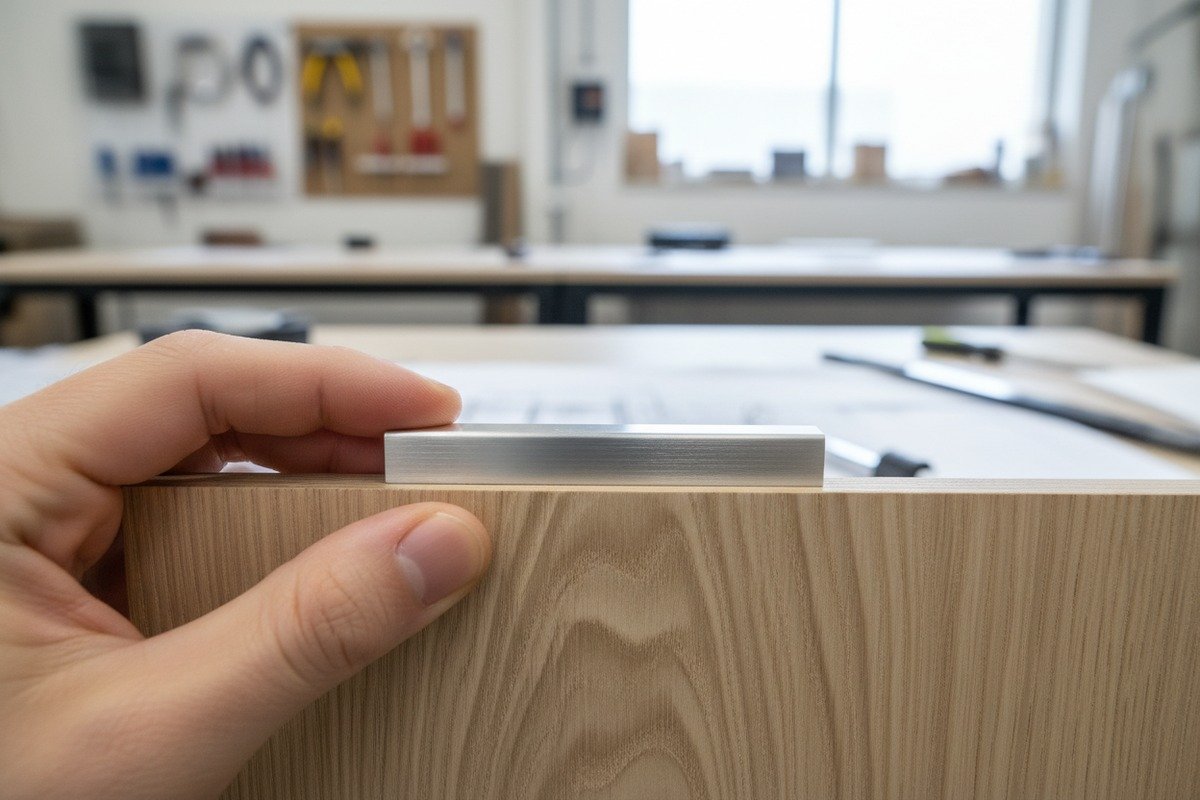
Furniture factories can customize aluminum profile handles through OEM/ODM services that adjust length, cross-section shape, finish color, and mounting dimensions. CNC machining and custom extrusion dies allow manufacturers to produce handles tailored to exact cabinet door specifications, even for non-standard thicknesses and unconventional designs.
What Can Be Customized?
Almost every dimension and aesthetic detail of an aluminum profile handle can be adjusted. Here is a breakdown of the most common customization parameters our team works with:
| Customization Parameter | Standard Range | Custom OEM Range |
|---|---|---|
| Handle length | 96mm, 128mm, 160mm, 320mm | Any length from 64mm to 1200mm+ |
| Profile height | 20mm – 40mm | 12mm – 60mm or custom |
| Cross-section shape | Rectangular, C-channel, L-profile | Fully custom via new extrusion die |
| Surface finish | Brushed silver, anodized black | Any RAL color, wood grain transfer, two-tone |
| Mounting hole spacing | 96mm, 128mm, 160mm | Custom to match existing door jig patterns |
| Door thickness compatibility | 16mm – 20mm | 10mm – 30mm with adapted clip or screw design |
The Custom Extrusion Process
Aluminum handles are typically made using an extrusion process 6. A heated aluminum billet is pushed through a steel die that shapes the cross-section. When a furniture factory needs a unique profile—say, a wider finger pull or a handle with an integrated LED channel—we design a new die.
Die creation takes about 7 to 15 days depending on complexity. Once the die is ready, the new profile can be extruded in any length and finished to specification. The initial die cost is a one-time investment, usually between $200 and $500 USD. For factories running large orders, this cost is negligible per unit.
CNC Machining for Precision Details
Beyond basic extrusion, CNC machining 7 adds precision features like chamfered edges, logo engravings, threaded mounting holes, and decorative grooves. Our CNC team regularly produces handles with client logos recessed into the surface—a subtle branding touch that distinguishes one furniture line from another.
CNC machining also allows us to cut handles to exact lengths with clean, burr-free ends. This is important for edge-mount pulls and Gola profiles where the handle length must perfectly match the cabinet door width. Even a 1mm discrepancy is visible on a finished kitchen cabinet.
Working With Your Design Team
The best custom results happen when the furniture factory's design team sends us a drawing or 3D file early in the product development cycle. We can provide DFM (Design for Manufacturability) feedback within 48 hours, flagging any dimensions that might cause production issues. Samples typically ship within 10 to 15 days after design approval.
For factories that do not have in-house design resources, our team can propose handle profiles based on a photo or sketch of the cabinet door. We have done this hundreds of times—translating a rough concept into a production-ready aluminum profile.
What are the most durable aluminum handle coatings that will maintain their look on my high-end cabinet materials?
Nothing frustrates a furniture factory owner more than a customer complaint about peeling or fading handles six months after delivery. We have tested dozens of coating methods over the years, and the difference between a cheap finish and a premium one is dramatic—especially under real-world kitchen and bathroom conditions.
Anodized coatings and PVDF powder coatings are the most durable options for aluminum handles, resisting scratches, UV fading, and chemical exposure for 10 to 20 years. Electrophoretic (e-coat) finishes offer strong corrosion protection for humid environments, while standard spray paint should be avoided on high-end furniture.
Coating Types Ranked by Durability
Not all coatings are created equal. Here is how the main options compare for furniture handle applications:
| Coating Type | Scratch Resistance | UV Resistance | Corrosion Resistance | Lifespan | Best For |
|---|---|---|---|---|---|
| Anodizing (Type II or III) | Excellent | Excellent | Excellent | 15–20+ years | High-end kitchens, outdoor furniture |
| PVDF powder coating | Excellent | Excellent | Very good | 15–20 years | Exterior-facing cabinets, coastal areas |
| Standard powder coating | Good | Good | Good | 8–12 years | General indoor furniture |
| Electrophoretic (e-coat) | Good | Moderate | Excellent | 10–15 years | Bathroom vanities, humid environments |
| Spray paint | Poor | Poor | Poor | 2–5 years | Budget/temporary applications only |
| Chrome plating | Moderate | Moderate | Moderate | 5–8 years | Decorative indoor use |
Why Anodizing Leads the Pack
Anodizing is not a coating applied on top of the aluminum. It is an electrochemical process that converts the surface aluminum into aluminum oxide 8—a material harder than steel. This oxide layer is integral to the metal itself, so it cannot peel, chip, or flake.
Type III hard anodizing creates a layer 25 to 75 microns thick. This finish withstands daily use in commercial kitchens where handles are grabbed with wet, greasy, or chemically treated hands. The color is embedded within the oxide layer during the process, so it resists UV fading even in sunlight-exposed installations.
On our production line, we run Type II anodizing as the standard for mid-to-high-end handles and offer Type III as an upgrade for clients who specify extra durability. The cost difference is about 15–20% per handle, but the lifespan improvement is significant.
Powder Coating vs. Spray Paint
Powder coating uses electrostatically charged dry powder that is baked onto the aluminum surface at around 200°C. The result is a thick, uniform film that resists chipping and scratching far better than liquid spray paint. PVDF (polyvinylidene fluoride) powder coatings add exceptional UV and chemical resistance, making them the top choice for handles exposed to cleaning agents or sunlight.
Standard spray paint, by contrast, sits loosely on the surface. It scratches easily, yellows under UV exposure, and can peel in humid conditions. We strongly advise our factory clients against spray-painted handles for any product positioned above the budget tier.
Matching Coating Performance to End-Use Environment
The coating you choose should match where the cabinet will live. Indoor living room furniture can use standard powder coating without issues. Kitchen and bathroom cabinets need anodized or e-coat finishes to handle moisture and cleaning chemicals. Outdoor or coastal installations demand anodized or PVDF coatings as a minimum specification.
When we work with factories producing for the Middle East market, we always recommend anodized finishes. The combination of high temperatures, humidity, and frequent cleaning in that region puts coatings under extreme stress. Anodizing consistently outperforms other options in these conditions.
How do I find a supplier that offers both ready-to-ship stock and custom OEM handles for my furniture production needs?
Lead time kills deals. We hear this from furniture factory owners constantly—they find a supplier with a great custom catalog but no stock, or a warehouse full of generic handles but zero customization capability. Either way, the factory's production schedule suffers.
The ideal aluminum handle supplier maintains a large ready-to-ship stock of popular styles and finishes while also offering full OEM/ODM customization with flexible minimum order quantities. Look for suppliers with in-house extrusion, finishing, and CNC capabilities, proven export experience, and transparent communication channels like WhatsApp for fast response times.

What to Look For in a Supplier
Finding the right supplier is about more than price. Here are the critical factors furniture factories should evaluate:
In-House Manufacturing: A supplier that extrudes, finishes, and machines handles under one roof can control quality and timelines far better than a trading company sourcing from multiple subcontractors. Ask for a factory tour or video walkthrough before committing to a large order.
Stock Availability: Ready-to-ship stock is essential for factories that receive rush orders or need to replenish fast-moving handle styles. A good supplier maintains inventory of their top 20 to 50 SKUs in standard lengths and finishes. At our Foshan facility, we keep our bestselling brushed silver, champagne gold, and matte black profiles in stock year-round.
Custom Capability: The supplier should be able to produce new extrusion dies, offer CNC machining, and provide multiple finishing options. Ask how long a new die takes, what the die cost is, and what the minimum order quantity is for custom runs.
Red Flags to Watch For
Not every supplier is what they claim. Here are warning signs:
- No factory photos or videos. Legitimate manufacturers are proud to show their production lines. A trading company may refuse or provide generic images.
- Samples that differ from bulk production. This is a common pain point. Always request a pre-production sample from the actual production run, not a hand-finished showroom piece.
- Rigid MOQs with no negotiation. While minimum orders are normal, a supplier unwilling to discuss flexible quantities for a first order may not be invested in building a long-term relationship.
- Slow communication. If it takes 3 days to get a quote reply, imagine what happens when a quality issue arises mid-shipment. Fast, responsive communication—especially via WhatsApp or WeChat—is a strong indicator of supplier reliability.
Questions to Ask Before Placing Your First Order
Ask these questions directly to evaluate whether a supplier fits your factory's needs:
- Do you extrude and finish handles in-house, or do you outsource any steps?
- What alloy grades 10 do you use for your standard handles (6063-T5, 6061-T6)?
- Can you provide a salt spray test report or coating adhesion test results?
- What is your lead time for stock items versus custom orders?
- What is your MOQ for custom profiles, and what is the die cost?
- Can you ship samples within 3 to 5 days?
- Do you have export experience to my region, and can you share references?
Building a Long-Term Partnership
The best supplier relationships go beyond transactions. A supplier who understands your product line, your end market, and your quality standards becomes an extension of your design and procurement team. We invest heavily in this kind of partnership—providing on-site technical guidance, helping clients troubleshoot mounting issues, and proactively suggesting new handle profiles that align with emerging furniture trends.
When you find a supplier who stocks what you need today and can engineer what you need tomorrow, you have found a partner worth keeping. That combination of immediate availability and custom development capability is rare, and it is exactly what keeps furniture production lines running without interruption.
Conclusion
Matching aluminum handles to cabinet door materials is a decision that affects both the look and the lifespan of your furniture. Choose the right finish, alloy, coating, and supplier—and your cabinets will speak for themselves.
Footnotes
1. Provides a comparison of various aluminum finishes suitable for kitchen handles. ↩︎
2. Replaced HTTP unknown with a clear explanation of electrophoretic (e-coat) finishes. ↩︎
3. Replaced HTTP 404 with an authoritative source from the Aluminum Anodizers Council explaining anodizing. ↩︎
4. Replaced HTTP 403 with an authoritative Wikipedia entry on brushed metal, including aluminum. ↩︎
5. Lists and describes common materials used for kitchen cabinet doors. ↩︎
6. Describes the aluminum extrusion process from a major industry player. ↩︎
7. Comprehensive guide explaining what CNC machining is and how it works. ↩︎
8. Provides a foundational definition and properties of aluminum oxide. ↩︎
9. Highlights the high-performance durability and properties of PVDF architectural coatings. ↩︎
10. Replaced HTTP 404 with an authoritative Wikipedia entry on aluminum alloy grades and classifications. ↩︎