Every year, we see buyers lose thousands of dollars because their aluminum handles arrive scratched, dented, or corroded. The handles themselves pass inspection perfectly at our Foshan facility. But poor packaging turns a flawless product into a costly claim. This problem is growing as more wholesalers source hardware from overseas.
To evaluate supplier packaging for aluminum cabinet handles, buyers should inspect individual wrapping, cushioning materials, carton strength, moisture protection, labeling accuracy, and stacking resistance. Requesting transit test certifications like ISTA 3A and reviewing documented packaging procedures ensures consistent protection against scratches, dents, and corrosion during shipping.
Below, we break down the most critical questions buyers ask us about protecting their handle shipments, ensuring design accuracy, finding reliable stock partners, and verifying aluminum quality before committing to large orders.
How can I protect my aluminum handle shipment from damage during long-distance sea freight?
Sea freight 1 is the most common and most punishing way to ship aluminum handles. Over 18 years of exporting from our facility, we have seen how a single overlooked packaging detail can ruin an entire container load.
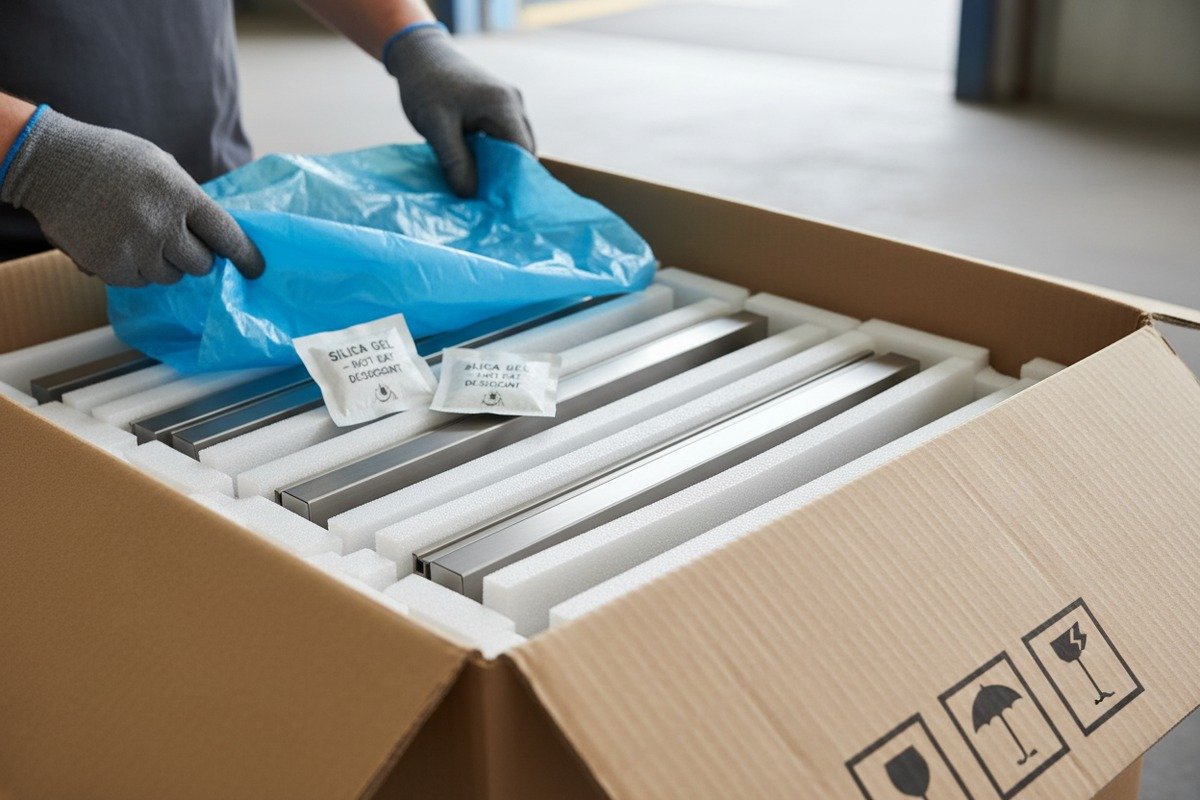
To protect aluminum handles during sea freight, use individual foam or film wrapping, double-walled cartons, VCI anti-corrosion paper, desiccants for humidity control, and proper stacking reinforcement. Clear "Fragile" labeling and documented drop-test results from your supplier further reduce damage risk significantly.
Why Sea Freight Is Especially Harsh on Aluminum Handles
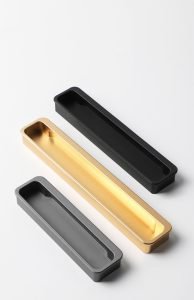
Sea containers experience temperature swings, high humidity, vibration, and rough handling at ports. Aluminum handles have smooth, matte-finished surfaces — the kind you see on our champagne gold or brushed silver edge-pull designs. Even minor contact between two handles can leave visible scratches. Moisture inside a sealed container condenses on metal surfaces and triggers oxidation. This is not a theoretical risk. It happens on nearly every route through Southeast Asia and the Middle East during monsoon season.
Individual Wrapping: The First Line of Defense
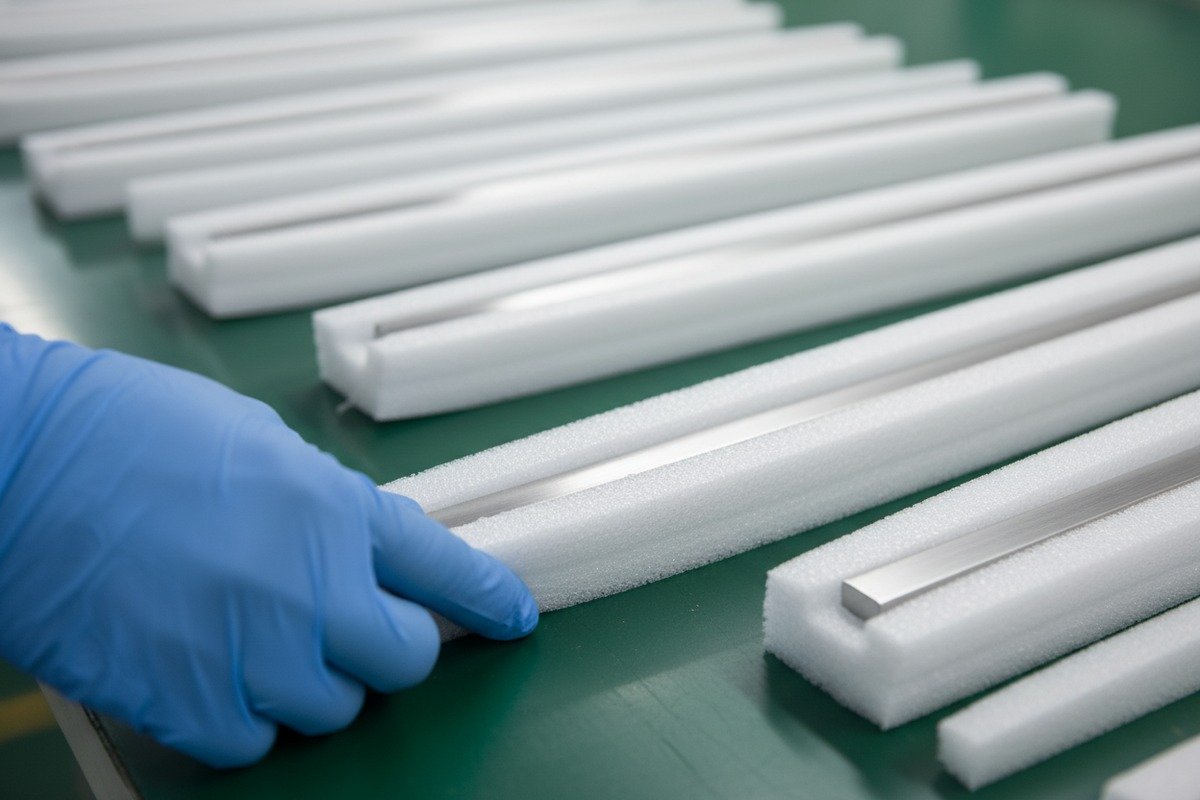
Each handle must be separated from its neighbors. We use PE foam sleeves 2 or protective film for every piece that leaves our production line. This prevents surface-to-surface contact. Bubble wrap works too, but foam is better for long voyages because it does not lose cushioning over weeks at sea.
Carton Selection and Internal Cushioning
The outer carton matters more than most buyers realize. Single-walled cardboard fails under container stacking pressure. Double-walled corrugated board 3 is the minimum standard. Inside, fill all empty space with foam rolls, air pillows, or die-cut foam inserts that cradle each handle in place.
| Packaging Element | Minimum Standard | Recommended for Sea Freight |
|---|---|---|
| Outer carton | Single-walled corrugated | Double-walled corrugated |
| Individual wrapping | Plastic bag | PE foam sleeve + protective film |
| Void fill | Packing peanuts | Custom die-cut foam inserts |
| Moisture protection | None | VCI paper + 2 desiccant packs per carton |
| Labeling | Product name only | PO#, item detail, "Fragile," carton number |
| Stacking test | No test | ISTA 3A 4 certified |
Humidity and Corrosion Control
VCI (Vapor Corrosion Inhibitor) paper 5 or film releases molecules that form a protective layer on the metal surface. Place one sheet inside each carton. Add silica gel desiccant packs 6 — at least two per box — to absorb moisture. This combination has cut our corrosion-related complaints by over 90%.
Labeling and Handling Instructions
Every carton should display the purchaser name, PO number, item description, carton dimensions and weight, set numbering (e.g., "Carton 5 of 20"), origin and destination countries, and handling icons like "Fragile" and "This Side Up." Clear labeling ensures warehouse workers, freight handlers, and customs agents treat your goods correctly.
Stacking and Compression Testing
Ask your supplier if their packaging has passed ISTA 3A or equivalent drop and vibration tests. At our facility, we simulate real shipping conditions — drops from 76 cm, vibration tables, and compression tests — before approving any new packaging design. This step alone can prevent the most common transit failures.
What should I ask a supplier to ensure my custom furniture handle designs are produced accurately?
Getting custom handles right the first time saves weeks of back-and-forth. When our OEM clients send us a new edge-pull or finger-pull design, we follow a structured confirmation process that eliminates guesswork.
Ask your supplier for detailed technical drawings with tolerances, a DFM (Design for Manufacturability) review, physical samples before mass production, surface finish swatches, and a signed specification sheet. Confirm material grade, anodizing thickness, hole spacing, and packaging specs in writing to prevent discrepancies between samples and final products.

Start With a Complete Technical Drawing
A sketch or photo is not enough. You need a dimensioned CAD drawing that specifies length, width, depth, radius of curves, hole center-to-center distance, screw size, and tolerances (usually ±0.1 mm for extruded aluminum profiles). technical drawings 7 If you do not have CAD capability, a good supplier will draft one for you based on your sketch and confirm it before tooling.
Request a DFM Review
DFM stands for Design for Manufacturability. It means the supplier's engineers review your design and flag anything that is difficult, expensive, or impossible to produce. DFM (Design for Manufacturability) review 8 For example, a very thin wall section in an aluminum extrusion might warp during anodizing. Our engineering team catches these issues early and suggests alternatives that keep the design intent while ensuring production consistency.
Surface Finish Confirmation
Aluminum handles come in many finishes — brushed, sandblasted, anodized, electrophoretic, powder-coated. Color matching is tricky. Champagne gold, for instance, shifts depending on the anodizing bath chemistry and time. Always request a physical color swatch or sample piece. Compare it under natural daylight, not fluorescent light. Approve it in writing.
The Sample Approval Process
Never skip the pre-production sample. We send our clients a first-article sample — usually 2 to 5 pieces — for physical inspection. Check dimensions with calipers. Test the fit on your cabinet or drawer. Confirm the finish and color. Only after written approval do we begin mass production.
| Verification Step | What to Check | Who Is Responsible |
|---|---|---|
| Technical drawing | All dimensions, tolerances, screw specs | Buyer provides or approves supplier draft |
| DFM review | Manufacturability, cost impact, material limits | Supplier engineering team |
| Material certificate | Alloy grade (e.g., 6063-T5), composition | Supplier provides mill certificate |
| Surface finish swatch | Color, texture, gloss level | Supplier sends; buyer approves |
| Pre-production sample | Fit, finish, dimensions, function | Supplier produces; buyer inspects |
| Signed spec sheet | All agreed specs in one document | Both parties sign before production |
What Happens When You Skip These Steps
We once had a client who approved a handle design over WhatsApp photos alone. The final batch arrived with hole spacing 2 mm off because the photo did not show the exact center-to-center dimension. The handles did not fit the client's cabinet doors. That single shortcut cost them a full re-order and six weeks of delay. Written specifications prevent this.
Packaging for Custom Orders
Custom designs often have unique shapes that standard packaging does not accommodate. Ask your supplier to design custom internal fitments — molded pulp trays, die-cut foam, or thermoformed plastic inserts — that match the exact profile of your handle. This prevents movement and contact damage during transit.
How do I find a reliable Chinese partner who offers ready-to-ship stock for my wholesale business?
Wholesalers in Southeast Asia and the Middle East tell us the same thing: lead time kills deals. When a furniture factory needs 500 handles next week, you cannot wait 30 days for production. That is why ready-to-ship stock is a make-or-break factor.
To find a reliable Chinese stock partner, look for suppliers with dedicated warehousing, published stock lists, transparent MOQs, and proven export history to your region. Verify stock availability through video calls, check their update frequency, and confirm packaging quality even for stock items to avoid receiving poorly stored inventory.
Why Stock Availability Matters for Wholesale
Your customers expect fast turnaround. If you are a building material distributor, your retail clients or project contractors will not wait. Having a Chinese supplier with ready stock means you can place an order today and have it on a vessel within days. At our Foshan warehouse, we maintain stock on over 200 popular handle models, including the minimalist edge-mount pulls and linear finger pulls that sell consistently across markets.
How to Verify Real Stock vs. Claimed Stock
Some suppliers list items as "in stock" but actually produce them after receiving your order. Here is how to verify:
- Request a live video call showing the warehouse shelves with your specific items.
- Ask for date-stamped photos of the inventory with your item codes visible.
- Place a small trial order and measure the actual shipping time. If it ships within 3 business days, the stock is real.
- Check their stock list update frequency. A supplier who updates weekly is more reliable than one with a static list.
Evaluating the Supplier Beyond Stock
Stock alone is not enough. You need consistency in quality, packaging, and communication. Here is a checklist we recommend to our wholesale partners:
| Evaluation Criteria | What to Look For | Red Flag |
|---|---|---|
| Warehouse capacity | Dedicated storage area, organized shelves | Items stored outdoors or in damp areas |
| Stock range | 100+ SKUs covering popular styles and finishes | Only 10–20 items available |
| Update frequency | Weekly or real-time stock list | Static list that never changes |
| MOQ for stock items | Low MOQ (50–100 pcs per style) | High MOQ same as custom orders |
| Export experience | Regular shipments to your region | No prior exports to your market |
| Packaging for stock | Same quality as custom orders | Loose items in generic boxes |
| Communication | Responsive on WhatsApp within 24 hours | Slow replies, vague answers |
| After-sales support | Handles claims and replacements quickly | Ignores post-delivery issues |
The Packaging Trap With Stock Items
Many buyers assume stock items come well-packaged. They often do not. Stock that sits in a warehouse for months may develop dust, minor surface oxidation, or packaging degradation. When you source stock handles, ask the supplier to repack or at least inspect the packaging before shipping. At our facility, we re-inspect and repack every stock order before dispatch. Fresh desiccants go in. Damaged film gets replaced. This small step prevents a lot of complaints.
Building a Long-Term Relationship
The best wholesale partnerships are not transactional. Visit the factory if possible. Meet the team. Understand their production capacity and stock replenishment cycle. A supplier who invests in understanding your market — the finishes your customers prefer, the sizes that sell — becomes a true partner, not just a vendor.
How can I verify the quality of aluminum profiles before I commit to a large-scale procurement?
Committing to a 5,000-piece order without verification is a gamble no smart buyer takes. When we onboard new clients at our facility, we encourage a structured quality verification process that protects both sides.
Verify aluminum profile quality by requesting mill certificates confirming alloy grade and temper, inspecting surface finish consistency, measuring dimensional tolerances with calipers, conducting salt spray and hardness tests, and ordering a pilot batch for real-world testing. Third-party inspection agencies add an independent layer of assurance before large commitments.

Understanding Aluminum Alloy Grades
Not all aluminum is the same. Furniture handles typically use 6063-T5 alloy 9 — it extrudes well, anodizes beautifully, and has good corrosion resistance. Some low-cost suppliers substitute cheaper alloys or skip the proper heat treatment (tempering). The result is handles that bend too easily, anodize unevenly, or corrode prematurely. Always ask for the mill certificate that specifies alloy composition and temper designation.
Dimensional Inspection
Use digital calipers to measure key dimensions: overall length, width, depth, wall thickness, and mounting hole center-to-center distance. Compare readings against the approved drawing. For extruded profiles, check for straightness along the length — even slight bowing is unacceptable for edge-mount pulls that must sit flush against a cabinet face.
Surface Quality Assessment
Examine the finish under good lighting. Look for:
- Scratches — even hairline marks are visible on brushed or matte finishes.
- Anodizing inconsistency — color should be uniform across all pieces in a batch.
- Pitting — tiny surface holes that indicate material defects or processing errors.
- Die lines — faint lines from the extrusion process that should be removed during finishing.
Testing Methods That Matter
| Test | Purpose | How It Works | When to Require |
|---|---|---|---|
| Salt spray test 10 | Corrosion resistance | Pieces exposed to salt mist for 48–200 hours | Humid climates (SEA, Middle East) |
| Hardness test (Webster) | Temper verification | Handheld gauge measures surface hardness | Every order |
| Anodizing thickness test | Coating durability | Eddy current probe measures microns | Anodized finishes |
| Adhesion test (cross-cut) | Coating bond strength | Grid cut + tape pull on coated surface | Powder-coated or painted finishes |
| Dimensional check | Spec compliance | Digital calipers + CMM for complex shapes | Every order |
| Visual inspection | Surface quality | Trained eye under controlled lighting | Every order |
The Pilot Batch Strategy
Before committing to full-scale procurement, order a pilot batch of 200–500 pieces. Install them on actual cabinets or drawers. Test the feel, the fit, and the finish durability over a few weeks. Share feedback with your supplier. This step costs very little compared to the risk of a failed large order.
Third-Party Inspection
If you cannot visit the factory yourself, hire a third-party inspection company. They visit the production site, pull random samples, and test against your specifications. The cost is typically $200–$400 per inspection — a fraction of the potential loss from a defective shipment. We welcome third-party inspectors at our facility because it builds trust and gives our clients peace of mind.
Packaging Inspection as Part of Quality Verification
Quality verification does not end at the product. Inspect the packaging at the same time. Are handles individually wrapped? Is the carton strong enough? Are desiccants included? A supplier who cuts corners on packaging will likely cut corners on product quality too. The two go hand in hand.
Conclusion
Evaluating supplier packaging is not a secondary concern — it is central to protecting your investment in quality aluminum cabinet handles. From individual wrapping and carton strength to humidity control and transit testing, every detail matters. Apply the checklists, request documentation, and verify before you commit.
Footnotes
1. Found a clear definition and explanation of sea freight from a major logistics provider. ↩︎
2. Illustrates a common type of protective packaging material used for delicate items. ↩︎
3. Details different types of corrugated packaging, including double-walled board. ↩︎
4. Explains the ISTA 3A test procedure for packaged products. ↩︎
5. Explains the mechanism of Vapor Corrosion Inhibitor paper in preventing metal corrosion. ↩︎
6. Explains the scientific principle behind silica gel’s moisture absorption. ↩︎
7. Found an authoritative overview of technical drawings on Wikipedia. ↩︎
8. Outlines the core principles and benefits of Design for Manufacturability. ↩︎
9. Found an authoritative overview of the 6063 aluminum alloy, including its T5 temper, on Wikipedia. ↩︎
10. Describes a standardized method for evaluating corrosion resistance of coated metals. ↩︎