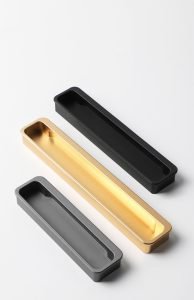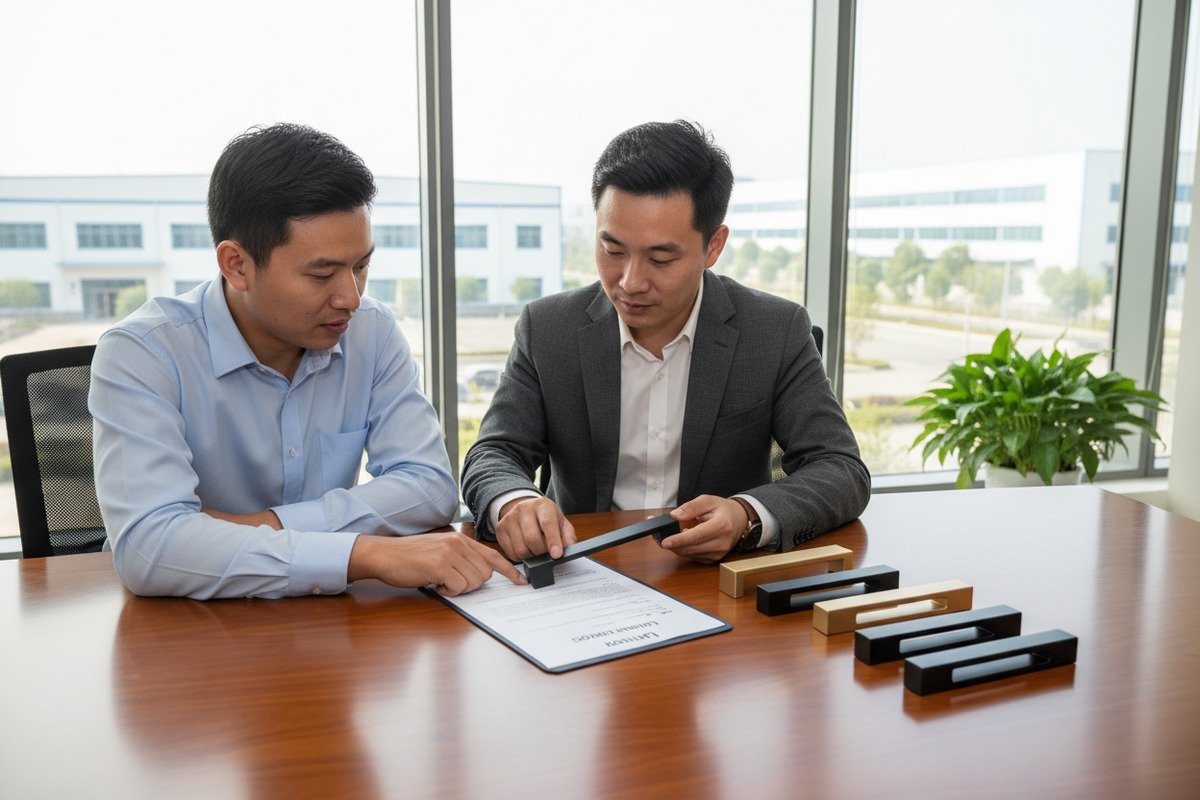
Every week, our sales team in Foshan fields calls from Indonesian wholesalers who share the same frustration — they found a supplier online, ordered samples that looked great, then received bulk shipments that didn’t match factory audits 1. The handles arrived late, the anodized finish 2 peeled within months, and their own customers started complaining. It’s a cycle that costs money, damages reputations, and makes wholesalers hesitant to trust any new supplier again.
Indonesian wholesalers can build stable aluminum cabinet handle supplier relations by vetting Foshan manufacturers through sample testing and factory audits, negotiating long-term contracts with clear quality benchmarks, establishing consistent reorder schedules, and partnering with suppliers who offer OEM/ODM customization and ready stock to reduce lead times.
This guide breaks down the exact steps — from finding the right factory to locking in pricing, quality, and delivery terms that actually hold up over years of partnership OEM/ODM customization 3. Each section tackles a real pain point our Indonesian partners have raised, with practical solutions you can act on today.
How do I find a reliable Foshan manufacturer for my aluminum handle wholesale business?
Searching for a Foshan manufacturer online returns thousands of results, and most Indonesian wholesalers tell us they feel overwhelmed before they even start die-casting 4. The sheer volume of listings on Alibaba and Made-in-China makes it nearly impossible to separate serious factories from trading companies reselling someone else's product.
Start by filtering Foshan manufacturers who have their own production lines, export experience to Southeast Asia, verifiable factory addresses, and at least 10 years of operation — then request physical samples before committing to any minimum order quantity.

Why Foshan Is the Right Place to Look
Foshan is China's furniture hardware capital. The city houses hundreds of aluminum extrusion 5 and die-casting facilities within a 30-kilometer radius. This concentration means competitive pricing, fast tooling, and deep expertise in cabinet handle manufacturing rapid prototyping 6. Our own facility sits in the heart of this cluster, giving us access to raw aluminum suppliers, anodizing plants, and CNC workshops — all within a short drive.
For Indonesian wholesalers, Foshan offers a clear advantage over sourcing from trading hubs like Yiwu or Guangzhou. Trading companies in those cities add 15–25% markup without adding value. A Foshan factory sells direct.
How to Separate Real Factories from Traders
Here is a simple checklist we share with new partners:
| Verification Step | What to Look For | Red Flag |
|---|---|---|
| Business license check | Manufacturing license, not trading | License says "trade" or "commerce" only |
| Factory photos/videos | Machines, workers, raw material storage | Only showroom photos, no production area |
| Export history | Customs records to Indonesia/ASEAN | No verifiable shipment records |
| Sample turnaround | 3–7 days from own stock or production | "We need 30 days for samples" |
| MOQ flexibility | 500–1,000 pieces for first order | MOQ above 5,000 for trial orders |
Steps to Take Before Your First Order
First, request 3–5 samples of your target handle style. Pay for shipping — serious buyers pay for samples, and serious factories respect that. Second, ask for a video call tour of the factory floor. At our facility, we do this routinely for Indonesian buyers who cannot travel. Third, check references. Ask the factory for two or three existing wholesale clients in Southeast Asia. A factory with 18 years of export experience, like ours, will have references ready.
Finally, consider visiting Foshan in person during the Canton Fair period 7. Many factories open their doors to visiting buyers during April and October. One trip can replace months of online guesswork.
Use a Tiered Supplier Strategy
Don't put all orders with one factory. Partner with a primary manufacturer for 70% of your volume — your high-demand standard handles. Then keep one or two backup suppliers for niche or custom items. This protects your business if one factory faces raw material shortages or capacity issues.
How can I ensure my supplier maintains consistent quality across every batch of cabinet handles?
Quality inconsistency is the single biggest complaint we hear from Indonesian wholesalers switching from another supplier. The first batch looks perfect. The second batch has slight color differences. By the third batch, the screw holes don't align with the mounting templates. This pattern destroys trust and costs wholesalers their own customers.
Ensure consistent quality by establishing written specifications with tolerances, requiring pre-shipment inspection photos and videos, conducting periodic third-party audits, and building a long-term relationship where the factory treats your standards as non-negotiable production benchmarks.
Define Your Specifications in Writing
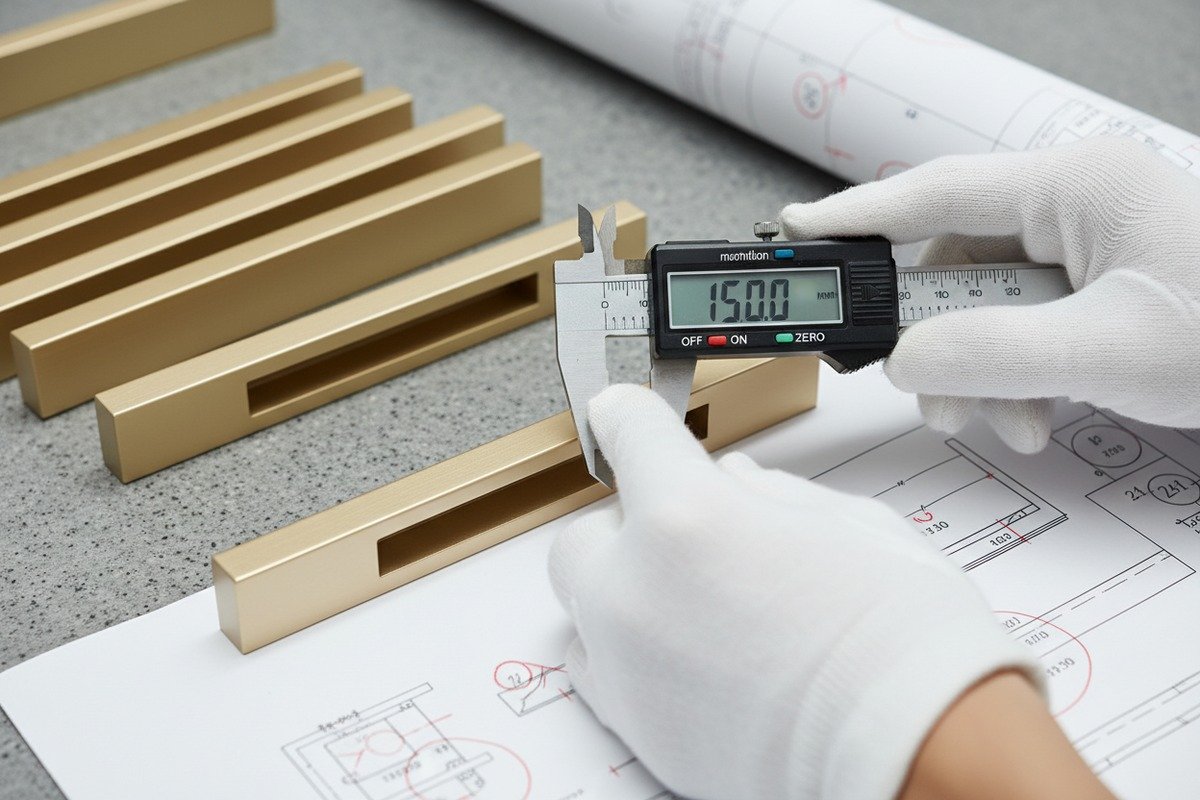
Verbal agreements fail. Every order should reference a written spec sheet that includes dimensions, tolerances, finish type, color code, screw specifications, and packaging requirements. On our production line, we maintain a client-specific quality card for each Indonesian partner. This card travels with the order from extrusion to anodizing to packaging.
Here is an example of what a spec sheet should cover:
| Specification | Example Value | Acceptable Tolerance |
|---|---|---|
| Handle length | 128 mm | ± 0.5 mm |
| Hole center distance | 96 mm / 128 mm / 160 mm | ± 0.3 mm |
| Material | 6063-T5 aluminum alloy 8 | No substitution |
| Finish | Brushed anodized, champagne gold | Color within RAL reference ± 5% |
| Screw type | M4 × 25 mm stainless steel | Grade 304 minimum |
| Surface defect | No scratches visible at 30 cm | Zero tolerance on face surface |
| Packaging | Individual PE bag, 50 pcs per carton | Carton weight ≤ 15 kg |
Implement a Three-Stage Quality Check
Quality cannot rely on final inspection alone. In our factory, we use a three-stage system:
Stage 1 — Incoming material check. We test raw aluminum billets for alloy composition before extrusion begins. Wrong alloy means brittle handles that snap during installation.
Stage 2 — In-process inspection. After extrusion and CNC cutting, our team checks dimensions on every 50th piece using digital calipers. After anodizing, we verify color consistency against a master sample stored under controlled lighting.
Stage 3 — Pre-shipment inspection. Before packing, we pull a random sample per AQL 2.5 standards 9. We photograph and video the inspection, then send the files to our client via WhatsApp before the container is sealed.
What to Do When Quality Slips
Even with the best systems, problems can occur. The key is how quickly they are resolved. Ask your supplier upfront: What is your complaint resolution process? At our facility, we guarantee a response within 24 hours and a corrective action plan within 72 hours. We also offer replacement shipments at no cost for verified defects — because losing a long-term Indonesian wholesale partner costs far more than replacing one batch.
Build a quality scorecard. Track each shipment for defect rate, dimensional accuracy, and delivery timing. Share the scorecard with your supplier quarterly. Factories that see data-driven feedback improve faster than those that only hear complaints.
What steps should I take to minimize lead times and keep my inventory stocked year-round?
Long lead times cause real damage. When an Indonesian wholesaler runs out of a popular 128mm brushed silver handle, their retail customers buy from a competitor. That lost sale often means a lost relationship. In our experience shipping to Jakarta, Surabaya, and Medan, the wholesalers who stay competitive are the ones who plan inventory proactively — not reactively.
Minimize lead times by maintaining a rolling forecast with your supplier, choosing manufacturers with ready stock programs, consolidating shipments on a fixed monthly schedule, and keeping a 30-day safety stock buffer for your top 10 best-selling handle models.
Understand the Full Timeline
Most Indonesian wholesalers underestimate total lead time. It is not just production time. Here is the full breakdown:
| Phase | Duration | Notes |
|---|---|---|
| Order confirmation | 1–2 days | After payment or deposit received |
| Production (standard items) | 7–12 days | From ready stock: 1–3 days |
| Production (custom/OEM items) | 18–25 days | Includes tooling if new mold needed |
| Quality inspection | 1–2 days | Pre-shipment checks and photos |
| Inland transport to port | 1–2 days | Foshan to Nansha/Shenzhen port |
| Sea freight to Jakarta | 8–12 days | Direct sailing; 14–18 days for Surabaya |
| Customs clearance Indonesia | 3–7 days | Depends on documentation accuracy |
| Total (standard) | 21–37 days | |
| Total (custom) | 32–50 days |
The Ready Stock Advantage
One reason our Indonesian partners reorder quickly is our ready stock program. We keep inventory of our 20 most popular handle profiles — including the champagne gold recessed pulls and the brushed silver edge-mount designs that dominate the Indonesian market right now. When a wholesaler in Bandung needs 2,000 pieces of a standard 160mm pull, we ship within 3 days instead of 12.
Ask your supplier which SKUs they hold in stock. If they stock nothing, every order starts from zero. That adds weeks to your supply chain.
Build a Rolling Forecast
Share a 3-month sales forecast with your supplier. It doesn't need to be exact. Even a rough projection — "I expect to need 5,000 pieces of Model A and 3,000 pieces of Model B next quarter" — lets the factory pre-purchase aluminum billets and schedule production slots. This simple communication step can cut lead times by 30–40%.
Consolidate and Schedule Shipments
Instead of placing ad-hoc orders when stock runs low, set a fixed monthly reorder date. For example, every 1st of the month, submit your replenishment order. This lets your factory batch your production with other orders, reducing per-unit cost and ensuring predictable delivery windows. Pair this with a 30-day safety stock for your top sellers, and you will rarely face stockouts.
Manage Import Logistics Proactively
Work with a freight forwarder who specializes in China-to-Indonesia routes. Provide them with your HS codes for aluminum cabinet handles 10 (typically 8302.42) so they can pre-clear documentation. Delays at Indonesian customs often come from incorrect paperwork, not slow processing. Our team prepares commercial invoices, packing lists, and certificates of origin in formats that Indonesian customs officers expect — because we have done it thousands of times.
How can I get the customization support I need for my unique furniture hardware designs?
The Indonesian furniture market has moved beyond generic handles. Designers in Jakarta and Bali want custom finishes, unique profiles, and exclusive dimensions that set their projects apart. But when wholesalers approach factories about customization, they often hear "MOQ 10,000 pieces" or "tooling costs $5,000" — numbers that kill the project before it starts.
Get customization support by partnering with a manufacturer that offers in-house OEM/ODM capabilities, low tooling fees with flexible MOQs starting at 500 pieces, rapid prototyping with CAD-to-sample turnaround under 10 days, and collaborative design input from experienced engineers.
What Customization Actually Means
Customization spans a wide range. Some clients only need a custom color on an existing profile. Others want a completely new cross-section designed from scratch. Here is how we categorize customization requests at our Foshan facility:
Level 1 — Finish customization. Same handle shape, different color or surface treatment. This includes switching from brushed silver to champagne gold, or from anodized to electrophoretic coating. No new tooling required. MOQ as low as 500 pieces. Lead time: 7–10 days.
Level 2 — Dimensional customization. Same profile, different cut lengths or hole spacing. For example, taking our edge-mount pull and producing it in 200mm and 350mm lengths instead of the standard 128mm. Minimal setup changes. MOQ: 500–1,000 pieces. Lead time: 10–15 days.
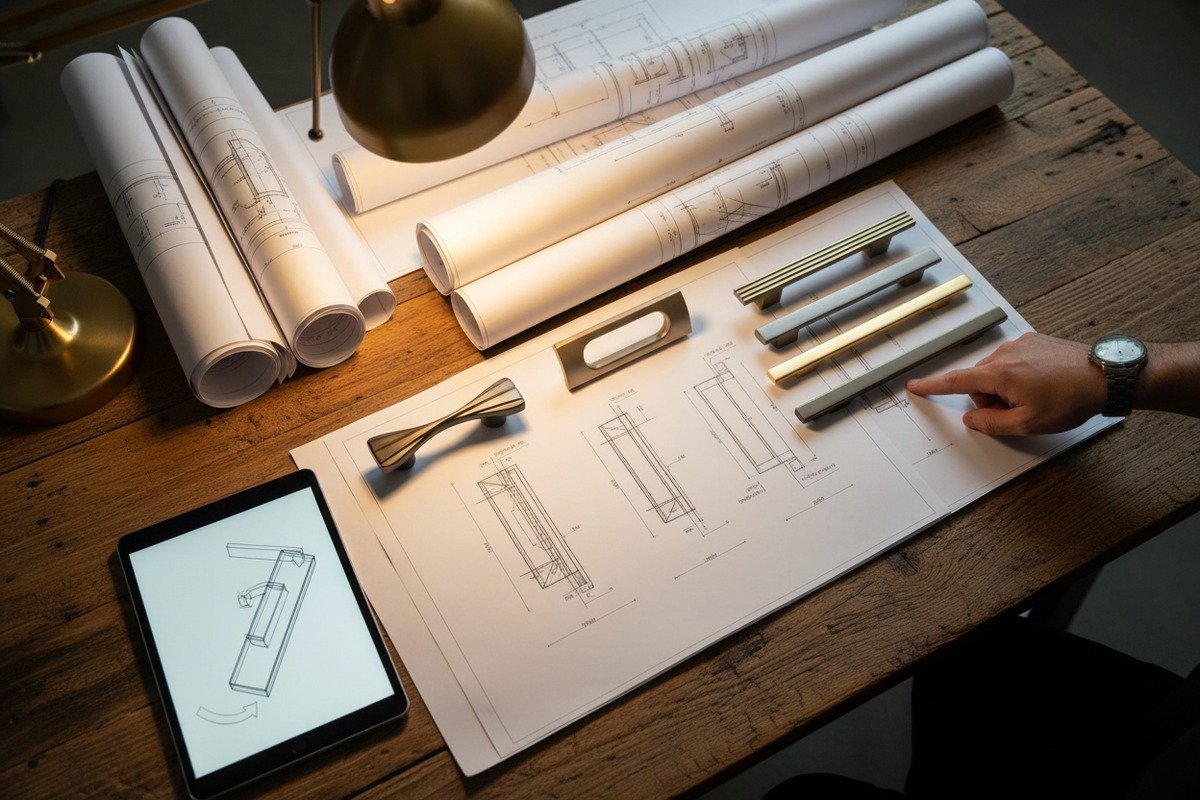
Level 3 — Profile customization (OEM/ODM). Completely new handle cross-section designed to your specifications. This requires a new extrusion die. Our engineering team works from your sketch, photo reference, or CAD file to produce the die and first samples. Tooling cost: typically $300–$800 depending on complexity. MOQ: 1,000 pieces for the first run. Lead time: 20–30 days including die fabrication.
The Design-to-Production Workflow
When an Indonesian furniture designer sends us a sketch of a recessed channel pull with a specific 15mm depth and rounded bottom edge — like the minimalist profiles trending in ASEAN markets right now — our process follows these steps:
- Design review. Our engineers evaluate the sketch for manufacturability. We suggest adjustments if needed — for example, adding a 0.5mm radius to internal corners to prevent stress cracking during extrusion.
- CAD drawing. We produce a 2D cross-section drawing and 3D model for client approval. This takes 2–3 days.
- Die fabrication. Once approved, we manufacture the extrusion die in-house. This takes 5–7 days.
- Sample extrusion. We run a trial batch of 10–20 pieces, finish them to spec, and ship samples to the client for physical testing.
- Approval and production. After client sign-off, full production begins.
Why Flexible MOQs Matter for Indonesian Wholesalers
The Indonesian market is diverse. A wholesaler in Jakarta serves modern apartment developers who want sleek edge-mount pulls. The same wholesaler supplies traditional furniture makers in Jepara who need classic arch handles. Forcing a 10,000-piece MOQ on every custom item makes it impossible to serve both segments.
Our approach is different. We offer MOQs of 500 pieces for custom colors and 1,000 pieces for new profiles. This lets wholesalers test a design with their market before scaling up. If the design sells well, they reorder in larger quantities at a lower per-unit cost. If it doesn't, they haven't committed a warehouse full of unsellable stock.
Sustainable Finishes Are the Next Opportunity
A growing trend among Indonesian designers and ASEAN export markets is demand for sustainable, eco-friendly finishes. Anodizing — which we use extensively — is inherently more sustainable than chrome plating because it produces no hexavalent chromium waste. Recycled aluminum content is another selling point. When you discuss customization with your supplier, ask about their sustainability credentials. These details increasingly appear in tender documents from commercial furniture projects across Southeast Asia.
Conclusion
Building stable aluminum cabinet handle supplier relations comes down to four actions: find a real Foshan factory, lock in quality standards, plan your inventory proactively, and choose a partner who supports your customization needs. Start with samples, build trust through consistent orders, and grow together.
Footnotes
1. Provides information on assessing a facility’s quality systems, workplace environment, and capabilities. ↩︎
2. Explains the electrochemical process that converts metal surfaces into a durable, corrosion-resistant finish. ↩︎
3. Clarifies the definitions and differences between Original Equipment Manufacturer (OEM) and Original Design Manufacturer (ODM). ↩︎
4. Replaced HTTP 404 with a detailed overview of the die casting process from a reputable manufacturing insights platform. ↩︎
5. Replaced HTTP 404 with an authoritative source from the Aluminum Extruders Council. ↩︎
6. Provides a comprehensive overview of techniques used to quickly fabricate a scale model of a physical part. ↩︎
7. The original URL was inaccessible due to ‘HTTP unknown’ but is now working and is the official website. No replacement needed, URL verified as working. ↩︎
8. Provides detailed properties and common applications of the 6063-T5 aluminum alloy. ↩︎
9. Explains the Acceptable Quality Limit (AQL) and its application in quality control inspections. ↩︎
10. Details the Harmonized System (HS) code for mountings and fittings suitable for furniture, including aluminum handles. ↩︎