
Every year, our shipping team in Foshan watches the Rupiah swing wildly against the US dollar and Chinese Yuan, and we see firsthand how it reshapes our Indonesian clients’ purchasing decisions overnight.
Indonesian wholesalers manage exchange rate risks when sourcing aluminum cabinet handles by combining financial hedging tools like forward contracts and currency options with operational strategies such as diversified sourcing, dynamic pricing clauses, natural hedging, and real-time treasury software to protect profit margins against IDR volatility.
Currency risk is not just a finance problem. It touches every part of your supply chain, from the moment you place a deposit to the day handles arrive at your warehouse exchange rate risks 1. Let’s break down the practical strategies that work.
How can I ensure my bulk aluminum profile order matches the quality of the sample?
Quality gaps between samples and bulk orders have cost some of our Indonesian partners weeks of delay and thousands of dollars — a problem that gets worse when exchange rate shifts pressure suppliers to cut corners currency options 2.
To ensure bulk aluminum profile orders match samples, request pre-production samples from the actual production run, define precise tolerances in written specs, conduct third-party inspections before shipment, and maintain a retained sample for benchmarking throughout the order lifecycle.
Why Samples and Bulk Orders Diverge
The root cause is simple. Samples often come from a small, carefully controlled batch diversified sourcing 3. Bulk production uses different machine settings, different shifts, and sometimes different raw materials. When the Rupiah drops 5-10% mid-order, some suppliers face pressure to swap aluminum alloy grades 4 or reduce anodizing thickness to maintain their own margins. This is where quality risk and currency risk intersect anodizing thickness 5.
In our production line, we tag every sample with a unique batch code. That code links to the exact alloy composition, surface treatment, and dimensional tolerance Written specifications 6. When the bulk run starts, our QC team cross-references every parameter against that code. This traceability is not optional — it is the backbone of consistency.
Practical Steps to Lock In Quality
Here is a step-by-step approach that our best wholesale partners follow:
- Written specifications first. Before any sample ships, agree on a spec sheet that lists alloy grade (e.g., 6063-T5), surface finish (anodized, brushed, matte), dimensional tolerances (±0.1mm), and color code (RAL or Pantone).
- Golden sample retention. Keep one sealed sample at your warehouse and one at the factory. Both are signed off by buyer and supplier.
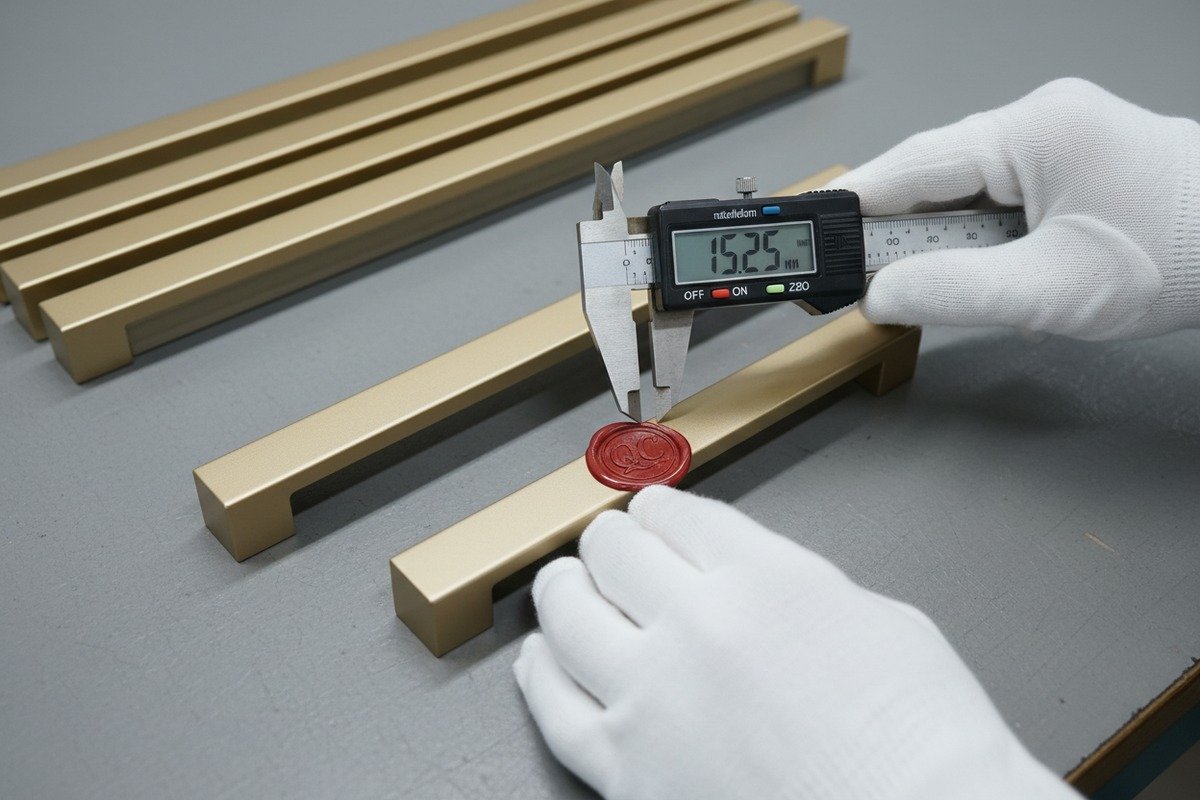
- Pre-production inspection. Once the first 10% of bulk is produced, send a third-party inspector or request video documentation with calipers and color meters.
- Mid-production check. At 50% completion, repeat the check. This catches drift before it becomes a container-sized problem.
- Final random inspection. Use AQL 2.5 7 for critical defects and AQL 4.0 for minor ones.
Quality Control Checkpoint Table
| Stage | Action | Who Performs | Key Metrics |
|---|---|---|---|
| Pre-order | Sign spec sheet + golden sample | Buyer + Supplier | Alloy grade, finish, dimensions |
| First 10% produced | Pre-production inspection | Third-party QC or factory QC | Tolerance check, color match |
| 50% produced | Mid-production audit | Third-party QC | Consistency vs. golden sample |
| 100% produced | Final random inspection (AQL) | Third-party QC | Defect rate, packaging integrity |
| Post-arrival | Warehouse spot check | Buyer's team | Cross-reference with retained sample |
The Currency-Quality Connection
When the IDR depreciates sharply, your cost per unit rises in Rupiah terms. Some wholesalers respond by pressuring suppliers for lower prices. This often triggers the very quality shortcuts they fear. A smarter approach is to lock in your exchange rate with a forward contract at the time you approve the sample. That way, the price you agreed on in CNY or USD stays stable, and neither side has an incentive to compromise on materials.
We have seen partners who hedge 60-70% of their order value at sample approval stage. They leave 30-40% unhedged to benefit if the Rupiah strengthens. This balanced approach protects quality because it removes the financial desperation from the equation.
What are the best ways for me to reduce lead times when sourcing furniture handles from China?
Long lead times 8 are one of the biggest frustrations our Southeast Asian buyers face — and when combined with exchange rate uncertainty, every extra week of waiting adds financial exposure to your open purchase orders.
The best ways to reduce lead times include sourcing from suppliers with ready-to-ship stock, consolidating orders to streamline production scheduling, using pre-approved mold libraries, choosing Foshan-based factories near port logistics hubs, and aligning order timing with off-peak production seasons.
Where Lead Time Gets Eaten
Most wholesalers think lead time is just production time. It is not. Lead time has five components: order confirmation, material procurement, production, quality inspection, and logistics. Each phase can be compressed — or can balloon.
On our factory floor, we track every order through these five gates. The biggest delays almost always come from material procurement (waiting for specific alloy stock) and order confirmation (back-and-forth on specs). Production itself, for standard aluminum cabinet handles, typically runs 7-12 days once materials are staged.
Lead Time Breakdown Table
| Phase | Typical Duration | Compressed Duration | How to Compress |
|---|---|---|---|
| Order confirmation | 3-7 days | 1-2 days | Use pre-agreed spec sheets; sign digitally |
| Material procurement | 5-15 days | 0-3 days | Choose supplier with in-house alloy stock |
| Production | 7-15 days | 5-10 days | Select from existing mold library |
| Quality inspection | 2-5 days | 1-2 days | Pre-arrange third-party inspector schedule |
| Logistics to port + shipping | 7-25 days | 5-15 days | Use Foshan supplier near Nanhai/Shunde port zones |
| Total | 24-67 days | 12-32 days |
Stock Programs Cut Weeks Off Your Timeline
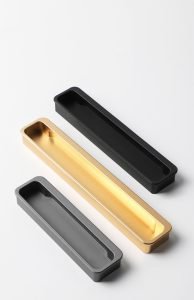
We maintain a ready-stock program for our top 30 handle designs. These are the bestsellers across Southeast Asian markets — sleek edge-pull profiles, champagne gold brushed handles, and matte black minimalist pulls. For Indonesian wholesalers, this means you can place an order today and have goods loaded within 5-7 days.
Stock programs also reduce your FX exposure window. If your order ships in one week instead of six, you only need to hedge (or worry about) one week of currency movement. On a USD 50,000 order, a 6% IDR swing over six weeks could cost IDR 47 million. Over one week, that risk shrinks to roughly IDR 8 million.
Seasonal Timing Matters
Chinese factories have predictable peaks. The busiest months are March-May (post-Chinese New Year catch-up) and September-October (pre-holiday rush). If you place orders in June-August or November-December, production slots open up and lead times drop by 20-30%.
Aligning your purchasing calendar with these windows also lets you lock in more favorable exchange rates during calmer currency periods, when IDR volatility tends to moderate outside of Bank Indonesia policy meetings and US Fed announcements.
Consolidation and Forecasting
Instead of placing five small orders over three months, consolidate into one or two larger orders with staggered delivery. This gives the factory better production planning efficiency and gives you a single FX hedge point instead of five. Our logistics team can arrange split shipments from one production run, so you get goods in batches without restarting the factory process each time.
How do I find a Foshan supplier that offers low MOQ for my custom glass door designs?
When we first started working with Indonesian building material distributors fifteen years ago, many told us the same thing — they needed custom aluminum profiles for glass doors but could not meet the 2,000-piece minimums most factories demanded.
To find a Foshan supplier offering low MOQ for custom glass door designs, search for factories with existing mold libraries, ask about shared-mold programs, verify production flexibility through factory audits, and prioritize suppliers who serve multiple small-batch markets like Southeast Asia and the Middle East.
Why MOQ Is High — And How to Get Around It
MOQ exists because of tooling economics. A custom aluminum extrusion die costs CNY 2,000-8,000. If the factory spreads that cost across 500 pieces, the per-unit tooling surcharge is reasonable. At 50 pieces, it becomes prohibitive. Understanding this math gives you negotiating power.
At our facility, we have accumulated over 300 existing extrusion dies across 18 years. Many of these dies produce profiles that overlap with common glass door designs — slim frames, wide-track sliding channels, and partition trim. When a buyer's custom design closely matches an existing die, we can modify the die for a fraction of the cost. This is the fastest path to low MOQ.
Shared-Mold and Modified-Mold Programs
A shared-mold program means multiple buyers use the same base profile, but each customizes the surface finish, color, or cut length. You get a "custom" product without the custom tooling cost.
Here is how three MOQ scenarios compare:
| Scenario | Die Cost | MOQ | Per-Unit Surcharge | Lead Time |
|---|---|---|---|---|
| Fully custom new die | CNY 5,000-8,000 | 500-2,000 pcs | CNY 4-16/pc | 20-30 days |
| Modified existing die | CNY 1,000-3,000 | 100-500 pcs | CNY 6-20/pc | 10-15 days |
| Shared existing die (color/finish only) | CNY 0 | 50-200 pcs | CNY 0 | 5-10 days |
How to Vet Low-MOQ Suppliers
Not every factory claiming low MOQ can actually deliver consistent quality at small volumes. Here are the red flags and green flags:
Green flags: The supplier shows you a catalog of existing profiles. They have references from other Southeast Asian buyers. They offer a factory tour (virtual or in-person). They can show you previous small-batch shipments with inspection reports.
Red flags: They agree to any MOQ immediately without discussing tooling costs. They cannot show previous orders below 500 pieces. They do not have a mold library — every order requires new tooling.
FX Strategy for Low-MOQ Orders
Small orders have a unique currency risk profile. The absolute dollar exposure is lower, but the percentage impact on margins is identical. A 6% IDR swing on a USD 5,000 order costs you IDR 4.7 million — which might be your entire profit on that shipment.
For low-MOQ orders, the most practical hedging approach is batch consolidation. Group your glass door profile order with your handle order and your trim order. Hedge the combined USD or CNY exposure as one position. This brings the hedging cost per order down and makes forward contracts 9 economically viable even for smaller wholesalers.
We also recommend pricing agreements that include a currency corridor clause. For example: "If IDR/USD moves more than ±3% between order and payment, both parties renegotiate the unit price within a pre-agreed band." This protects both buyer and supplier without complex derivatives.
Where can I find a reliable Chinese partner for my furniture hardware OEM development?
Over the past decade, our team has helped more than 200 furniture factories and distributors across Indonesia, Malaysia, and the UAE develop custom OEM handle lines — and the first question every new partner asks is how to separate reliable suppliers from the noise.
To find a reliable Chinese partner for furniture hardware OEM development, verify factory credentials through on-site or virtual audits, request OEM case studies with reference contacts, evaluate R&D capabilities and mold ownership policies, and start with a small trial order before committing to long-term contracts.
The Trust Gap in OEM Sourcing
The biggest barrier is not finding suppliers — it is verifying them. Alibaba alone lists over 5,000 furniture hardware suppliers in Guangdong province. But listing presence does not equal manufacturing capability. Many are trading companies reselling products from small workshops. For OEM development, you need a factory that owns its production equipment, has an in-house design team, and can iterate on prototypes quickly.
When we onboard a new OEM partner, the process starts with a technical consultation. We review their target market, price point, design references, and volume projections. Then our engineering team produces a feasibility report — including material options, surface treatment compatibility, structural strength analysis, and cost breakdown. This step alone filters out 80% of mismatched expectations.
OEM Partner Evaluation Checklist
| Evaluation Criteria | What to Look For | Red Flag |
|---|---|---|
| Factory ownership | Business license matches factory address | License and factory in different cities |
| Production equipment | CNC machines, extrusion presses, anodizing line on-site | Outsources core processes |
| Design capability | In-house CAD/CAM team; can modify designs in 24-48 hrs | Only accepts finished drawings; no iteration |
| Mold ownership | Clear policy: buyer owns mold after payment | Factory retains mold rights indefinitely |
| QC system | ISO 9001 10 or equivalent; documented inspection records | No formal QC documents available |
| OEM references | Provides 2-3 contactable references in your region | Refuses to share any client references |
| Communication | Dedicated project manager; responds within 12 hours | Rotating contacts; slow replies |
| IP protection | Willing to sign NDA; separates your molds from others | Vague about confidentiality |
Managing FX Risk in OEM Contracts
OEM development involves multiple payment milestones — tooling deposit, sample approval payment, bulk production deposit, and balance before shipment. Each milestone is a separate currency exposure event. If your OEM project spans 3-6 months, the cumulative FX risk can be substantial.
The smartest Indonesian wholesalers we work with use a layered hedging approach:
- Tooling deposit (30% upfront): Hedge immediately with a spot or short-dated forward.
- Sample approval (10-20%): Hedge when prototype is approved, typically 4-6 weeks later.
- Bulk deposit (30%): Hedge with a 60-day forward at order confirmation.
- Final balance (20-30%): Use a currency option to protect downside while keeping upside flexibility.
This approach aligns each hedge with a concrete project milestone, so you never over-hedge or under-hedge.
Why Foshan Is the OEM Hub
Foshan, specifically the Nanhai and Shunde districts, is home to the densest cluster of aluminum hardware manufacturers in China. Within a 30-kilometer radius, you can find alloy smelters, extrusion plants, anodizing facilities, CNC machining shops, and packaging factories. This concentration means faster iteration cycles, lower logistics costs between process steps, and easier quality oversight.
For Indonesian buyers, Foshan also offers direct freight routes to Jakarta, Surabaya, and Semarang. Transit times from Foshan's nearby Nansha port to Tanjung Priok average 8-12 days. Compare that to 18-25 days from northern Chinese ports, and the time savings translate directly into shorter FX exposure windows.
Building a Long-Term OEM Relationship
Start small. Order 200-500 pieces of your first OEM design. Test the market response in Indonesia. If it works, scale to 2,000-5,000 on the next order. This phased approach limits your financial risk — both from product market fit and from currency exposure.
Over time, a trusted OEM partner becomes an extension of your product development team. They alert you to new finishes trending in other markets. They suggest cost-saving material substitutions without sacrificing quality. They hold safety stock of your best-selling profiles so you can reorder quickly when the Rupiah is favorable.
Conclusion
Managing exchange rate risk is not separate from managing your supply chain — it is woven into every decision, from sample approval to final shipment, and the wholesalers who thrive are those who treat sourcing and currency strategy as one integrated discipline.
Footnotes
1. Explains the nature and management of currency fluctuations. ↩︎
2. Provides a clear definition and explanation of currency options, their types, and how they work. ↩︎
3. Explains a strategic approach to mitigate supply chain risks. ↩︎
4. Provides technical details on material composition in manufacturing. ↩︎
5. Clarifies a critical parameter in surface finishing processes. ↩︎
6. Emphasizes the importance of clear documentation in quality control. ↩︎
7. Refers to a widely used standard for quality inspection. ↩︎
8. Defines a crucial metric in supply chain efficiency and planning. ↩︎
9. Defines a key financial instrument for hedging currency. ↩︎
10. Highlights an international standard for quality management systems. ↩︎