Every year, our production floor handles thousands of repeat orders for aluminum cabinet handles Delta E values 1. The complaint we hear most from new buyers? “The second batch doesn’t match the first.” Color drift between batches causes real headaches—mismatched handles on finished cabinets, returned shipments, and strained relationships with your own clients.
To compare supplier color consistency, request physical samples from different production batches, measure color differences using a spectrophotometer with Delta E values below 2.0, evaluate samples under multiple lighting conditions, and confirm the supplier follows documented process controls for anodizing or powder coating.
This guide walks you through every practical step, from sample verification to repeat-order management D65 daylight 2. I’ll share what we’ve learned after 18 years of making aluminum handles and profiles in Foshan—including where things go wrong and how to prevent it.
How can I verify that the handle samples match the bulk production colors?
Sample approval is the moment that defines your entire order. We've seen buyers approve a single beautiful sample, only to receive 5,000 handles two shades darker. The gap between a handpicked sample and mass production is real, and it catches people off guard.
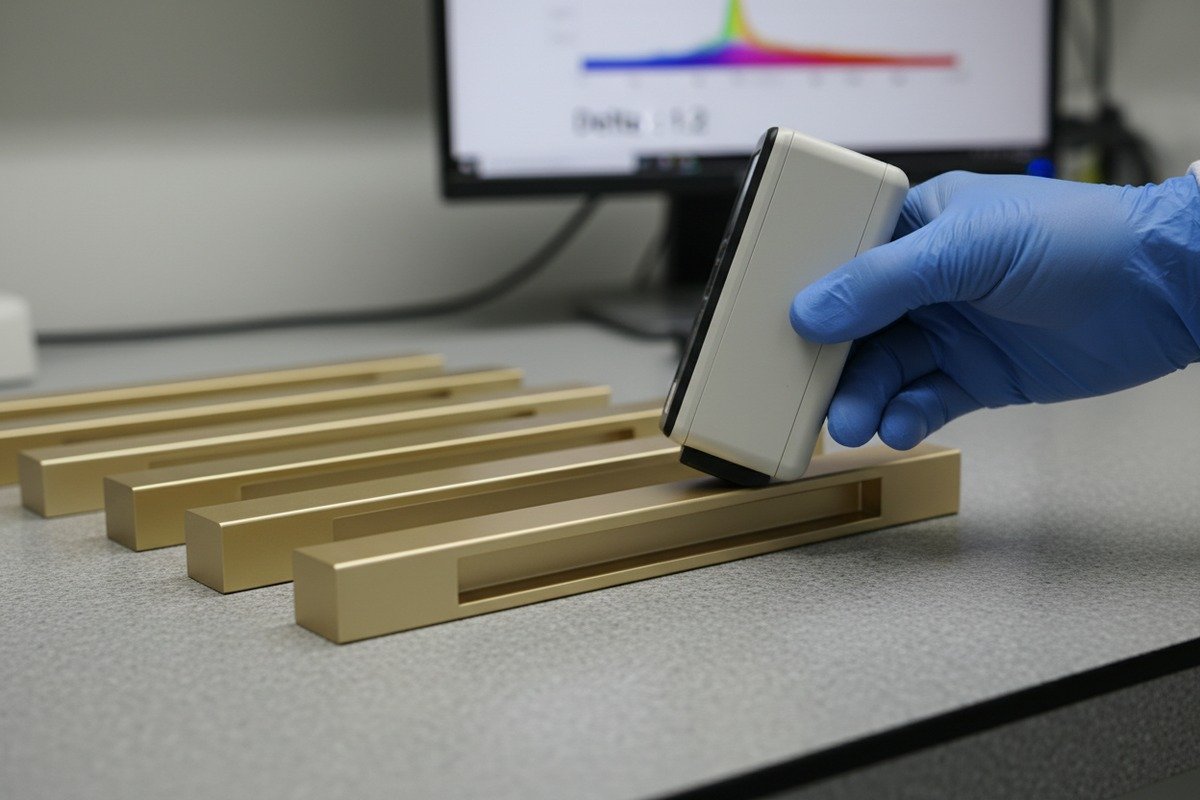
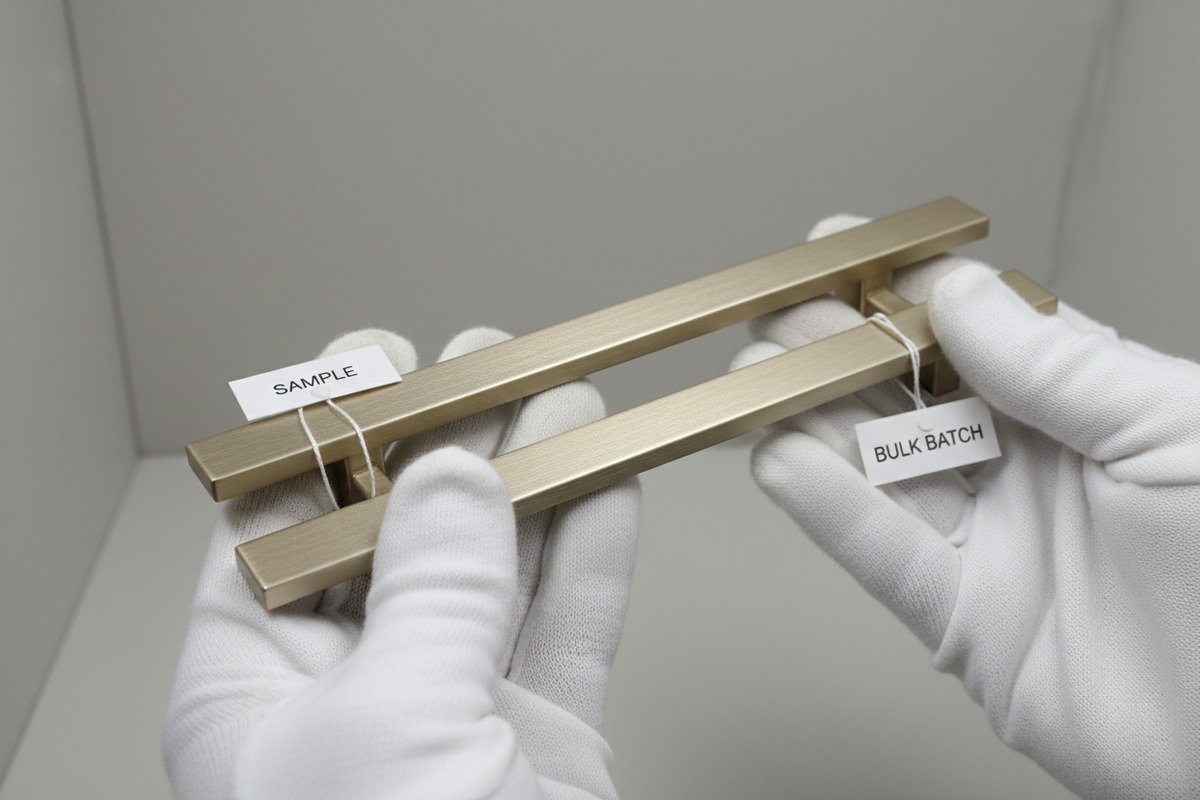
To verify sample-to-bulk color matching, request samples pulled directly from a trial production run—not hand-finished showpieces. Compare them side by side under D65 daylight, and use a spectrophotometer to confirm the Delta E value stays below 2.0 before approving mass production.
Why "Golden Samples" Mislead Buyers
Most suppliers send their best work as samples. These are often polished by hand, anodized in a small controlled batch, or cherry-picked from a larger run. The problem is that bulk production uses automated racking, larger anodizing tanks, and different dwell times. All of these factors shift the final color.
When we prepare samples for our clients, we pull them from a pilot run of at least 50–100 pieces. This gives a realistic picture. If your supplier only sends one or two perfectly finished pieces, ask specifically: "Was this pulled from a production batch or made separately?"
Step-by-Step Sample Verification Process
Here is a practical checklist you can follow:
- Request a pilot batch sample, not a single piece.
- Keep a physical reference sample sealed and labeled with the date and batch number.
- Measure the color using a spectrophotometer 3 if available, or use a calibrated color card (RAL or Pantone).
- Compare under three light sources: daylight (D65), fluorescent (F2), and incandescent (A). This detects metamerism 4—where two colors look the same under one light but different under another.
- Document everything in writing. Include photos, Delta E readings, and agreed tolerance ranges.
Understanding Delta E Values
Delta E quantifies the difference between two colors in CIE Lab* color space. Here is what the numbers mean in practice:
| Delta E Range | Human Perception | Acceptable for Handles? |
|---|---|---|
| 0 – 0.5 | Imperceptible difference | Ideal |
| 0.5 – 1.0 | Only experts notice | Excellent |
| 1.0 – 2.0 | Slight difference, most people won't notice | Acceptable |
| 2.0 – 3.5 | Noticeable difference | Borderline—negotiate |
| 3.5+ | Obvious mismatch | Reject the batch |
For most cabinet handle applications, a Delta E below 2.0 is the industry standard. Anything above 3.5 is visible to almost anyone, even from a distance.
A Personal Note on Powder Coating vs. Anodizing
From our experience shipping to Southeast Asia and the Middle East, powder-coated finishes hold color much better across multiple batches. Anodized finishes 5—especially gold brushed tones—are notoriously difficult to replicate exactly. The oxide layer thickness, dye concentration, and even the aluminum alloy's trace elements all affect the final shade. If your project involves repeat orders over months, powder coating 6 gives you more predictable results.
What quality control standards should I look for to ensure anodized color consistency?
Anodizing is where color consistency gets tricky. Our anodizing line processes hundreds of aluminum handles daily, and we've learned that even a 2°C shift in electrolyte temperature can push a champagne gold into yellow territory. Without documented standards, you're gambling.
Look for suppliers with ISO 9001 quality management, documented anodizing process controls covering electrolyte temperature, current density, and dwell time, plus spectrophotometer-based inspection at defined intervals. Ask for accelerated weathering test data and agreed Delta E tolerances in writing.

The Critical Process Variables
Anodizing is an electrochemical process. The aluminum handle is submerged in an acid electrolyte bath, and an electric current grows an oxide layer on the surface. Dye is then absorbed into this porous layer before it is sealed. Each step has variables that affect color:
- Electrolyte temperature: Higher temperatures create softer, more porous oxide layers that absorb more dye, producing darker colors.
- Current density: Affects the oxide layer growth rate and thickness uniformity.
- Anodizing time: Longer times mean thicker oxide layers and deeper color absorption.
- Dye concentration and immersion time: Directly controls hue intensity.
- Sealing process: Locks in the color. Poor sealing causes fading over time.
Certifications and Standards to Request
Not all quality claims are equal. Here is what to ask for:
| Certification / Standard | What It Covers | Why It Matters |
|---|---|---|
| ISO 9001:2015 7 | Quality management system | Proves the supplier documents and controls processes |
| QUALANOD 8 (if applicable) | Anodizing quality label | European standard for anodized aluminum quality |
| AAMA 611 9 (US market) | Anodized architectural aluminum | Specifies color uniformity, corrosion resistance, abrasion |
| Internal SPC records | Statistical process control 10 charts | Shows real-time monitoring of bath chemistry and color |
| Accelerated weathering data | QUV or Xenon Arc test results | Predicts long-term color stability under UV exposure |
If a supplier cannot show you any process documentation, that is a red flag. At our facility, we log electrolyte temperature, pH, and current density every two hours. We also pull random samples from each batch for spectrophotometer checks. This level of documentation is what separates consistent suppliers from inconsistent ones.
Surface Preparation Matters More Than You Think
Before anodizing, the aluminum handle must be cleaned, etched, and sometimes blasted or brushed. The surface condition before anodizing directly affects how the oxide layer forms and how dye is absorbed. A handle with inconsistent surface roughness will show uneven color, even if the anodizing process is perfectly controlled.
Ask your supplier: "What is your pre-treatment process?" If they can describe their cleaning, etching, and mechanical finishing steps in detail, that is a good sign.
Handle Geometry Creates Hidden Challenges
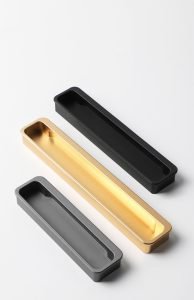
Complex shapes, recessed channels, and varying wall thicknesses—like the edge-mount finger pulls common in minimalist designs—create uneven current distribution during anodizing. Thicker sections may anodize differently than thinner ones. Our engineering team accounts for this by adjusting racking positions and using conforming anodes for complex profiles. If your handle design has deep channels or sharp transitions, discuss this with the supplier upfront.
How do I ensure my repeat orders of aluminum profiles maintain the same color tone?
This is the question that keeps procurement managers up at night. You placed a great first order. The handles matched perfectly. Six months later, you reorder—and the new batch looks different next to the installed ones. We deal with this challenge constantly, especially with our Southeast Asian distributors who order the same champagne gold brushed handles quarter after quarter.
To maintain color tone across repeat orders, retain sealed physical reference samples from each approved batch, specify the exact aluminum alloy grade, require your supplier to use the same process recipe and raw material source, and verify each new batch against the reference sample using instrumental measurement before shipment.

Why Repeat Orders Drift in Color
Color drift happens for several reasons, and understanding them helps you prevent it:
- Alloy variation: Even within the same grade (say, 6063-T5), different ingot suppliers introduce trace element differences. Silicon, magnesium, and iron content at slightly different ratios change how the alloy responds to anodizing.
- New chemical batches: When the anodizing facility refreshes its electrolyte or dye solution, subtle concentration differences appear.
- Seasonal factors: Ambient temperature and humidity in the factory affect drying and curing stages.
- Operator changes: Different technicians may rack handles at different densities or adjust process steps slightly.
Powder Coating: The More Forgiving Option
From our direct production experience, powder coating handles color consistency significantly better than anodizing across multiple batches. Here is a comparison:
| Factor | Anodizing | Powder Coating |
|---|---|---|
| Batch-to-batch consistency | Difficult, especially for metallic/gold tones | Good, easier to match with RAL/Pantone codes |
| Sensitivity to alloy variation | High—trace elements affect dye uptake | Low—coating covers the substrate |
| Color range | Limited by dye chemistry | Virtually unlimited |
| Brushed gold reproducibility | Very challenging | Moderate—textured powders available |
| Cost per unit | Generally lower for standard colors | Slightly higher, but more predictable |
| Long-term UV stability | Excellent for clear anodize; varies for dyed | Excellent with quality polyester powders |
If you need gold brushed finishes across many orders, consider a powder-coated metallic gold with a brushed texture effect. It will never be identical to anodized gold brushing, but the batch-to-batch consistency is far superior. This is something we actively recommend to clients who order in quarterly cycles.
Building a Reference Sample Library
The single most effective thing you can do is maintain a physical reference sample library. Here is how we do it with our key accounts:
- After each approved batch, we seal two reference handles in airtight bags with silica gel packets.
- Each bag is labeled with: order number, production date, alloy lot number, anodizing recipe code, and Delta E reading.
- One sample stays with us in Foshan. One goes to the client.
- Before each new production run, we pull the reference and measure the first pieces against it.
- If the Delta E exceeds the agreed tolerance, we adjust before continuing.
This system requires discipline, but it works. It has helped our repeat clients in the Middle East maintain consistent showroom displays across years of reordering.
PVD Coatings for Ultimate Consistency
For clients who need absolute color lock across many batches, PVD (Physical Vapor Deposition) coatings are gaining traction. PVD deposits thin metallic layers onto the aluminum surface in a vacuum chamber. The result is a scratch-resistant, fade-proof finish that maintains color consistency far better than traditional anodizing. Matte black and copper tones in PVD resist scratching up to 5 times better than conventional plating. The downside is cost—PVD is more expensive. But for premium product lines, it's worth considering.
What is the best way for me to inspect color variations under different lighting conditions?
Here is a mistake we see often: a buyer approves a handle color under their office fluorescent lights, then installs it in a kitchen with warm LED downlights. Suddenly the "silver" handle looks greenish, or the "champagne" turns pale yellow. Lighting changes everything, and most people don't test for it until it's too late.
The best way to inspect color variations is to evaluate handle samples under at least three standardized light sources—D65 daylight, fluorescent (F2), and incandescent (A)—inside a color assessment cabinet. This detects metamerism, where colors appear to match under one light but differ noticeably under another.

What Is Metamerism and Why Should You Care?
Metamerism occurs when two objects appear the same color under one light source but look different under another. This happens because the objects reflect light at different wavelengths, and different light sources emphasize different parts of the spectrum.
For aluminum handles, this is common when comparing anodized versus powder-coated surfaces, or when matching handles to cabinet finishes from different materials. Two "matte black" handles might look identical under your warehouse's fluorescent tubes but visibly diverge under a showroom's warm spotlights.
Setting Up a Practical Inspection Workflow
You don't need a laboratory. Here's a practical approach:
- Get a color assessment cabinet. These are standard light boxes (brands like X-Rite, VeriVide) with multiple light sources. They cost between $500 and $2,000. For high-volume buyers, this is a worthwhile investment.
- If a light box isn't available, test samples near a north-facing window for daylight, under standard fluorescent office lighting, and under a warm-white LED (2700K–3000K). Document what you see under each.
- Always compare handles against each other AND against the cabinet or surface material they'll be installed on. A handle that looks great alone may clash with the cabinet door finish.
- Photograph each comparison with a gray card in the frame for white balance reference. This creates a visual record you can share with your supplier.
Digital Tools and Phone Apps
While professional spectrophotometers (like the X-Rite Ci64 or Konica Minolta CM-2600d) are the gold standard, some buyers use smartphone color-matching apps as a preliminary screening tool. Apps like "Color Grab" or "Nix Toolkit" can capture approximate Lab* values. However, they are not accurate enough for final quality decisions. Use them for quick field checks, but rely on instruments for approval or rejection.
Matching Handles to Cabinetry Under Real-World Conditions
The 2025 trend toward matte black and brushed aluminum finishes actually simplifies lighting concerns in some ways. Matte finishes diffuse light rather than reflecting it directly, so they show less dramatic color shift between light sources compared to polished or high-gloss finishes. Brushed aluminum, in particular, reads as a cool-toned neutral under most lighting conditions—which is why it pairs well with both white and gray cabinets.
If you're mixing metals—say brushed aluminum pulls on lower cabinets with warm brass knobs on upper cabinets—test them together under the specific lighting your end customer will use. The general rule is "warm with warm, cool with cool," but intentional mixing works beautifully when you verify it under real conditions first.
Warm vs. Cool Undertone Quick Reference
Understanding undertones helps you predict how handles will behave under different lights:
| Finish | Undertone | Behavior Under Warm Light | Behavior Under Cool Light |
|---|---|---|---|
| Brushed aluminum / satin chrome | Cool | Appears slightly warmer, more silver | Appears crisp, blue-silver |
| Champagne gold anodized | Warm | Deepens to rich gold | Can look washed out or greenish |
| Matte black | Neutral | Stays consistent | Stays consistent |
| Polished nickel | Warm-neutral | Picks up warm reflections | Looks cooler, more chrome-like |
| PVD copper | Warm | Glows warmly | Can appear slightly pink |
Matte black's neutrality is one reason it has surged 30% in popularity for 2025 kitchen hardware. It performs reliably across lighting environments, which reduces callback complaints for distributors and installers.
The "Installed Environment" Test
Before finalizing any large order, we recommend our clients do an "installed environment" test. Mount two or three sample handles on an actual cabinet door or a sample board in the same material, color, and finish as the final installation. Place it in the room where it will live. View it at morning, midday, and evening. This 24-hour test catches issues that no light box can fully simulate, because it accounts for natural light angles, reflected colors from walls and countertops, and the specific artificial lighting the homeowner or business will use.
Conclusion
Color consistency is a solvable problem when you combine the right tools, clear supplier communication, and disciplined sample management. Whether you choose anodizing, powder coating, or PVD, the key is to measure objectively, test under real-world lighting, and build a reference system that carries across every reorder. If you need help setting up this process for your next aluminum handle project, reach out to us at Al**************@********************************************te.com.
Footnotes
1. Defines Delta E and its significance in quantifying color differences. ↩︎
2. Explains the standard D65 illuminant for consistent industrial color matching. ↩︎
3. Replaced HTTP 404 with authoritative Wikipedia page on spectrophotometry. ↩︎
4. Replaced HTTP 404 with authoritative Wikipedia page on color metamerism. ↩︎
5. Replaced HTTP 404 with authoritative Wikipedia page on anodizing. ↩︎
6. Replaced HTTP 403 with authoritative Wikipedia page on powder coating. ↩︎
7. Official standard for quality management systems, ensuring process control. ↩︎
8. Official quality label organization committed to maintaining and promoting anodized aluminum quality. ↩︎
9. Specifies test procedures and requirements for anodized architectural aluminum. ↩︎
10. Replaced HTTP 403 with authoritative Wikipedia page on statistical process control. ↩︎