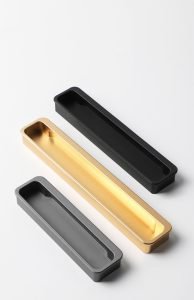
Finding a reliable aluminum handle supplier overseas can feel like navigating a minefield third-party inspection 1. One wrong choice and you face delayed shipments, fading finishes, or bulk orders that look nothing like your approved samples. Over 18 years on our production floor in Foshan, we have seen buyers lose thousands of dollars to unvetted suppliers — and we have helped many recover by showing them exactly what to look for.
To identify and screen aluminum cabinet handle suppliers with stable export experience, verify their export history through shipment databases, check ISO 9001 and RoHS certifications, request physical samples for testing, audit their production capacity, and confirm on-time delivery rates above 95% before committing to bulk orders.
This guide breaks down the process into four key questions every buyer should ask technical drawings 2. Each section gives you practical tools, benchmarks, and red flags so you can source with confidence. Let’s start with the most fundamental question.
How can I verify that an aluminum handle supplier has enough export experience to handle my international orders?
Many suppliers claim years of export experience on their websites. But claims are cheap. When our team processes orders for buyers in Southeast Asia and the Middle East, we always encourage them to verify before they trust.
You can verify a supplier's export experience by searching shipment records on platforms like ImportYeti or Panjiva using HS code 8302.41, checking their presence on verified B2B directories, requesting client references in your target market, and confirming at least five years of continuous export activity.

Start With Shipment Databases
The fastest way to check if a supplier actually exports is to search their company name on ImportYeti or Panjiva. These tools pull real customs data. You can see which countries they ship to, how often, and in what volumes. Look for HS code 8302.41 3 — this covers base metal mountings and fittings for furniture, including handles.
A stable supplier should show consistent shipments over at least three to five years. Gaps of six months or more are a red flag. They may signal production problems, lost clients, or financial instability.
Verify Through B2B Platforms
Alibaba, Made-in-China, and Global Sources all offer verified supplier badges. These mean a third party has confirmed the factory exists and has basic export capability. But do not stop at the badge. Read buyer reviews. Check the supplier's response rate. Look at how many years they have been a Gold Supplier or Verified member.
Use This Screening Table
| Verification Method | What It Tells You | Cost | Reliability |
|---|---|---|---|
| ImportYeti / Panjiva search | Real shipment history, volume, destinations | Free / $99+/mo | High |
| Alibaba Verified Badge | Factory exists, basic audit passed | Free to check | Medium |
| Google Earth factory check | Physical location matches claims | Free | Medium |
| Video call factory tour | Live production line, real workers, real machines | Free | Medium-High |
| Third-party audit (SGS, Bureau Veritas) | Full production and quality assessment | $300–$800 | Very High |
Ask for References
A confident supplier will share two or three client references in your region. Call or email those references. Ask about on-time delivery, defect rates, and communication quality. In our experience shipping to distributors across Southeast Asia, the buyers who do reference checks almost never face major surprises.
Watch for These Red Flags
- No export records before 2020.
- Vague or unverifiable certifications.
- Refuses to provide references.
- Cannot name specific ports or shipping routes.
- Only communicates through a trading company, not the factory directly.
A supplier with stable export experience will have clear records, real clients, and nothing to hide.
What should I look for to ensure my custom aluminum profile designs are manufactured exactly to my specifications?
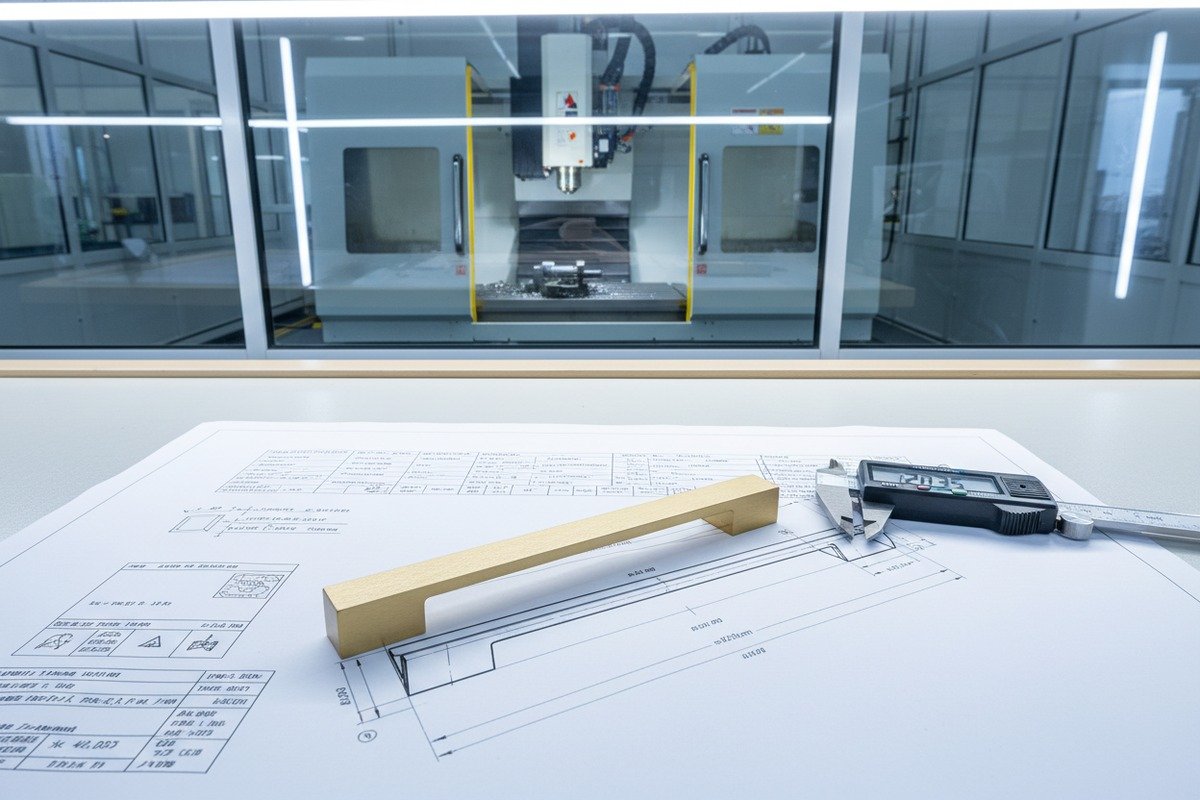
Customization is where many deals fall apart. A supplier says "yes, we can do it," but the final product does not match your drawing. Our engineering team handles OEM and ODM projects daily, and we know the exact checkpoints that prevent costly mismatches.
To ensure custom aluminum handle designs match your specifications, provide detailed technical drawings with tolerances, confirm the supplier uses precision CNC machining or extrusion dies for your alloy grade (6063-T5 or 6061-T6), request a rapid prototype before mass production, and define surface finish standards in writing with approved color samples.
Define Your Specifications Clearly
Vague specs lead to vague results. Your technical drawing should include:
- Exact dimensions in millimeters (hole center distance, length, width, depth).
- Alloy grade 5 (6063-T5 for most furniture handles; 6061-T6 for heavier-duty applications).
- Surface finish type (anodized, brushed, powder-coated, electrophoretic).
- Color code (RAL number or Pantone reference).
- Tolerance range (typically ±0.1mm for CNC parts, ±0.3mm for extrusions).
When we develop new handle profiles for our clients — like the minimalist edge-mount finger pulls popular in modern kitchens — every detail is locked down before a single piece of aluminum is cut. This saves weeks of back-and-forth.
Understand the Manufacturing Process
Different processes suit different designs. Here is a quick comparison:
| Process | Best For | Tolerance | Cost per Unit (500 pcs) | Lead Time |
|---|---|---|---|---|
| Aluminum extrusion 6 | Linear profiles, finger pulls, long handles | ±0.3mm | $1.50–$4.00 | 20–30 days |
| CNC machining 7 | Complex shapes, tight tolerances | ±0.05mm | $3.00–$8.00 | 15–25 days |
| Die casting | High-volume simple shapes | ±0.5mm | $0.80–$2.50 | 25–35 days |
| Stamping | Flat or shallow forms | ±0.2mm | $0.50–$1.50 | 15–20 days |
For the sleek, recessed-channel handles with a champagne gold finish — the kind we produce in volume — extrusion followed by CNC finishing gives the best balance of precision and cost.
Prototype Before You Commit
Never skip the prototype stage. Order 10 to 20 sample units. Test them for:
- Dimensional accuracy against your drawing.
- Pull strength (should exceed 50 kg for cabinet handles).
- Finish adhesion (salt spray test 8 for 96 hours minimum).
- Fit with your cabinet or furniture frame.
A good supplier welcomes sample requests. A bad one pressures you to skip straight to bulk. Our approach has always been to send samples first, because we know the product speaks louder than any sales pitch.
Lock Down Surface Finish Standards
Surface finish is where the biggest visual discrepancies happen. Anodizing thickness, powder coat texture, and brushed grain direction all vary between batches if not controlled. Specify:
- Anodizing thickness: 10–15 microns for indoor use.
- Powder coat thickness: 60–80 microns.
- Gloss level: matte (10–20 GU), satin (30–40 GU), or gloss (70+ GU).
Ask the supplier for a physical color swatch you can keep as a master reference. Match every incoming shipment against it.
How do I find a furniture hardware manufacturer that offers ready-to-ship stock to avoid long lead times?
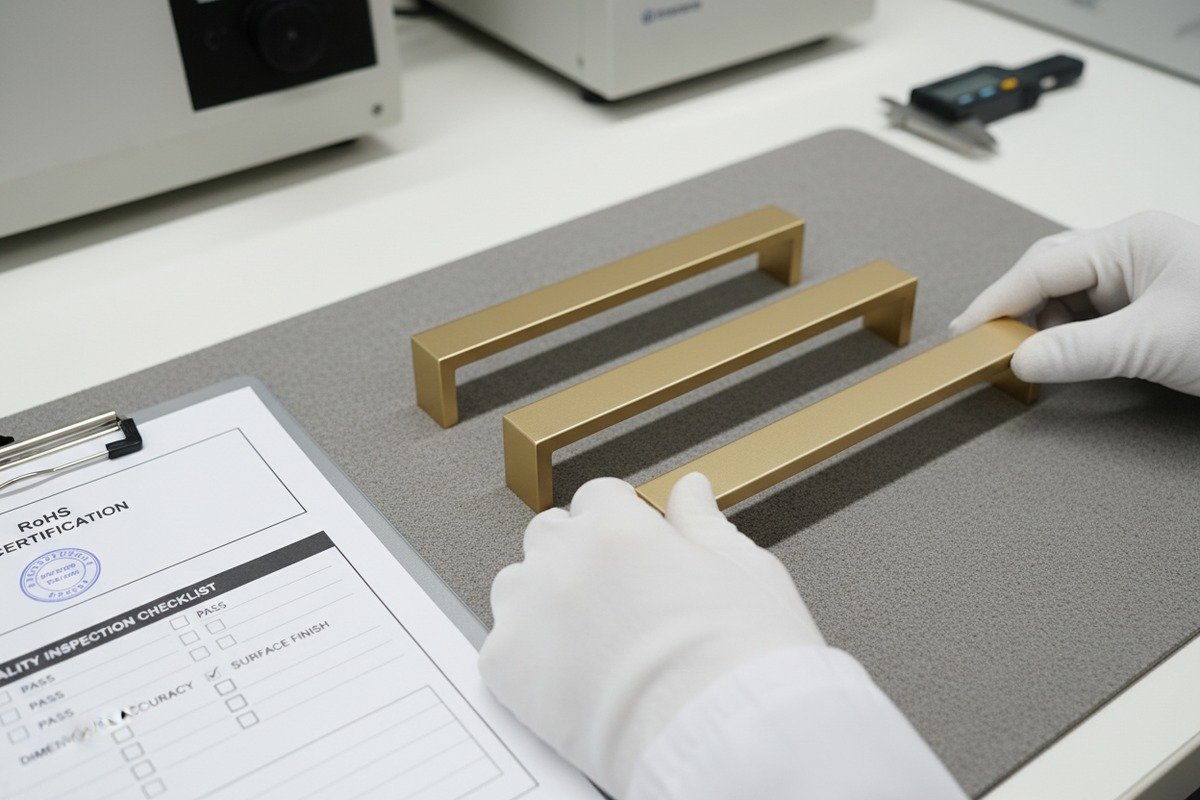
Long lead times kill deals. When a furniture factory needs 2,000 handles next week for a production run, waiting 30 days is not an option. This is something we learned early — which is why our warehouse in Foshan keeps popular handle styles in stock and ready to ship within days.
To find a manufacturer with ready-to-ship stock, look for suppliers who maintain warehouse inventory of standard designs, offer MOQs as low as 500 units for stocked items, provide clear stock lists updated weekly, and can arrange air freight delivery within 7 to 10 days for urgent orders.
Why Stock Availability Matters
The aluminum cabinet hardware market is valued at approximately $2.5 billion in 2025 and growing at 6.2% annually. Competition is fierce. Distributors who can fulfill orders fast win more business. If your supplier cannot keep stock, your customers will find someone whose supplier can.
Common lead time scenarios look like this:
| Order Type | Typical Lead Time | Best For |
|---|---|---|
| In-stock standard handles | 3–7 days | Urgent restocking, sample orders |
| Semi-custom (stock + finish change) | 10–15 days | Color variations on popular models |
| Full custom (new die/mold) | 25–40 days | New product launches |
| Sea freight (standard) | 20–35 days | Planned bulk replenishment |
| Air freight (urgent) | 7–10 days | Emergency orders, first samples |
How to Identify Stock-Ready Suppliers
Not every factory keeps inventory. Many produce only to order. Here is how to tell the difference:
- Ask for a stock list. A real stock-ready supplier can send you a current inventory spreadsheet with SKUs, quantities, and finishes available.
- Check their product range. Suppliers with 200+ SKUs in standard sizes (76mm, 96mm, 128mm, 160mm hole centers) are more likely to hold stock.
- Look for warehouse photos. Request images or a video of their finished goods warehouse. Rows of packaged handles on shelves are a strong sign.
- Test with a small urgent order. Place a 500-unit order and request delivery within one week. If they deliver, they have real stock. If they delay, they are producing to order.
Balance Stock and Customization
The best suppliers offer both. They keep their top 50 to 100 designs in stock for fast delivery, while also supporting full OEM and ODM for custom projects. This hybrid model is exactly what we run. Our top-selling minimalist finger pulls and recessed channel handles are always ready. Custom colorful finishes — champagne gold, matte black, rose gold — ship within two weeks because we keep the base profiles extruded and only apply the finish to order.
This approach cuts lead times by 40 to 60 percent compared to starting from raw aluminum.
Negotiate Smart Delivery Terms
When you find a stock-ready supplier, negotiate these terms upfront:
- CIF pricing that includes freight and insurance.
- Split shipment options for large orders (e.g., 30% by air, 70% by sea).
- Safety stock agreements where the supplier holds 30-day buffer inventory for your top SKUs.
- 90-day payment terms for established relationships.
These terms protect your cash flow and keep your shelves full.
How can I be sure that the quality of the bulk handles I receive will match the initial samples I approved?
This is the number one fear for international buyers — and for good reason. Industry data shows that unvetted suppliers have defect rates of 15 to 20 percent, while properly screened suppliers keep defects below 5 percent. The gap between a beautiful sample and a disappointing bulk shipment can cost you $10,000 or more.
To ensure bulk quality matches approved samples, establish a signed sample approval process, define Acceptance Quality Limits (AQL) in your purchase contract, require the supplier to conduct in-line and final inspections, and arrange independent third-party inspection (SGS or Bureau Veritas) before shipment at a cost of $300 to $800.

The Sample Approval Process
Before any bulk order begins, you need a formal sample approval workflow:
- Request 10 to 20 initial samples. Budget $50 to $200 including shipping.
- Test each sample for dimensions, finish quality, pull strength, and screw threading.
- Sign off on a golden sample. This is the reference piece. Both you and the supplier keep one. Every bulk shipment is measured against it.
- Document everything. Take photos, record measurements, and note the finish code. Put it all in a shared quality agreement document.
When we ship samples to our clients, we include a detailed spec sheet with every measurement so there is zero ambiguity about what was approved.
Set Clear AQL Standards
AQL (Acceptance Quality Limit) is the statistical framework for judging batch quality. Acceptance Quality Limits (AQL) 9 Here is what we recommend for aluminum handles:
| Defect Type | Example | AQL Level | Action if Exceeded |
|---|---|---|---|
| Critical | Handle breaks during normal use | 0% | Reject entire batch |
| Major | Visible scratches, color mismatch, wrong dimensions | 1.5% | Reject batch, request rework |
| Minor | Slight packaging damage, minor surface marks | 4.0% | Accept with discount or rework |
Write these AQL levels directly into your purchase order. A professional supplier will not resist this — they will welcome the clarity.
In-Line and Final Inspections
Quality control 10 should happen at three stages:
- Raw material inspection. Check alloy certificates. The aluminum should be 6063-T5 or 6061-T6, verified by mill test certificates.
- In-line inspection. During production, check dimensions and surface quality at 30% and 60% completion milestones.
- Final inspection. Before packing, inspect a random sample per AQL standards. Test pull strength, finish adhesion, and dimensional accuracy.
Many buyers skip in-line inspection because it feels expensive or inconvenient. This is a mistake. Catching a problem at 30% completion costs far less than discovering it after 10,000 handles are packed and shipped.
Third-Party Inspection Is Worth Every Dollar
Hiring SGS, Bureau Veritas, or TÜV for a pre-shipment inspection costs $300 to $800. For a $5,000 to $20,000 order, this is cheap insurance. The inspector visits the factory, pulls random samples, measures against your golden sample and spec sheet, and issues a pass or fail report.
One real-world example: a buyer sourcing "Alu Look" knobs from an unvetted seller received a shipment with a 25 percent defect rate — fading finishes and loose screw threads. The $10,000 loss could have been prevented with a $300 inspection. Do not learn this lesson the hard way.
Build a Long-Term Quality Partnership
Quality consistency improves over time with the right supplier. After three to five successful bulk orders, you can reduce inspection frequency. But in the first year, inspect every shipment. Share feedback after each delivery. A good supplier — the kind we strive to be — treats feedback as a tool for improvement, not a complaint.
Track defect rates order by order. If defects trend upward, investigate immediately. If they stay below 3 percent consistently, you have found a keeper.
Conclusion
Screening aluminum cabinet handle suppliers takes effort upfront, but it saves you money, time, and headaches for years. Verify export records, lock down specifications, prioritize stock-ready suppliers, and never skip quality inspections.
Footnotes
1. Explains independent third-party inspection services for quality control and compliance. ↩︎
2. Defines technical drawings and their role in conveying design and manufacturing information. ↩︎
3. Details the Harmonized System code for base metal mountings and fittings, including handles. ↩︎
4. Authoritative global trade data platform from the United Nations. ↩︎
5. Compares properties and applications of aluminum alloys like 6061-T6 and 6063-T5. ↩︎
6. Describes the aluminum extrusion process for shaping materials into various profiles. ↩︎
7. Explains Computer Numerical Control machining, an automated manufacturing process. ↩︎
8. Provides the standard for operating salt spray (fog) apparatus for corrosion resistance testing. ↩︎
9. Correct and authoritative Wikipedia page defining ‘Acceptable quality limit’. ↩︎
10. Explains quality control as a process for ensuring products meet specified standards and are defect-free. ↩︎