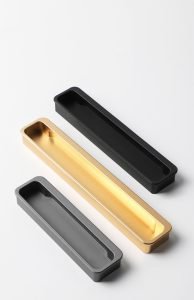
Every week, our sales team fields the same question from furniture factory buyers across Southeast Asia: “How many handles should I order?” Get it wrong, and you either drown in dead stock or halt your production line waiting for resupply.
Furniture factories set order quantity and batch size for aluminum cabinet door handles by balancing demand forecasts, ordering costs, holding costs, and supplier MOQ requirements. Most factories use a mix of Economic Order Quantity formulas, product lifecycle staging, and supplier negotiation to find the sweet spot that keeps production flowing without tying up excess capital.
Below, we break down the exact methods factories use — from calculating optimal order sizes to finding low-MOQ suppliers, managing stock levels, and requesting custom batch sizes Economic Order Quantity formulas 1. Each section draws on what we see daily at our Foshan facility serving furniture manufacturers and wholesalers.
How can I calculate the best order quantity for my furniture factory's aluminum handles?
Getting the math right on handle orders is one of those things that separates profitable factories from the ones constantly firefighting B2B platforms 2. We have seen buyers order 10,000 pieces of a handle style that sold 500 units in six months — a painful lesson in overcommitting.
The best way to calculate order quantity is by applying the Economic Order Quantity (EOQ) formula, which factors in your annual demand, cost per order, and holding cost per unit. For most mid-size furniture factories, the ideal order lands between 500 and 3,000 pieces per SKU per cycle, adjusted by sales velocity and storage capacity.
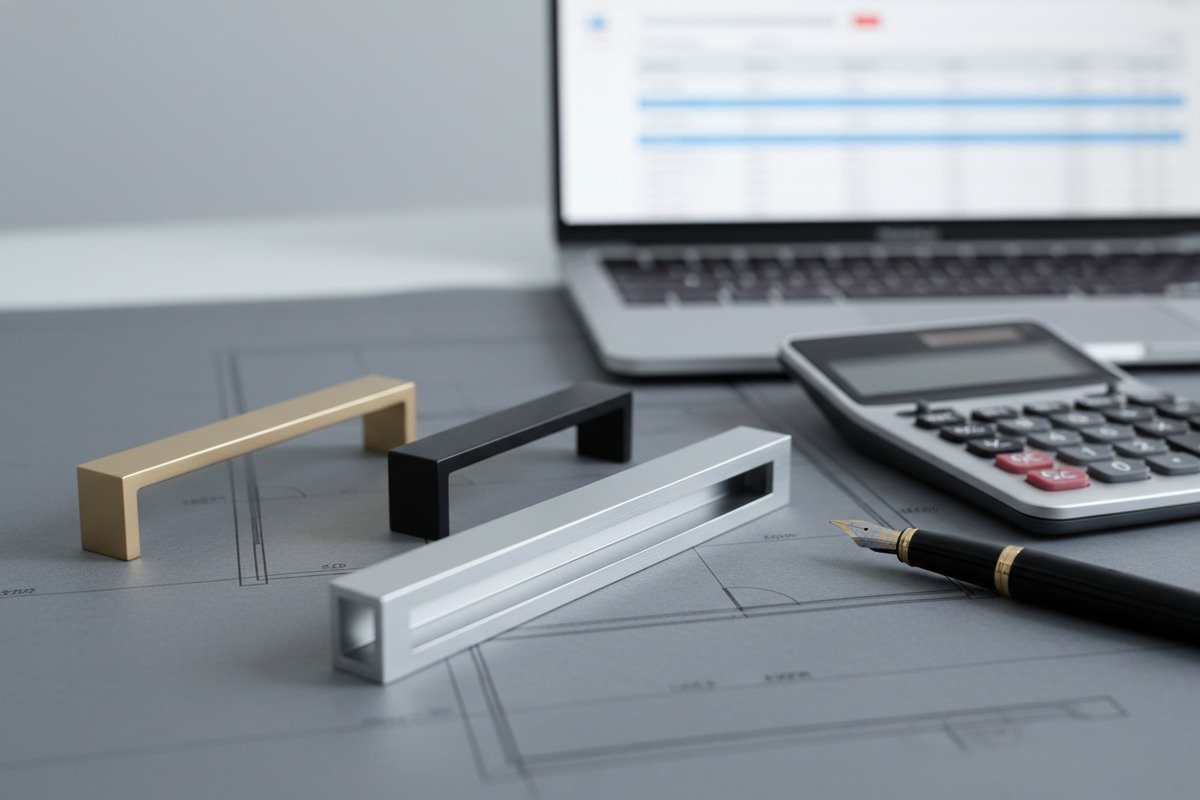
Understanding the EOQ Formula
The Economic Order Quantity formula is straightforward:
EOQ = √(2DS / H)
Where:
- D = Annual demand (units per year)
- S = Ordering cost per order (shipping, admin, inspection fees)
- H = Holding cost per unit 3 per year (warehousing, insurance, depreciation)
Let's say your factory uses 6,000 pieces of a particular brushed aluminum finger pull per year. Each order costs you roughly $150 in shipping and admin fees from China. Your holding cost per handle is about $0.20 per year. Plugging those numbers in:
EOQ = √(2 × 6,000 × 150 / 0.20) = √9,000,000 = 3,000 pieces
That means your optimal order size is around 3,000 handles per batch.
Practical Adjustments Beyond the Formula
The formula gives you a starting point, but real life adds layers. Here is what we tell our factory clients to consider:
- Sales velocity matters most. If a champagne gold edge-pull handle is your best seller, order deeper. If a niche matte black profile sells slowly, keep the batch small.
- Storage constraints. A factory with limited warehouse space cannot stock 10,000 handles even if the math says so.
- Cash flow cycles. Tying up $5,000 in handle inventory when you need that cash for wood panels is a bad trade.
- Supplier price breaks. Many suppliers — including us — offer better unit pricing at certain quantity thresholds.
Sample Order Quantity Breakdown by Factory Size
| Factory Size | Monthly Handle Usage | Recommended Order Qty | Order Frequency |
|---|---|---|---|
| Small (5–20 workers) | 200–500 pcs | 500–1,000 pcs | Every 2–3 months |
| Medium (20–80 workers) | 500–2,000 pcs | 1,500–3,000 pcs | Monthly |
| Large (80+ workers) | 2,000–10,000 pcs | 5,000–10,000 pcs | Bi-weekly to monthly |
Don't Forget the Safety Stock Buffer
We always recommend adding a safety stock of 10–15% above your calculated EOQ. safety stock buffer 4 Supply chains between China and Southeast Asia can face unexpected delays — port congestion, holidays, or raw material shortages. That buffer keeps your assembly line running when a shipment arrives three days late.
From our experience, the factories that calculate their orders methodically spend 15–20% less on handle procurement annually compared to those that just guess.
Where can I find a China supplier that offers low MOQ for my custom cabinet profiles?
Finding a supplier who will accept small orders for custom aluminum profiles without charging you a fortune — that is the real challenge. When we first started working with furniture factory buyers in Malaysia and Thailand, many told us they had been turned away by suppliers demanding 5,000-piece minimums for simple customizations.
To find a low-MOQ China supplier for custom cabinet profiles, search B2B platforms like Alibaba and Made-in-China, attend Canton Fair or furniture hardware expos, and contact Foshan-based manufacturers directly. Suppliers with ready stock programs and flexible tooling — like those offering 200–500 piece MOQs — are your best bet for small custom runs.
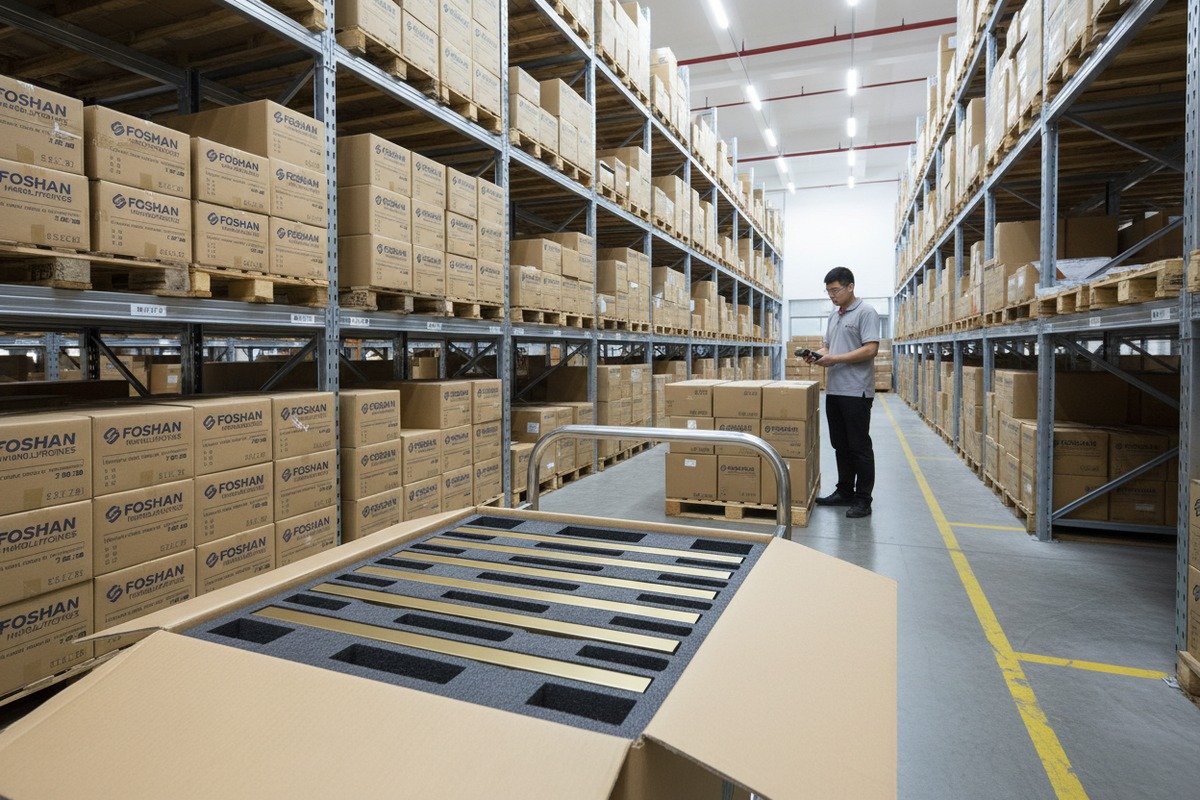
Why MOQ Varies So Much Among Chinese Suppliers
MOQ is not arbitrary. It reflects a supplier's production setup, material sourcing, and margin structure. Here is a quick breakdown:
| Factor | High-MOQ Supplier (5,000+) | Low-MOQ Supplier (200–500) |
|---|---|---|
| Production model | Large-batch extrusion runs | Flexible small-batch or stock-based |
| Tooling cost | Spread across big orders | Absorbed or charged separately |
| Target customer | Large OEM factories | Small-to-mid factories, wholesalers |
| Customization | Full custom only | Semi-custom + standard options |
| Lead time | 30–45 days | 7–15 days (if from stock) |
Where to Search
B2B Platforms: Alibaba, Made-in-China, and Global Sources all list thousands of handle suppliers. Filter by MOQ and look for "ready to ship" badges. But be careful — listed MOQs are often negotiable. Message the supplier directly.
Trade Fairs: Canton Fair 5 (Phase 2 covers building materials), CIFF Guangzhou, and Interzum Guangzhou are the best places to meet handle manufacturers face to face. You can see samples, discuss custom options, and negotiate MOQ on the spot.
Direct Outreach to Foshan Manufacturers: Foshan is the hardware capital of China. Many small-to-mid manufacturers here — our facility included — keep popular profiles in stock and can ship within days. We maintain inventory of best-selling finishes like champagne gold, matte black, and brushed silver specifically so that buyers do not have to wait weeks or meet unreasonable minimums.
Tips for Negotiating Lower MOQ
- Start with standard profiles. If you choose from existing molds, the supplier avoids tooling costs and can offer lower minimums.
- Combine SKUs. Order 200 pieces each of five different handle styles in the same finish. The combined volume may qualify you for better terms.
- Offer repeat business. A supplier is more willing to flex on MOQ if they see a long-term partnership ahead.
- Pay for tooling upfront. For truly custom designs, offering to cover the mold cost separately lets the supplier accept a smaller first batch.
Red Flags to Watch For
Avoid suppliers who refuse to send samples, who quote unrealistically low prices, or who cannot provide factory audit reports 6. A low MOQ means nothing if the quality gap between the sample and the bulk order is wide — a pain point we hear about constantly from buyers switching to our factory after bad experiences elsewhere.
How do I balance my stock levels to avoid long lead times for my handle orders?
Long lead times are production killers. We once had a furniture factory client in Vietnam who ran out of a specific edge-pull handle mid-project. The replacement order took 35 days by sea. That factory lost a week of assembly output — and the trust of their end buyer.
To balance stock levels and avoid long lead times, furniture factories should maintain a safety stock of high-turnover handles, use reorder point calculations based on lead time and daily usage, and partner with suppliers who offer ready-to-ship inventory. A hybrid approach — stocking best-sellers while ordering slow-movers on demand — delivers the best results.
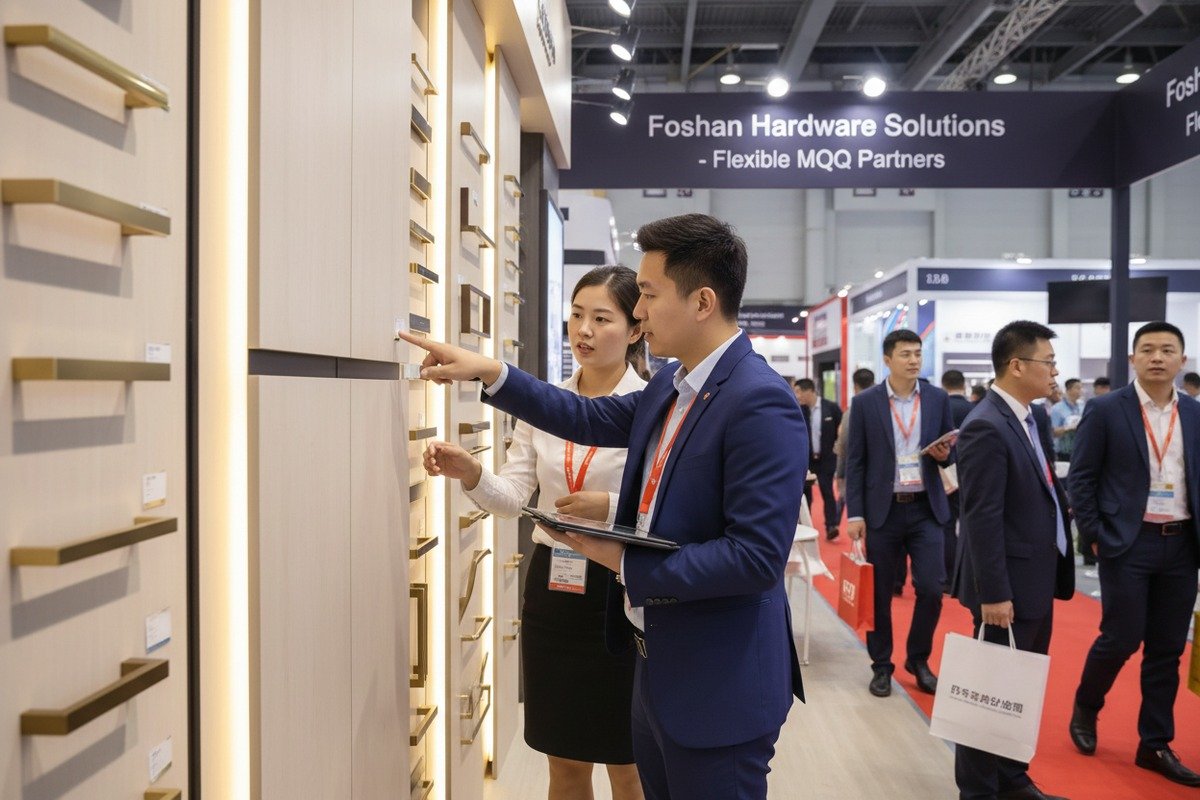
The Reorder Point Formula
The reorder point tells you exactly when to place your next order so new stock arrives before you run out: Reorder Point Formula 8
Reorder Point = (Daily Usage × Lead Time in Days) + Safety Stock
If your factory installs 50 champagne gold finger pulls per day and your supplier's lead time is 14 days, with a safety stock of 200 pieces:
Reorder Point = (50 × 14) + 200 = 900 pieces
When your inventory hits 900, place the order. Simple, but effective.
Categorize Your Handles with ABC Analysis
Not every handle deserves the same inventory treatment. ABC analysis 9 groups your SKUs by value and usage:
| Category | Description | Inventory Strategy | Example |
|---|---|---|---|
| A items | Top 20% of SKUs, 80% of usage value | High safety stock, frequent reorders | Best-selling champagne gold edge pull |
| B items | Next 30% of SKUs, 15% of usage value | Moderate safety stock, monthly review | Standard brushed silver T-bar handle |
| C items | Bottom 50% of SKUs, 5% of usage value | Minimal stock, order on demand | Specialty matte black recessed pull |
This approach prevents you from over-investing in slow-moving items while ensuring your production line never stalls on the handles you use most.
Strategies That Work in Practice
Keep a rolling 30-day stock of A items. These are your bread-and-butter handles. Running out of them is not an option. Work with your supplier to set up scheduled shipments so restocking happens automatically.
Use a Just-in-Time approach for C items. If you only use 100 pieces of a specialty handle per quarter, there is no reason to warehouse 500. Order them when the project comes in. The key is having a supplier who can turn around small batches quickly.
Leverage supplier stock programs. At our warehouse in Foshan, we keep popular handle profiles — like the minimalist recessed pulls and low-profile edge mounts shown in our catalog — in ready-to-ship condition. Buyers in Southeast Asia can get them in 7–10 days instead of the usual 30–45 day production cycle. This alone eliminates most lead time anxiety.
Track your data. Even a basic spreadsheet that logs monthly usage per SKU gives you the visibility to spot trends and adjust orders before a shortage hits. Advanced factories use ERP or MRP systems for real-time tracking, but you do not need expensive software to start.
The Hidden Cost of Running Out
Stockouts do not just delay your production. They cascade. Your workers sit idle. Your end customer gets frustrated. You may rush-order at premium shipping rates to catch up. We have seen factories pay three times the normal freight cost for air-shipped handles just to meet a deadline. That is money you never recover.
Planning ahead — even with rough estimates — always costs less than reacting to a crisis.
Can I get custom batch sizes that align with my specific furniture production needs?
This is the question we hear most from factory owners building to order rather than building to stock. When you produce 300 kitchen cabinet sets per month with a specific handle configuration, a rigid MOQ of 5,000 pieces makes no sense. You need exactly what your production schedule demands — no more, no less.
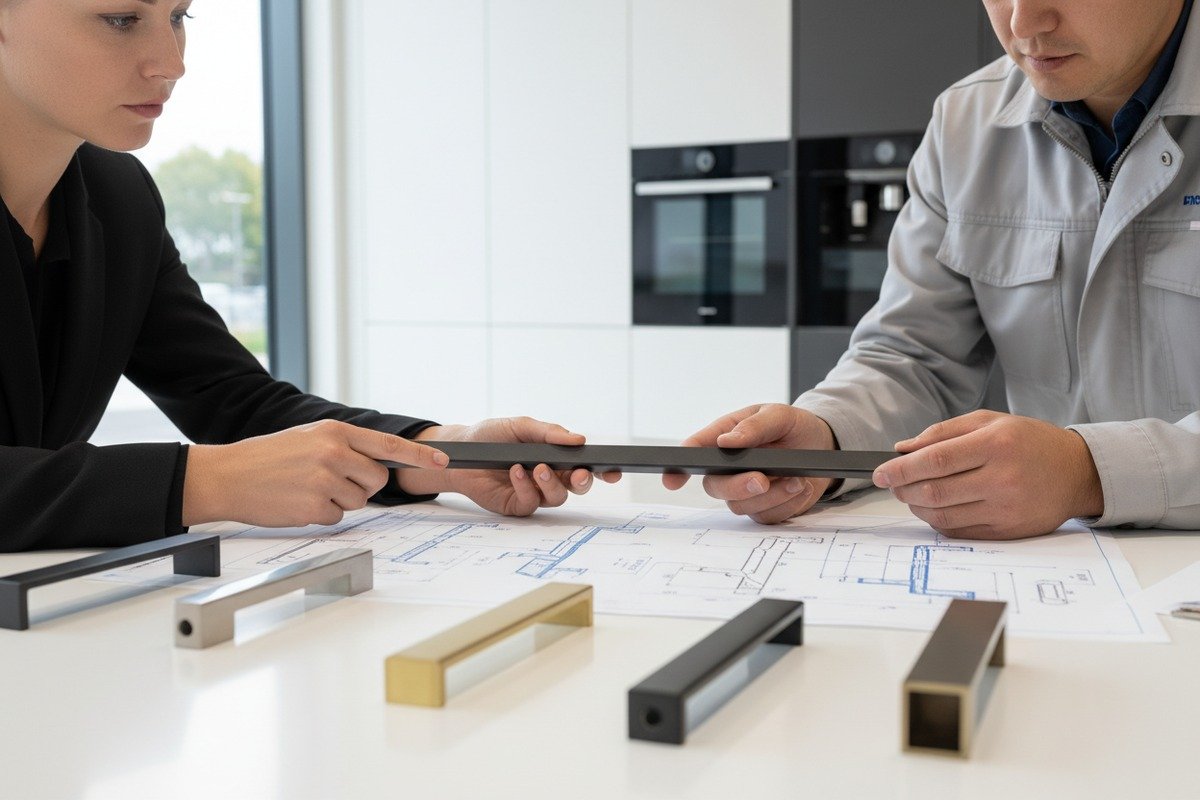
Yes, many aluminum handle suppliers offer custom batch sizes tailored to your production schedule. The key is choosing a supplier with flexible manufacturing cells, existing tooling for your profile type, and a willingness to work on a per-project or per-production-run basis. Batch sizes as small as 200–500 pieces are achievable with the right partner.
What Makes Custom Batch Sizes Possible
Traditional aluminum extrusion runs 10 favor large batches because the setup time for dies and finishing equipment is significant. However, not every order requires a fresh extrusion run. Here is how flexible suppliers make small custom batches work:
Pre-extruded stock profiles. If your handle design matches or closely resembles an existing profile — like our popular minimalist edge-mount or recessed finger pull — the extrusion is already done. The supplier only needs to cut to length, finish the surface, and pack. This dramatically reduces both the minimum batch size and the lead time.
Modular finishing lines. Factories that can switch between anodizing colors, powder coating, or brushed finishes quickly can handle small runs without wasting time on lengthy changeovers. Our facility, for example, can switch finish colors within a single shift, making it practical to run 300 champagne gold handles followed by 200 matte black handles on the same day.
Shared tooling. If five different buyers all use the same base profile but with different lengths or finishes, the supplier can run one long extrusion batch and split it. You get a small custom order; the supplier gets production efficiency.
How to Request Custom Batches from Your Supplier
- Share your production schedule. Tell your supplier how many units you need per month or per project, which finishes and lengths you require, and your delivery windows.
- Ask about existing profiles. Before requesting a fully custom design, check if the supplier already has a die that matches your needs. This saves tooling fees and drops MOQ dramatically.
- Negotiate a blanket order. Commit to an annual volume but receive shipments in smaller monthly or bi-monthly batches. This gives the supplier forecasting certainty while giving you inventory flexibility.
- Request a production calendar alignment. Some suppliers will slot your small batch into a larger production run of the same profile for another client, reducing your per-unit cost.
When Full Customization Is Worth It
For high-end or bespoke furniture lines, a unique handle design can become a brand signature. In those cases, investing in custom tooling (typically $300–$800 for a new extrusion die) makes sense — even for modest volumes. The tooling is a one-time cost, and once the die exists, your supplier can run batches of any size.
We have worked with several designers in the Middle East who commissioned custom handle profiles for luxury kitchen lines. Their first order was only 500 pieces, but the repeat orders over 18 months totaled over 8,000 — more than justifying the initial tooling investment.
Matching Batch Size to Product Lifecycle
Your handle batch strategy should evolve as your furniture product matures:
| Product Stage | Recommended Batch Strategy | Reasoning |
|---|---|---|
| New launch | Small test batch (200–500 pcs) | Validate market demand before committing |
| Growth phase | Medium batches (1,000–3,000 pcs) | Scale up to meet rising orders |
| Mature / stable | Optimized EOQ batches | Costs are predictable, demand is steady |
| Declining / phase-out | Minimum viable batches (100–300 pcs) | Avoid leftover inventory of outgoing styles |
This lifecycle-based approach prevents you from getting stuck with thousands of handles for a furniture line that is being discontinued — a mistake that costs more factories money than they like to admit.
Conclusion
Setting the right order quantity and batch size for aluminum cabinet door handles comes down to knowing your numbers, choosing the right supplier, and staying flexible. Whether you calculate with EOQ, negotiate low MOQs, manage stock with reorder points, or request custom batches aligned to your production — every decision protects your margins and keeps your line moving.
Footnotes
1. Explains the concept and formula of Economic Order Quantity. ↩︎
2. Defines B2B platforms and their role in facilitating commercial exchanges between businesses. ↩︎
3. Defines and explains the calculation of holding cost per unit. ↩︎
4. Replaced with a working and updated article from the original domain explaining safety stock. ↩︎
5. The original URL is now accessible and is the official website for the Canton Fair. ↩︎
6. Replaced with a working and comprehensive article on factory audits, including definition, process, and types. ↩︎
7. Highlights Foshan as a leading manufacturing hub for furniture and building materials. ↩︎
8. Explains the reorder point formula and its role in inventory management. ↩︎
9. Describes ABC analysis as an inventory categorization technique for prioritization. ↩︎
10. Explains the process of aluminum extrusion, a common manufacturing method. ↩︎