Every year, our production lines in Foshan ship thousands of aluminum handles to Indonesia — and the number one question buyers ask us is which style and color will actually sell anodized or powder-coated finishes 1. The challenge is real: Indonesia’s market mixes modern urban tastes with tropical durability demands, and getting it wrong means dead stock sitting in your warehouse.
To choose the right aluminum furniture cabinet handles for Indonesia, match sleek modern styles like C-shaped, G-profile, or recessed pulls with anodized or powder-coated finishes in brushed silver, matte black, or champagne gold. Prioritize corrosion-resistant coatings for Indonesia’s high humidity and source from suppliers offering low MOQ customization.
In this guide, I will walk you through style selection, color strategy, sourcing from China, and quality testing — all based on what we have seen work across hundreds of Indonesian wholesale orders. Let’s get into the details.
How do I choose the most popular aluminum handle styles for my furniture projects in Indonesia?
When we review order data from our Indonesian distributors, clear patterns emerge in what sells and what collects dust. Style choice is not guesswork — it follows cabinet type, room function, and buyer demographics.
The most popular aluminum handle styles in Indonesia include double-hole C-shaped pulls for kitchen cabinets, G-shape profile strips for modern wardrobes, recessed finger pulls for minimalist designs, and D-shape bars for general furniture. Choose based on cabinet size, door type, and your target buyer's aesthetic preference.
Understanding the Core Handle Styles
Not every handle fits every cabinet. Here is a breakdown of the main styles we produce and export to Southeast Asia.
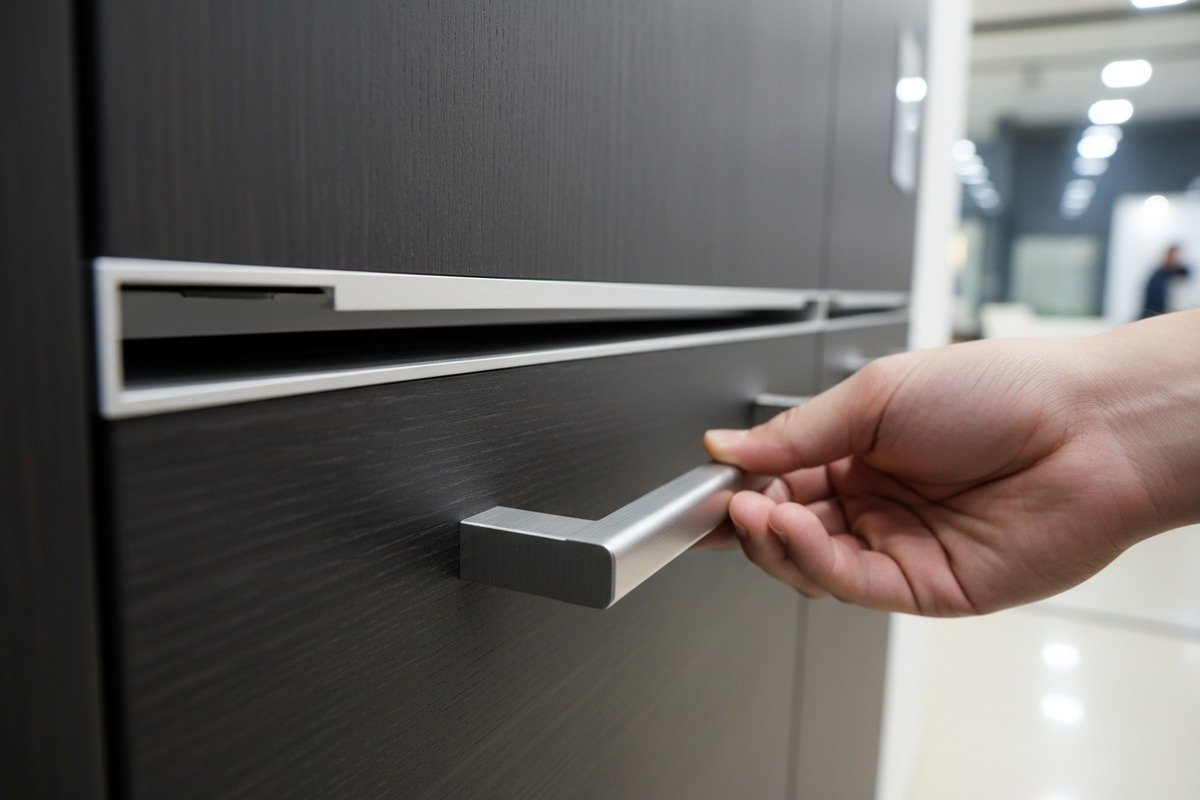
Double-hole straight and C-shaped handles remain the best sellers. They offer a stable two-point grip and work well on medium to large cabinet doors. Urban Jakarta buyers prefer the slim, rectangular versions. These handles typically come in lengths from 96mm to 256mm center-to-center.
G-shape and profile handles are gaining ground fast. These mount along the top or bottom edge of a cabinet door, creating a seamless look. European-style kitchen sets drive this trend. Our clients in Surabaya and Bandung have doubled their orders for G-profile strips in the past two years.
Recessed or built-in handles sit flush with the door surface. They eliminate protrusion entirely. This makes them ideal for households with children and tight kitchen layouts common in Indonesian apartments. They look clean. They feel modern. They sell well online through Shopee and Tokopedia 2.
D-shape bar handles serve as a versatile middle ground. They are simple to install and comfortable to grip. Furniture factories use them across drawer units, bathroom vanities, and office furniture.
Matching Handle Style to Cabinet Type
| Cabinet / Furniture Type | Best Handle Style | Why It Works |
|---|---|---|
| Kitchen wall cabinets | C-shaped or G-profile | Easy grip at height; sleek appearance |
| Kitchen base cabinets | Double-hole straight bar | Strong pull force for heavy doors |
| Wardrobe sliding doors | Recessed finger pull | Flush design prevents snagging on clothes |
| Bathroom vanities | D-shape bar | Corrosion-resistant 3; simple to clean |
| Compact apartment drawers | Single-hole knob or short bar | Space-saving; proportional look |
| European-style full kitchen sets | G-shape profile strip | Seamless integration across door rows |
Protruding vs. Recessed: The Safety Debate
There is a genuine trade-off here. Protruding handles like C-shaped and D-shape bars offer a firm, comfortable grip. They are easier to operate, especially for elderly users. But in narrow Indonesian kitchens — common in apartment complexes across Jakarta and Bekasi — they can catch clothing or bump hips.
Recessed handles solve this problem entirely. However, they require more precise routing during cabinet production. If your factory does not have CNC capability 4, recessed handles add cost and complexity. Our recommendation for most Indonesian wholesalers is to stock both types: protruding for standalone furniture, recessed for built-in kitchen systems.
Brands like NAIERDI and Häfele push both categories in Indonesia, but our LiliTONG profiles offer the customization flexibility that smaller furniture factories need — custom lengths, included screws, and no excessive MOQ requirements.
Which handle colors will help my products stand out in the competitive Indonesian market?
Color decisions can make or break a product line. We have seen Indonesian distributors reorder champagne gold handles three times in a year while identical handles in polished chrome sat unsold. The market speaks clearly through sales data.
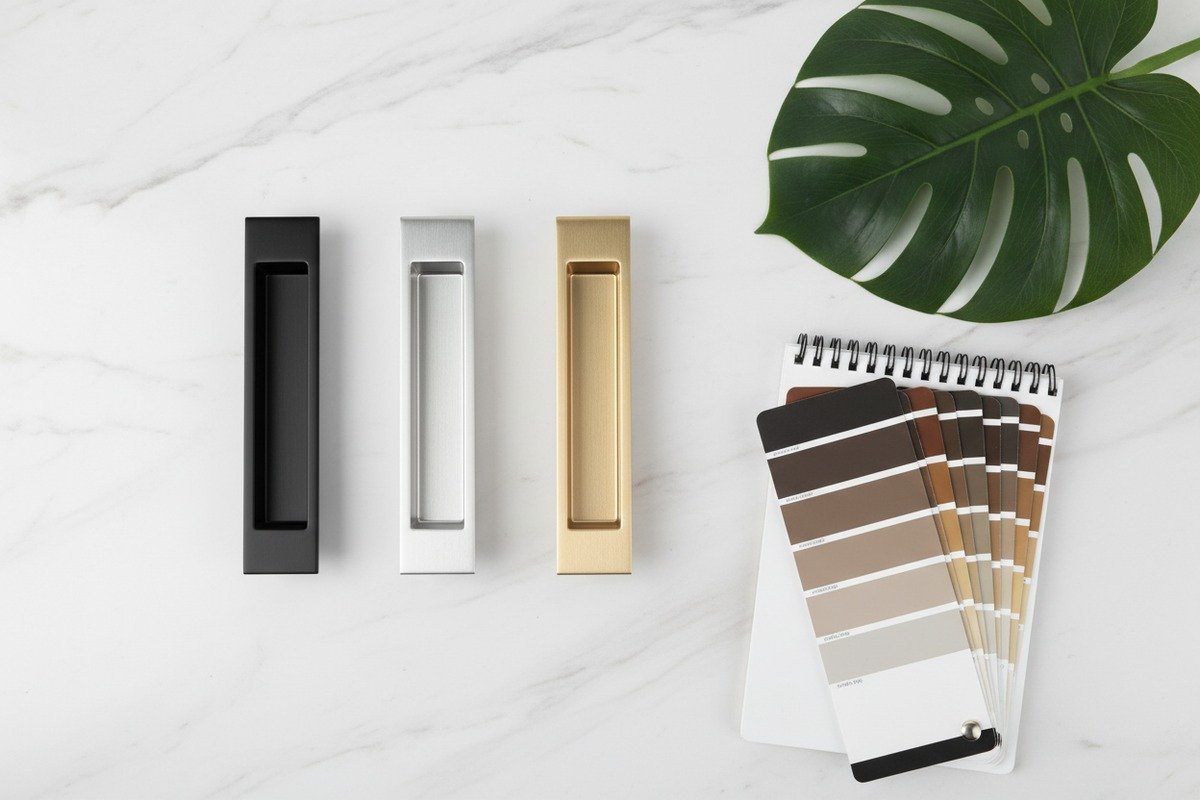
Brushed silver, matte black, and champagne gold are the top-performing aluminum handle colors in Indonesia. Brushed silver suits modern minimalist kitchens, matte black appeals to urban apartment buyers seeking bold contrast, and champagne gold matches the warm wood tones popular in Indonesian furniture. Anodized finishes outperform paint in humidity resistance.
The Color Landscape in Indonesia
Indonesian buyers are not monolithic. A furniture factory in Jakarta targeting young apartment dwellers needs different colors than a wholesaler in Bali serving villa developers. Here is what we observe from our order patterns.
Brushed silver remains the safest bet. It is neutral, professional, and hides fingerprints well. About 45% of our Indonesian orders specify brushed silver or anodized silver finishes. It works with white, grey, and wood-tone cabinets equally well.
Matte black is the fastest-growing color segment. American-style cabinet designs have surged on Tokopedia, where black aluminum alloy handles sell around Rp101,000 per piece. Black creates contrast against light cabinetry and suits the industrial-modern aesthetic trending in co-working spaces and urban condos.
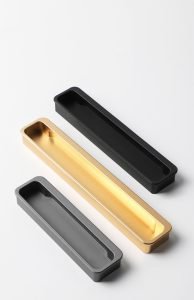
Champagne gold sits in a unique position. It bridges the gap between modern and traditional. Indonesian culture favors warm, harmonious tones, and champagne gold complements the teak and mahogany wood species 5 common in local furniture. Our three-piece handle set in champagne gold with recessed channel design has become one of our most reordered items for the Southeast Asian market.
Color and Finish Comparison
| Color / Finish | Best Paired With | Fingerprint Visibility | Humidity Resistance | Price Tier |
|---|---|---|---|---|
| Brushed silver (anodized) | White, grey, light wood cabinets | Low | Excellent | Mid |
| Matte black (powder-coated) | White, light oak, concrete-look surfaces | Medium-High | Very Good | Mid-High |
| Champagne gold (anodized) | Warm wood tones, cream cabinets | Low | Excellent | Mid-High |
| Polished chrome | Modern all-white kitchens | Very High | Good | Mid |
| Dark bronze | Traditional or rustic furniture | Low | Good | High |
The Fingerprint Factor
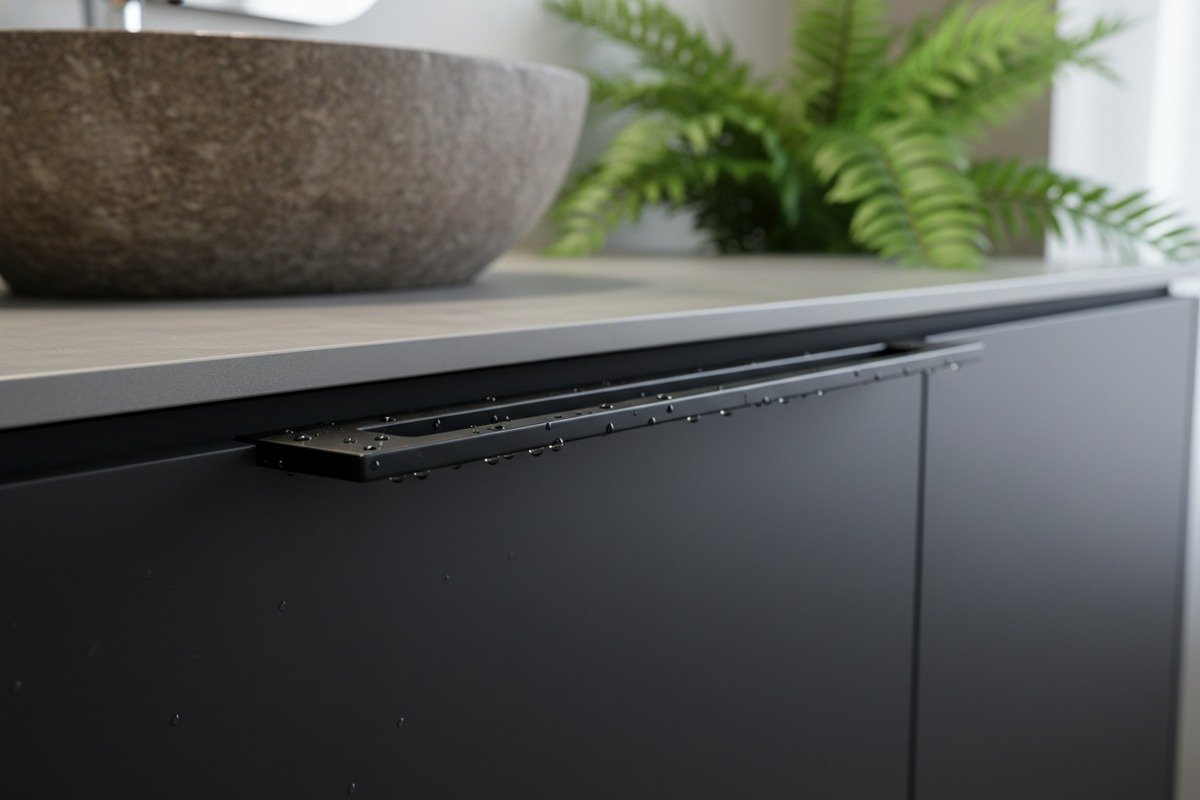
This is worth discussing honestly. Matte black handles look stunning in product photos and showrooms. But in daily use, they show fingerprints and water marks more than silver or gold finishes. For bathroom vanities and kitchen cabinets — where wet hands are constant — we advise our clients to either choose brushed silver or specify a fingerprint-resistant coating on black handles. Our powder-coating line can apply an anti-fingerprint clear coat that significantly reduces this issue.
Regional Color Preferences Within Indonesia
From what our distributors tell us, color preferences vary by city and island. Jakarta and Surabaya lean modern — black and silver dominate. Bali's hospitality market prefers champagne gold and bronze for villa furniture. Medan and Makassar show strong demand for classic silver across general furniture applications. Understanding your specific market within Indonesia matters more than following a national trend.
How can I source custom aluminum profiles from China that meet my specific design requirements?
Sourcing from China sounds simple until you face your first quality dispute or discover your "custom" order is actually a stock mold with your logo slapped on. Our team has helped hundreds of Southeast Asian buyers navigate this process, and there are clear steps that separate successful sourcing from expensive mistakes.
To source custom aluminum profiles from China, start by sending detailed drawings or samples to manufacturers with proven extrusion capability. Verify their factory with video calls or third-party audits. Request physical samples before bulk orders. Prioritize suppliers offering low MOQ, included hardware like screws, and flexible OEM/ODM services to match your specific design, size, and finish requirements.

Step 1: Define Your Specifications Clearly
Before contacting any supplier, prepare your requirements in writing. Include handle length, cross-section dimensions, mounting hole spacing, finish type, color, and quantity. If you have a reference photo or a competitor's product, share it. The more detail you provide upfront, the faster and more accurate your quotation will be.
Our engineering team works from CAD drawings 6, physical samples, or even rough sketches. We have developed custom G-shape profiles, edge-mount finger pulls, and elongated bar handles entirely from a buyer's concept photo and a WhatsApp conversation. But specificity saves time.
Step 2: Verify the Manufacturer
This is where many Indonesian buyers get burned. Not every Alibaba listing represents an actual factory. Trading companies add markup and reduce your control over quality. Here is how to verify:
- Request a factory video tour via WhatsApp or WeChat.
- Ask for their business license and export records.
- Check if they have their own extrusion presses and anodizing lines.
- Ask for references from other Southeast Asian buyers.
At our Foshan facility, we welcome video tours and have hosted Indonesian buyers on-site multiple times. A 30-person team with 18 years of experience means we control the process from die-making through final packing.
Step 3: Sample Before Bulk
Never skip the sample stage. Even if you have ordered similar handles before, a new mold or finish variation can produce unexpected results. Request 2-3 samples in your desired finish and color. Test the grip feel, screw fit, and surface quality yourself.
We ship samples within 5-7 days for stock profiles and 10-15 days for custom extrusions 7. Samples cost is typically refundable on bulk order placement.
Step 4: Negotiate MOQ and Lead Time
This is a major pain point for Indonesian furniture factories and distributors. Many Chinese suppliers set MOQs 8 at 1,000-5,000 pieces per style. For a small furniture workshop testing a new handle design, that is risky.
We have structured our production to support lower MOQs — often 200-500 pieces for stock profiles and 500-1,000 for custom extrusions. This lets our Indonesian clients test market response before committing to large volumes.
Common Sourcing Mistakes to Avoid
| Mistake | Consequence | How to Prevent |
|---|---|---|
| No physical sample requested | Color or size mismatch on arrival | Always order and approve samples first |
| Choosing lowest price only | Poor anodizing, rough edges, weak screws | Compare 3-4 suppliers; test samples |
| Unclear finish specification | Receiving polished when you wanted brushed | Use finish reference codes (e.g., "brushed anodized silver, AA15") |
| Ignoring screw compatibility | Handles arrive without matching screws | Confirm screw inclusion and thread size in PO |
| Skipping factory verification | Dealing with a trader, not a manufacturer | Request factory video, license, production photos |
The Value of OEM/ODM Partnership
Rather than treating sourcing as a one-time transaction, consider building a manufacturing partnership 9. When we work with Indonesian distributors long-term, we maintain their custom dies, hold buffer stock, and adjust designs based on their market feedback. This reduces lead times from 30 days to 7-10 days for repeat orders. It also means your products look distinct from what competitors buy off generic catalogs.
What should I look for to ensure the handle quality holds up in Indonesia's tropical environment?
Indonesia's climate is unforgiving to hardware. We have received photos from clients showing competitor handles with white oxidation spots after just six months of coastal use. That kind of failure destroys trust between a distributor and their furniture factory clients. Quality assurance starts before production, not after.
To ensure aluminum handles survive Indonesia's tropical climate, demand anodized or powder-coated finishes with a minimum 10-micron coating thickness. Test for salt spray resistance of at least 200 hours. Verify that screws are stainless steel or zinc-plated. Insist on edge smoothness and consistent color across batches to prevent field complaints and returns.
Why Indonesia's Climate Is a Handle Killer
Indonesia sits on the equator with average humidity between 70-90%. Coastal cities like Jakarta, Semarang, and Makassar add salt air exposure. Kitchens and bathrooms generate additional moisture and chemical contact from cleaning agents. Untreated or poorly treated aluminum handles will develop pitting, discoloration, or surface chalking within months under these conditions.
This is why finish quality matters more than handle design. A beautiful G-profile handle that corrodes is worse than a basic bar handle that lasts five years.
Key Quality Checkpoints
Here are the specific quality factors we control in our production and recommend our buyers inspect:
Anodizing thickness. Standard anodizing for interior use is 8-12 microns. For Indonesian applications, we recommend 10-15 microns minimum. Thicker anodizing means better corrosion resistance. We measure every batch with an eddy current coating thickness gauge.
Salt spray test results. The international standard (ASTM B117 10) uses salt spray chambers to simulate accelerated corrosion. A quality anodized aluminum handle should withstand 200+ hours without visible corrosion. Our standard products pass 240 hours. Ask your supplier for test certificates.
Surface consistency. Run your finger along the handle edge. It should be smooth with no burrs or sharp points. Check that the color matches across all handles in a batch — anodizing can vary between production runs if the process is not tightly controlled.
Screw quality. This is often overlooked. The handle itself may be excellent, but if the included screws are bare iron, they will rust within weeks in a tropical bathroom. We include stainless steel or zinc-plated screws with every handle — and we specify this in our product documentation.
Structural integrity. Handles should not flex or bend under normal grip force. Die-cast aluminum handles are generally stronger than thin-wall extruded profiles. For large wardrobe handles over 300mm, we recommend a wall thickness of at least 1.2mm.
Quick Quality Inspection Checklist
| Test | Method | Pass Criteria |
|---|---|---|
| Coating thickness | Eddy current gauge | ≥ 10 microns for anodized; ≥ 40 microns for powder coat |
| Salt spray resistance | ASTM B117 chamber | ≥ 200 hours, no white corrosion spots |
| Edge smoothness | Finger and visual inspection | No burrs, sharp edges, or rough spots |
| Color consistency | Compare 5 random pieces side by side | No visible color variation under daylight |
| Screw material | Magnet test (stainless is non-magnetic) | Stainless steel or confirmed zinc-plated |
| Grip strength | Apply 10kg pull force | No flex, no loosening at mounting points |
Maintenance Advice for End Users
Even the best-finished handle benefits from basic care. We include a simple maintenance card with our bulk shipments for Indonesian distributors to pass to their clients. The advice is straightforward: wipe handles monthly with a damp cloth, avoid abrasive cleaners, and dry after heavy moisture exposure. This extends handle life significantly and reduces warranty claims for your business.
The Real Cost of Poor Quality
When a handle fails in the field, the furniture factory blames the distributor. The distributor blames the supplier. Returns, replacements, and lost trust cost far more than the price difference between a properly anodized handle and a cheap alternative. In our 18 years of exporting, we have learned that mid-to-high-end quality is not a luxury — it is the minimum for building repeat business in tropical markets like Indonesia.
Conclusion
Choosing the right aluminum handles for Indonesia comes down to four decisions: pick styles that match your cabinet types, select colors your regional buyers prefer, source from a verified manufacturer, and insist on finishes that survive the tropics.
Footnotes
1. Explains the differences and applications of anodized and powder-coated finishes. ↩︎
2. Official website of the Indonesian e-commerce platform mentioned in the article. ↩︎
3. Found a comprehensive guide on corrosion-resistant coatings for aluminum applications from a reputable source. ↩︎
4. Found a working and relevant page on ‘What Is CNC Manufacturing?’ from the same domain as the original failed link. ↩︎
5. Compares the properties, durability, and aesthetic appeal of teak and mahogany wood. ↩︎
6. Defines Computer-Aided Design (CAD) and its use in creating precise technical drawings. ↩︎
7. Found a working and relevant page on ‘Custom Aluminum Extrusions & Profiles’ from the same domain as the original failed link. ↩︎
8. Explains Minimum Order Quantity (MOQ) and its importance in manufacturing and supply chain. ↩︎
9. Found a relevant article discussing different types of manufacturing partners, including OEM and ODM, which aligns with the original link’s context. ↩︎
10. Found the official ASTM International page for the ASTM B117 standard, providing the most authoritative source. ↩︎