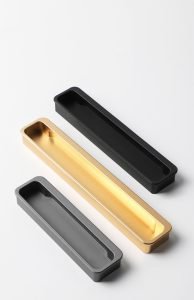
Over the past 18 years on our production floor in Foshan, we have seen buyers burned by suppliers who promised innovation but delivered stale, recycled designs months behind schedule. The frustration is real—you send a custom handle brief, wait weeks, and receive a prototype that looks nothing like the trend you are chasing. That gap between promise and delivery can cost you shelf space, client trust, and margin.
To evaluate a supplier’s R&D and innovation speed for aluminum cabinet handles, assess their engineering team credentials, prototyping turnaround time, patent portfolio, finish innovation history, and quality consistency under rapid iteration—using a weighted scorecard that balances innovation metrics with traditional KPIs like delivery and defect rates.
Below, we break down the four most common questions buyers ask when vetting a handle supplier’s R&D strength. Each section includes practical metrics, tables, and real-world checks you can apply before placing your next order.
How can I assess if a supplier's R&D team is capable of handling my complex OEM/ODM handle designs?
When our engineering team receives a complex edge-pull handle brief with tight tolerances and a custom champagne-gold PVD finish, the first question is always about feasibility—not price. Many buyers skip this step and jump straight to quoting, only to discover mid-production that the supplier lacks the metallurgical know-how for their chosen alloy or profile geometry.
Assess a supplier's OEM/ODM capability by reviewing their engineering team qualifications, Design for Manufacturing review process, mold development track record, alloy expertise in 6063-T5 or 6061-T6, and certifications like ISO 9001—then validate with a paid pilot prototype before committing to bulk.
Start with Team Credentials
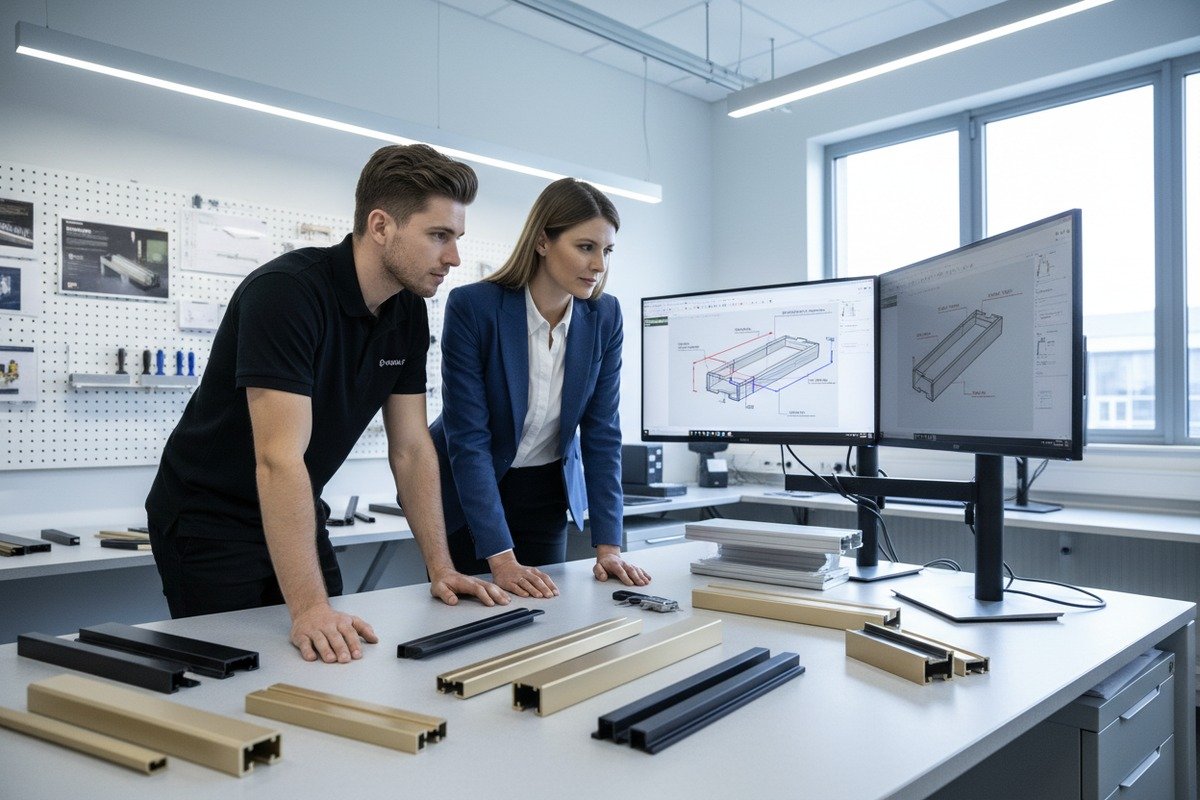
A capable R&D department is built on people, not just machines. Ask for the team roster. You want to see engineers with degrees in materials science or mechanical engineering, plus hands-on experience with aluminum extrusion 1 and CNC machining. On our floor, our lead engineers each carry over a decade of experience specifically in aluminum profile design for furniture hardware. That kind of specialization matters when your handle design calls for a recessed center channel with a 0.8 mm wall thickness.
Request a Design for Manufacturing Review
Any supplier can say "yes, we can make it." A strong supplier will push back—constructively. A proper DFM review identifies potential issues in your CAD file before tooling begins. They should flag draft angles, wall uniformity, and extrusion feasibility. If a supplier accepts every design without questions, that is a red flag, not a green one.
Check Mold Development History
Ask how many new molds the supplier developed in the last 12 months. A supplier doing 30+ new molds per year for handle profiles is clearly active in OEM work. A supplier doing 2–3 may be primarily a stock catalog operation.
Verify Alloy and Process Expertise
Not all aluminum is the same. For cabinet handles, 6063-T5 2 is the workhorse alloy—excellent extrudability, good corrosion resistance, and a beautiful anodized finish. If your design requires higher strength, 6061-T6 3 comes into play. Ask the supplier which alloys they stock, which they have extrusion dies for, and whether they run salt spray tests 4 on finished handles.
| Evaluation Criterion | What to Ask | Strong Answer | Weak Answer |
|---|---|---|---|
| Team qualifications | How many R&D engineers? What degrees? | 5+ engineers, materials/mechanical degrees | "Our boss handles design" |
| DFM review process | Do you review my CAD before tooling? | Yes, formal DFM report in 3 days | "We just follow your drawing" |
| Mold development volume | How many new molds last year? | 30+ new handle molds | Under 5 |
| Alloy knowledge | Which alloys for finger-pull handles? | 6063-T5 standard, 6061-T6 optional | "We use aluminum" |
| Certifications | ISO 9001 or equivalent? | Current ISO 9001, test reports available | No third-party certification |
Validate with a Paid Pilot
Never skip this step. Commission a single paid prototype. Measure it against your specs. Check the finish under daylight and LED. Test the mounting hardware. This one investment reveals more about R&D capability than any factory brochure ever will.
What indicators should I look for to ensure my manufacturer can provide fast prototyping for new handle styles?
In our production workflow, we track every prototype from brief to shipment. Some clients need a new sleek finger-pull sample in 10 days for a trade show; others have 6 weeks. Either way, the speed at which a supplier moves from concept to physical sample tells you everything about their operational agility—and whether they can keep up with fast-moving furniture trends.
Key fast-prototyping indicators include average sample turnaround time under 15 days, in-house CNC and extrusion capabilities, dedicated prototyping staff, a digital design-to-production pipeline, and a clear iteration policy—ideally with the first revision free within a defined scope.
Benchmark the Turnaround Time
Ask every prospective supplier one simple question: "How many calendar days from approved drawing to physical sample in my hands?" Record their answers. Industry benchmarks for aluminum handle prototyping typically fall between 7 and 21 days, depending on complexity. If a supplier quotes 30+ days for a simple linear pull, their process likely involves outsourcing key steps.
Look for In-House Capabilities
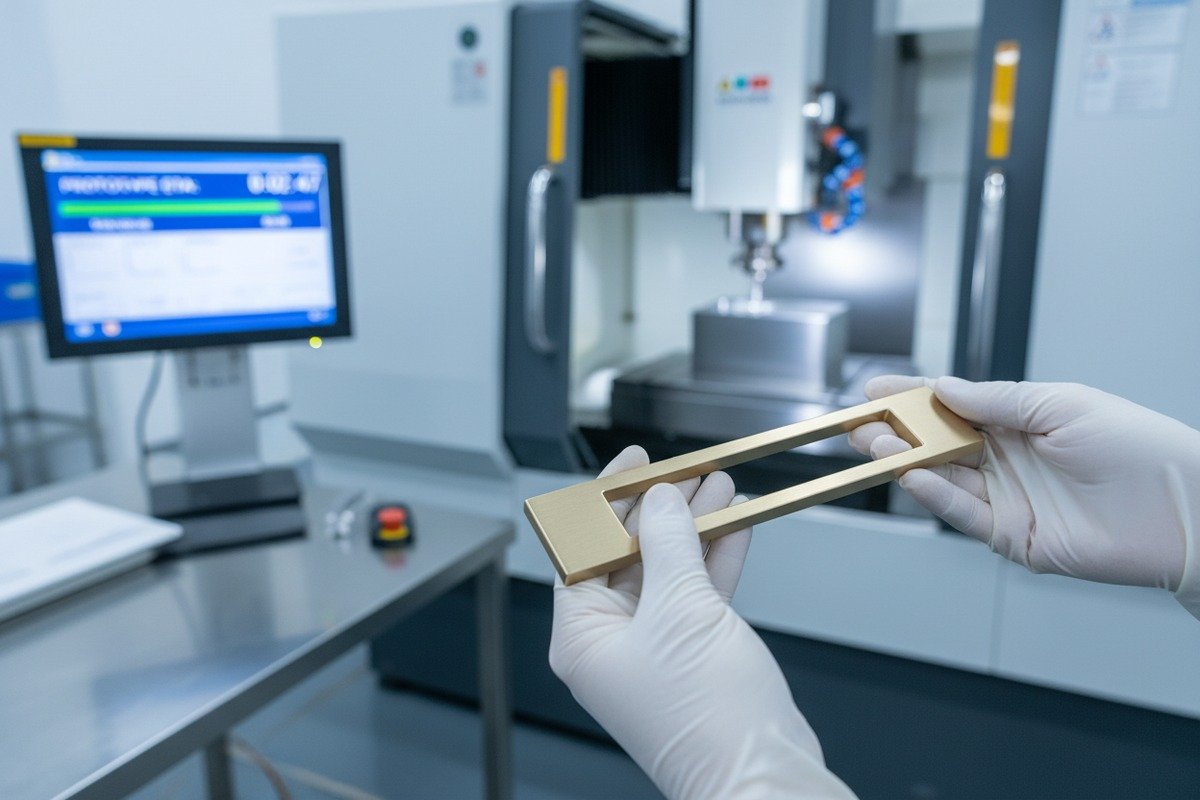
Speed comes from control. A supplier who extrudes, CNC-machines, finishes, and packs under one roof will always outpace a supplier who subcontracts three of those four steps. During our factory tours with Southeast Asian buyers, we walk them through each station—from the extrusion press to the anodizing line to the brushing and PVD chambers. Seeing everything connected eliminates doubt.
Evaluate Their Digital Pipeline
Modern fast-prototyping relies on digital tools. Ask whether the supplier uses CAD/CAM software for direct toolpath generation. Some advanced suppliers now use digital twin simulations 5 to predict extrusion behavior and handle stress distribution before cutting any metal. This cuts physical iteration cycles significantly.
| Prototyping Speed Indicator | Target Benchmark | Red Flag |
|---|---|---|
| Drawing to sample (simple pull) | 7–12 days | Over 25 days |
| Drawing to sample (complex OEM) | 12–18 days | Over 30 days |
| In-house extrusion | Yes | Outsourced |
| In-house CNC machining 6 | Yes | Outsourced |
| In-house surface finishing | Anodize, brush, PVD on-site | Only powder coat available |
| CAD/CAM digital pipeline | Direct file-to-machine workflow | Manual drawing translation |
| Iteration policy | 1st revision free within scope | Every change re-quoted |
Ask About Iteration Cycles
A prototype is rarely perfect on the first attempt. What matters is how quickly the supplier iterates. Ask: "If I request a dimensional change after the first sample, how many days for the revised sample?" Strong suppliers turn revisions in 3–5 days because the tooling and setup are already in place.
Confirm Dedicated Prototyping Resources
Some factories run prototypes on the same lines as mass production. That means your sample waits behind a 50,000-piece bulk order. Better suppliers maintain a dedicated prototyping cell—small-batch CNC machines, sample-grade finishing equipment, and an engineer assigned to each project. This separation is what makes 10-day turnarounds possible.
On our end, we keep a 3-person rapid sample team whose sole job is new product development. They do not touch bulk orders. That structural decision alone cut our average sample time from 18 days to 11 days over the past two years.
How do I verify if a supplier is consistently innovating their aluminum profile finishes to match current furniture trends?
Walking through furniture expos in Guangzhou and Kuala Lumpur over the years, we have watched finish trends shift dramatically—from high-gloss chrome to matte black, then champagne gold, and now textured brushed finishes that mimic natural materials. A supplier stuck offering only three basic anodized colors in 2025 is a supplier who stopped investing in their finishing line years ago.
Verify finish innovation by reviewing the supplier's new-finish launch frequency, requesting their latest finish sample card with dates, checking for PVD and electrophoresis capabilities, confirming trend-tracking practices through trade show participation, and comparing their catalog against current furniture market color palettes.

Request a Dated Sample Card
Every serious handle supplier maintains a physical finish sample card. Ask for one—and ask when each finish was added. A card with 20 finishes all labeled "2019" tells a different story than one showing 4–6 new finishes added in the last 18 months. On our latest sample card, we introduced a satin bronze and a gunmetal grey specifically because our Middle Eastern distributors reported surging demand for those tones in kitchen cabinetry.
Check the Finishing Technology Stack
Different finishes require different technology. Basic anodizing gives you silvers, blacks, and champagne. Electrophoretic coating 7 (e-coating) adds wood-grain and textured options. PVD (Physical Vapor Deposition) 8 opens the door to rose gold, titanium grey, and mirror-like metallics. Ask what equipment the supplier operates in-house.
| Finish Technology | Colors/Effects Possible | Innovation Signal | Typical Cost Premium |
|---|---|---|---|
| Standard anodizing | Silver, black, champagne, bronze | Baseline—expected | None |
| Electrophoretic coating | Wood-grain, matte textures | Moderate innovation | 10–15% |
| Powder coating | Any RAL color, textured matte | Moderate innovation | 5–10% |
| PVD coating | Rose gold, gunmetal, titanium | High innovation | 20–35% |
| Nano-coating | Anti-fingerprint, hydrophobic | Advanced innovation | 25–40% |
Evaluate Trend Awareness
Ask the supplier directly: "What are the top three handle finish trends you see for 2025–2026?" A strong supplier will name specific tones, reference recent furniture expos, and possibly show you client project photos. A weak supplier will say "whatever the customer wants." Both answers are revealing.
Look at Patent and Design Registrations
Some innovative suppliers file design patents 9 on unique finishes or surface treatments. While not every new finish warrants a patent, a portfolio of 5–10 design registrations in the past five years shows a culture of innovation, not just imitation. We filed two utility model patents last year for a proprietary anti-scratch brushed finish developed for our edge-pull handle line.
Assess Sustainability in Finishing
Forward-thinking suppliers are also innovating toward sustainability. Chrome-free anodizing, low-VOC powder coatings, and recycled aluminum compatibility are all signals of R&D investment. Buyers in Europe and increasingly in Southeast Asia now ask about these factors. If your supplier is ahead of the curve here, they are likely ahead on aesthetic innovation too.
Cross-Reference Against Market Demand
Pull up the latest cabinet hardware trends from Houzz, Pinterest, or major furniture trade publications. Compare the finishes you see trending with the supplier's catalog. If there is a significant mismatch—for example, matte black and brushed brass are dominating but the supplier only offers polished chrome and silver—their R&D is not tracking the market.
How can I evaluate whether a supplier's focus on innovation speed will affect the long-term quality of my bulk orders?
This is the question that keeps procurement managers awake at night. We hear it often from furniture factory buyers: "If you're rushing to innovate, how do I know my 20,000-piece order won't suffer?" It is a fair concern. Speed and quality are not natural allies—unless the supplier has built systems that make them compatible.
Evaluate the speed-quality balance by examining the supplier's quality management certifications, batch-to-batch consistency data, salt spray and stress test reports, defect rate trends during new product launches, and whether they separate R&D prototyping resources from mass production lines to prevent cross-contamination of priorities.
Understand the Speed-Quality Tension
Innovation speed becomes dangerous when it diverts engineering attention, machine time, or quality control resources away from existing bulk orders. A supplier running prototype trials on the same extrusion press filling your 15,000-unit order is a supplier creating risk. The solution is structural separation—and you can verify this during a factory audit.
Ask for Defect Rate Data During Launches
Here is a powerful question most buyers never ask: "What was your defect rate on bulk orders during your last three new product launches?" If the supplier tracks this data and can show stable defect rates (under 1.5%) even during busy R&D periods, their systems are working. If they cannot answer the question, that itself is your answer.
Review Testing Protocols
For aluminum cabinet handles, standard quality tests include:
- Salt spray testing: 48–72 hours minimum for anodized finishes; 200+ hours for PVD.
- Adhesion test: Cross-cut tape test per ASTM D3359 10 for coatings.
- Load test: Handle must withstand 15–20 kg pull force without deformation.
- Dimensional tolerance: ±0.1 mm on critical mounting points.
Ask the supplier which tests they run on every batch versus only on prototypes. A quality-focused supplier runs salt spray on random production samples, not just on the initial approval sample.
Use a Weighted Scorecard
The most effective way to balance innovation and quality is a structured scorecard. Below is a framework we recommend to our distributor clients when they are comparing potential handle suppliers.
| KPI Category | Weight | Metrics to Track |
|---|---|---|
| Quality | 30% | Defect rate, salt spray hours, dimensional accuracy |
| Delivery | 25% | On-time rate, lead time consistency |
| Innovation / R&D | 20% | New finishes per year, prototyping speed, patents |
| Cost competitiveness | 15% | Unit price, tooling costs, MOQ flexibility |
| Communication | 10% | Response time, proactive updates, issue resolution |
This 100-point framework lets you score each supplier objectively. A supplier scoring 90 on innovation but 60 on quality is a risk. A supplier scoring 80 on both is a partner.
Conduct a Phased Ramp-Up
Never jump from a successful prototype directly to your full order volume. Place a pilot batch of 500–1,000 units first. Measure the pilot against your specs. Only then release the full PO. This phased approach is especially important with innovative suppliers who may still be fine-tuning new processes.
Monitor Long-Term Consistency
Innovation-driven suppliers sometimes deliver an excellent first batch but struggle with consistency on the fourth or fifth reorder. Set up a simple incoming quality inspection checklist—color match against the original sample, dimension spot-check on 5% of units, and finish adhesion test on 3 random pieces. Track results over time. Consistency is the ultimate proof that innovation speed is not eroding quality.
On our production lines, we maintain a "golden sample" vault—physically archived approval samples for every active SKU. When a reorder arrives on the production schedule, the QC team pulls the golden sample and matches every batch against it, regardless of how many new products we launched in between.
Conclusion
Evaluating a handle supplier's R&D capability and innovation speed comes down to evidence—team credentials, prototyping timelines, finish technology, and quality data under pressure. Use structured scorecards, request dated samples, and always validate with pilot orders before scaling.
Footnotes
1. Explains the industrial process of shaping aluminum profiles. ↩︎
2. Replaced with a Wikipedia page providing a comprehensive overview of 6063 aluminum alloy, including its T5 temper, from an authoritative source. ↩︎
3. Replaced with a Wikipedia page offering a comprehensive overview of 6061 aluminum alloy, including its T6 temper, from an authoritative source. ↩︎
4. Explains a standard method for evaluating corrosion resistance. ↩︎
5. Introduces a modern technology for virtual product development. ↩︎
6. Describes a key manufacturing process for precision parts. ↩︎
7. Details a surface finishing technique for various aesthetic effects. ↩︎
8. Describes an advanced coating process for durable and decorative finishes. ↩︎
9. Replaced with an authoritative legal definition of design patents from the Legal Information Institute at Cornell Law School. ↩︎
10. Identifies a specific industry standard for testing coating adhesion. ↩︎