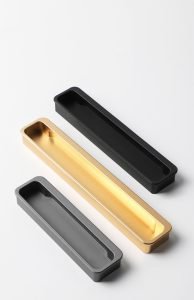
Every week, our sales team at the Foshan factory fields calls from frustrated wholesalers who just lost a big cabinet order because their previous handle supplier couldn’t deliver on time. The pain is real — stock-outs on popular aluminum finishes, samples that look nothing like the bulk shipment, and lead times that stretch from three weeks to three months without warning.
To evaluate supplier capacity for wholesale aluminum cabinet door handles, assess their production output, quality control systems, stock availability, customization capabilities, and industry experience. Request factory audits, trial orders, and certifications like ISO 9001 to verify claims before committing to a long-term partnership.
This guide breaks down the exact steps you can take to vet an aluminum handle supplier. We will cover quality verification 1, stock readiness, OEM/ODM capability, and technical support. Each section includes checklists, tables, and real-world benchmarks drawn from 18 years of manufacturing experience.
How can I verify if the supplier's mass production quality matches the samples I received?
We have seen it happen too many times on our production floor — a buyer approves a beautiful champagne gold finger pull sample, only to receive 5,000 units with uneven anodizing and rough edges. The gap between sample quality and mass production quality 2 is one of the biggest risks in wholesale hardware sourcing.
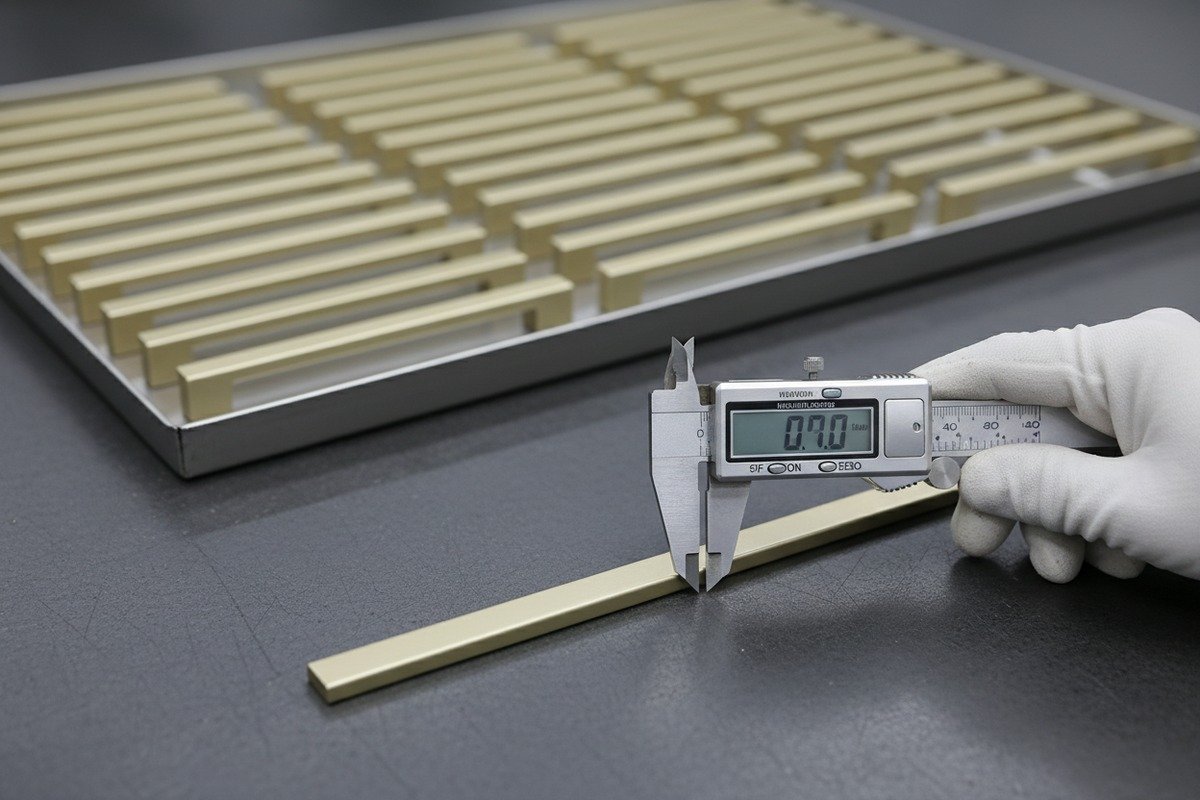
To verify mass production quality, request a trial order of 500–1,000 units before placing a full bulk order. Compare dimensions, finish consistency, and surface defects against the approved sample using calipers and visual inspection under standardized lighting conditions.
Why Samples Can Be Misleading
Samples are often made on dedicated equipment with extra care. A single handle might get hand-polished for 10 minutes. In mass production, that same handle gets 30 seconds on an automated line. The difference shows up in surface finish, edge smoothness, and dimensional accuracy 3.
Here is what to check when comparing samples to bulk production:
- Dimensional tolerance: Aluminum extruded handles should hold ±0.1mm. Measure length, width, depth, and mounting hole spacing on at least 20 random units from the trial batch.
- Surface finish: Look for scratches, pitting, or color variation. Brushed aluminum and champagne gold finishes are especially prone to batch-to-batch inconsistency if the anodizing bath chemistry 4 drifts.
- Structural integrity: Test the mounting points. A good handle should withstand 30kg of pull force without bending or cracking at the screw holes.
Set Up a Multi-Stage Quality Gate
Don't rely on a single inspection. Build quality checks into the process at multiple stages.
| Stage | What to Check | Who Does It |
|---|---|---|
| Raw material incoming | Aluminum alloy grade (6063-T5 typical), billet surface quality | Supplier QC team |
| Post-extrusion | Profile dimensions, straightness, wall thickness | Supplier QC + your inspector |
| Post-finishing | Color match (use RAL or Pantone reference), coating thickness (≥10μm for anodizing) | Third-party or your inspector |
| Pre-shipment | Random sampling per AQL 2.5, packaging integrity, labeling accuracy | Third-party inspection agency |
Request Objective Data
Ask the supplier for defect rate records 5. A reliable aluminum handle factory should maintain defect rates below 2% and first-pass yield above 95%. When we run our production lines, every batch gets logged — the extrusion date, the anodizing bath number, the operator on shift. If a supplier cannot produce this data, that is a red flag.
Also request material test certificates 6 for the aluminum alloy. Consistent mechanical properties (hardness, tensile strength) ensure every handle performs the same way when installed. If they use recycled aluminum content, confirm it meets the same alloy specifications.
A practical step: ask for a video walk-through of the production line during your order run. Many suppliers now offer real-time video calls to show in-process quality. This costs nothing and tells you more than any written report.
Can the factory provide enough ready-to-ship stock to reduce my lead times?
During peak renovation seasons, our warehouse team ships out over 10,000 handles per week to wholesalers across Southeast Asia and the Middle East. The difference between winning and losing a project bid often comes down to one question — do you have stock right now?
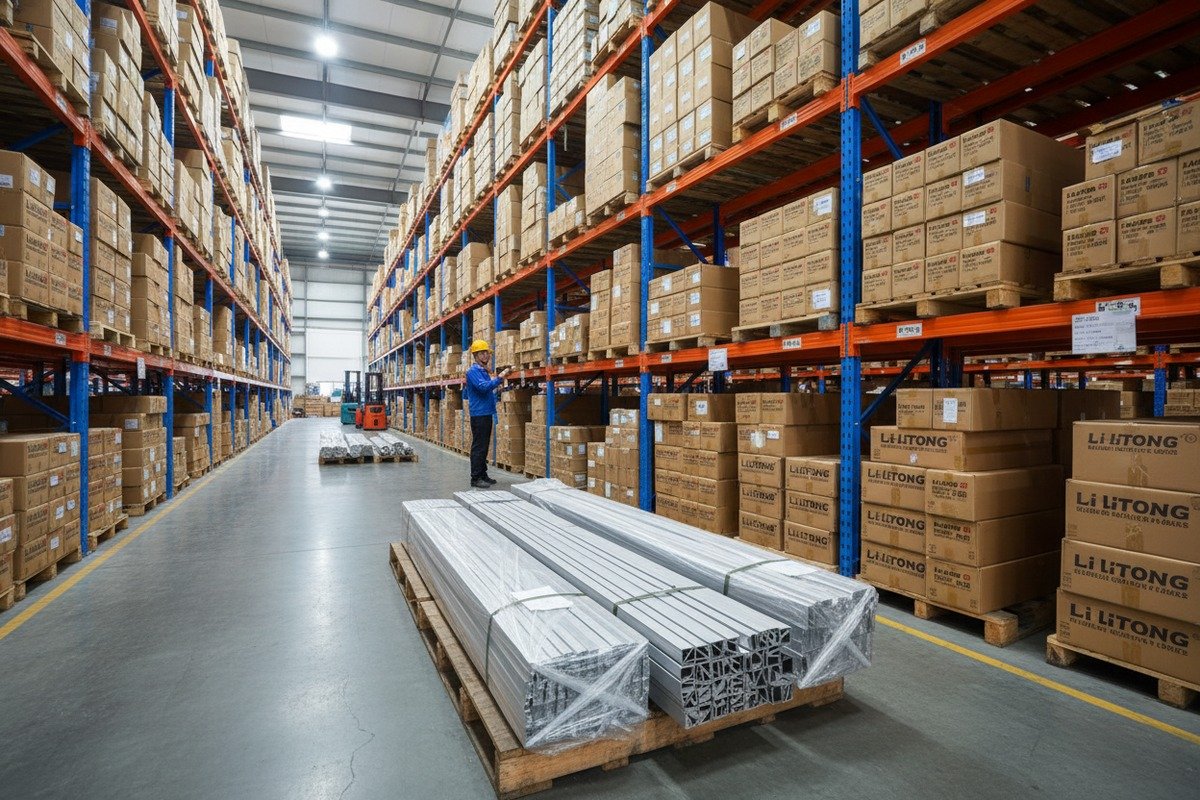
A capable supplier should maintain ready-to-ship inventory of popular aluminum handle models, typically covering 5,000–20,000 units of best-selling SKUs. This reduces lead times from the standard 15–25 days to just 3–5 days for in-stock items, helping wholesalers respond quickly to urgent orders.
Stock Availability Is a Competitive Advantage
For building material distributors, time is money. Your customer — the cabinet installer or furniture factory — won't wait six weeks for handles. They will switch to another supplier. Having a handle supplier with real inventory means you can promise fast delivery and keep your customers loyal.
But not all "in-stock" claims are real. Here is how to verify:
- Ask for a current stock list with quantities. Update it monthly. A trustworthy supplier will share exact SKU counts, not vague promises.
- Request photos or a virtual tour of the warehouse. Finished goods should be organized, labeled, and protected from scratches.
- Place a small urgent order. Ask for 200 units with 3-day shipping. If they deliver on time, their stock claim is credible.
Balance Between Stock and Custom Orders
Most wholesalers need a mix. You want popular finishes — brushed silver, champagne gold, matte black — available for immediate dispatch. But you also want custom lengths or special finishes for specific projects.
| Order Type | Typical Lead Time | MOQ | Best For |
|---|---|---|---|
| Ready stock (standard SKUs) | 3–5 days | 100–200 pcs | Urgent orders, repeat best-sellers |
| Semi-custom (stock profile + custom finish) | 10–15 days | 500 pcs | Project-specific color matching |
| Full custom (new profile + new finish) | 25–40 days | 1,000 pcs | New product development, OEM |
Watch for Hidden Lead Time Risks
A supplier might say "15-day lead time" but forget to mention that the clock starts only after raw material arrives. If they don't keep aluminum billets 7 in stock, add another 7–10 days. Ask explicitly:
- Do you stock raw aluminum billets or buy per order?
- What is your current production backlog?
- Can you handle a 2x volume surge within 10 business days?
At our facility, we keep a rolling 30-day supply of 6063-T5 billets specifically because we learned the hard way that billet shortages can cascade into 40-day delays. A supplier operating at 60–80% capacity utilization is ideal — they have room to absorb your spikes without pushing you to the back of the queue.
Also consider geographic logistics. A Foshan-based manufacturer with established freight routes to your market can shave 2–3 days off transit compared to a factory in a remote inland location.
How do I assess if a manufacturer can handle my custom OEM/ODM designs for aluminum profiles?
When a furniture factory in Indonesia sent us a hand-drawn sketch of a recessed edge-mount pull with a 7mm channel depth and a specific champagne gold tone, our engineering team turned it into a production-ready CAD file 8 within 48 hours. Not every factory can do that. Custom work requires specific tooling, expertise, and process flexibility.
Assess OEM/ODM capability by reviewing the supplier's in-house design team, mold-making capacity, prototyping speed, and range of finishing processes. A qualified manufacturer should deliver DFM feedback within 48 hours, produce aluminum profile prototypes within 7–10 days, and support CAD/STEP/IGS file formats.

What Custom Capabilities Actually Mean
"Customization" is a broad word. Some factories mean they can change the color. Others mean they can design entirely new extrusion dies and create profiles that don't exist anywhere else. Understand the difference.
There are three levels of customization for aluminum cabinet door handles:
- Surface-level: Same profile shape, different finish (color, texture, coating type). This requires no new tooling.
- Dimensional: Same general design, modified length or mounting spacing. May need minor die adjustment.
- Full OEM/ODM: Entirely new cross-section profile, new extrusion die, new surface treatment recipe. This requires tooling investment and engineering capability.
Key Questions to Ask About OEM/ODM
- Can you accept CAD drawings in DWG, STEP, or IGS formats 9?
- Do you have in-house die/mold making, or do you outsource it?
- What is the die cost, and is it refundable above a certain order volume?
- How many custom profiles have you developed in the past 12 months?
- Can you provide a DFM (Design for Manufacturability) review before prototyping?
Evaluate Their Finishing Range
For minimalist aluminum cabinet pulls — like the sleek, linear extruded finger pulls and low-profile edge-mount designs popular today — the finish makes or breaks the product. Your supplier must offer a full range.
| Finish Type | Process | Best For | Typical Thickness |
|---|---|---|---|
| Anodizing | Electrolytic oxidation | Champagne gold, silver, black | 10–25 μm |
| Powder coating | Electrostatic spray + bake | Matte colors, textured finishes | 60–80 μm |
| Electrophoresis | E-coat immersion | High corrosion resistance, wood grain | 15–25 μm |
| Brushing + clear coat | Mechanical abrasion + lacquer | Brushed aluminum, industrial look | N/A (surface texture) |
| Polishing | Mechanical buffing | Mirror chrome, high-gloss | N/A (surface texture) |
A factory with only anodizing cannot serve you long-term. You need a partner who can handle multiple finish types, because your customers will ask for variety. During our 18 years of production, the trend has shifted from simple silver anodizing to complex multi-tone finishes and wood-grain electrophoresis 10. A manufacturer stuck in one process era will limit your product range.
Prototyping and Iteration Speed
Speed matters in custom work. If a supplier takes 30 days to make one prototype, your product launch timeline stretches to 4–5 months. A competent aluminum hardware factory should:
- Provide DFM feedback within 2 business days
- Cut a new extrusion die within 7–10 days
- Produce first article samples within 3 days after die completion
- Complete finish samples within 5 days
Ask for a timeline chart before committing. And always get prototypes before approving mass production — especially for new profiles with recessed channels or complex geometries where tolerances matter.
Cross-reference their claims with their equipment list. A factory with CNC machining centers, wire-cut EDM machines for die making, and spectrometers for alloy verification has real capability. A factory that only lists "extrusion press" likely outsources the rest.
What technical support and industry experience should I look for in a long-term wholesale partner?
Over the past 18 years, our team has guided hundreds of wholesalers through product selection, installation troubleshooting, and market adaptation. The technical questions never stop — and they shouldn't. A good supplier relationship goes far beyond placing orders and receiving shipments.
Look for a supplier with at least 10 years of aluminum hardware experience, dedicated technical support staff, on-site installation guidance capability, and a proven track record serving your target market. They should proactively advise on material selection, finish durability, and compliance with regional standards.

Why Experience Matters More Than Price
A cheaper supplier with two years of experience might save you 5% per unit. But when you get a container of handles that don't fit your customer's cabinet frames, or when the finish starts peeling after six months in a humid climate, that 5% savings disappears — replaced by returns, refunds, and lost clients.
Industry experience shows up in subtle ways:
- Knowing that 6063-T5 alloy is better than 6061 for decorative handles because it anodizes more evenly
- Understanding that edge-mount pulls for frameless cabinets need tighter length tolerances than standard drawer pulls
- Recommending electrophoresis over powder coating for handles going into coastal or high-humidity markets
Technical Support Checklist
Here is what to evaluate when assessing a supplier's technical support capability:
| Support Area | What to Look For | Red Flag |
|---|---|---|
| Material guidance | Alloy recommendations by application | "We use standard aluminum" (no alloy details) |
| Finish advice | Climate-specific coating suggestions | Only one finish option available |
| Installation support | Mounting templates, screw specs, torque guidelines | "Just use any screw" |
| Compliance knowledge | Familiarity with Prop 65, REACH, RoHS as needed | No awareness of regional regulations |
| After-sales response | Reply within 24 hours, replacement policy for defects | No warranty, slow email responses |
| Market insight | Trend updates, new finish options, design suggestions | Same product catalog for 5+ years |
Assess Financial Stability and Reputation
A long-term partner must be financially stable. A factory that shuts down mid-order leaves you stranded. Check for:
- Annual revenue: Suppliers with $5M+ annual revenue typically have the stability to weather market downturns.
- Client references: Ask for 2–3 references from wholesalers in your region. Call them. Ask about on-time delivery, quality consistency, and communication responsiveness.
- Years in business: 10+ years indicates survival through multiple economic cycles. Our 18-year track record, for example, means we have navigated raw material price spikes, shipping disruptions, and demand swings — and we are still here.
Digital Infrastructure and Communication
In 2025 and beyond, your supplier should offer more than just email and phone. Look for:
- Real-time order tracking via a shared system or regular update reports
- Digital catalogs with 3D renders and specification sheets
- Inventory visibility so you can check stock levels before ordering
- WhatsApp or equivalent instant messaging for fast communication across time zones
A supplier who only communicates through slow email chains will create bottlenecks in your business. At our company, WhatsApp is the primary channel for most Southeast Asian and Middle Eastern buyers — because speed matters when a project deadline is two days away.
Sustainability and Forward Thinking
Increasingly, end consumers and large retail chains demand sustainability credentials. Ask your supplier about:
- Recycled aluminum content percentage (look for 30%+ post-consumer content)
- Energy-efficient extrusion and anodizing processes
- Waste reduction initiatives (aluminum scrap recycling rates should be 95%+)
- Environmental compliance certifications
A supplier who invests in sustainability is also signaling long-term thinking — they are not cutting corners today at the expense of tomorrow.
Build a Weighted Scorecard
To make your final decision objective, score your top 2–3 suppliers using a weighted matrix:
- Quality: 40%
- Capacity and delivery: 30%
- Cost competitiveness: 20%
- Technical support and experience: 10%
Adjust the weights based on your priorities. If customization is critical, shift more weight to technical support. If fast turnaround drives your business, emphasize capacity and stock availability.
The goal is not to find a perfect supplier. The goal is to find one who is strong where it matters most to your business — and honest about where they need to improve.
Conclusion
Evaluating a wholesale aluminum handle supplier takes effort, but it protects your business from costly mistakes. Check quality with trial orders, verify stock availability, test customization capability, and confirm technical expertise before signing any long-term agreement.
Footnotes
1. Explains the importance and methods of quality control in manufacturing. ↩︎
2. Discusses quality control strategies and challenges during mass production. ↩︎
3. Defines dimensional accuracy and its critical role in manufacturing, especially metalworking. ↩︎
4. Explains the importance of controlling anodizing bath chemistry for quality finishes. ↩︎
5. Details what defect rate is, how to calculate it, and its importance in manufacturing quality. ↩︎
6. Explains the purpose and importance of material test certificates for product quality and traceability. ↩︎
7. Describes the manufacturing process and importance of aluminum billets in industrial applications. ↩︎
8. Highlights the importance of manufacturing-ready CAD drawings for efficient production and reduced errors. ↩︎
9. Compares and explains common CAD file formats like IGES and STEP for data exchange. ↩︎
10. Explains electrophoretic coating (e-coating) process, benefits, and applications, including wood grain. ↩︎