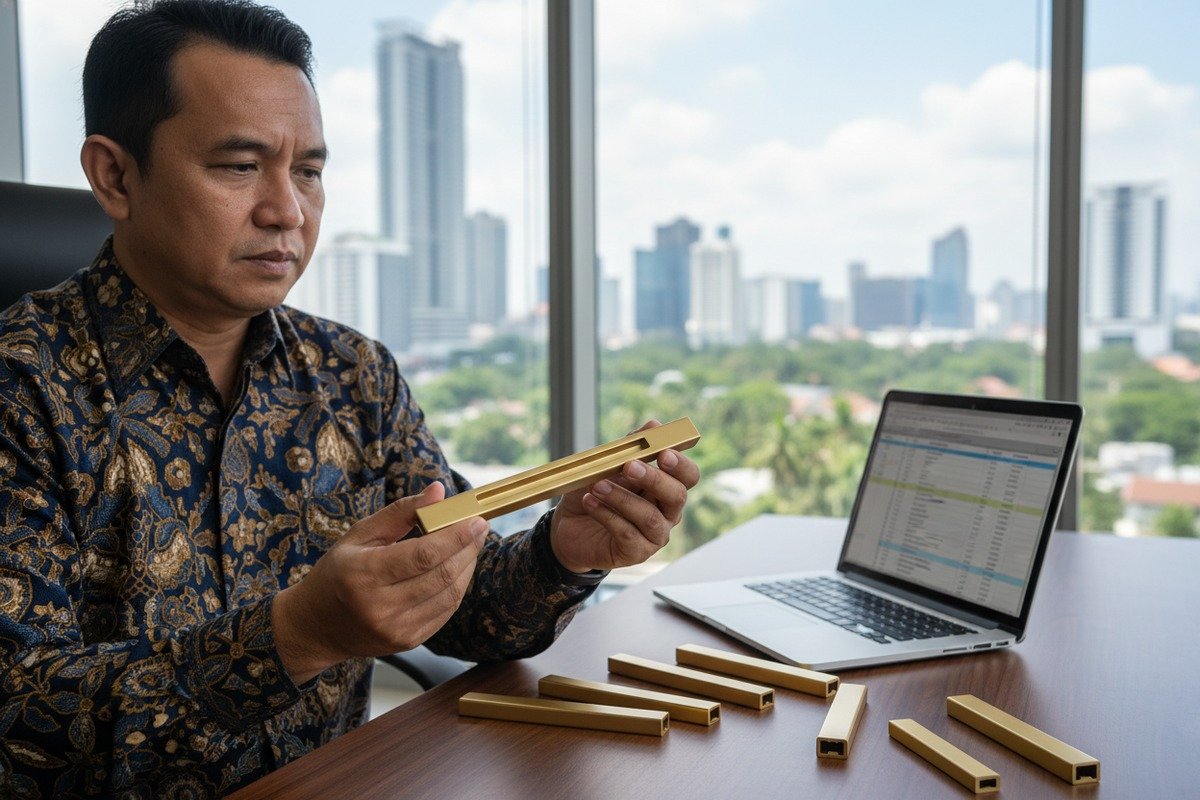
Every month, our Foshan production line ships containers of aluminum handles to Jakarta, Surabaya, and Bekasi supplier certifications 1. Yet too many Indonesian wholesalers still tell us the same painful story: samples looked perfect, but the bulk order arrived with dull finishes, wrong dimensions, or weeks of delay that cost them a furniture factory contract. The gap between expectation and delivery is real, and it costs real money.
Indonesian wholesalers should evaluate alloy grade (preferably 6063-T5), surface finish consistency, supplier certifications, MOQ flexibility, lead-time guarantees, and landed cost when sourcing aluminum cabinet door handles to stay competitive in Southeast Asia’s growing furniture market.
Below, we break down the four most critical questions wholesalers ask us — and share the practical answers our 18 years of export experience have taught us.
How do I verify that the aluminum handle quality matches the samples I received?
Sample-to-bulk mismatch is the number-one complaint we hear from distributors across Java and Sumatra mill test certificate 2. A champagne gold pull that looked stunning on a sample board can arrive as a pale, streaky mess in a 5,000-piece shipment. The frustration is understandable — your reputation with furniture factories is on the line OEM projects 3.
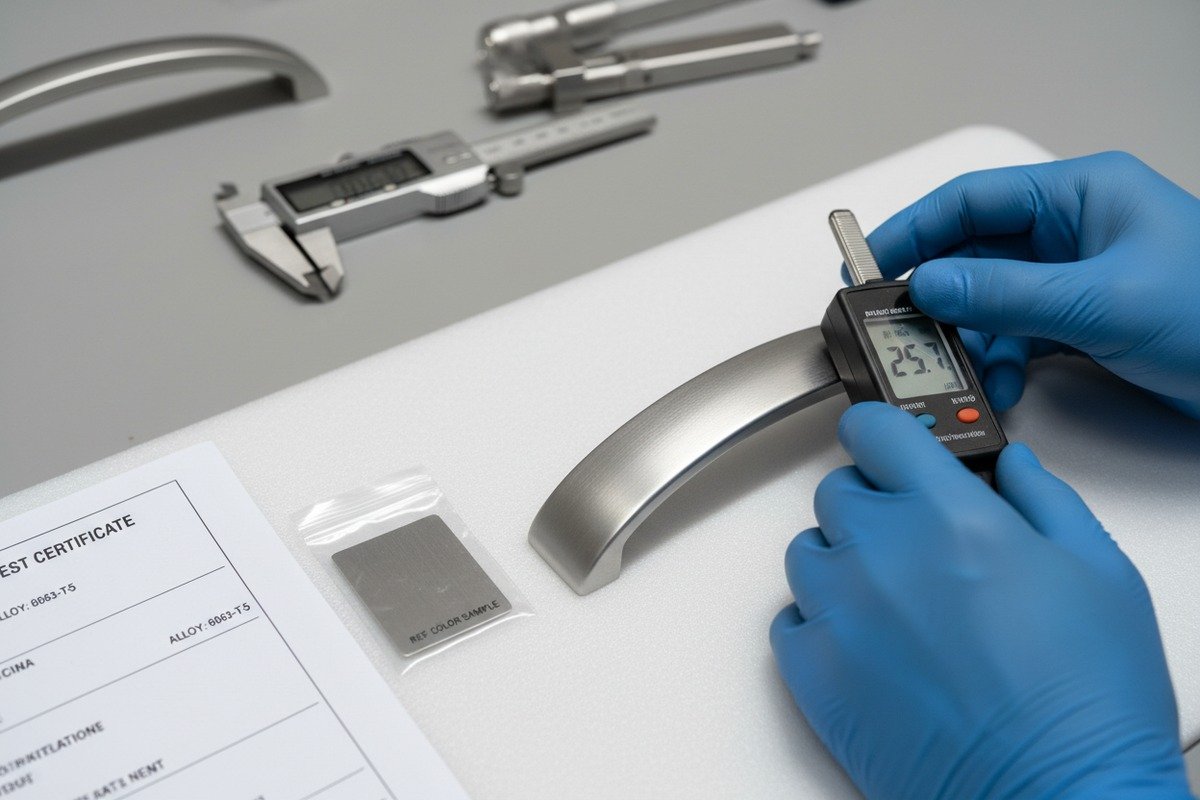
Verify quality by requesting a pre-production sample from the actual bulk run, checking alloy mill certificates for 6063-T5 composition, measuring anodization thickness with a coating gauge, and comparing color against a sealed reference sample under standardized lighting.
Why Samples and Bulk Orders Diverge
The root cause is usually process variation. A sample might be hand-finished by a skilled technician, while bulk production runs through automated anodizing lines at different bath temperatures. If the supplier switches aluminum billets between sample and production, the alloy composition shifts, and so does the surface reaction to anodizing or electrophoresis.
At our facility, we tag each approved sample with a batch code that locks the billet source, anodizing parameters, and finish recipe. When the bulk run starts, our QC team pulls the first 50 pieces and compares them side-by-side with the sealed reference sample under D65 daylight simulation. This is not complicated — any serious supplier can do it. If yours cannot, that is a red flag.
Key Checks You Should Demand
Here is a practical checklist:
- Mill test certificate — Confirm the alloy is 6063-T5 4 (or T4 for curved profiles). Check silicon and magnesium percentages.
- Coating thickness report — Anodized layers 5 should be ≥10 µm for indoor handles, ≥15 µm for humid-climate use. Use a portable eddy-current gauge.
- Color delta-E value — Ask the supplier to measure color difference (ΔE) between sample and bulk. Color delta-E value 6 Acceptable range is ΔE ≤ 1.5.
- Dimensional tolerance — Profile cross-section should hold ±0.15 mm. Check screw-hole spacing with a caliper.
- Salt spray test report — For Indonesia's coastal cities, request a 48-hour neutral salt spray result showing no pitting.
Alloy Grade Comparison for Cabinet Handles
| Property | 6063-T5 | 6061-T6 7 | 6060-T5 |
|---|---|---|---|
| Tensile Strength | 185 MPa | 310 MPa | 160 MPa |
| Extrudability | Excellent | Moderate | Excellent |
| Surface Finish Quality | Very High | Medium | High |
| Corrosion Resistance | Very Good | Good | Very Good |
| Best Use for Handles | Decorative pulls, finger pulls | Heavy-duty industrial | Lightweight trim profiles |
| Relative Cost | Medium | Higher | Lower |
For most cabinet door handles — especially the sleek, minimalist edge-mount pulls and finger pulls popular in Indonesian kitchen projects — 6063-T5 hits the sweet spot. It extrudes cleanly into thin-wall profiles, accepts anodizing beautifully, and resists the humidity that destroys cheaper alternatives.
The Finish Factor
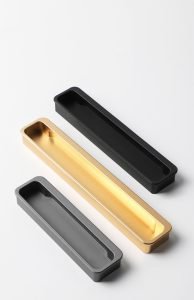
Indonesian wholesalers currently favor five finishes: blasted black, dark bronze, brushed silver, champagne gold, and hairline satin. Each finish has a different failure mode. Black anodizing shows fingerprints and scratches if the sealing step is rushed. Champagne gold drifts yellow if bath chemistry is off. Ask your supplier which finishes they run most frequently — high-volume finishes have more stable process windows and fewer rejects.
Where can I find a supplier that supports my need for custom OEM designs and low MOQs?
We often get WhatsApp messages from Indonesian buyers that start the same way: "I need 300 pieces in a custom length — every factory says MOQ is 3,000." When you serve small and mid-sized furniture workshops across the archipelago, flexibility is not a luxury; it is survival.
Look for mid-sized Chinese or local manufacturers with in-house extrusion dies, ready-stock base profiles, and a proven track record of OEM projects — these suppliers typically offer MOQs as low as 200–500 pieces for standard modifications and 1,000–2,000 pieces for fully custom cross-sections.

Understanding Why MOQs Exist
MOQs are not arbitrary. They reflect three real costs: die fabrication, machine setup time, and anodizing bath minimums. A new extrusion die can cost USD 300–800. If you order only 100 handles, that die cost alone adds USD 3–8 per piece — killing your margin. The trick is to find suppliers who already own a library of popular profile dies, so you only pay for finish customization, not tooling.
Our die library, for example, holds over 400 handle cross-sections built over 18 years. When an Indonesian client sends a sketch that is close to an existing profile, we suggest minor tweaks to fit an existing die. This drops the MOQ from 2,000 to as low as 200 pieces and saves two weeks of die-cutting lead time.
Local vs. China-Based Suppliers
| Factor | Indonesian Local Supplier | China-Based Supplier (e.g., Foshan) |
|---|---|---|
| Die Library Size | Small to medium (50–150 profiles) | Large (300–500+ profiles) |
| Typical MOQ for Custom | 1,000–3,000 pcs | 200–2,000 pcs (with existing die) |
| New Die Cost | USD 400–1,000 | USD 300–800 |
| Lead Time (Custom Order) | 2–4 weeks | 3–5 weeks (incl. shipping) |
| Finish Options | 3–5 standard colors | 8–15+ colors incl. wood grain |
| Communication Language | Bahasa Indonesia | English, some Mandarin |
| Shipping to Jakarta | 1–3 days domestic | 7–14 days sea freight |
Local Indonesian manufacturers like PT Wijaya Karya, PT Multikarya Sinar Pratama, and PT Alcomex Indo offer proximity advantages — faster delivery and easier factory visits. However, their die libraries tend to be smaller, and finish options are more limited. For wholesalers who need differentiation through unique designs and trending colors like champagne gold or hairline black, a Foshan-based partner with a deep die library and flexible finishing lines often provides better value.
How to Evaluate OEM Capability
Ask these questions before placing a deposit:
- How many existing handle dies do you have? Can I see a catalog?
- Can you modify a standard profile's length and screw spacing without a new die?
- What is the die charge, and is it refundable after a certain volume?
- Do you offer color matching from a RAL or Pantone reference?
- Can I mix colors within one MOQ lot?
A supplier who answers these questions clearly and quickly is one who has done OEM work before. Hesitation or vague answers suggest they are primarily a stock trader, not a manufacturer.
The Power of Ready-Stock Plus Customization
The smartest Indonesian wholesalers we work with use a hybrid model. They keep ready-stock popular items — 128 mm and 160 mm center-to-center pulls in black and silver — for immediate dispatch to furniture factories. Then they layer on quarterly custom orders for trending finishes like dark bronze or champagne gold. This approach keeps inventory lean while still offering a differentiated catalog.
How can I reduce my lead times to keep my Indonesian furniture factory clients happy?
A furniture factory in Semarang once told us they lost a hotel project because their handle supplier delivered three weeks late. Three weeks. The cabinets sat in the warehouse, finished and beautiful, waiting for 2,000 pulls that were stuck in customs. That story is not unique — it repeats across Indonesia every month.
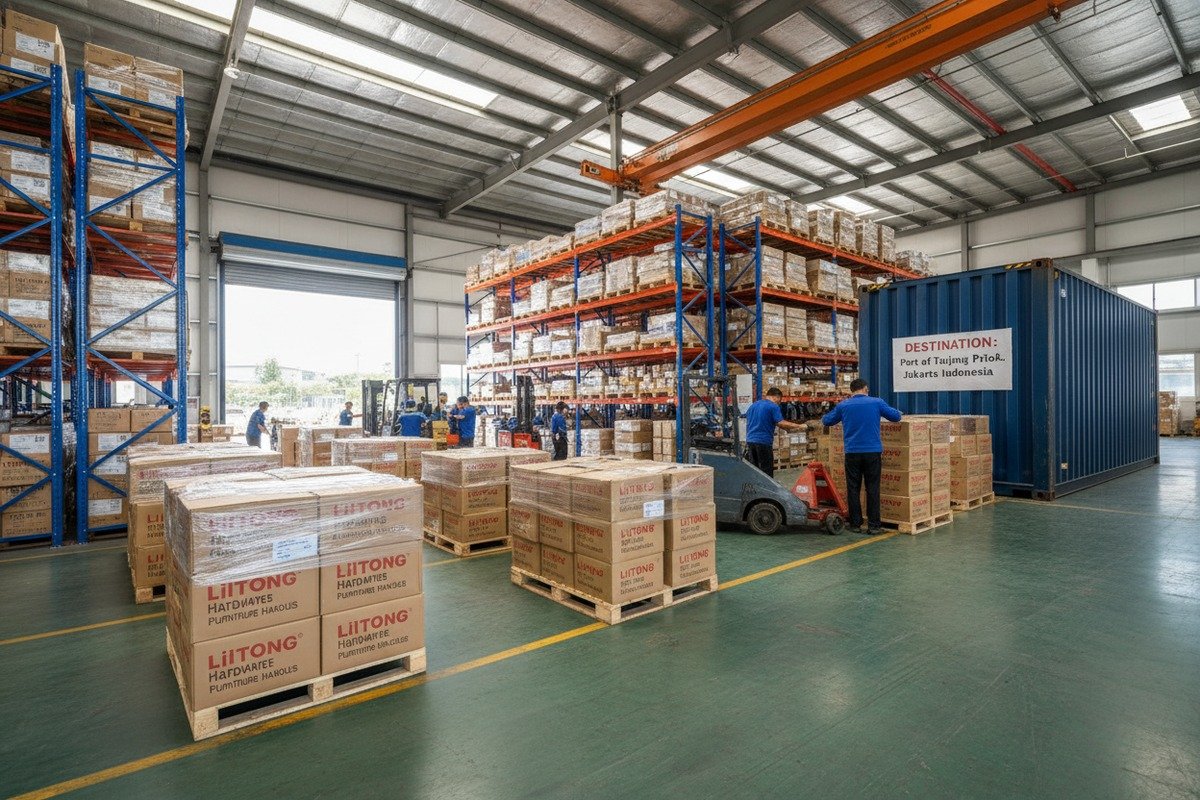
Reduce lead times by maintaining safety stock of fast-moving SKUs, choosing suppliers with pre-finished inventory, consolidating shipments through established freight routes like Foshan-to-Jakarta, and using digital order tracking to catch delays before they cascade.
Mapping the Lead-Time Chain
To cut lead time, you first need to understand where the days go. Here is a typical timeline for a custom handle order from China to Indonesia:
| Stage | Duration | Where Delays Happen |
|---|---|---|
| Order confirmation & deposit | 1–2 days | Slow bank transfers, unclear specs |
| Die selection or fabrication | 0–14 days | New die = 10–14 days; existing die = 0 days |
| Extrusion | 3–5 days | Queue backlog at peak season |
| Surface finishing (anodize/paint) | 3–5 days | Color rework if no sealed sample |
| Quality inspection & packing | 1–2 days | Rarely delayed |
| Inland transport to port | 1–2 days | Foshan to Nansha port is well-routed |
| Sea freight to Jakarta (Tanjung Priok) | 7–10 days | Vessel schedule gaps |
| Customs clearance in Indonesia | 2–5 days | HS code errors, missing docs |
| Last-mile delivery | 1–3 days | Depends on destination city |
| Total (existing die, standard finish) | 19–34 days | |
| Total (new die, custom finish) | 29–48 days |
Practical Strategies That Work
1. Stock your top 10 SKUs locally. We advise Indonesian wholesalers to identify their top-selling handles by finish and length, then keep 2–3 months of buffer stock in a Jakarta warehouse. This turns a 25-day order into a 2-day dispatch.
2. Use a supplier with pre-finished profiles. At our Foshan facility, we keep semi-finished extruded bars in popular alloys and pre-anodize them in black, silver, and champagne gold. When an order comes in, we only need to cut, drill, and pack. This shaves 8–12 days off the production cycle.
3. Consolidate shipments. Instead of ordering five small shipments per month, combine them into one full container load (FCL). FCL shipments get priority booking and avoid the delays that LCL (less-than-container-load) consolidation causes at transshipment ports.
4. Get your import documents right the first time. Misclassified HS codes are the top cause of customs delays in Tanjung Priok. Aluminum handles typically fall under HS 8302.42. Ensure your commercial invoice, packing list, certificate of origin, and any required SNI documentation are complete before the vessel sails.
5. Build a digital tracking habit. Ask your supplier for a shared spreadsheet or simple project management board where production milestones are updated in real time. A photo of packed cartons with your PO number takes 30 seconds to send via WhatsApp but saves days of uncertainty.
The Ready-Stock Advantage
Furniture factory clients in Indonesia increasingly expect same-week delivery. They do not plan months ahead — they order handles when the cabinet carcasses are nearly done. If you can deliver within 3–5 business days from a local warehouse, you become indispensable. That speed premium justifies a slightly higher per-piece price and locks in repeat orders.
What steps should I take to ensure my wholesale pricing remains competitive in the Southeast Asian market?
Price pressure in Southeast Asia is relentless. Every year, our Indonesian partners tell us their competitors are quoting lower. Meanwhile, aluminum billet prices fluctuate, shipping rates spike, and the rupiah moves against the dollar. Staying competitive is not just about finding the cheapest supplier — it is about engineering your total landed cost.
Maintain competitive pricing by negotiating volume-based tiered pricing, selecting the right alloy grade to avoid over-specification, reducing waste through standard lengths, leveraging Foshan's freight infrastructure, and building long-term supplier partnerships that unlock preferential rates and priority scheduling.
Breaking Down Your Landed Cost
Most wholesalers focus only on the FOB price per piece. But your true cost — the number that determines your margin — is the landed cost in your Jakarta or Surabaya warehouse. Here is how it breaks down:
| Cost Component | Typical Share of Landed Cost | Where to Optimize |
|---|---|---|
| Raw material (aluminum billet) | 35–45% | Choose 6063 over 6061 (lower cost, sufficient strength) |
| Extrusion & machining | 15–20% | Use existing dies; standardize screw-hole patterns |
| Surface finishing | 10–15% | Batch popular colors together for lower per-unit anodizing cost |
| Packing & inland freight | 3–5% | Use nested packing to maximize carton density |
| Sea freight (Foshan → Jakarta) | 8–12% | FCL shipping; negotiate annual freight contracts |
| Import duties & taxes | 10–15% | Correct HS code (8302.42); utilize ACFTA preferential tariff |
| Last-mile logistics | 2–4% | Partner with a local 3PL in Jakarta |
Alloy Selection Saves More Than You Think
Over-specifying aluminum is a hidden cost killer. Some wholesalers request 6061-T6 because it sounds stronger. But for a cabinet door handle that bears minimal load, 6061 adds roughly 15–20% to billet cost with no functional benefit. The 6063-T5 alloy extrudes more easily, finishes better, and costs less. Save 6061 for structural applications like door frames or heavy-duty commercial fittings.
Leverage ACFTA Tariff Benefits
Indonesia and China are both members of the ASEAN-China Free Trade Area (ACFTA) 8. Under this agreement, many aluminum hardware products qualify for reduced or zero import duty — provided you supply a valid Form E (Certificate of Origin) 9. We issue Form E for every shipment, but some buyers forget to request it or submit it late to customs. That oversight can add 5–10% to your landed cost. Make it a standard line item on every purchase order.
Volume Tiers and Annual Contracts
Short-term, spot-buy pricing will always be higher. If your annual consumption exceeds 20,000–50,000 pieces, negotiate an annual framework agreement with your supplier. At our facility, annual contracts lock in billet pricing for six months, guarantee production slots, and offer 3–5% volume discounts that compound significantly over a year.
Trending Styles and Colors That Sell
Pricing competitiveness also means stocking what sells fast. Based on what our Indonesian distributors reorder most frequently, here are the current top sellers:
- Edge-mount finger pulls in matte black — the number-one seller for modern minimalist kitchens.
- 128 mm center-to-center bar pulls in champagne gold — popular for mid-range apartment projects.
- Recessed channel handles in brushed silver — favored by commercial office fit-out contractors.
- Dark bronze elongated pulls — growing fast in the premium residential segment.
Stocking these proven movers reduces dead inventory and accelerates cash flow — two factors that matter more to your margin than shaving a few cents off the unit price.
Sustainability as a Pricing Strategy
Indonesian consumers and developers increasingly value sustainability. Aluminum is infinitely recyclable, and handles made from recycled content carry a lower carbon footprint. Some wholesalers are starting to market "green hardware" lines at a slight premium. If your supplier can certify recycled aluminum content, this opens a new price tier that protects margin while aligning with Indonesia's growing environmental awareness.
Conclusion
Sourcing aluminum cabinet door handles 10 for the Indonesian market comes down to four pillars: verified quality, flexible customization, fast lead times, and smart cost engineering. Get these right, and your wholesale business becomes the reliable partner that furniture factories cannot replace.
Footnotes
1. Explains various quality management certifications relevant for manufacturing suppliers, such as ISO and IATF. ↩︎
2. Defines and explains the purpose and content of a mill test report in the metals industry. ↩︎
3. Provides a clear definition and explanation of Original Equipment Manufacturers (OEMs) and their role in manufacturing. ↩︎
4. Explains the composition, properties, and common applications of 6063 aluminum alloy, including the T5 temper. ↩︎
5. Describes the electrochemical anodizing process and the formation of durable, corrosion-resistant aluminum oxide layers. ↩︎
6. Explains Delta E as a standardized metric for quantifying color difference and its importance for accuracy. ↩︎
7. Provides detailed information on the chemical composition, properties, and uses of 6061 aluminum alloy, including the T6 temper. ↩︎
8. Provides an official overview of the ASEAN-China Free Trade Area, its agreements, and benefits. ↩︎
9. Explains Form E as a preferential tariff certificate of origin for shipments within the ASEAN-China Free Trade Area. ↩︎
10. Provides a comprehensive guide to aluminum cabinet handles, including types, benefits, and finishes. ↩︎