Every year, our production line ships hundreds of tons of aluminum handles 1 to Vietnam — and the designs that sell out fastest always surprise newcomers to the market.
To choose aluminum furniture handle designs that suit Vietnamese consumers, prioritize clean, minimalist profiles in neutral metallics like black, silver, brushed aluminum, gold, and bronze. Focus on corrosion-resistant finishes, ergonomic comfort, and versatile shapes that complement both modern apartments and warmer traditional interiors across Vietnam’s diverse furniture market.
Vietnamese buyers are not just purchasing a functional piece of hardware Powder-coated and anodized surfaces 2. They are choosing a visible design element that must blend seamlessly with cabinetry, wardrobes, and entire room aesthetics. In this guide, we break down the exact finishes, shapes, specifications, and sourcing strategies that help distributors and furniture factories win in Vietnam custom OEM aluminum handles 3. Let’s get into it.
What are the most popular aluminum handle finishes and colors currently trending in the Vietnamese furniture market?
When we review order data from our Vietnamese wholesale partners over the past two years, a clear pattern emerges in color and finish preferences.
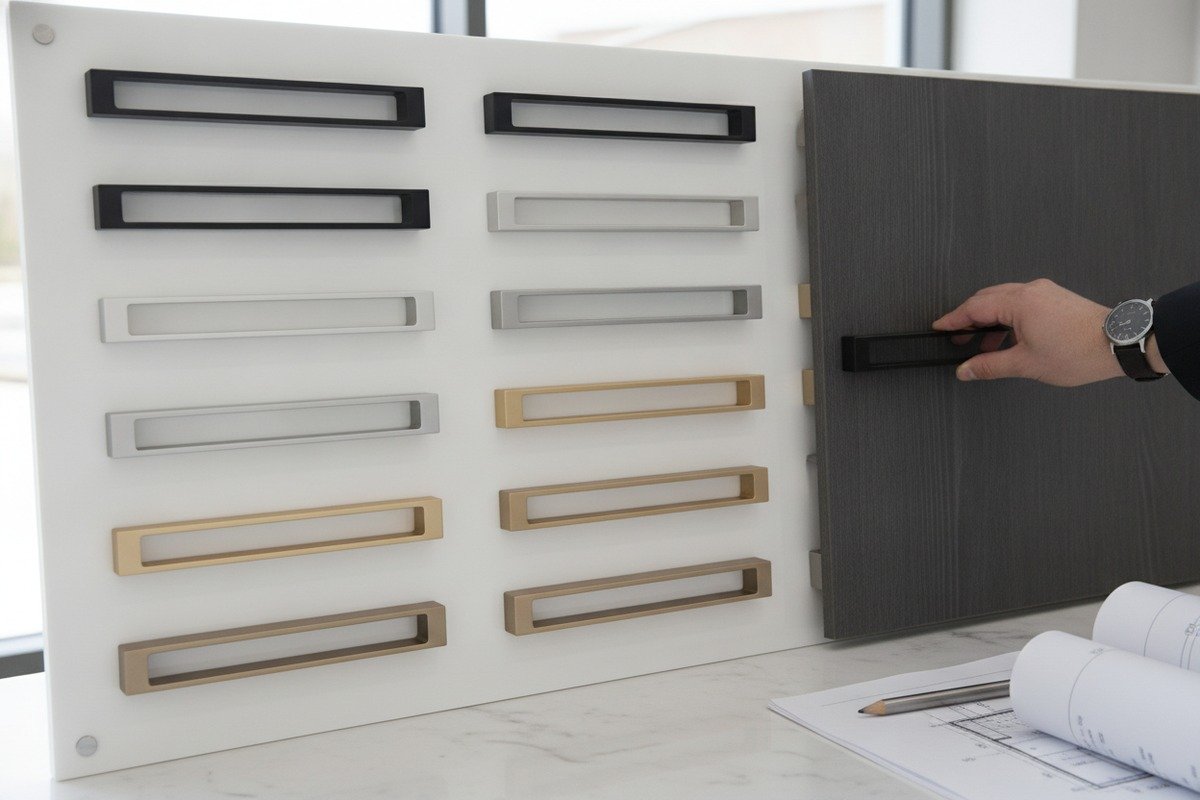
The most popular aluminum handle finishes in Vietnam right now are matte black, brushed silver, champagne gold, and light bronze. Powder-coated and anodized surfaces dominate because they deliver color depth, scratch resistance, and a refined non-reflective look that suits both modern kitchens and warmer living spaces.
Why Neutral Metallics Win in Vietnam
Vietnamese interior design 4 has shifted heavily toward contemporary minimalism in urban areas like Ho Chi Minh City and Hanoi. Apartments are getting smaller. Furniture lines are getting cleaner. In this context, handles need to disappear into the design — or make a quiet, intentional statement. Flashy chrome or overly ornate finishes feel out of place. Instead, the market gravitates toward matte and brushed textures that feel refined without demanding attention.
At the same time, there is a strong segment of Vietnamese consumers who value warmth and natural material pairings. Wood-grain melamine cabinets, rattan accent pieces, and bamboo furniture remain popular. For these interiors, champagne gold and light bronze handles create a sense of harmony. They echo earthy tones without clashing with natural textures.
Finish Types and Their Market Fit
| Finish Type | Visual Character | Best Market Fit in Vietnam | Maintenance Level |
|---|---|---|---|
| Matte Black Powder-Coat | Bold, modern, non-reflective | Urban apartments, modern kitchens | Low — hides fingerprints well |
| Brushed Silver/Aluminum | Industrial, clean, timeless | Office furniture, contemporary cabinets | Low — scratches blend in |
| Champagne Gold Anodized | Warm, elegant, subtle | Premium wardrobes, living room furniture | Medium — shows smudges slightly |
| Light Bronze Anodized | Classic warmth, earthy refinement | Traditional and fusion interiors | Medium |
| Satin Nickel | Soft sheen, versatile | Mid-range kitchens, bathroom vanities | Low |
| Polished Chrome | Bright, reflective, premium feel | High-end showroom pieces | High — fingerprints visible |
The Role of French Colonial and Zen Influences
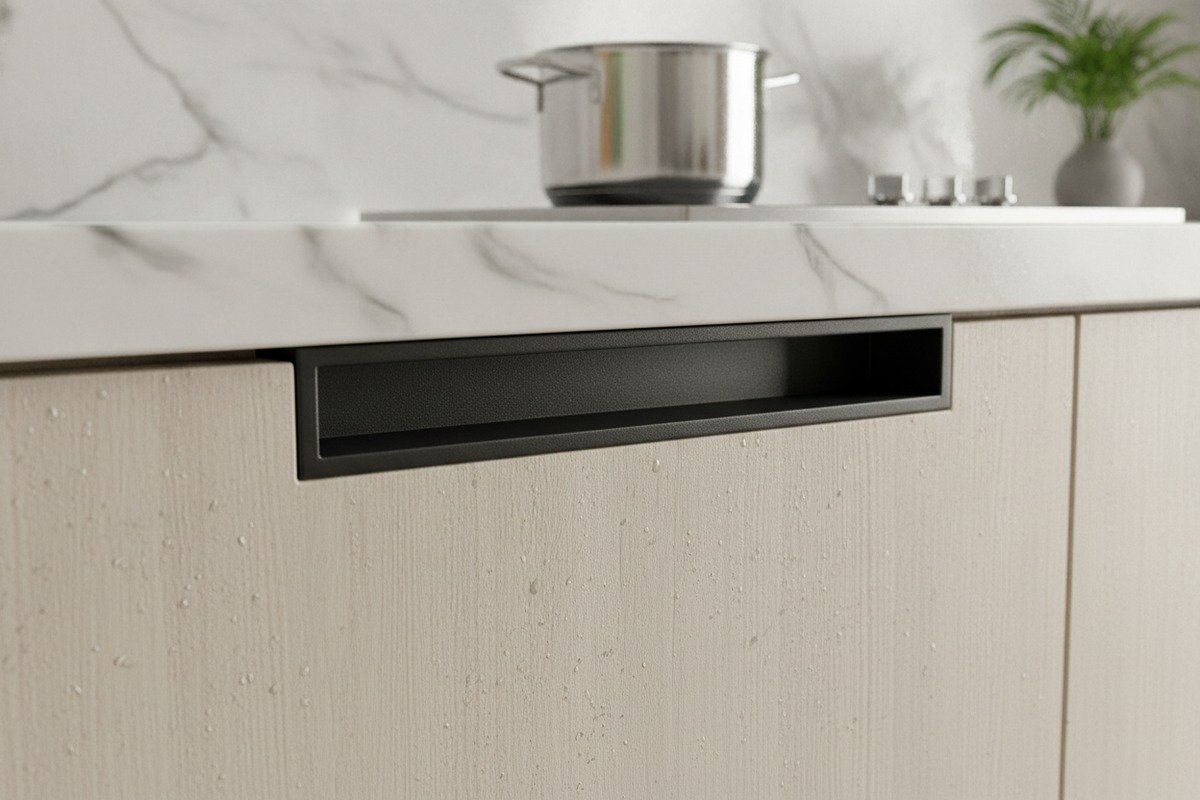
Vietnam's aesthetic identity blends multiple cultural threads. French colonial architecture 5 still influences premium interiors, especially in older urban districts. Handles with refined proportions and subtle curves echo this heritage without being overtly decorative. On the other end, Zen-inspired minimalism calls for handles that are almost invisible — recessed pulls, slim channels, and ultra-low-profile designs. Our best-selling recessed handle in charcoal grey, for example, was originally developed for a Hanoi-based furniture factory that wanted a "no-handle look" for their wardrobe line.
What About Color Trends for 2024–2025?
Dark tones continue to gain ground. Matte black has moved from a niche choice to a mainstream default for modern kitchens. White and light beige handles are also emerging, especially for Scandinavian-inspired furniture lines that Vietnamese urban consumers increasingly favor. The safest commercial palette for a distributor stocking aluminum handles for Vietnam is: black, silver, champagne gold, bronze, and one light neutral like white or beige.
How can I find a Chinese supplier that offers custom OEM designs tailored specifically for my Vietnamese clients' tastes?
Over the past 18 years, our team in Foshan has worked with dozens of Vietnamese distributors to develop handles that look like they were designed locally — because, in a sense, they were.
To find a Chinese supplier for custom OEM aluminum handles tailored to Vietnamese tastes, look for factories with proven Vietnam export experience, in-house mold and extrusion capabilities, low MOQs for custom orders, a 3–7 day turnaround on samples, and willingness to adjust finishes, lengths, and profiles based on your specific market feedback.
Start With Export Track Record
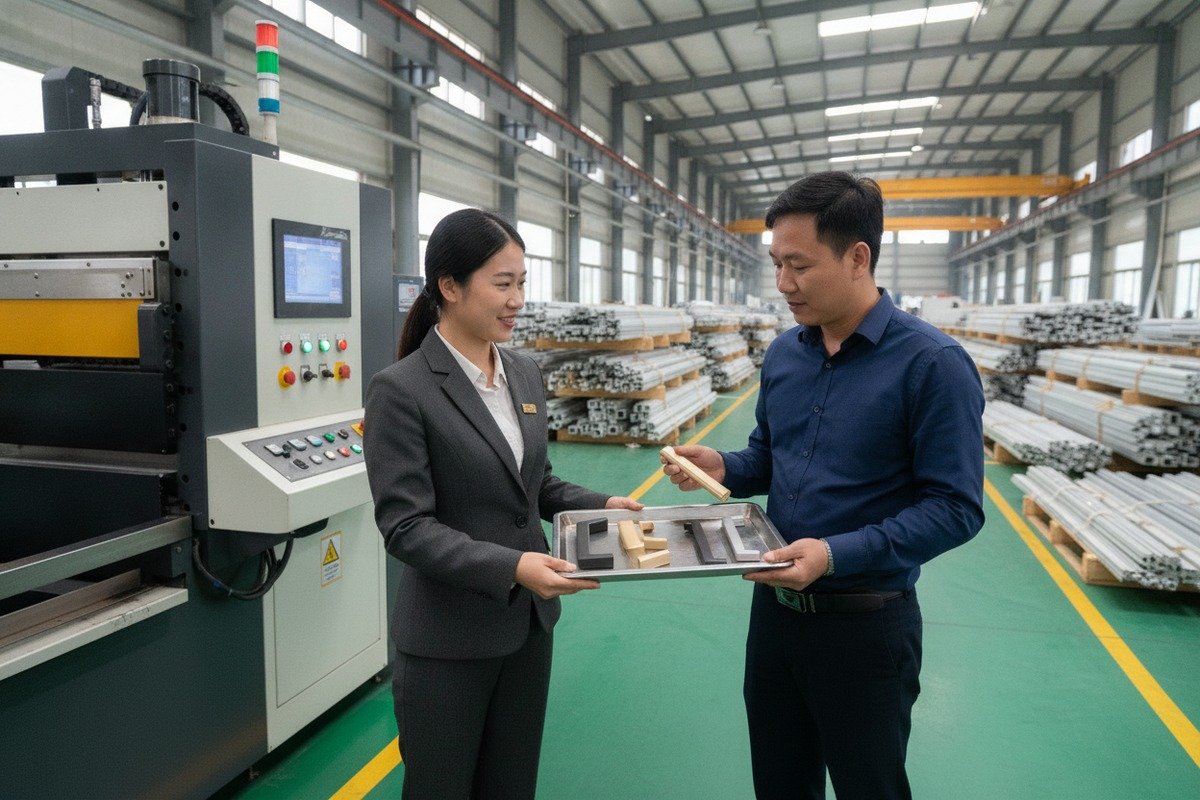
Not every aluminum handle factory in China understands the Vietnamese market. The design sensibilities are different from Middle Eastern or European preferences. When evaluating suppliers, ask directly: "How many containers have you shipped to Vietnam in the past year?" A factory that regularly exports to Vietnam will already know which profiles, finishes, and packaging standards work. They will also understand Vietnamese import requirements and labeling preferences.
What to Look for in an OEM Partner
Here is a practical checklist we share with new partners:
| Evaluation Criteria | What to Ask | Why It Matters |
|---|---|---|
| Extrusion capability | Do you extrude your own profiles or buy semi-finished stock? | In-house extrusion means faster customization and tighter quality control in-house extrusion capabilities 6 |
| Finish range | Can you provide anodized, powder-coated, and electrophoretic finishes? | Vietnamese buyers need multiple finish options from one source |
| Sample turnaround | How fast can you produce a custom sample? | 3–7 days is competitive; anything over 14 days slows your product launch |
| MOQ for custom items | What is the minimum order for a new finish or profile? | Low MOQ (50–100 pieces) lets you test designs before committing |
| Ready stock depth | Do you hold inventory of popular profiles? | 300+ tons of ready stock means you can mix custom and stock orders |
| Communication | Do you have a dedicated export team for Vietnam? | Language fluency and market awareness reduce miscommunication |
The Custom Design Process
A good OEM collaboration follows a simple flow. First, you share a sketch, a competitor sample, or even a photo from a Vietnamese furniture showroom. The supplier's design team creates a technical drawing. Then a sample is extruded, finished, and shipped for your approval. Once confirmed, production begins. The entire cycle from concept to first shipment can take as little as two weeks with an experienced factory.
Personalization as a Market Advantage
Vietnamese furniture factories increasingly want handles that differentiate their product lines. This means custom lengths, unique cross-section profiles, or exclusive finishes that competitors cannot easily copy. A supplier who offers engraving, custom color matching, or even subtle texture variations gives you a sourcing edge. We have seen Vietnamese clients request wood-grain texture on aluminum handles to match melamine cabinet panels — and it works beautifully.
Avoiding Common OEM Pitfalls
The biggest risk in OEM sourcing is a gap between sample quality and bulk production quality. Always request a pre-production sample from the actual production batch, not just a showroom piece. Insist on consistent anodizing thickness and powder-coat adhesion testing. A reliable factory will welcome these requests because they already run these checks internally.
Which aluminum handle specifications should I prioritize to ensure long-lasting quality in Vietnam's humid climate?
When our engineers test handle durability, they simulate tropical humidity conditions specifically because Vietnam is one of our largest markets — and we have learned exactly where quality fails first.
For Vietnam's humid climate, prioritize aluminum handles with anodized coatings of at least 10–15 microns, powder-coat thickness of 60–80 microns, marine-grade corrosion resistance, smooth sealed edges to prevent moisture ingress, and stainless steel mounting hardware to avoid galvanic corrosion at contact points.
Why Humidity Is the Hidden Quality Killer
Vietnam's tropical climate 7 means average humidity levels of 75–85% year-round, with coastal cities like Da Nang and Ho Chi Minh City often exceeding 90% during the rainy season. This humidity accelerates oxidation, loosens poor-quality coatings, and causes corrosion at mounting points. An aluminum handle that looks perfect in a dry warehouse in northern China can start showing white oxidation spots within months in a Vietnamese kitchen.
Critical Specifications to Check
Coating Thickness
Anodized aluminum 8 creates a hard, protective oxide layer. But not all anodizing is equal. A thin 5-micron anodized layer may pass a quick visual check but will not survive years of humid kitchen use. Insist on 10–15 microns for standard applications and 20+ microns for coastal or outdoor-adjacent installations.
For powder-coated handles, 60–80 microns is the sweet spot. Thinner coatings chip and peel. Thicker coatings can crack during bending or installation. Ask your supplier for coating thickness test reports — any professional factory measures this routinely.
Material Grade
Not all aluminum alloys perform the same way. For furniture handles, 6063-T5 is the industry standard for extruded profiles. aluminum alloy 6063-T5 9 It offers excellent corrosion resistance, good surface finish quality, and adequate strength for handle applications. Avoid suppliers who cannot specify the alloy grade — this is a basic quality indicator.
| Specification | Recommended Value | Why It Matters for Vietnam |
|---|---|---|
| Alloy grade | 6063-T5 | Best balance of corrosion resistance, finish quality, and formability |
| Anodizing thickness | 10–15 microns minimum | Prevents white oxidation in high humidity |
| Powder-coat thickness | 60–80 microns | Resists chipping, peeling, and moisture penetration |
| Edge treatment | Deburred and sealed | Prevents moisture trapping at sharp edges |
| Mounting screws | Stainless steel 304 | Prevents rust and galvanic corrosion at contact points |
| Salt spray test | 200+ hours minimum | Simulates long-term coastal/humid exposure |
Edge Treatment and Sealing
This is a detail many buyers overlook. If the cut edges of an aluminum handle are rough or unsealed, moisture can creep under the coating and cause hidden corrosion. Every handle should be deburred, and end caps or sealed edges should be standard. Our production line includes an automatic edge-finishing step for exactly this reason.
Mounting Hardware Matters
A common failure mode is not the handle itself but the screws. Carbon steel screws in a humid environment will rust within weeks, leaving orange stains on cabinet surfaces. Always specify stainless steel 304 screws 10. The small cost increase is negligible compared to the warranty claims and customer complaints that rusty screws generate.
Ergonomic Grip in Daily Use
Beyond corrosion, daily comfort matters. Handles with smooth, rounded grip channels reduce hand fatigue and feel more pleasant to use. Sharp internal edges on recessed pulls can be uncomfortable, especially for elderly users. A good factory rounds these internal edges during the extrusion or finishing stage. This is a quality detail that Vietnamese furniture factories notice immediately — it separates professional suppliers from commodity sellers.
How do I balance unique design choices with the need for ready-to-ship inventory to keep my Vietnamese distribution business moving?
Running our warehouse with 300 tons of ready stock has taught us that the balance between uniqueness and availability is not a compromise — it is a strategy.
Balance unique designs with ready-to-ship inventory by stocking a core range of 5–8 best-selling profiles in neutral finishes for immediate dispatch, while offering custom finishes, lengths, and exclusive designs on a 3–7 day production cycle. This dual approach keeps your warehouse turning and your product catalog distinctive.
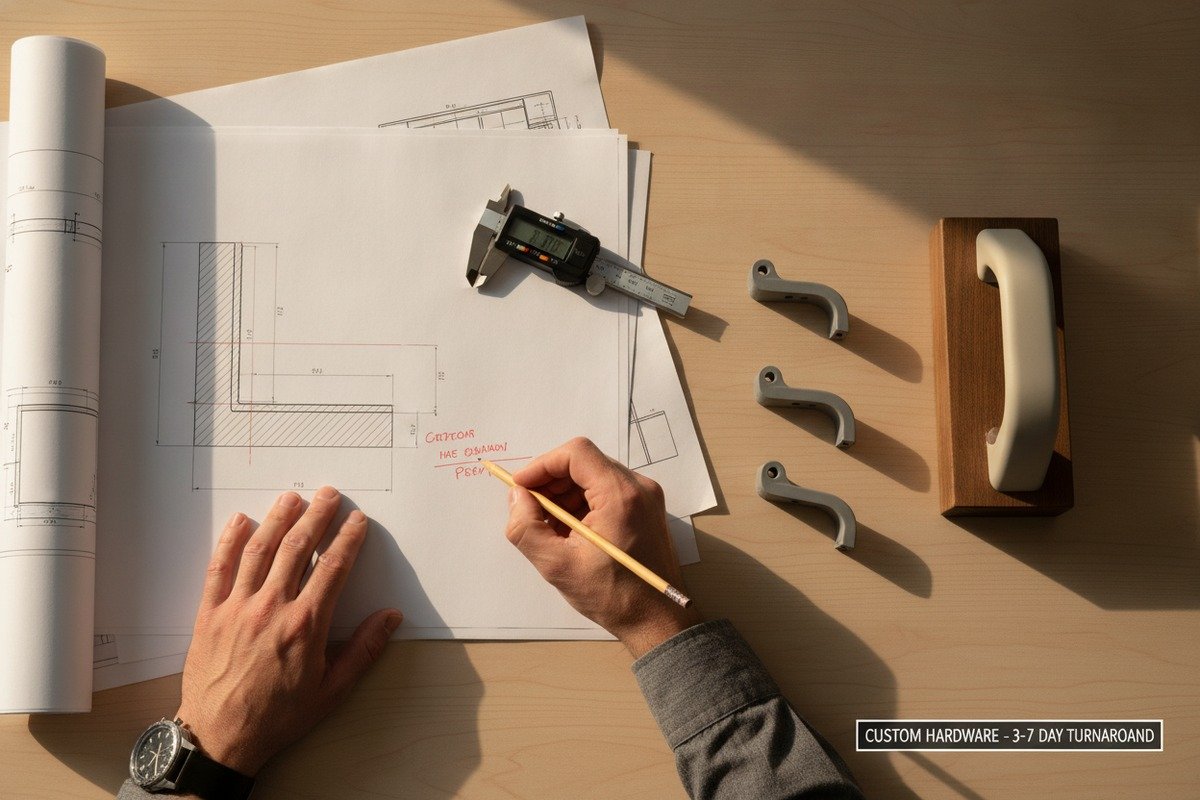
The Two-Tier Inventory Strategy
The most successful Vietnamese distributors we work with operate on a clear two-tier model. Tier one is their bread-and-butter stock: proven profiles in black, silver, and champagne gold that ship within 48 hours. These handles cover 70–80% of daily orders. Tier two is their differentiation range: custom finishes, exclusive profiles, or special lengths that they order in smaller batches for specific furniture factory clients or premium projects.
This model works because it solves two problems at once. Your warehouse never runs dry on popular items. And you always have something unique to offer when a furniture factory asks, "Do you have anything different from what everyone else carries?"
Building Your Core Stock Range
The core range should be small and versatile. Here is a framework based on what moves fastest in Vietnam:
- Two to three recessed pull profiles (slim rectangular channel, low-profile L-shape, and a curved finger pull)
- Two standard bar pull lengths (128mm and 256mm center-to-center, the most universal cabinet sizes)
- Five finishes maximum (matte black, brushed silver, champagne gold, light bronze, and one light neutral)
This combination gives you roughly 25–30 SKUs — enough variety to serve most furniture styles without drowning in slow-moving inventory.
Managing Custom Orders Without Slowing Down
The fear with custom orders is always lead time. If a furniture factory needs 500 handles in a custom rose gold finish and it takes 30 days, you lose the deal. This is why supplier selection is critical. A factory with in-house anodizing and powder-coating lines can turn custom finish orders in 3–7 days. We keep base profiles in stock as raw extruded aluminum, so when a custom color order comes in, we only need to finish and ship — not extrude from scratch.
How Customization Drives Margin
Stock handles are price-competitive but margin-thin. Every distributor in Vietnam can source a basic black handle. Custom handles, however, command higher margins because they cannot be easily price-compared. A furniture factory that orders a handle in a proprietary finish or an exclusive length is locked into your supply chain. They cannot switch to a cheaper source without changing their entire furniture design. This is why smart distributors invest in a few custom SKUs even if the volumes are smaller.
Practical Reorder Workflow
Set up a reorder system with your Chinese supplier based on consumption data. For core stock, use a monthly replenishment cycle with a safety stock buffer of 15–20% above average monthly sales. For custom items, negotiate a standing production slot so your supplier reserves capacity for your orders each week. This way, you never wait in a long production queue.
A Quick Decision Framework
Ask yourself three questions for every new handle design:
- Can at least three of my existing clients use this handle? If yes, add it to core stock.
- Is this design requested by only one client but at a good volume? If yes, treat it as a custom order with a minimum commitment.
- Is this a trend piece that might fade in 6 months? If yes, order a small trial batch and monitor sell-through before restocking.
This simple filter prevents over-stocking niche designs while keeping your catalog fresh.
Conclusion
Choosing aluminum furniture handle designs for Vietnamese consumers comes down to three priorities: style compatibility, climate durability, and supply chain speed. Stock clean, modern profiles in proven neutral finishes, partner with a capable OEM factory, and your distribution business stays ahead.
Footnotes
1. Explains the manufacturing process and properties of aluminum handles. ↩︎
2. Compares the properties and applications of powder coating and anodizing finishes. ↩︎
3. Defines OEM in the context of hardware manufacturing and product ownership. ↩︎
4. Discusses current and future trends in Vietnamese interior design. ↩︎
5. Provides historical context and examples of French colonial architecture in Vietnam. ↩︎
6. Explains the aluminum extrusion process and its benefits in manufacturing. ↩︎
7. Describes the general climate and humidity levels in Vietnam. ↩︎
8. Explains the electrochemical process and benefits of anodized aluminum. ↩︎
9. Provides details on the composition and mechanical properties of 6063-T5 aluminum alloy. ↩︎
10. Replaced with an article specifically comparing 304 and 316 stainless steel screws, directly relevant to the anchor text. ↩︎