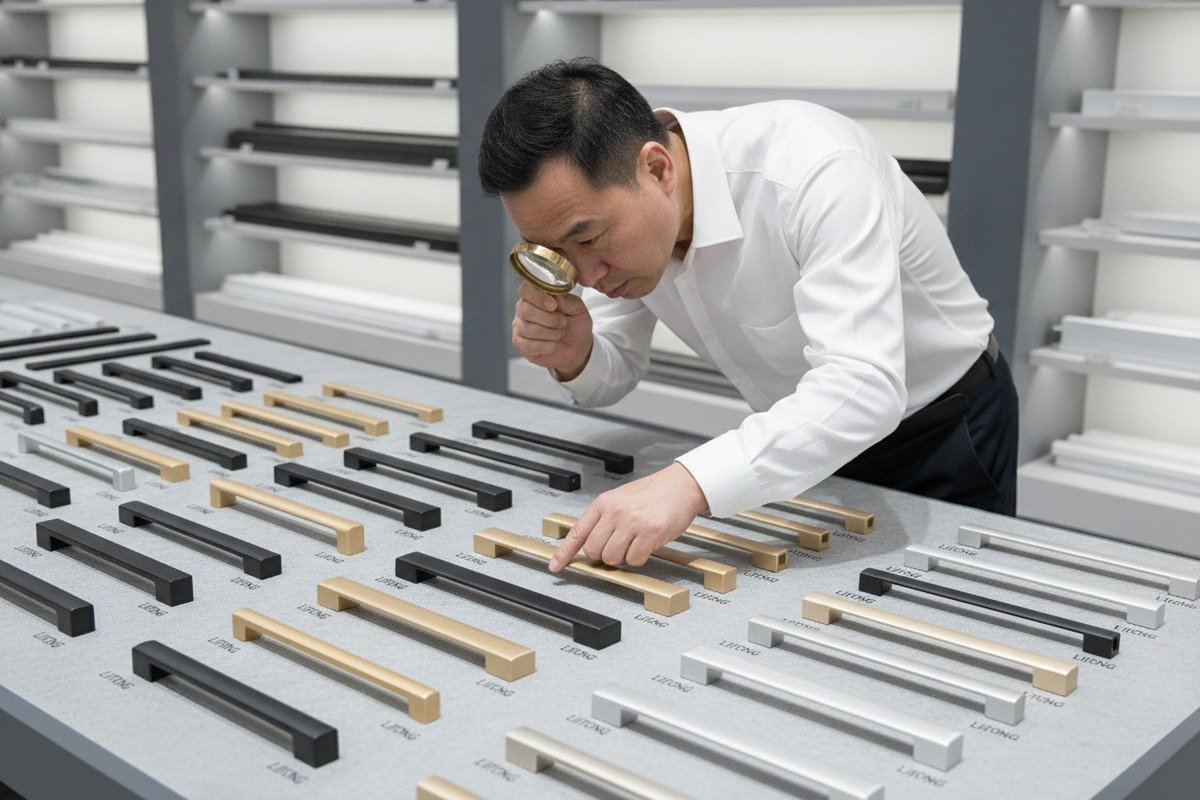
Every week, our sales team in Foshan fields questions from furniture factories and distributors who struggle to tell one aluminum finish from another — and that confusion often leads to costly reorders.
The most common surface treatments for aluminum furniture handles sourced from China include anodizing, electrophoresis (e-coating), sandblasting, powder coating, painting, electroplating, PVD, and passivation. Each finish differs in appearance, corrosion resistance, scratch durability, and cost, so the right choice depends on your handle’s intended environment and performance target.
Below, I break down the finishes that matter most for sourcing decisions — from choosing between anodizing 1 and electrophoresis, to understanding why sandblasting creates that sought-after matte texture, to managing costs and quality control across bulk orders from Chinese suppliers.
How do I choose between anodizing and electrophoresis for my high-end furniture handle projects?
When we develop new handle designs with overseas furniture factories, this is the single most frequent finishing question we hear — and the answer is rarely one-size-fits-all AQL sampling 2.
Choose anodizing when you need a metal-integrated oxide layer that resists scratches and preserves a metallic look. Choose electrophoresis when you need uniform color coverage on complex shapes and strong corrosion protection in humid or coastal environments. Both suit high-end projects, but they serve different performance priorities.
What Exactly Is Anodizing?
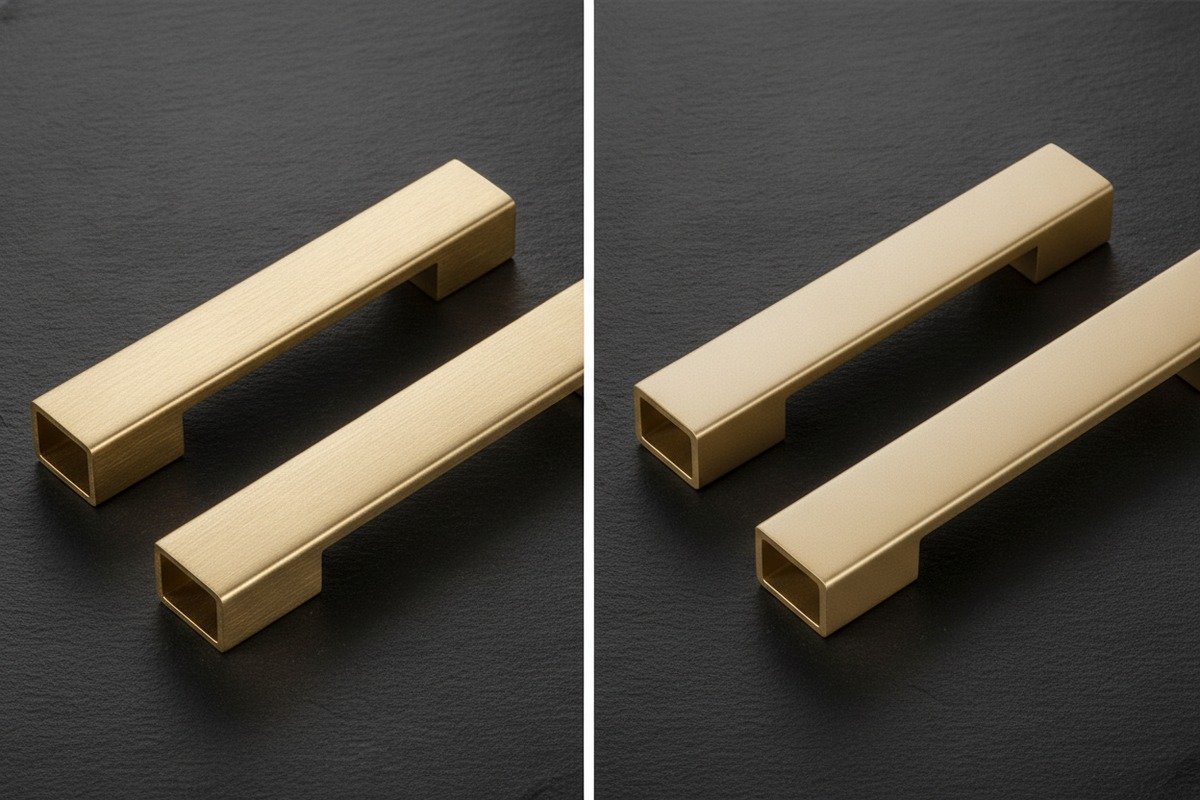
Anodizing is an electrochemical process that converts the surface of aluminum into a hard, stable oxide layer 3. Unlike paint or powder coating 4, this layer is not sitting on top of the metal — it grows from the metal itself. That is why anodized handles feel distinctly metallic rather than "coated." You can dye the oxide layer in many colors, from champagne gold and bronze to matte black, while still letting the aluminum grain show through.
On our production line, we routinely produce anodized profiles in thicknesses ranging from 10 µm for light interior use up to 25 µm or more for handles that need extra scratch resistance. The thicker the oxide layer, the harder the surface and the better it resists daily wear. Hard anodizing can push thickness even further, but it is less common for furniture handles due to cost.
What Exactly Is Electrophoresis?
Electrophoresis 5, also called e-coating, uses an electric field to deposit a uniform paint film onto the aluminum surface. The part is submerged in a bath of charged paint particles, which migrate and bond evenly to every exposed surface — including recessed areas, corners, and channels that spray methods can miss. This is especially relevant for handles with deep geometric channels or L-shaped cross-sections.
The result is a thin, even film with excellent adhesion and good corrosion resistance 6. In corrosive environments — think coastal kitchens, humid bathrooms, or Middle Eastern climates with high salinity — electrophoresis often outperforms standard anodizing in salt-spray test 7s.
Side-by-Side Comparison
| Feature | Anodizing | Electrophoresis (E-Coating) |
|---|---|---|
| Coating type | Integral oxide layer | Deposited paint film |
| Scratch resistance | High (especially hard anodized) | Moderate |
| Corrosion resistance | Good to very good | Very good to excellent |
| Color uniformity | Good, but slight batch variation possible | Excellent, very consistent |
| Metallic appearance | Preserved — aluminum grain visible | Less metallic, smoother paint-like look |
| Complex shape coverage | Uneven on deep recesses | Excellent — coats every surface evenly |
| Typical thickness | 10–25 µm | 15–30 µm |
| Cost | Mid to high | Mid |
| Best for | Premium visible handles, scratch-prone use | Humid environments, complex geometries |
How to Decide for Your Project
Start with three questions:
-
Where will the handle live? If it faces salt air, bathroom moisture, or chemical cleaners, electrophoresis gives you a more reliable corrosion barrier. For dry, indoor furniture in living rooms or bedrooms, anodizing's scratch hardness and metallic aesthetic usually win.
-
Does the design have deep channels or tight geometry? Our recessed cabinet handles — the slim, rectangular pulls with a deep finger groove — coat more evenly with electrophoresis. Anodizing can leave slight color variation inside tight channels because the oxide growth rate differs with surface geometry.
-
Is the metallic grain part of your design language? If you want buyers to see and feel that this is real aluminum, anodizing is the clear choice. Electrophoresis hides the metal grain under its film, which some designers prefer and others do not.
One misconception I see often: buyers assume anodizing is always "better" because it costs more. In reality, electrophoresis can outperform anodizing in coverage consistency and corrosion protection for certain handle shapes and environments. The best finish is the one matched to your use case.
Our design team noticed a clear trend over the last few years: more and more furniture brands in Vietnam and the Middle East are requesting matte and satin finishes instead of high-gloss options.
Sandblasting creates a uniform, fine-textured matte surface by propelling abrasive media against the aluminum at high pressure. It hides minor casting marks, polishing inconsistencies, and handling scratches, producing the premium low-sheen aesthetic that is now dominant in modern furniture hardware design.
Sandblasting as a Preparation Step, Not Just a Final Finish
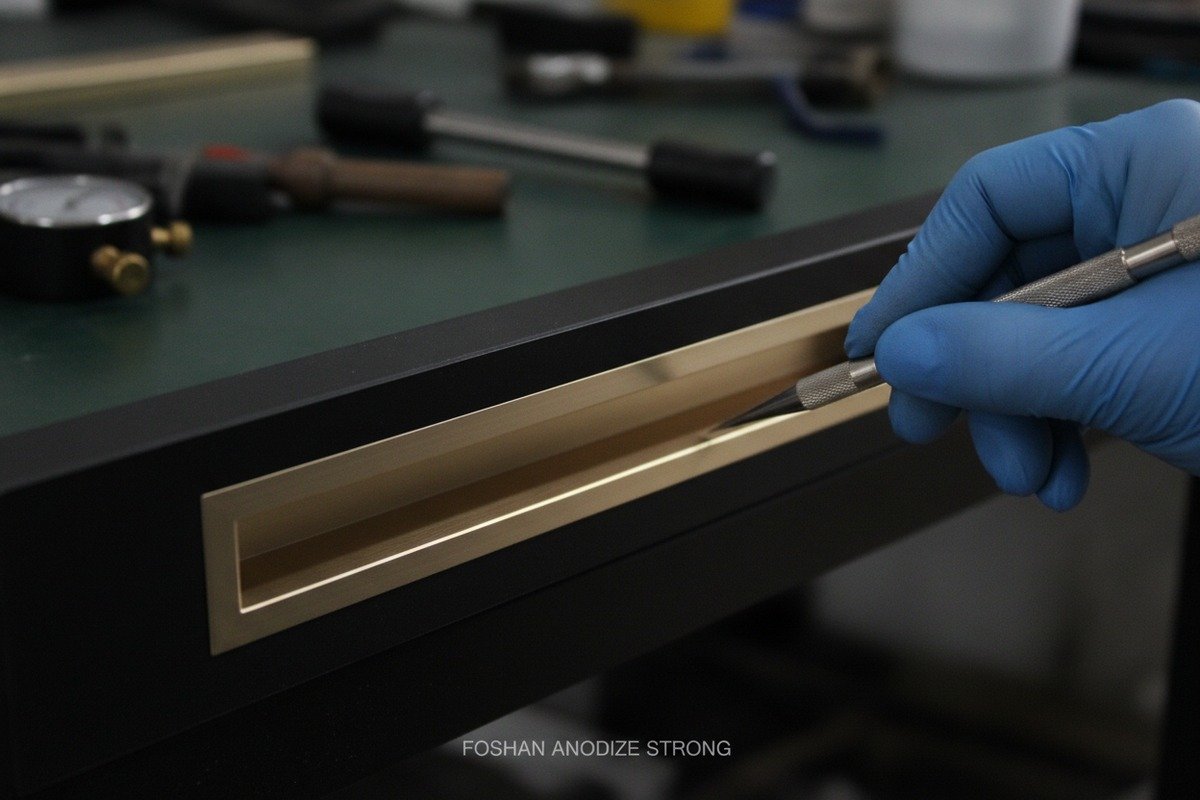
This is one of the most important distinctions buyers miss. Sandblasting 8 — and its close cousin, shot blasting — is primarily a surface preparation and texturing process. It roughens the aluminum to a controlled profile, which does two things at once. First, it creates the matte or satin look you see on the finished handle. Second, it dramatically improves the adhesion of any subsequent coating, whether that is anodizing, powder coating, or electrophoresis.
When we produce our champagne gold anodized recessed handles, for example, the profile goes through sandblasting before the anodizing tank. The blasting step ensures that the anodized oxide layer bonds tightly and that the final surface has that smooth, non-reflective quality buyers expect. Without blasting, the same anodized finish can look uneven, with visible extrusion lines or minor tool marks.
How Sandblasting Hides Imperfections
Aluminum extrusion and die-casting inevitably leave small surface marks — die lines on extruded profiles, flow marks on castings, or tiny scratches from handling during transport. On a high-gloss polished surface, every one of these marks is visible. On a sandblasted surface, the uniform micro-texture absorbs and scatters light, making those marks nearly invisible.
This matters a lot for bulk orders. When you order 5,000 or 10,000 handles, maintaining a perfect mirror finish on every piece is extremely difficult and expensive. A sandblasted matte finish is far more forgiving and consistent across large batches.
Sandblasting vs. Shot Blasting
| Feature | Sandblasting | Shot Blasting |
|---|---|---|
| Media used | Fine sand, aluminum oxide, glass beads | Steel shot, steel grit |
| Surface result | Fine, smooth matte | Slightly coarser, more textured |
| Typical use | Furniture handles, decorative profiles | Industrial parts, heavy cleaning |
| Aggressiveness | Low to moderate | Moderate to high |
| Best paired with | Anodizing, powder coating | Powder coating, painting |
For furniture handles, sandblasting with fine glass beads or aluminum oxide is almost always the better choice. It produces a refined, even texture that feels premium to the touch. Shot blasting is more aggressive and is typically reserved for industrial or structural applications.
The Fingerprint Factor
Matte sandblasted finishes resist visible fingerprints far better than glossy or polished surfaces. Since furniture handles are high-touch components — grabbed dozens of times a day — this is a practical advantage that affects the end user's daily experience. Our clients who supply to hotel furniture projects and high-end residential kitchens specifically request sandblasted finishes for this reason.
Always Ask About the Full Process Chain
When you request a "sandblasted finish" from a Chinese supplier, make sure you clarify whether sandblasting is the final step or a pretreatment. A sandblasted-only surface has limited corrosion resistance. For long-term durability, sandblasting should be followed by anodizing, powder coating, or at minimum a clear protective sealant. At our facility, we treat sandblasting as step one in a multi-step finishing workflow — never as the sole protective treatment for a finished handle.
How do different surface treatments impact my procurement costs and lead times when ordering from China?
In our experience exporting handles to Vietnam and the Middle East, we have seen buyers lose weeks — and significant margin — simply because they chose a finish without understanding its production implications.
Simpler treatments like sandblasting and basic painting cost less and ship faster, while anodizing, PVD, and electrophoresis require tighter process control, specialized equipment, and longer lead times. Cost differences can range from 15% to over 100% depending on finish type, thickness, color complexity, and order volume.
Cost Drivers You Need to Understand
Surface treatment cost is not just about the finish itself. Several factors stack on top of each other:
- Pretreatment steps: Degreasing, chemical cleaning, sandblasting, and rinsing all add labor and material cost before the main finish even begins.
- Coating thickness: A 10 µm anodized layer costs significantly less than a 25 µm hard anodized layer on the same handle.
- Color complexity: Standard silver or natural anodizing is cheaper than custom champagne gold or matte black, because color matching requires more process control and sometimes multiple dye baths.
- Batch size: Setup costs for anodizing or PVD 9 lines are high, so small orders carry a higher per-unit finish cost. This is one reason why MOQ matters in finishing.
- Substrate type: Die-cast aluminum finishes differently than extruded aluminum. Die-cast parts often need more surface prep, which adds cost.
Cost and Lead Time Overview
| Surface Treatment | Relative Cost | Typical Added Lead Time | Notes |
|---|---|---|---|
| Sandblasting only | Low | 1–2 days | Preparation step; rarely a final finish alone |
| Painting (liquid) | Low to mid | 2–3 days | Wide color range; less durable than powder coating |
| Powder coating | Mid | 3–5 days | Durable, consistent color; good for large batches |
| Anodizing (standard) | Mid to high | 3–7 days | Thickness and color affect cost and time |
| Electrophoresis | Mid | 3–5 days | Efficient for complex shapes; consistent film |
| Electroplating | Mid to high | 5–7 days | Chrome, nickel, or brass effects; adds metallic look |
| PVD | High | 7–14 days | Premium decorative effects; excellent wear resistance |
| Passivation | Low | 1–2 days | Chemical cleaning; minimal visual change |
These are general ranges. Actual costs and lead times vary by supplier capability, order volume, and seasonal demand. During peak season — typically Q3 and Q4 — finishing lines in Foshan run at near capacity, and lead times can stretch 30% to 50% longer than the figures above.
How to Keep Costs Down Without Sacrificing Quality
Here are practical strategies we recommend to our wholesale clients:
-
Combine sandblasting with anodizing instead of requesting a polished-then-anodized finish. Sandblasting is cheaper than mechanical polishing and hides more defects, which means fewer rejects and lower total cost.
-
Standardize your color palette. If you order matte black, champagne gold, and silver across your handle range, your supplier can batch similar colors together and reduce changeover waste. Custom one-off colors cost more because they require dedicated dye batches and test runs.
-
Order stock finishes when possible. We keep over 300 tons of ready-to-ship inventory in popular finishes. Ordering from stock eliminates the finishing lead time entirely — we can ship within 48 hours.
-
Clarify your performance needs upfront. If your handles are for indoor kitchen cabinets in a dry climate, you likely do not need the most expensive corrosion-resistant finish. A standard anodized or powder-coated finish will perform well and cost less.
The Hidden Cost of Choosing Wrong
One thing I want to emphasize: the cheapest finish is not always the cheapest decision. A furniture factory in Dubai once ordered 8,000 handles with a basic painted finish to save cost. Within six months, the paint began flaking in the humid coastal air. They had to replace every handle and lost the trust of their end customer. If they had spent 20% more on electrophoresis or anodizing upfront, the total cost of ownership would have been far lower.
What quality checks should I perform to ensure my custom handle finishes remain consistent across bulk orders?
Over 18 years of producing aluminum handles, our quality team has developed a checklist specifically for surface finish consistency — because we learned the hard way that even small process drifts can cause visible batch-to-batch differences.
To ensure consistent finishes across bulk orders, perform incoming sample approval with color and gloss standards, measure coating thickness with a calibrated gauge, run adhesion tests (cross-cut or tape pull), conduct salt-spray testing for corrosion-rated finishes, and visually inspect under standardized lighting to catch color shifts and surface defects early.

Start With a Golden Sample
Before any bulk production begins, insist on approving a "golden sample" — a physical reference piece that represents the exact finish, color, texture, and gloss level you expect. This sample should be stored by both you and your supplier. Every subsequent batch is compared against it.
At our facility, we keep golden samples in a controlled environment so they do not degrade or shift color over time. We photograph them under standardized D65 daylight and provide digital color data (Lab* values) to clients who want objective measurements.
Key Tests to Perform or Request
Here is a practical quality checklist you can use with any Chinese supplier:
Coating Thickness Test
Use an eddy-current thickness gauge (for non-magnetic coatings on aluminum) to measure coating thickness at multiple points on each handle. Anodized layers should meet the agreed specification — for example, 15 µm ± 2 µm. Inconsistent thickness within a single handle or across a batch signals process problems.
Adhesion Test
The cross-cut adhesion test 10 (ASTM D3359 or ISO 2409) is simple and effective. A grid pattern is cut into the coating, adhesive tape is pressed over it, and then pulled off. The amount of coating that lifts reveals adhesion quality. For electrophoresis and powder coating, this is an essential test. Well-adhered coatings should show zero or minimal flaking.
Salt Spray Test
If your handles will be used in humid or coastal environments, request salt spray test results (ASTM B117). This test exposes finished samples to a salt fog for a specified number of hours — typically 200 to 500 hours for furniture hardware. The surface is then examined for pitting, blistering, or corrosion. This test is especially important for electrophoresis and anodized finishes marketed as corrosion-resistant.
Visual Inspection Under Controlled Lighting
Color and gloss differences that are invisible under factory fluorescent lights can become obvious in showroom or daylight conditions. Inspect samples under D65 standardized daylight or request that your supplier does. Compare each batch against the golden sample at the same angle and distance.
What to Ask Your Supplier Before Production
| Question to Ask | Why It Matters |
|---|---|
| What is the exact process sequence (pretreatment, finish, post-treatment)? | "Anodized" can mean many different workflows. Details prevent misunderstandings. |
| What coating thickness spec do you follow? | Confirms the supplier has a measurable standard, not just visual judgment. |
| What alloy grade are you using (e.g., 6063, 6061)? | Different alloys respond differently to anodizing and produce different color tones. |
| Can you provide salt-spray test data? | Proves corrosion performance with objective evidence, not just claims. |
| How do you handle color matching between batches? | Reveals whether the supplier uses colorimeters, golden samples, or just eyeballs it. |
| What is your rejection and rework process? | Shows whether quality control is built into production or only checked at the end. |
The Alloy Variable
One thing many buyers overlook: the aluminum alloy grade affects finish quality. For example, 6063 alloy is the standard for architectural and furniture extrusions because it anodizes cleanly and produces consistent color. If a supplier substitutes 6061 or a recycled alloy with higher impurity content, the same anodizing process can produce a different shade or a rougher surface texture. Always confirm the alloy grade in your purchase order, and verify it if you notice color inconsistency.
Batch Sampling Strategy
For orders of 5,000 handles or more, do not rely on inspecting just one or two pieces. Use AQL (Acceptable Quality Level) sampling — typically AQL 2.5 for major defects and AQL 4.0 for minor defects. Pull samples from the beginning, middle, and end of the production run. Surface finish drift is more common toward the end of a long anodizing or coating run, when chemical baths begin to deplete.
Conclusion
Choosing the right surface treatment for aluminum furniture handles is not just a style decision — it is a performance, cost, and quality decision that shapes your entire sourcing outcome. Match the finish to your environment, clarify every process detail with your supplier, and test consistently across batches.
Footnotes
1. Replaced 404 link with an authoritative explanation from the Aluminum Anodizers Council. ↩︎
2. Explains the statistical method for quality control in manufacturing. ↩︎
3. Explains the formation and properties of an aluminum oxide layer. ↩︎
4. Provides information on the powder coating application process. ↩︎
5. Provides a Wikipedia overview of electrophoretic deposition (e-coating). ↩︎
6. Defines corrosion resistance in the context of material science. ↩︎
7. Replaced 404 link with a comprehensive explanation of the salt spray test, including ASTM B117, from Wikipedia. ↩︎
8. Details the process of sandblasting for surface texturing. ↩︎
9. Explains the Physical Vapor Deposition coating process and benefits. ↩︎
10. Details methods for testing coating adhesion on surfaces. ↩︎