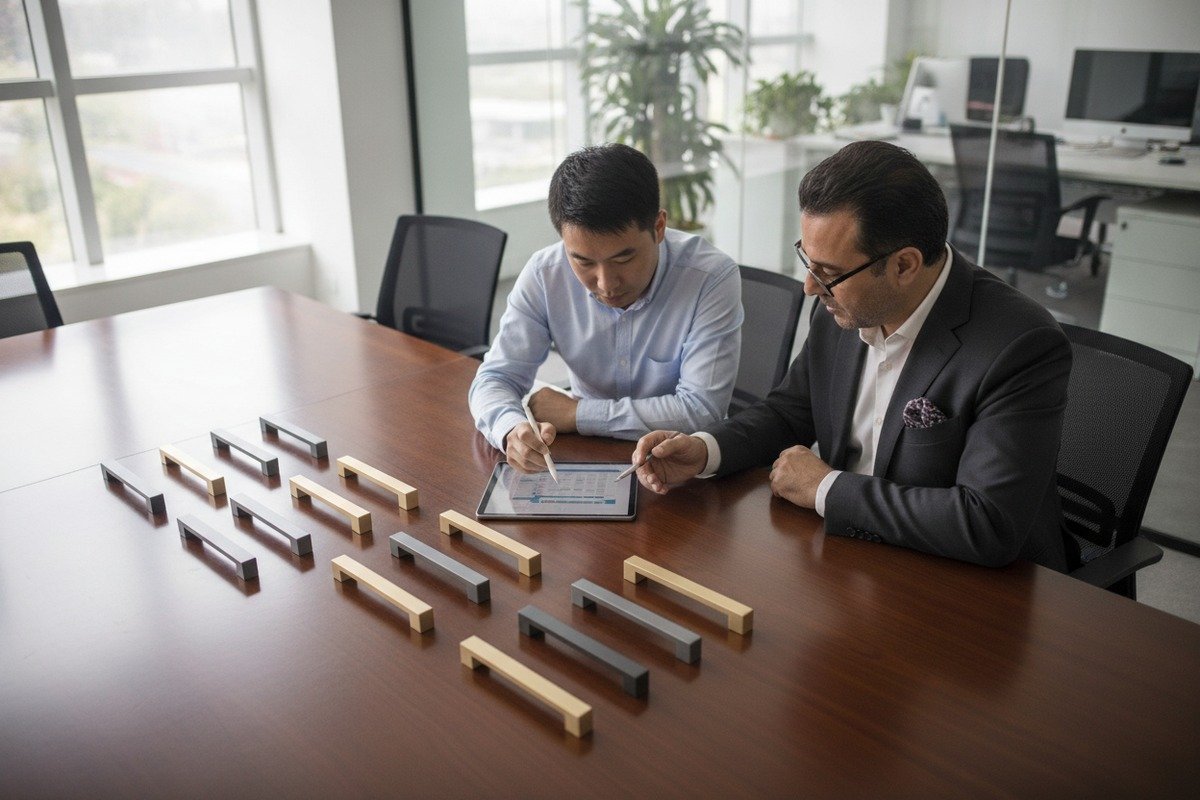
Every week, our sales team in Foshan fields calls from furniture wholesalers who just lost weeks and thousands of dollars on a bad mold from a supplier who looked great on paper.
To evaluate a Chinese supplier’s mold development capabilities, request detailed tooling breakdowns, ask for proof of in-house mold-making equipment, review sample projects with similar complexity, and compare total cost of ownership rather than just the initial mold quote. Separating tooling, sampling, finishing, and per-unit costs reveals the true picture.
This guide walks you through the exact steps we recommend to our own B2B partners before they commit to any tooling investment wire-cut EDM machines 1. Whether you are a furniture factory owner or a building material distributor, the checklist below will save you time, money, and headaches.
How can I assess if a Chinese factory has the technical expertise to develop custom molds for my unique handle designs?
Many buyers send a CAD file to five factories and just compare prices FEA results 2. That approach hides the most important variable: whether the supplier actually understands your design at the engineering level.
Assess technical expertise by requesting a Design-for-Manufacturability (DFM) review, asking about in-house tooling equipment like CNC and EDM machines, reviewing past projects with similar handle geometries, and evaluating how clearly the supplier discusses parting lines, gating, shrinkage, and surface-finish implications before quoting.
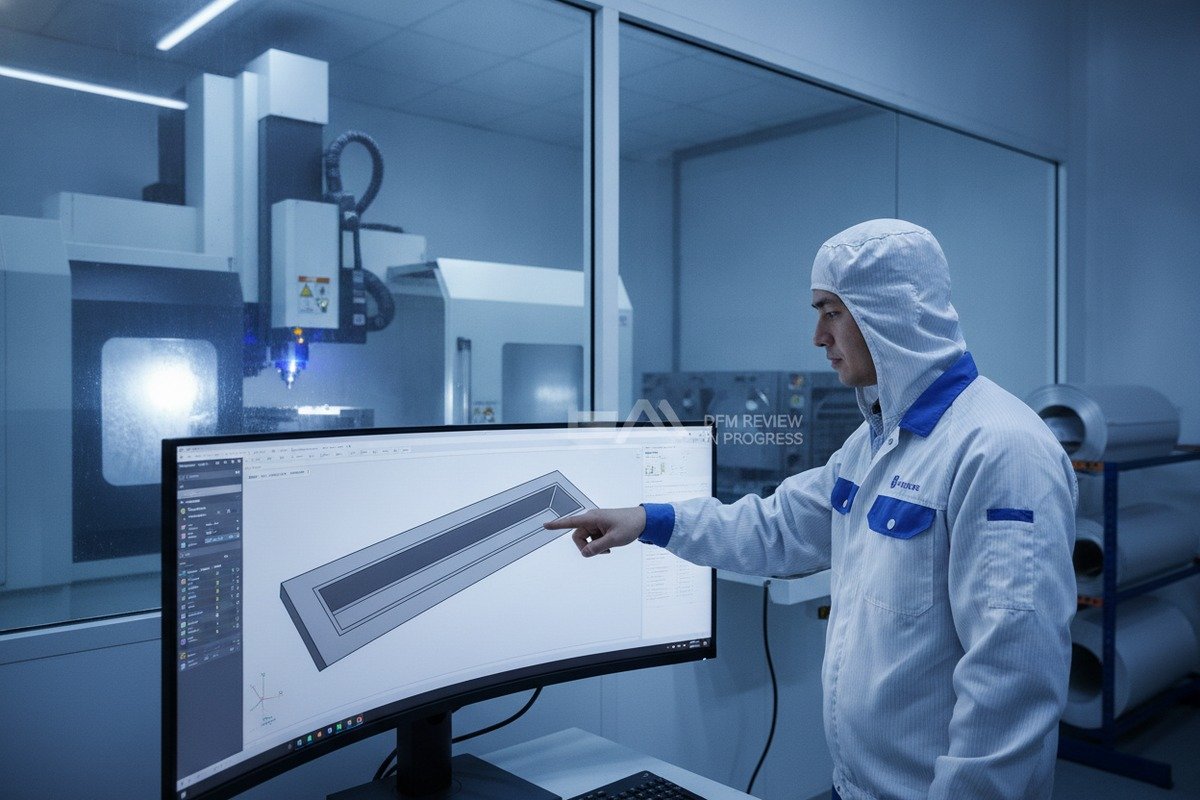
Start with the DFM Conversation
The fastest way to judge a supplier's engineering depth is to send your drawing and see what comes back. Design-for-Manufacturability (DFM) review 3 A competent factory will not just say "yes, we can do it." They will come back with questions and suggestions. On our production floor, our engineers routinely flag issues like wall thickness that is too thin for stable extrusion, or a channel depth that will cause polishing problems later. If a supplier quotes you in 30 minutes without asking a single technical question, that is a warning sign.
Check for In-House Mold-Making Equipment
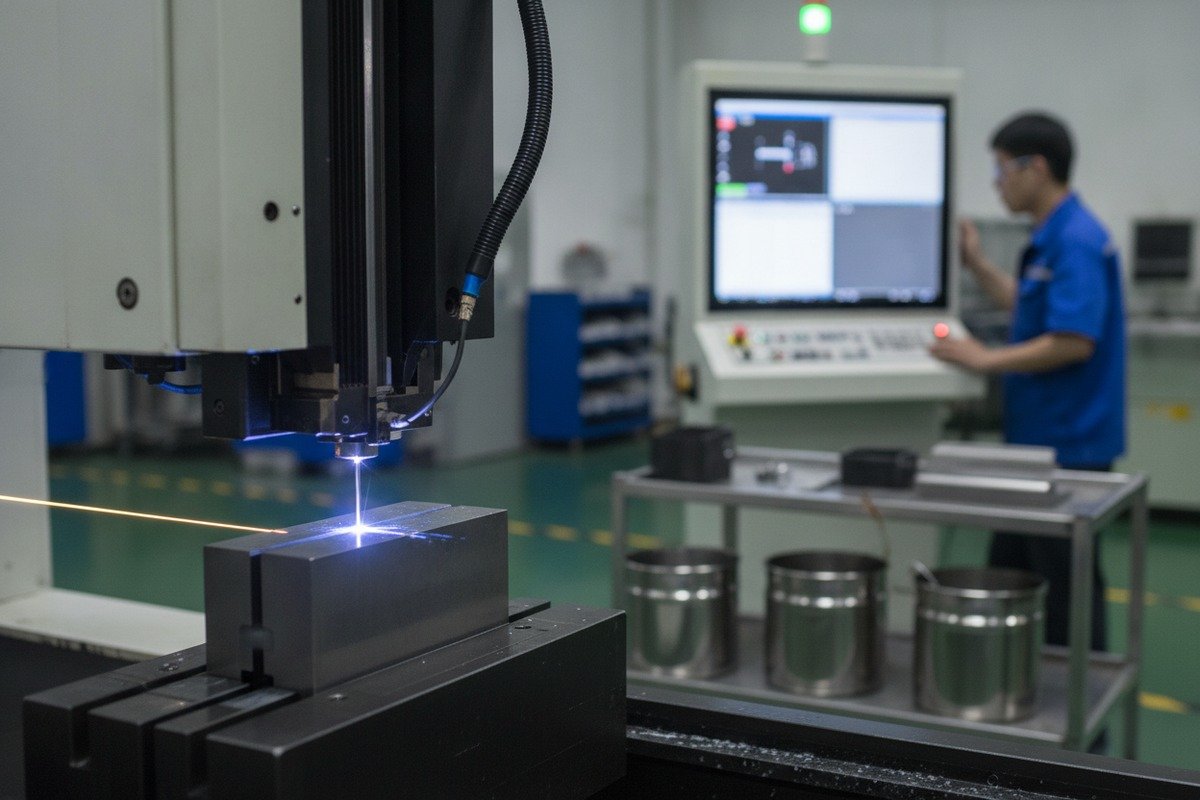
Real mold development capability means the factory owns or directly controls the machines that cut, shape, and finish the mold. The key equipment includes CNC machining centers 4, wire-cut EDM machines, and surface grinders. If a supplier outsources all mold making to a third party, coordination delays and quality gaps are almost guaranteed.
Review Similar Handle Projects
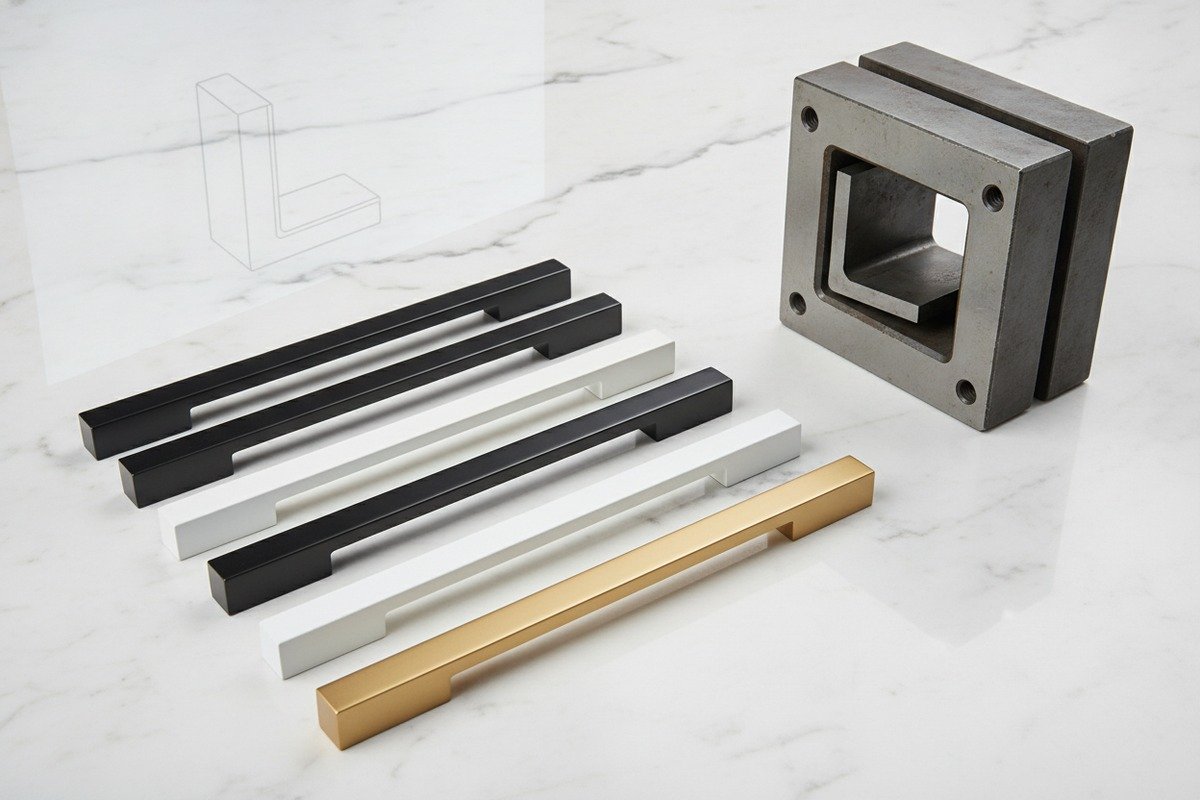
Ask for photos of molds and finished handles that match your complexity level. For instance, a long, slim recessed handle with a deep geometric channel and sharp edges requires precise mold geometry and careful parting-line placement. A factory that has done similar work before can show you the mold, the trial samples, and the finished product side by side.
Key Questions to Ask During Evaluation
| Question | Why It Matters | Good Answer Looks Like |
|---|---|---|
| Do you make molds in-house or outsource? | Controls quality and lead time | "We have 8 CNC machines and 3 EDM machines on-site" |
| What molding process do you recommend for my handle — die casting 5 or extrusion? | Wrong process choice ruins the product | Explains trade-offs clearly based on your geometry |
| How many new molds do you develop per year? | Indicates active capability vs. dormant | 50+ new molds per year shows routine competence |
| Can you show mold flow analysis 6 or FEA results? | Advanced digital tools reduce prototyping cycles | Shares actual simulation screenshots or reports |
| How do you handle parting lines on visible surfaces? | Cosmetic quality depends on this | Describes specific strategies for your handle shape |
| What is expected mold life and maintenance plan? | Affects long-term per-unit cost | "100,000+ shots with scheduled maintenance every 20,000" |
Extrusion vs. Die Casting: Know the Difference
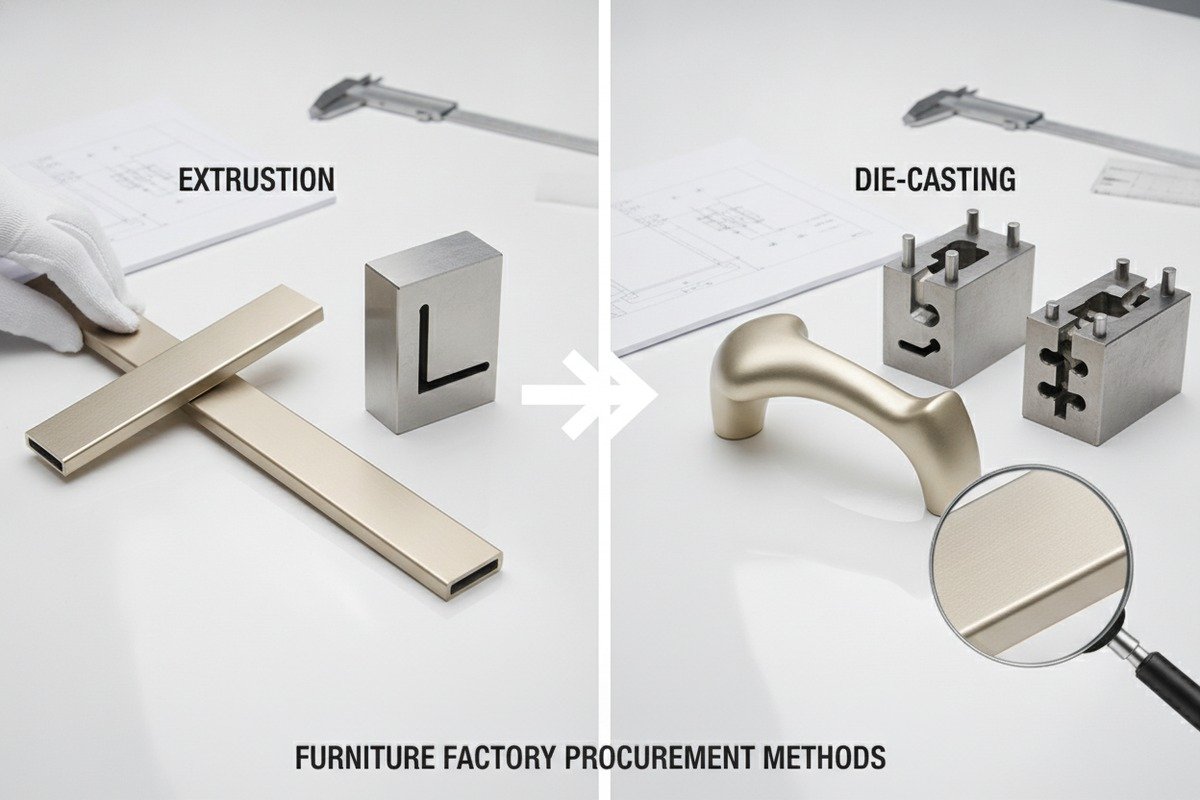
For minimalist recessed handles with a consistent cross-section — like the long, slim rectangular pulls with an L-shaped profile — aluminum extrusion 7 is usually the right process. The mold for extrusion is called a die, and it is simpler and cheaper than a die-casting mold. Die casting is used for handles with three-dimensional shapes that vary along their length. Knowing which process your handle requires is step one. A supplier that does not clearly distinguish between these two processes may lack the depth you need.
Watch for These Red Flags
Be cautious if a factory claims "everything is in-house" but cannot name specific machines. Be wary if they quote an extremely low mold price but stay vague on specifications. And if they cannot explain how they will handle surface defects, tooling wear, or sample revisions, walk away. We have seen buyers waste entire seasons because they chose a supplier based on price alone, only to discover the mold could not produce handles with the champagne gold anodized finish they needed.
What are the typical mold development costs I should expect when ordering custom aluminum profiles from Foshan?
Price is the question every buyer asks first. But the real question is what the price actually includes — and what it hides.
For custom aluminum extrusion dies in Foshan, expect to pay roughly $300 to $1,500 per die depending on profile complexity, size, and alloy. Die-casting molds for three-dimensional handles cost significantly more, often $3,000 to $15,000 or higher. Always request a line-item breakdown covering tooling, sampling, finishing, and per-unit production costs.
Understanding the Five Cost Buckets
When we prepare quotes for our B2B clients, we separate costs into distinct categories. This transparency is not standard across all suppliers, so you need to ask for it explicitly.
| Cost Bucket | What It Covers | Typical Range (Foshan) |
|---|---|---|
| Tooling / Mold Cost | Design, machining, and assembly of the die or mold | $300–$1,500 (extrusion die); $3,000–$15,000+ (die-casting mold) |
| Sample / Prototype Cost | Trial runs, sample pieces, and shipping for approval | $100–$500 per round |
| Unit Production Cost | Material, extrusion or casting, and cutting per piece | Varies by weight, alloy, and order volume |
| Finishing Cost | Polishing, anodizing, powder coating, or other surface treatments | $0.20–$2.00+ per piece depending on finish type |
| Maintenance / Repair Cost | Scheduled die maintenance, replacement of worn components | Often included in first 50,000–100,000 pieces, then negotiable |
Why a Low Mold Quote Can Be Expensive
A factory that quotes $200 for a die when others quote $800 is probably cutting corners on steel quality, machining precision, or both. A weak die wears out faster, produces inconsistent profiles, and leads to higher reject rates. We have had clients come to us after a first supplier's mold failed at 10,000 pieces, forcing them to pay for a second mold and lose weeks of production time. The cheapest mold is almost never the cheapest decision.
What Drives Mold Cost Up
Several factors push tooling prices higher. More complex handle cross-sections with multiple channels, sharp edges, or thin walls require more precise machining. Tighter dimensional tolerances mean more time on CNC machines. Higher cosmetic requirements — like achieving a flawless surface for champagne gold anodizing — demand finer die finishing. And larger handle profiles need bigger dies with more material. When you compare quotes, make sure every supplier is quoting for the same tolerance and finish standard.
Total Cost of Ownership Matters Most
Do not compare mold quotes in isolation. A mold that costs $1,200 but produces 150,000 flawless handles over its lifetime is far cheaper per piece than a $400 mold that needs replacement at 30,000 pieces. Always ask about expected mold life, included maintenance, and the cost of repairs or replacements. The total cost of ownership 8 is the only fair basis for comparison between suppliers.
How do I verify the turnaround time for mold creation and sample approval to avoid delays in my furniture production?
Delays in mold development can ripple through your entire production schedule and damage your relationships with your own customers. This is one of the most common pain points we hear from furniture factory owners.
Verify turnaround time by requesting a written production timeline with milestones for mold design, machining, trial runs, sample shipping, and revisions. Confirm how many sample iterations are included, set clear approval deadlines on both sides, and ask for photographic progress updates at each stage to catch delays early.
A Realistic Mold Development Timeline
For aluminum extrusion dies, most competent Foshan factories can complete the full cycle — from confirmed drawing to approved sample — in 7 to 15 working days. Die-casting molds take longer, typically 20 to 45 working days, depending on complexity. Here is a typical timeline breakdown for extrusion-based furniture handles.
| Stage | Duration | Key Output |
|---|---|---|
| Drawing confirmation and DFM review | 1–2 days | Finalized drawing with both parties' approval |
| Die design | 1–3 days | Die blueprint or 3D model |
| Die machining | 3–5 days | Finished die ready for trial |
| First trial extrusion | 1 day | Raw extruded profile samples |
| Surface finishing of samples | 1–3 days | Anodized or coated sample pieces |
| Sample shipping to buyer | 3–7 days | Physical samples in buyer's hands |
| Buyer review and approval | Buyer-dependent | Written approval or revision request |
| Revision (if needed) | 2–5 days per round | Adjusted die and new samples |
How to Prevent Delays on Your Side
In our experience exporting to the Middle East and Vietnam, the biggest delay is often not on the factory side. It happens when the buyer takes two or three weeks to review samples, or when internal approval chains are slow. Set a deadline for your own team. If you commit to a 3-day review window, tell the factory upfront and hold yourself to it.
How to Prevent Delays on the Factory Side
Ask for a named project manager or contact person. Request photo updates at each milestone — die machining complete, trial extrusion done, samples in finishing. Factories that share progress proactively are more likely to stay on schedule. If a factory goes silent for a week, that is usually a bad sign.
Sample Iterations: Set Expectations Early
Most suppliers include one or two sample rounds in the initial mold cost. Additional rounds usually cost extra and add time. Clarify this before you pay. Ask specifically: "How many sample iterations are included? What does each additional round cost? How long does each revision take?" Getting these answers in writing prevents disputes later.
Stock Items vs. Custom Items
For buyers who need fast delivery, some handles can be produced from existing dies. Our warehouse in Foshan keeps 300 tons of ready-to-ship inventory of popular handle profiles. Stock items ship within 48 hours. Custom items with new dies take 3 to 7 working days after die completion. Knowing which category your order falls into helps you plan your furniture production schedule accurately.
Can I negotiate a mold fee refund or waiver based on my annual purchase volume of aluminum handles?
This is the question every procurement manager wants to ask but sometimes feels uncomfortable raising. The good news is that mold fee negotiation is standard practice in the Chinese aluminum hardware industry.
Yes, many Chinese suppliers offer partial or full mold fee refunds once cumulative order volume reaches an agreed threshold. Some waive the mold fee entirely for large committed volumes. The key is to negotiate clear, written terms that specify the refund trigger volume, timeline, and conditions before you pay for tooling.
How Mold Fee Refunds Typically Work
The most common arrangement is a volume-based rebate. You pay the full mold fee upfront. Once your cumulative order volume hits a pre-agreed threshold — say 50,000 or 100,000 pieces — the factory refunds part or all of the mold fee. Some factories amortize the mold cost into the per-unit price instead, spreading the tooling investment across every piece. Both approaches have trade-offs.
Refund vs. Amortization: Which Is Better?
| Approach | How It Works | Best For | Risk |
|---|---|---|---|
| Pay upfront, get refund at volume | You pay full mold fee; refund triggered at agreed volume | Buyers confident in hitting volume targets | If volume falls short, you absorb the full mold cost |
| Amortized into unit price | No separate mold fee; unit price is slightly higher | Buyers uncertain about future volume | You pay more per piece forever, even after "paying off" the mold |
| Full waiver for committed volume | No mold fee charged; buyer commits to annual volume | Large-volume buyers with predictable demand | Factory may set higher unit price or less favorable terms elsewhere |
When We Waive Mold Fees
On our end, we regularly work with furniture factories and distributors who commit to annual volumes. For clients placing repeat orders of popular handle profiles, we often absorb the tooling cost because the long-term relationship makes it worthwhile. But we always put the terms in writing. Verbal promises about mold fee refunds are meaningless — make sure any agreement specifies the exact volume trigger, the refund amount, the timeline, and what happens if your volume falls short.
Mold Ownership: A Critical Detail
Regardless of whether you negotiate a refund or waiver, clarify who owns the mold. In most cases, if you pay the full mold fee, you own the mold. That means the supplier cannot use it for other clients, and you can theoretically move it to another factory. If the supplier waives the fee, they usually retain ownership. This distinction matters for intellectual property protection and long-term supply chain flexibility. Get mold ownership terms in writing before any money changes hands.
Protecting Your Design
If your handle design is unique, consider a Non-Disclosure, Non-Circumvention, and Non-Use agreement 9 before sharing technical drawings. Registering design patents in China 10 adds another layer of protection. A trustworthy supplier will not hesitate to sign reasonable IP protection agreements. If a factory resists or dismisses your concerns, treat that as a serious red flag.
Negotiation Tips for Buyers
Keep these principles in mind when discussing mold fees with Chinese handle suppliers. First, always negotiate the total package, not just the mold fee. A waived mold fee with a 20% higher unit price may cost you more in the long run. Second, bring data. Show your purchase history, growth projections, and how many SKUs you plan to source. Third, be direct but respectful. Chinese suppliers appreciate straightforward communication and long
Footnotes
1. Replaced with an authoritative Wikipedia entry on wire-cut EDM. ↩︎
2. Found a relevant article on interpreting Finite Element Analysis (FEA) results. ↩︎
3. Explains Design for Manufacturability (DFM) as an engineering practice to reduce manufacturing costs and defects. ↩︎
4. Defines CNC machining centers as advanced computer-controlled machine tools for various operations. ↩︎
5. Replaced with an authoritative Wikipedia entry on die casting. ↩︎
6. Wikipedia page detailing Moldflow, a software for simulating plastic injection molding. ↩︎
7. Explains aluminum extrusion as a process where preheated aluminum is forced through a die to form a cross-section. ↩︎
8. Defines Total Cost of Ownership (TCO) as a calculation quantifying the total cost of a product or service over its lifecycle. ↩︎
9. Replaced with an article explaining non-circumvention agreements, which often include non-disclosure and non-use provisions. ↩︎
10. Provides guidance on protecting 3D product designs through registered design patents in China. ↩︎