
Every week, our sales team in Foshan fields calls from Vietnamese furniture factories asking one question that keeps coming up: “How do I know this handle will still look clean after months of daily use?”
Vietnamese OEM buyers should evaluate anti-fingerprint and easy-to-clean aluminum handles by defining measurable acceptance criteria for smudge visibility, wipe-clean recovery, coating durability, and batch consistency before placing any bulk order. Request finish specifications, sample testing, and documented performance data rather than relying on supplier marketing language alone.
This guide breaks down exactly what these surface claims mean, how to test them, and where the pitfalls hide coating durability 1. Let us walk through each step so you can source with confidence.
How can I verify the durability of anti-fingerprint coatings on aluminum handles before placing a bulk order?
We have shipped over 300 tons of aluminum handles to Vietnamese factories, and one lesson keeps repeating itself: a handle that looks perfect on a sample board can disappoint within weeks on a kitchen cabinet if the coating was never properly tested abrasion simulation 2.
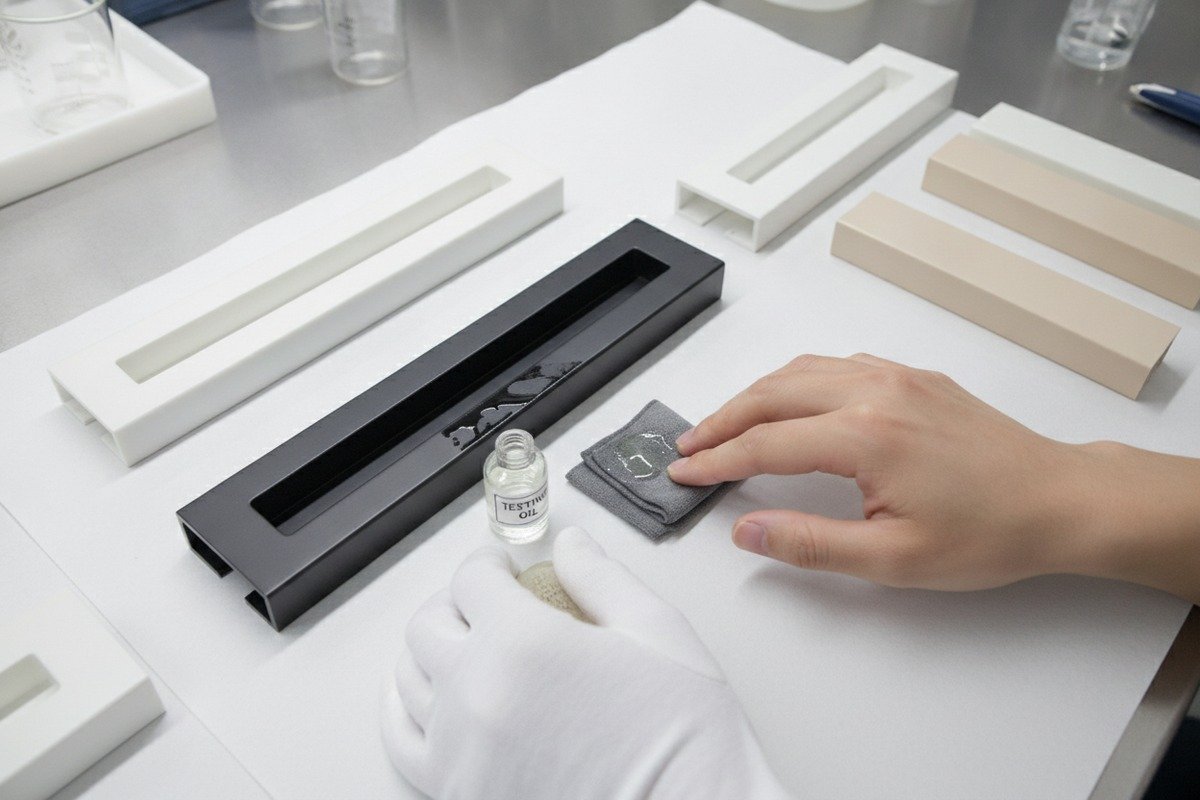
To verify coating durability, request physical samples and perform a structured series of tests including fingerprint visibility checks, oil-mark resistance, repeated wipe cycles, abrasion simulation, and chemical exposure trials. Document results with photos under consistent lighting before approving any production order.
What "Anti-Fingerprint" Actually Means
Many buyers assume "anti-fingerprint" means fingerprints never appear minimum order quantities 3. That is not accurate. The term refers to surfaces that either reduce the visibility of fingerprints or make them easier to remove. Matte, brushed, and frosted finishes scatter light in ways that hide oil marks. Some handles add a dedicated coating layer that lowers surface energy 4, causing oils to bead up instead of spreading.
The distinction matters for purchasing decisions. A brushed aluminum handle relies on its texture to mask prints. A coated handle uses chemistry to repel oils. Both can be marketed as "anti-fingerprint," but their long-term behavior differs.
A Practical Testing Framework
Before you sign a purchase order, run these tests on at least five sample handles from the same production batch.
| Test | Method | What to Look For |
|---|---|---|
| Fingerprint visibility | Press bare fingers firmly on the handle surface, then examine under a 45-degree LED light | Low contrast between touched and untouched areas |
| Oil-mark resistance | Apply a thin layer of cooking oil with a cotton pad, wait 30 seconds, then examine | Oil should bead, not spread into a film |
| Dry wipe recovery | Wipe with a clean microfiber cloth using 5 strokes | Surface should return to original appearance with no streaks |
| Damp wipe recovery | Wipe with a slightly damp microfiber cloth | No water spots or residue after drying |
| Repeated cleaning | Wipe the same area 200 times with moderate pressure | No dulling, discoloration, or patchiness |
| Abrasion at edges | Rub handle ends and mounting zones with a standard eraser 50 times | No coating loss or color change at edges |
| Chemical resistance | Apply common household cleaner, leave for 2 minutes, then wipe | No surface damage, staining, or gloss change |
Coating vs. Base Finish
Our engineering team often explains this difference to new OEM partners. A matte anodized surface gets its fingerprint resistance from surface texture alone. A handle with a dedicated anti-fingerprint topcoat adds a thin layer, often nano-ceramic or fluoropolymer-based, that actively repels oils. fluoropolymer-based coating 5
For OEM sourcing, ask your supplier to specify which approach they use. If the handle relies on a coating, you need data on coating thickness, adhesion strength, and wear resistance. If it relies on texture, you need consistency in the anodizing or bead-blasting process across batches.
Why Batch Consistency Matters More Than You Think
A single sample can pass every test and still cause problems in production. If the supplier cannot maintain consistent gloss levels, color uniformity, and texture depth across multiple batches, your finished furniture will show visible mismatches. Ask for samples from at least three different production runs before approving.
Will easy-to-clean surface treatments maintain their quality in the humid climate of my Vietnamese furniture factory?
When we prepare shipments bound for Ho Chi Minh City or Hanoi, our quality team always flags one environmental factor that changes everything: humidity levels that can stay above 80% for months.
Easy-to-clean surface treatments can maintain quality in humid Vietnamese conditions, but only if the coating system includes proper substrate preparation, adequate anodize thickness, and sealed topcoat layers. Untested or low-grade coatings risk delamination, discoloration, and reduced hydrophobic performance within months of warehouse storage or end-user installation.

How Humidity Attacks Surface Treatments
High humidity does not just sit on the surface. Moisture migrates into micro-pores in the coating. If the anodize layer is too thin or the sealing step was skipped, water molecules reach the bare aluminum underneath. Over time, this causes white oxidation spots, coating bubbles, and a chalky texture that ruins the easy-to-clean function.
Vietnamese factories often store hardware in open warehouses without climate control. Handles sit in cardboard boxes on pallets for weeks or months before assembly. During that storage period, poor coatings degrade silently.
Key Factors for Humidity Resistance
There are three layers of defense against humidity damage.
Substrate preparation. The aluminum must be cleaned and degreased properly before any surface treatment. Residual oils or contaminants trapped under the coating will react with moisture and cause blistering.
Anodize or primer layer. A well-sealed anodized layer acts as a barrier. For handles destined for tropical climates, we recommend a minimum anodize thickness 6 of 10 microns with hot-water or nickel acetate sealing.
Topcoat integrity. If the handle uses an anti-fingerprint topcoat, that layer must be continuous with no pinholes. Even tiny gaps allow moisture entry.
Testing for Tropical Conditions
Standard salt spray tests 7 give some indication of corrosion resistance, but they do not fully simulate the warm, humid air of a Vietnamese factory. Ask your supplier for results from the following:
| Test | Standard | Minimum Target |
|---|---|---|
| Salt spray resistance | ASTM B117 or ISO 9227 | 200 hours with no visible corrosion |
| Humidity cabinet test 8 | ASTM D2247 or ISO 6270 | 500 hours at 95% RH, 40°C with no blistering or delamination |
| Adhesion after humidity exposure | ASTM D3359 cross-hatch tape test | 4B rating or higher after humidity exposure |
| Gloss retention after humidity | ASTM D523 at 60° angle | Less than 10% gloss change |
If your supplier cannot provide humidity cabinet test results, request that they run the test on your specific finish before you commit to production quantities. At our facility, we routinely run these tests for OEM partners shipping to Southeast Asia because we know the conditions demand it.
Storage Recommendations
Even with a robust coating, proper storage helps. Keep handles in sealed plastic bags with silica gel desiccant packs 9 inside the cartons. Store cartons off the floor on raised pallets. If your warehouse has ventilation fans, position them to keep air circulating around the stock.
Can I customize the finish of my OEM aluminum handles while still ensuring high-performance anti-smudge properties?
Our R&D team works with Vietnamese furniture brands every month on custom finishes. The most common request sounds like this: "I need the handle in champagne gold to match my door panel, but it still has to resist fingerprints."
Yes, you can customize the finish color, texture, and sheen of OEM aluminum handles while maintaining anti-smudge performance. The key is to specify the anti-fingerprint requirement as a measurable coating parameter alongside the aesthetic specification, so the surface treatment process accommodates both goals without compromise.

Where Customization and Performance Overlap
Most anti-fingerprint performance comes from two things: surface texture and topcoat chemistry. Neither of these is locked to a single color. A matte black handle can have the same anti-smudge coating as a champagne gold one. A brushed silver handle can use the same bead-blast pattern as a charcoal grey one.
The trick is sequencing. Color is applied at the anodizing or powder-coating stage. Anti-fingerprint performance is delivered by the finishing step, which can be a nano-coating applied after the color layer. When these steps are properly separated, you get full color freedom without sacrificing function.
Common Custom Finish Options with Anti-Smudge Compatibility
| Finish Type | Color Flexibility | Anti-Fingerprint Method | Typical Use Case |
|---|---|---|---|
| Matte anodized | Silver, champagne, bronze, black | Inherent texture + optional nano-topcoat | Minimalist kitchen and wardrobe pulls |
| Brushed anodized | Silver, gold, dark bronze | Directional brush lines hide prints + sealant | Mid-range to premium cabinet handles |
| Powder-coated matte | Any RAL or Pantone color | Low-gloss formulation + anti-fingerprint additive | Color-matched furniture systems |
| PVD-style decorative | Gold, rose gold, gunmetal, black | Dense coating naturally resists oils | High-end decorative hardware |
| Bead-blasted + clear coat | Natural aluminum tones | Micro-texture scatters light + sealed surface | Industrial and modern designs |
How to Write a Finish Specification
When you send us a custom order, we ask for a specification that covers both appearance and performance. Here is what to include:
Color reference. Provide a RAL number, Pantone code, or a physical sample. Digital photos are unreliable because screen color varies.
Gloss level. State the target in gloss units (GU) measured at 60 degrees. For anti-fingerprint handles, a range of 10–30 GU (matte to satin) works best.
Texture description. Specify brushed, bead-blasted, smooth matte, or another texture. Include a reference sample if possible.
Anti-fingerprint requirement. State it clearly: "Handle must show no visible fingerprints under standard office lighting after being touched with bare hands." This gives the factory a testable target.
Cleaning requirement. For example: "Surface must return to original appearance after one wipe with a dry microfiber cloth."
Avoiding the Glossy Trap
Some buyers request glossy finishes for a premium look but then complain about fingerprints. Glossy surfaces reflect light uniformly, which makes any oil film highly visible. If your customer insists on gloss, set expectations clearly: a glossy handle will always show more prints than a matte one, even with the best coating. The anti-fingerprint topcoat helps, but it cannot overcome physics. Light reflection on a smooth, shiny surface will reveal every touch.
Our recommendation for Vietnamese OEM projects is to stay in the matte-to-satin range. These finishes deliver the modern, architectural look that sells well in the Southeast Asian market while keeping maintenance expectations realistic.
How will choosing specialized surface treatments for my handles impact my sourcing lead times and MOQ requirements?
When our Vietnamese partners plan a new furniture collection, timing is everything. Production schedules are tight, container bookings are fixed, and a delay on hardware can hold up an entire shipment.
Specialized anti-fingerprint and easy-to-clean surface treatments typically add 3–7 days to standard lead times and may increase minimum order quantities by 20–50% compared to basic finishes. However, suppliers with in-house coating lines and ready stock of popular finishes can minimize both impacts through pre-finished inventory and flexible batch scheduling.

Why Specialized Finishes Take Longer
A standard anodized aluminum handle follows a straightforward process: extrude, cut, drill, anodize, pack. Adding an anti-fingerprint topcoat inserts extra steps: surface cleaning, coating application, curing, and quality inspection of the coating layer. Each step adds time and requires dedicated equipment.
If the finish also involves a custom color, the anodizing bath must be adjusted and tested before production begins. Color matching alone can take one to two days when the target is a non-standard shade.
Lead Time Comparison
Here is a realistic comparison based on what we see in daily operations.
| Order Type | Standard Anodized Finish | Anti-Fingerprint Matte Finish | Custom Color + Anti-Fingerprint |
|---|---|---|---|
| Stock item (popular profile and color) | Ships within 48 hours | Ships within 48 hours if pre-coated stock is available | Not available from stock; requires production |
| Standard production order | 7–10 days | 10–14 days | 14–18 days |
| Custom profile + custom finish | 15–20 days | 18–25 days | 20–30 days |
The biggest time savings come from choosing finishes that your supplier already keeps in stock. At our warehouse in Foshan, we maintain 300 tons of ready-to-ship inventory in the most popular profiles and finishes, including matte black, champagne gold, and brushed silver with anti-fingerprint treatment. Orders for these ship within 48 hours.
MOQ Considerations
Specialized coatings often come with higher MOQs because the coating process has setup costs. A nano-coating machine needs to be cleaned, calibrated, and tested before each run. Running it for 50 handles is not economical. Running it for 500 is.
For standard finishes, many suppliers accept MOQs as low as 200 pieces per SKU. For custom anti-fingerprint finishes, expect the minimum to rise to 300–500 pieces per SKU. If you need a truly unique coating, some suppliers may require 1,000 pieces or more.
How to Reduce Lead Time and MOQ Pressure
Consolidate SKUs. If you need handles in five lengths but one finish, order them together so the coating run covers all sizes in one batch.
Choose from the supplier's standard palette. Most established manufacturers have 8–12 standard anti-fingerprint finishes. Picking from this list avoids custom setup time.
Plan ahead. Give your supplier a rolling forecast so they can pre-produce your handles during slow periods. This converts urgent orders into scheduled production, which reduces both lead time and cost.
Negotiate blanket orders. Commit to a total annual volume and release in monthly batches. This gives the supplier confidence to invest in coating setup and may lower your per-unit price.
Cost Impact
Anti-fingerprint coatings add cost. The increase depends on the coating technology, application method, and order volume. As a general guide, expect a 5–15% premium over a standard anodized finish for a nano-ceramic topcoat 10, and up to 20% for specialized PVD-style treatments. At scale, this premium drops because the fixed setup cost is spread across more units.
The return on this investment comes from fewer customer complaints, lower cleaning maintenance for end users, and a more premium positioning for your furniture brand. Many of our Vietnamese partners tell us the price difference pays for itself in reduced warranty issues alone.
Conclusion
Evaluating anti-fingerprint and easy-to-clean aluminum handles comes down to measurable standards, not marketing claims. Define your acceptance criteria, test samples rigorously, and choose a supplier who backs their finish performance with data.
Footnotes
1. Provides requirements and scope for durability testing of coatings. ↩︎
2. Explains methods and standards for evaluating material resistance to abrasion and wear. ↩︎
3. Explains the definition, purpose, and optimization of minimum order quantities in supply chains. ↩︎
4. Provides a comprehensive definition and explanation of surface energy. ↩︎
5. Details the properties, advantages, and applications of fluoropolymer coatings. ↩︎
6. Provides a NASA standard for anodizing aluminum alloys, including thickness specifications. ↩︎
7. Explains the standardized method for checking corrosion resistance of materials and coatings. ↩︎
8. Defines the standard procedure for testing resistance of coatings to humid environments. ↩︎
9. Describes silica gel’s properties and uses as a desiccant to absorb moisture. ↩︎
10. Explains what nano ceramic coating is, how it works, and its benefits. ↩︎