Every year around March, our production floor starts buzzing with urgent reorders from furniture factories that waited too long supply chain management 1. The panic emails pile up. Delivery windows shrink. Freight costs spike. And the same question echoes across every call: “Can you ship faster?”
To align aluminum furniture handle supplier schedules with peak season stocking, place confirmed orders 60–90 days before demand peaks, share rolling forecasts with your supplier, maintain safety stock on best-selling SKUs, and leverage ready-to-ship inventory for urgent fills. Early coordination prevents costly delays and stockouts.
This guide breaks down the exact steps you can take — from timeline planning to inventory tactics — so your factory shelves are full before the rush begins rolling forecast 2. Let’s walk through each piece of the puzzle.
How can I better coordinate my order timeline with my supplier to avoid peak season delays?
We have seen it happen dozens of times on our Foshan production lines: a furniture factory in Vietnam places a large handle order in late February, right when spring demand is about to explode inventory management software 3. By then, our machines are already running at 95% capacity. The result? A four-week delay that cascades through their entire production schedule.
To better coordinate your order timeline, share a 90-day rolling forecast with your supplier, confirm orders at least 60 days before peak season, and establish clear milestone dates for sample approval, production start, and shipment. This advance visibility lets your supplier reserve capacity and raw materials before the rush.

Why 60–90 Days Matters
Aluminum handle production is not instant. Raw aluminum profiles need to be extruded, cut, surface-treated, and packed. If you want a brushed champagne gold finish on a minimalist edge-pull design, the anodizing or PVD coating stage alone can add 7–10 days. When our factory is running at normal capacity, a standard order takes about 30 days. During peak season, that stretches to 45–55 days because every client places orders simultaneously.
The 60–90 day window gives your supplier enough room to source aluminum billets, schedule your job in the production queue, and arrange quality checks without rushing.
Map Your Peak Seasons to a Calendar
Not every furniture category peaks at the same time. Here is a simple reference:
| Peak Season | Months | Primary Furniture Types | Handle Demand Level |
|---|---|---|---|
| Spring Refresh | March – May | Living room, bedroom, kitchen | High |
| Back-to-School / Home Office | July – August | Desks, shelving, storage | Medium-High |
| Fall / Holiday Prep | September – October | Dining, entertainment centers | High |
| Post-Holiday Renovation | January | Cabinets, wardrobes, bathrooms | Medium |
Once you know which peaks affect your product lines, count backwards 60–90 days. That is your order window. For a spring peak starting in March, your confirmed purchase order should land with your supplier by late December or early January at the latest.
Build a Shared Timeline Document
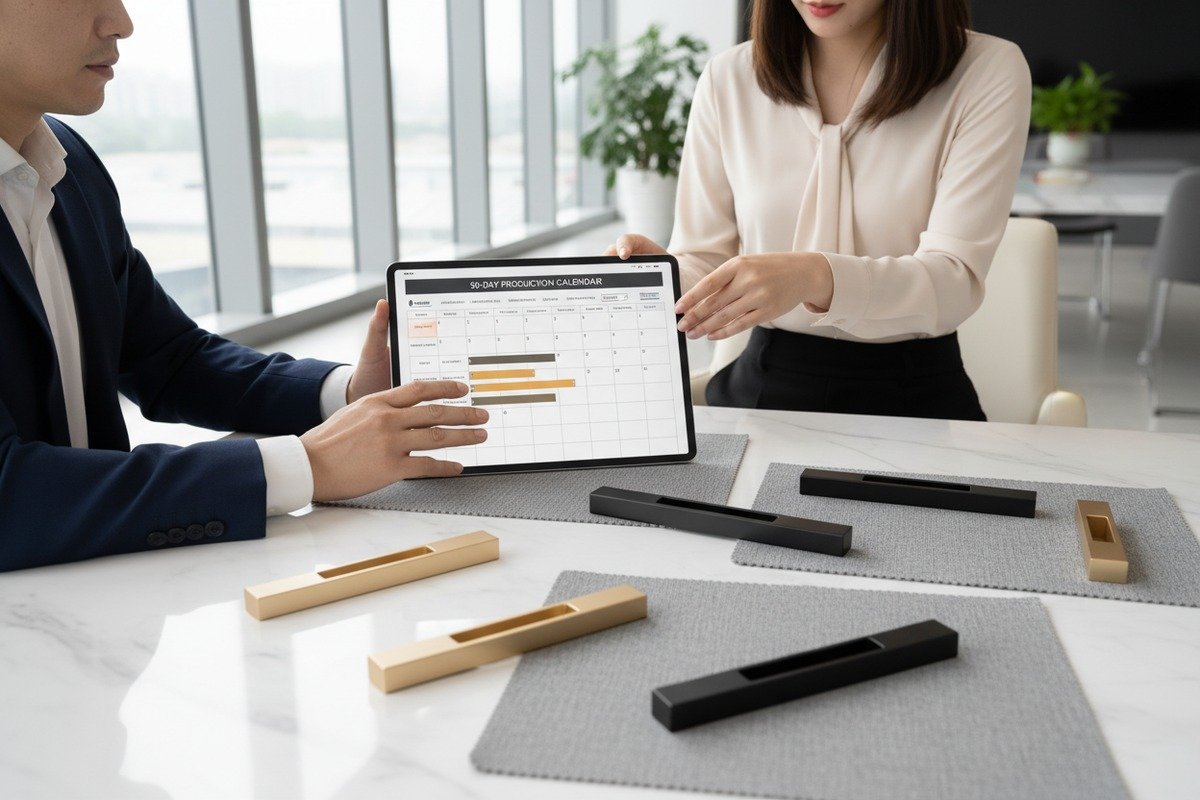
One practice that has dramatically reduced delays for our long-term clients is a shared milestone tracker. It does not need to be fancy. A simple spreadsheet works. The key columns include: order confirmation date, sample approval deadline, production start date, quality inspection date, and estimated shipment date. Both sides update it weekly. When a milestone slips, everyone sees it immediately and can adjust.
Account for Chinese New Year
This is a critical detail many overseas buyers overlook. Chinese New Year 4 typically falls in late January or early February, and most Chinese factories — including ours — shut down for two to four weeks. The weeks before the holiday are a frenzy of last-minute shipments, and the weeks after involve a slow ramp-up as workers return. If your spring peak starts in March, and you have not placed orders before the holiday, you are already behind. The smartest buyers confirm their spring orders by mid-December.
What steps should I take to ensure my furniture factory has enough stock before the high season hits?
Running out of handles mid-production is one of the most frustrating problems we hear about from our furniture factory clients. A cabinet line stops. Workers idle. Deadlines slip. And all because a $0.50 handle was not on the shelf when it needed to be.
To ensure sufficient stock before high season, analyze your previous year's sales data to forecast demand, place blanket orders with staggered deliveries, maintain two to four weeks of safety stock on top-selling SKUs, and use inventory management software to trigger automatic reorders at preset thresholds.

Start With Historical Data
Your best forecasting tool is your own order history. historical data 5 Pull the last two to three years of handle purchase records. Look for patterns. Which SKUs move fastest in spring? Which finishes spike in the fall? Group your handles into three tiers:
| Tier | Description | Stocking Strategy |
|---|---|---|
| A – High Demand | Top 20% of SKUs by volume, consistent reorders | Maintain 4 weeks of safety stock 6; place blanket PO |
| B – Moderate Demand | Middle 30% of SKUs, seasonal fluctuation | Maintain 2 weeks of safety stock; order 60 days ahead |
| C – Low Demand / Custom | Bottom 50%, niche or project-specific | Order on demand; no safety stock needed |
This tiered approach prevents you from tying up capital in slow-moving inventory while keeping your best sellers always available.
Use Blanket Orders With Staggered Deliveries
A blanket order 7 is a single purchase agreement covering a larger quantity, but with deliveries split across multiple dates. For example, you might commit to 20,000 pieces of a matte black edge-mount pull for the year, with 5,000 shipping each quarter. This gives our production team certainty to buy raw materials in bulk — often at a lower cost — and it gives you a guaranteed slot in the production schedule. You avoid the risk of your order being bumped during a busy month.
Calculate Your Safety Stock
Safety stock is the buffer between your forecast and reality. A simple formula works well for most furniture factories:
Safety stock = (Maximum daily usage × Maximum lead time) – (Average daily usage × Average lead time)
If you typically use 100 handles per day, your average lead time is 30 days, your maximum daily usage spikes to 150, and your worst-case lead time is 45 days, then:
Safety stock = (150 × 45) – (100 × 30) = 6,750 – 3,000 = 3,750 pieces.
That buffer of 3,750 pieces protects you against both demand spikes and shipping delays.
Audit Your Warehouse Before Ordering
Before placing any pre-season order, do a physical inventory count. We have seen clients order 10,000 pieces of a handle they already had 4,000 of sitting in a back warehouse. Overstocking ties up cash and warehouse space. A quick audit takes one day but can save thousands of dollars.
Coordinate Across Departments
Your procurement team, production planners, and sales team all hold pieces of the demand puzzle. Sales knows which new furniture lines are launching. Production knows the assembly schedule. Procurement knows lead times 8 and supplier constraints. A monthly cross-functional meeting — even a 30-minute call — aligns everyone and prevents surprises.
How do I manage lead times for my custom handle designs when my supplier is at full capacity?
Custom designs are where things get tricky. Our engineering team works on new profiles, unique finishes, and special dimensions every week. But when our CNC machines 9 and anodizing lines are already full with standard orders, squeezing in a custom run demands careful planning from both sides.
To manage custom handle lead times during full-capacity periods, finalize your designs and approve samples during the off-season, break custom orders into smaller pilot batches first, and lock in your production slot at least 90 days before peak season. This front-loads the time-intensive design work and reserves manufacturing capacity when it matters most.

Front-Load the Design Phase
Custom aluminum handles — like a sleek recessed finger pull with a champagne gold PVD finish 10 — involve multiple stages before mass production begins. There is the initial design review, 3D modeling, prototype tooling, sample production, finish testing, and your approval. Each stage has potential revision loops. If you start this process in January for a March peak, you are already too late.
The smart approach is to use the off-season (November–December or June–July) to complete all design and sampling work. When peak season arrives, your custom handle is ready for immediate production with no design delays.
Understand Where Bottlenecks Occur
Not every stage of custom production takes the same time. Here is a typical breakdown:
| Production Stage | Normal Lead Time | Peak Season Lead Time | Key Bottleneck Risk |
|---|---|---|---|
| Design Review & 3D Modeling | 3–5 days | 5–7 days | Engineering team stretched |
| Mold / Tooling Creation | 10–15 days | 15–25 days | CNC machine queue |
| Sample Production | 5–7 days | 7–12 days | Surface treatment line busy |
| Sample Shipping & Approval | 5–10 days | 5–10 days | Client response time |
| Mass Production | 20–30 days | 35–50 days | Full production queue |
| Total | 43–67 days | 67–104 days | — |
During peak season, total lead time for a custom handle can stretch past 100 days. That is more than three months. If you know this in advance, you can plan around it.
Use Pilot Batches to Reduce Risk
Instead of committing to 50,000 pieces of a brand-new design, consider a pilot batch of 1,000–2,000 pieces during the off-season. This lets you test the handle on your actual furniture, get feedback from your end customers, and identify any fit or finish issues before scaling up. When peak season arrives, you can place the full order with confidence — and your supplier already has the tooling and process parameters dialed in.
Negotiate a Reserved Production Slot
Some of our most strategic clients reserve a production window months in advance, even before their final order quantities are confirmed. They provide a forecast range — say 15,000 to 25,000 pieces — and we block machine time accordingly. The final quantity is confirmed 30 days before production starts. This approach works because it gives both sides flexibility while ensuring capacity is available.
Modular Design for Faster Turnaround
One underused strategy is designing custom handles with modular components. For instance, if your handle base profile is standard but the finish or length varies, we can pre-produce the base and apply custom finishes as orders come in. This hybrid approach cuts lead times by 30–40% compared to fully custom runs. Our low-profile edge-mount pulls, for example, use a common extrusion profile that we customize through different anodizing colors and cutting lengths.
Can I leverage my supplier's ready-to-ship inventory to meet my urgent peak season demands?
There are moments when planning fails. A sudden large order from a retail chain lands on your desk. A shipping container gets delayed three weeks. Your forecasted demand was 30% too low. In these situations, having a supplier with ready-to-ship stock is not a luxury — it is a lifeline.
Yes, you can leverage your supplier's ready-to-ship inventory to meet urgent peak season demands. Many established aluminum handle suppliers maintain stock of popular profiles, finishes, and sizes that can ship within 3–7 days. Combining stocked items with custom orders creates a hybrid strategy that balances speed with design flexibility.

What "Ready-to-Ship" Actually Means
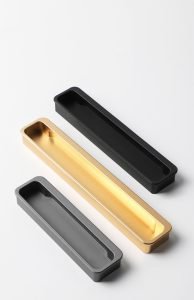
Not all suppliers maintain finished goods inventory. Many operate strictly on a make-to-order basis. At our facility in Foshan, we keep a rotating stock of our best-selling handle designs — including minimalist linear pulls, recessed finger pulls, and edge-mount cabinet handles — in popular finishes like brushed aluminum, matte black, and champagne gold. These items are packaged and sitting in our warehouse, ready to load onto a truck or into a container the moment your payment clears.
This model works because these SKUs have consistent, proven demand across multiple markets in Southeast Asia and the Middle East. We are not guessing what to stock. We are stocking what we know sells.
When to Use Ready-to-Ship vs. Custom Orders
The decision depends on your situation:
- Use ready-to-ship when you need handles within 1–2 weeks, when the design and finish match your requirements closely, or when you are filling an emergency gap in your production line.
- Use custom orders when your furniture line requires a unique profile, proprietary finish, or non-standard dimensions that are not available in stock.
- Use a hybrid approach when you need standard handles immediately for current production while waiting for a custom order to be manufactured for a future furniture series.
How to Build a Hybrid Stocking Strategy
The most resilient furniture factories use a two-track approach. Track one covers their core handle needs with stocked items that ship fast. Track two covers their premium or differentiated lines with custom handles ordered well in advance. Here is how this looks in practice:
For your everyday cabinet line that uses a standard 128mm brushed aluminum pull, order from your supplier's ready stock. For your high-end kitchen series that features a custom 350mm champagne gold recessed channel handle, place a custom order 90 days before you need it. This way, your standard production never stops, and your premium line gets the bespoke details it needs.
Verify Stock Availability Regularly
Do not assume your supplier's stock levels are static. Popular items sell out, especially during peak season when multiple buyers draw from the same pool. Establish a routine — weekly or biweekly — of checking stock availability with your supplier. A quick WhatsApp message asking "What is your current stock on SKU X in matte black?" takes 30 seconds and can prevent a painful surprise.
Negotiate a Stock Reservation Agreement
Some factories negotiate a reserved stock arrangement. You commit to purchasing a minimum quantity per quarter, and in return, the supplier holds a dedicated portion of their ready-to-ship inventory for you. This is essentially a priority access agreement. It costs you a commitment, but it guarantees availability when every other buyer is scrambling.
Consider Shipping Speed as Part of the Equation
Ready-to-ship inventory only helps if it can physically reach your factory fast enough. Sea freight from Foshan to Ho Chi Minh City takes about 3–5 days. To Jakarta, about 5–7 days. Air freight is faster but significantly more expensive. Factor these transit times into your planning. If your supplier can ship in 3 days but transit takes 7, your total fulfillment time is 10 days — still much faster than a 45-day custom production run.
Conclusion
Aligning your handle supplier's schedule with your peak season needs comes down to early planning, clear communication, smart inventory tiers, and knowing when to use custom versus ready-to-ship stock. Start your coordination 90 days out, and the peak season becomes manageable instead of chaotic.
Footnotes
1. ASCM provides a comprehensive definition and overview of supply chain management, a core concept in the article. ↩︎
2. Wikipedia offers a clear explanation of rolling forecasts, a key planning tool mentioned. ↩︎
3. Found a comprehensive guide to inventory management software. ↩︎
4. Loyalty Logistics explains the significant impact of Chinese New Year on global supply chains and manufacturing. ↩︎
5. Inbound Logistics discusses using historical data as a primary method for demand forecasting. ↩︎
6. Found an authoritative definition of safety stock from IBM. ↩︎
7. Wikipedia defines blanket orders as a purchase agreement for multiple deliveries over time. ↩︎
8. Inbound Logistics provides a clear definition and importance of lead times in supply chain management. ↩︎
9. Dassault Systèmes provides an overview of CNC machining as a subtractive manufacturing process. ↩︎
10. Found an authoritative explanation of Physical Vapor Deposition (PVD) on Wikipedia. ↩︎