Navigating China’s furniture hardware landscape can feel overwhelming, especially when dozens of supplier listings blur together across provinces and cities.
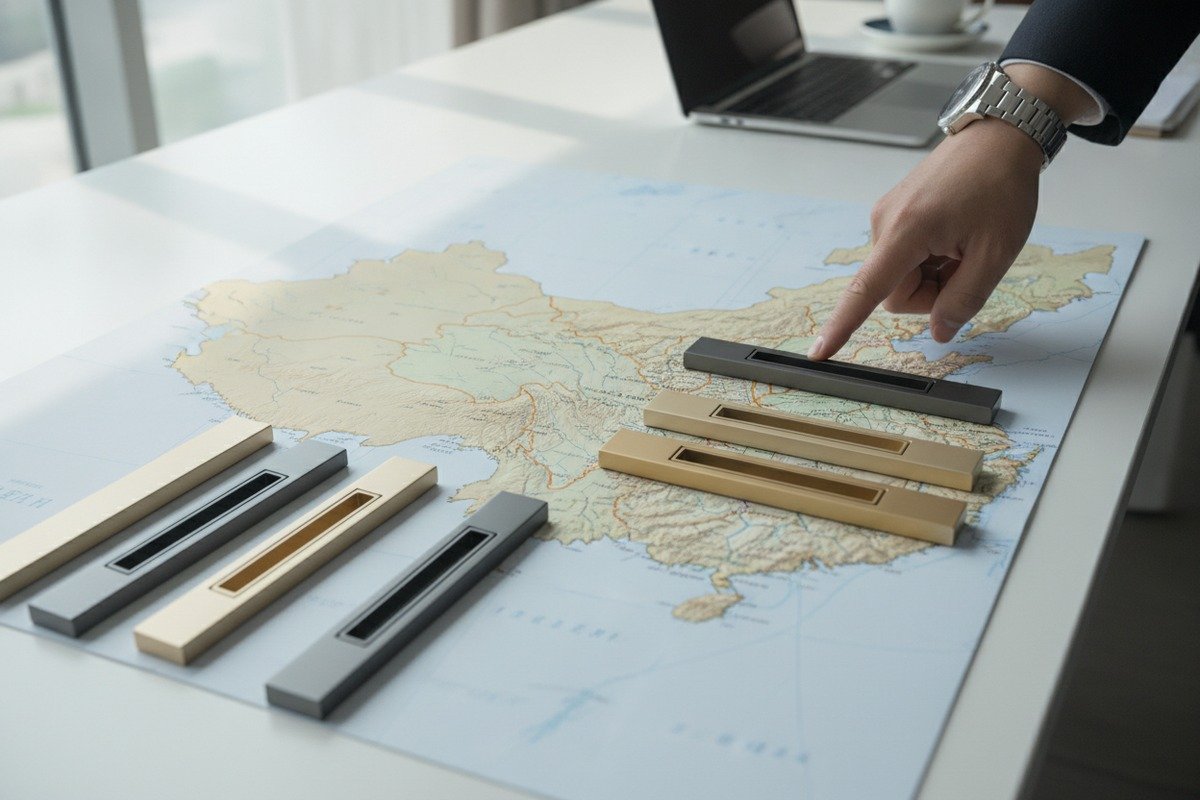
China’s aluminum furniture handle production concentrates in two coastal powerhouses—Guangdong and Zhejiang. Guangdong, especially Foshan, excels in furniture-centric ecosystems with integrated supply chains and export-ready infrastructure. Zhejiang distributes its strength across specialized cities like Ningbo, Yongkang, and Wenzhou, each offering distinct hardware and metal-processing capabilities. Choosing the right cluster depends on your product strategy, not just price.
Over the past 18 years, our team in Foshan has shipped aluminum handles and profiles to wholesalers across Vietnam and the Middle East matte powder coating 1. We have watched these two regions evolve in real time. This article breaks down exactly what makes each cluster tick—and how you can use that knowledge to source smarter die-cast and stamped handles 2. Let’s dig into the city-level details that actually matter.
What Are the Primary Differences in Product Quality and Design Styles Between Aluminum Handle Manufacturers in Guangdong and Zhejiang?
When our design team develops a new recessed pull or slim architectural handle, the upstream ecosystem around us shapes what finishes and tolerances we can achieve cost-effectively integrated supply chain support 3.
Guangdong manufacturers, centered in Foshan, typically produce higher-end aluminum handles with refined finishes like champagne gold anodizing, matte powder coating, and precision-extruded profiles. Zhejiang manufacturers across Ningbo and Yongkang often focus on functional hardware with competitive pricing, offering solid die-cast and stamped handles suited to volume-driven wholesale markets.
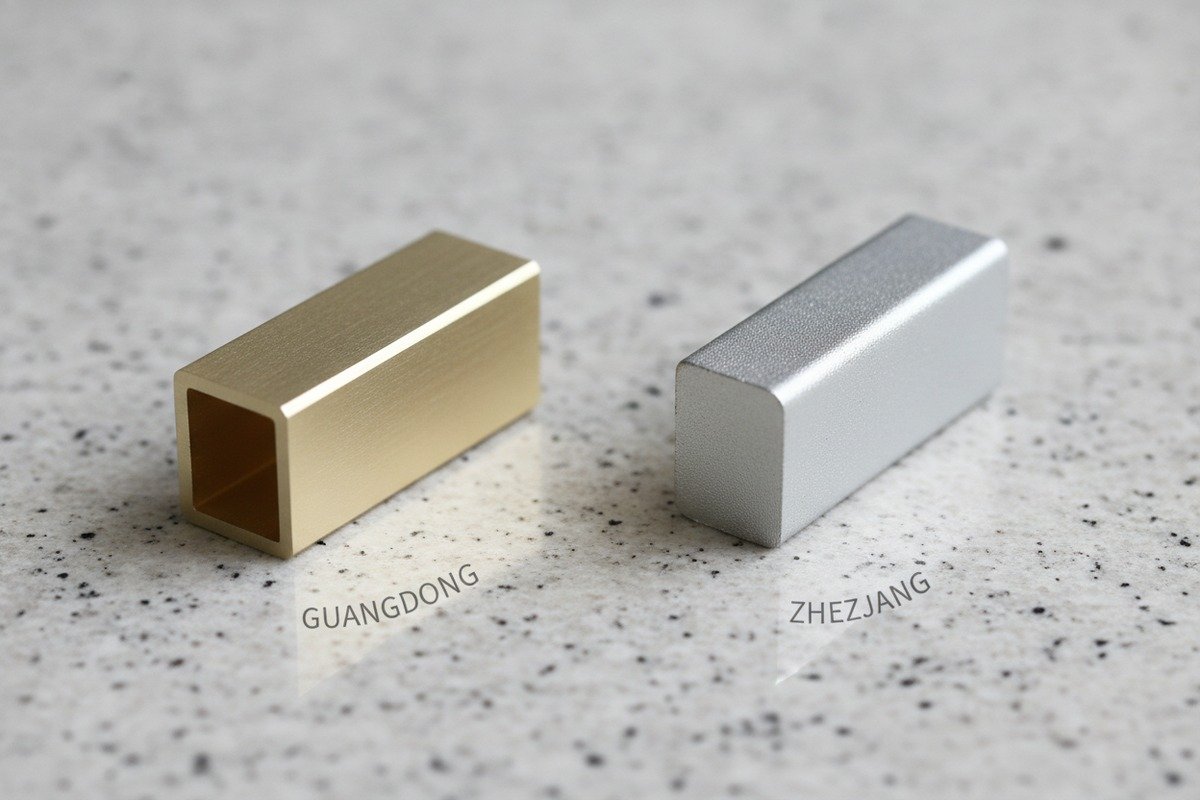
Understanding quality and design differences requires looking beyond labels like "Made in Guangdong" or "Made in Zhejiang." The real story is about what each city cluster does best and how that translates to the handle you hold in your hand.
Guangdong's Design DNA: Furniture-First Thinking
Foshan is widely known as China's furniture capital 4. The city hosts massive furniture exhibitions, thousands of furniture factories, and a dense network of surface-treatment specialists. When a handle manufacturer sits inside this ecosystem, design thinking starts with the finished cabinet or wardrobe—not with the raw aluminum billet.
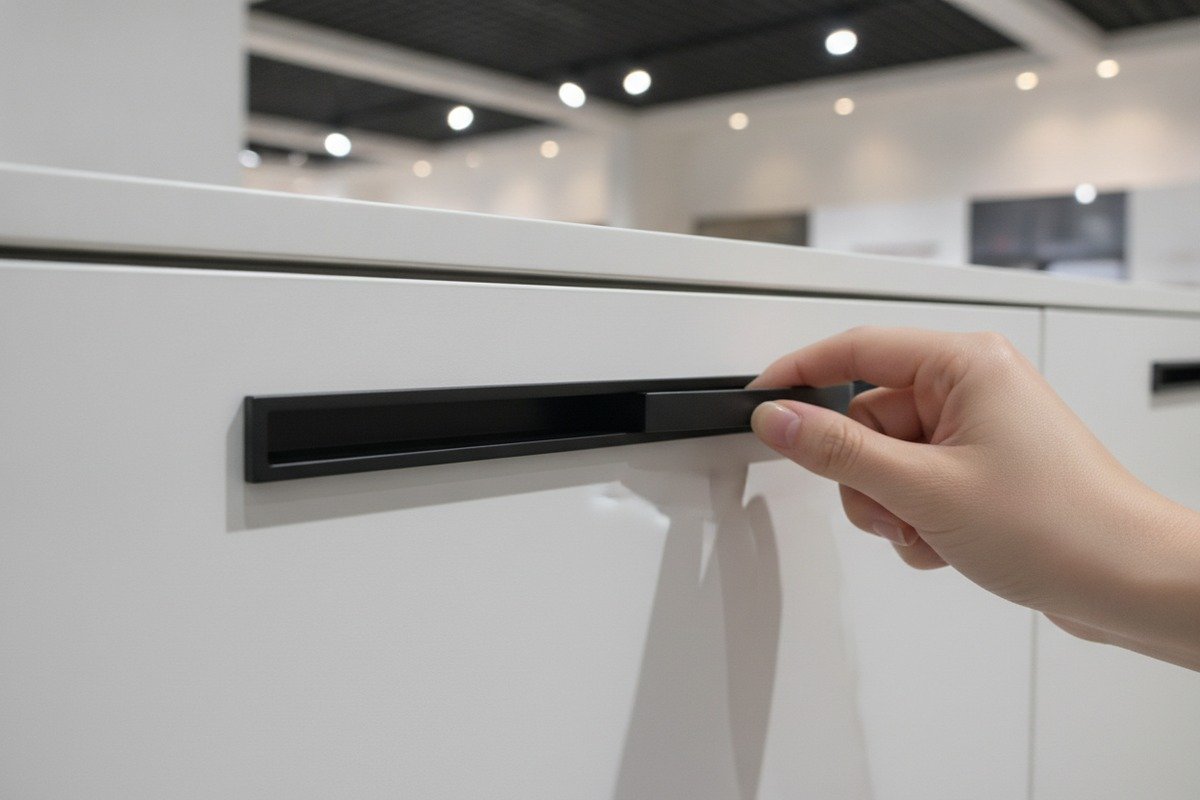
That means Guangdong-made handles often feature architectural details like deep geometric channels for finger grips, low-profile L-shaped cross-sections, and finishes calibrated to match popular cabinet colors. In our own production, for example, we routinely produce recessed pulls in matte white, charcoal grey, black, champagne gold, and light beige—all because furniture factories in the same region demand these exact tones.
Zhejiang's Strength: Hardware Precision at Scale
Zhejiang takes a different path. Cities like Yongkang have earned the nickname "China's hardware capital 5." The focus there is on metal products—door handles, locks, hinges, tools—produced at enormous volume. Ningbo adds mold-making expertise 6, while Wenzhou brings lighter industrial manufacturing into the mix.
The result is that Zhejiang handles tend to be robust, functional, and price-efficient. Design innovation happens, but it is often driven by catalog breadth rather than furniture-specific aesthetics. If you need 50 SKUs of basic pull handles at rock-bottom pricing, Zhejiang's distributed cluster model makes that easy.
Quality and Design Comparison Table
| Quality Dimension | Guangdong (Foshan) | Zhejiang (Ningbo / Yongkang) |
|---|---|---|
| Primary finish types | Anodized, powder-coated, brushed, polished | Powder-coated, electroplated, brushed |
| Typical design approach | Furniture-integrated, architectural minimalism | Functional catalog designs, wide SKU range |
| Surface tolerance | Tight — matched to cabinet panel colors | Standard — suited for general hardware use |
| Common production method | Aluminum extrusion, CNC milling | Die-casting, stamping, extrusion |
| Design collaboration | OEM/ODM with furniture factory input | OEM with trading-company catalogs |
What This Means for Your Sourcing Decision
If your customers are furniture factories or custom-home distributors who care about how a handle looks next to a lacquered door panel, Guangdong's ecosystem gives you a head start. The suppliers there already think in furniture terms. If your business model is high-volume wholesale of general-purpose cabinet hardware, Zhejiang offers breadth and cost advantages that are hard to beat.
Neither region is universally "better." The question is always: what does your end customer need?
How Do the Lead Times and Customization Services for Aluminum Profiles Vary Across These Two Major Chinese Industrial Clusters?
One of the biggest pain points we hear from wholesalers in Vietnam and the Middle East is unpredictable lead times—containers arriving weeks late, samples that don't match production runs.
Guangdong’s Foshan cluster typically delivers faster lead times for customized aluminum handles—often 3 to 7 days for custom orders and 48 hours for stocked items—because the entire supply chain from extrusion to finishing sits within a small geographic radius. Zhejiang’s distributed city-cluster model may add coordination time when multiple subcontractors handle different production stages across separate cities.
Lead time is not just about how fast a factory runs its machines. It is about how many steps in the production chain sit under one roof—or at least within a short truck ride.
Why Geographic Density Cuts Lead Time
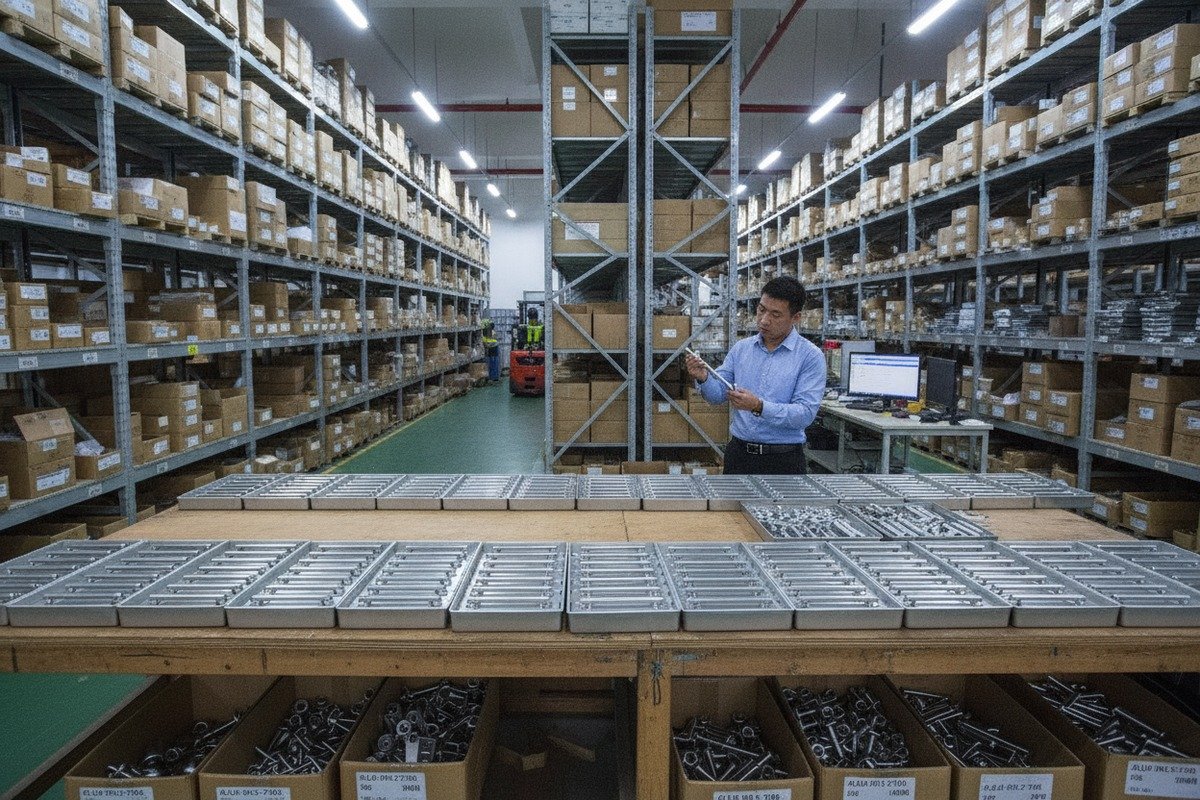
An aluminum furniture handle goes through several stages: billet sourcing, extrusion or die-casting, CNC machining 7 (if needed), surface treatment, quality inspection, and packaging. In Foshan, many of these steps happen within a 30-kilometer radius. Our own facility, for instance, keeps 300 tons of ready-to-ship inventory on site and can fulfill stock orders within 48 hours. For custom profiles, our turnaround is 3 to 7 days because our anodizing and powder-coating partners are minutes away.
In Zhejiang, the picture is different. A die-casting shop in Yongkang might send parts to a surface-treatment facility in Ningbo, then to a packaging operation in Taizhou. Each hand-off adds transit time, communication overhead, and potential for delays.
Customization Depth: OEM vs. ODM
Customization means different things to different buyers. Some need a new color on an existing profile. Others want a completely new cross-section designed from scratch. Here is how the two regions compare:
| Customization Level | Guangdong (Foshan) | Zhejiang (Multi-City) |
|---|---|---|
| Color/finish change on existing profile | Fast — 3-7 days typical | Moderate — 5-10 days depending on subcontractor location |
| New mold/die for custom profile | Available in-house or nearby; 15-25 days | Available across Ningbo/Yongkang; 15-30 days |
| Full ODM design collaboration | Common — designers work with furniture OEMs | Less common — more OEM catalog-driven |
| Sample turnaround | 2-5 days for finish samples | 3-7 days, varies by city |
| Prototype-to-production gap | Short — same ecosystem handles both | Longer — may involve multiple facility hand-offs |
How to Evaluate a Supplier's Real Lead Time
Do not just ask "What is your lead time?" Instead, ask these specific questions:
- Do you extrude or die-cast in your own factory, or outsource it?
- Where is your surface-treatment facility located relative to your factory?
- Can you show me a recent production schedule with actual ship dates?
- What happens to lead time if I need a custom finish like champagne gold anodizing 8?
These questions reveal whether the supplier controls its own timeline or depends on a chain of subcontractors. In our experience, buyers who ask these questions upfront avoid the most common delays.
The Role of Inventory in Speed
For repeat buyers and distributors, ready stock changes everything. A manufacturer who maintains significant inventory can ship standard SKUs within hours, not weeks. This is especially valuable for wholesalers who need to replenish fast-moving items without waiting for a full production cycle. Our 300-ton inventory buffer exists precisely for this reason—it lets our Middle East and Vietnamese partners keep their own warehouses lean.
Which Region Offers the Most Competitive Pricing and Flexible MOQ Options for My Furniture Hardware Wholesale Business?
Pricing conversations with Chinese suppliers can feel like a maze—especially when one factory quotes half the price of another for what looks like the same handle.
Zhejiang generally offers lower unit prices for standard aluminum handles due to intense competition among its distributed hardware clusters and high production volumes. However, Guangdong’s Foshan cluster often delivers better total cost of ownership by bundling competitive pricing with lower effective MOQs, integrated services, and reduced quality-risk costs—making it the stronger choice for mid-to-high-end wholesale buyers.
Price is never just the number on a quote sheet. Smart wholesalers calculate total landed cost, including samples, tooling, defect rates, shipping, and reorder flexibility. Here is how the two regions stack up.
Unit Price vs. Total Cost
Zhejiang's hardware clusters—especially Yongkang—compete fiercely on unit price. When dozens of handle factories sit in the same industrial park, price wars are inevitable. For basic pull handles in standard finishes, Zhejiang quotes are often 5% to 15% lower than comparable Foshan quotes.
But unit price tells only part of the story. Guangdong manufacturers who serve the furniture export market tend to invest more in consistent quality control, export-grade packaging, and accurate color matching. That means fewer rejections at your warehouse, fewer customer complaints, and lower hidden costs.
MOQ Flexibility: A Critical Factor for Wholesalers
Minimum order quantities 9 can make or break a deal for small and mid-size distributors. Here is a general comparison:
| MOQ Factor | Guangdong (Foshan) | Zhejiang (Yongkang / Ningbo) |
|---|---|---|
| Standard SKU MOQ | 200–500 pcs per SKU typical | 500–1,000 pcs per SKU typical |
| Custom finish MOQ | 300–500 pcs | 500–2,000 pcs |
| New mold/tooling MOQ | Negotiable, often 500 pcs+ | Varies widely, 1,000 pcs+ common |
| Mixed-SKU orders | Often accepted with combined volume | Less common; factories prefer single-SKU runs |
| Sample order flexibility | High — small sample batches common | Moderate — some factories resist small runs |
In our own practice, we work with wholesalers who need to test 10 or 15 handle styles before committing to large volumes. We keep MOQs flexible because we understand that a distributor in Dubai or Ho Chi Minh City cannot predict which champagne-gold recessed pull will sell best until it hits the showroom.
Why "Cheapest Quote" Can Be the Most Expensive Decision
A handle that arrives with inconsistent anodizing, rough edges, or incorrect dimensions costs you more than the price difference you saved. You spend time on returns, lose customer trust, and tie up working capital in unsellable inventory. This is the hidden tax of chasing the lowest unit price without evaluating the factory behind it.
Practical Pricing Framework
When comparing quotes from Guangdong and Zhejiang, use this checklist:
- Get quotes on the same specification—same alloy, same finish, same dimensions.
- Ask for the landed cost including packaging, palletizing, and port delivery.
- Request defect-rate data or references from existing export customers.
- Factor in your reorder cycle—can the factory ship partial orders from stock?
- Calculate the cost of one rejected shipment and add that risk to the "cheaper" quote.
This framework almost always shows that the gap between Guangdong and Zhejiang pricing is smaller than it first appears—and sometimes Guangdong wins on total cost.
Why Should I Prioritize Sourcing From the Foshan Cluster if My Project Requires High-End Finishes and Integrated Supply Chain Support?
When we walk visitors through our facility and the surrounding Foshan industrial zone, the first thing they notice is how close everything is—extrusion lines, anodizing plants, powder-coating booths, packaging suppliers, and logistics hubs all within a short drive.
Foshan should be your priority when you need high-end aluminum handle finishes—such as precision anodizing in champagne gold or matte architectural tones—paired with integrated supply chain support. The cluster’s furniture-centric ecosystem concentrates extrusion, finishing, quality control, and export logistics in one area, reducing coordination risk and enabling faster, more consistent delivery for demanding projects.

Foshan is not just a city with factories. It is an ecosystem engineered over decades to serve the global furniture market. Here is why that matters for aluminum handle sourcing.
The Foshan Furniture Ecosystem Explained
Foshan hosts one of the highest concentrations of furniture production facilities in the world. The city and its surrounding districts—Nanhai, Shunde, and others—cover the full range from raw material processing to finished furniture export. For aluminum handles specifically, this means:
- Aluminum billet and ingot suppliers are local, keeping raw material costs stable.
- Extrusion and die-casting specialists operate within the cluster, many with advanced CNC capabilities.
- Surface-treatment providers specialize in furniture-grade finishes, including multi-step anodizing for colors like champagne gold and light bronze.
- Quality testing labs familiar with international standards (ISO, REACH, RoHS) serve the export market.
- Freight forwarders and logistics companies with deep experience shipping furniture hardware to global destinations operate from nearby Guangzhou and Shenzhen ports.
High-End Finishes Demand Ecosystem Depth
A champagne gold anodized finish on an extruded aluminum handle is not a simple one-step process. It requires precise alloy selection, controlled extrusion temperatures, multi-stage cleaning, sulfuric or hard anodizing, electrolytic coloring, and sealing. Each step must be calibrated to achieve the smooth, matte, non-reflective surface that modern furniture designs demand.
In Foshan, the anodizing specialists who serve handle manufacturers also serve the broader furniture and architectural aluminum industry. They invest in equipment and expertise that would be hard to justify in a smaller or less specialized cluster. This is why Foshan consistently produces finishes that match the quality expectations of European and Middle Eastern markets.
Integrated Supply Chain: What It Means in Practice
"Integrated supply chain" sounds like a buzzword, but in Foshan it has a concrete meaning. When you place an order with a handle manufacturer here, the factory can:
- Source aluminum billets from a local supplier within 24 hours.
- Extrude the profile in-house or at a partner plant minutes away.
- Send the extruded profile to a nearby anodizing or powder-coating facility.
- Receive finished parts back within 1-2 days.
- Perform QC, assemble, package, and prepare for export—all on site.
- Deliver to Guangzhou or Shenzhen port the same day.
This tight loop is what allows us to promise 48-hour shipping on stock items and 3-to-7-day turnaround on custom orders. It is not magic. It is geography plus decades of industrial investment.
Port Access and Export Readiness
Foshan sits between two of China's busiest container ports: Guangzhou (Nansha) and Shenzhen (Yantian and Shekou). About 80% of China's top 100 industrial clusters are in coastal provinces, and Guangdong's port infrastructure is among the most developed in the country. For furniture hardware buyers shipping to Vietnam, the UAE, or Saudi Arabia, this translates to more frequent sailings, competitive freight rates, and established logistics partners who understand furniture-grade cargo handling.
When Foshan Is the Clear Choice
Choose Foshan when:
- Your project requires finishes like anodized champagne gold, matte black, or custom architectural tones.
- You need a single point of contact managing extrusion, finishing, QC, and export.
- Your end customers are furniture factories or custom-home distributors who expect design-matched handles.
- You want to reduce lead time by sourcing from a geographically concentrated supply chain.
- You plan to combine aluminum handle orders with other furniture hardware or aluminum profile products.
Foshan does not make sense for every buyer. If you need basic nickel-plated knobs at the absolute lowest price and design does not matter, a Zhejiang factory might serve you fine. But for mid-to-high-end aluminum handles where finish quality, design integration, and supply chain reliability are non-negotiable, Foshan's cluster is hard to beat.
Conclusion
Sourcing aluminum furniture handles from China works best when you choose a cluster, not just a province—match your product strategy to the right city ecosystem for quality, speed, and value.
Footnotes
1. Describes the characteristics and application of matte powder coating as a finish. ↩︎
2. Compares die casting and metal stamping, two common manufacturing methods for metal parts. ↩︎
3. Explains integrated supply chain management and its importance. ↩︎
4. Confirms Foshan’s reputation and role as a global hub for furniture manufacturing. ↩︎
5. Provides information on Yongkang, including its designation as China’s hardware capital. ↩︎
6. Explains the process and importance of mold making in manufacturing. ↩︎
7. Defines Computer Numerical Control (CNC) machining and its role in manufacturing. ↩︎
8. Explains the technical process of achieving champagne gold anodizing on aluminum. ↩︎
9. Defines Minimum Order Quantity (MOQ) and its significance in purchasing. ↩︎
10. Provides a comprehensive definition of Total Cost of Ownership (TCO) and its components. ↩︎