Every year, our sales team fields dozens of requests from overseas buyers asking us to prove our ISO 9001 status 1—and honestly, that skepticism is healthy.
To verify if a Chinese supplier’s aluminum furniture handle production line is ISO 9001 certified, request the full certificate with the certificate number, confirm the legal company name matches the business license, check that the scope covers aluminum handle manufacturing, and cross-verify the certificate directly with the issuing certification body’s online registry.
ISO 9001 is one of the most commonly cited certifications in China’s furniture hardware sector, yet many buyers still get confused about what it actually proves issuing certification body’s online registry 2. This guide breaks down each verification step so you can source aluminum handles with confidence. Let’s walk through it together.
Where Can I Officially Verify a Chinese Supplier's ISO 9001 Certificate Number Online?
When we send our ISO 9001 certificate to new clients, we always encourage them to verify it independently—because trust should be built on evidence, not promises CNCA certification query platform 3.
You can officially verify a Chinese supplier's ISO 9001 certificate number by searching it on the issuing certification body's online registry, the IAF CertSearch database, or China's CNCA certification query platform. Always match the certificate number, company name, and active status before trusting the document.

Understanding Who Issues ISO 9001 Certificates
ISO 9001 certificates are not issued by ISO itself IAF (International Accreditation Forum) 4. They are issued by third-party certification bodies (CBs). These bodies must be accredited by a national accreditation agency Corrective and preventive action (CAPA) 5. In China, the main accreditation agency is CNAS (China National Accreditation Service for Conformity Assessment) 6. Internationally, the IAF (International Accreditation Forum) coordinates mutual recognition.
This means you need to know two things: which certification body issued the certificate, and whether that body is properly accredited. A certificate from an unaccredited or unknown body carries little weight.
Step-by-Step Online Verification
Here is a practical workflow you can follow today:
-
Get the full certificate. Ask the supplier for a clear PDF or high-resolution scan—not a cropped logo or a thumbnail image. The certificate must show the certificate number, legal company name, factory address, scope, issue date, expiry date, and the certification body's name with its accreditation mark.
-
Go to the certification body's website. Most reputable CBs like SGS, TÜV, Bureau Veritas, and BSI have online certificate verification portals. Enter the certificate number. Confirm the company name and status.
-
Use the IAF CertSearch database. This is a global registry at www.iafcertsearch.org. It pulls data from accredited certification bodies worldwide. Search by company name or certificate number.
-
Check China's CNCA platform. The Certification and Accreditation Administration of China (CNCA) maintains a public query system. This is especially useful for certificates issued by Chinese domestic certification bodies.
-
Verify on GSXT. Use China's National Enterprise Credit Information Publicity System (www.gsxt.gov.cn) to confirm the company's legal name, unified social credit code 7, and registered address. Make sure these match the certificate exactly.
Key Verification Databases at a Glance
| Database / Platform | URL | What It Verifies |
|---|---|---|
| IAF CertSearch | iafcertsearch.org | Global ISO certificate validity |
| CNCA Query System | cx.cnca.cn | Chinese-issued certificate status |
| GSXT | gsxt.gov.cn | Company legal registration details |
| SGS Certificate Finder | sgs.com | SGS-issued certificate lookup |
| TÜV Certificate Database | certipedia.com | TÜV-issued certificate lookup |
If the certificate number returns no results, or if the company name does not match, that is a serious concern. Do not proceed until the discrepancy is resolved.
What Specific Details Should I Look for on the Certificate to Ensure It Covers Aluminum Handle Production?
Our own ISO 9001 certificate specifically lists aluminum profile processing and furniture hardware manufacturing in its scope—and that level of detail is exactly what you should demand from any supplier.
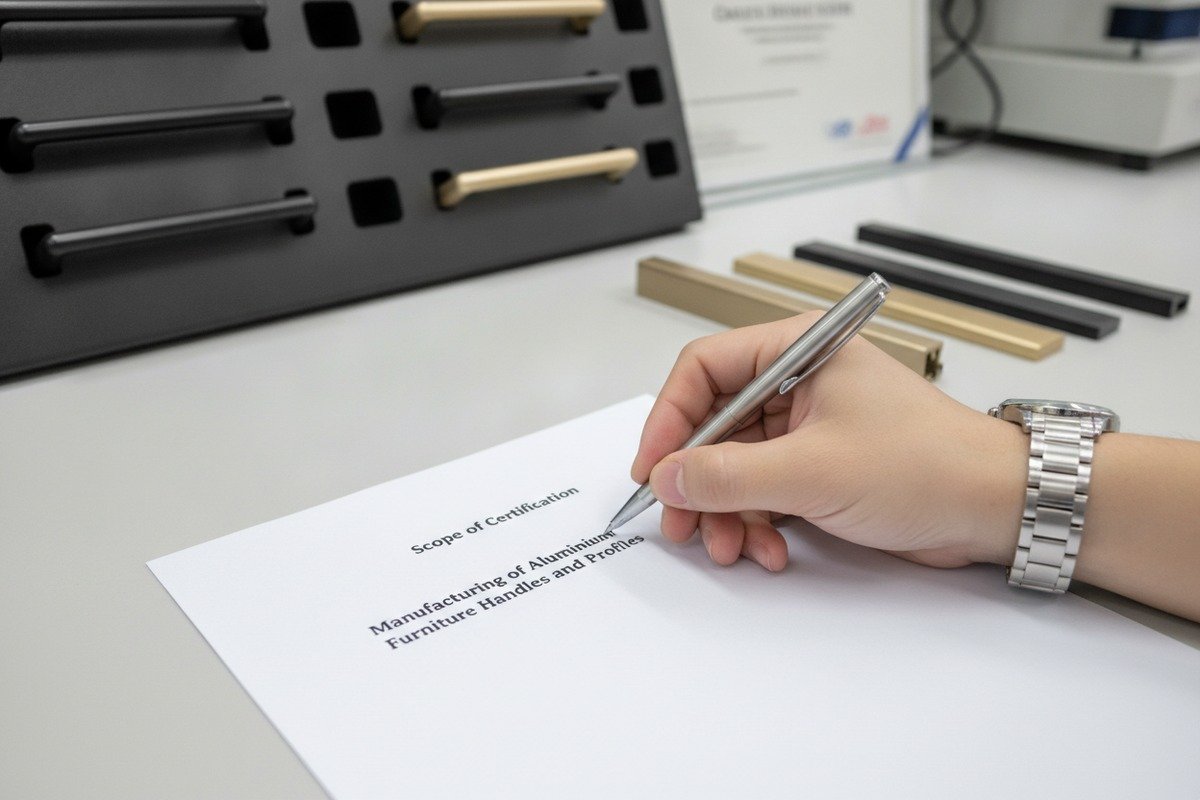
On the ISO 9001 certificate, look for the scope statement to confirm it explicitly covers activities like aluminum extrusion, surface treatment, furniture handle manufacturing, or hardware component production. Also verify the certified site address matches the actual factory where your handles are made, and that the certificate has not expired.
Why the Scope Statement Is Critical
ISO 9001 certifies a quality management system 9, not a specific product. This is the most misunderstood point in supplier verification. A company can hold an ISO 9001 certificate for its logistics operations while its manufacturing division is completely uncertified. That is why the scope statement is the most important line on the entire certificate.
For aluminum furniture handles, the scope should reference activities directly related to your product. Look for phrases like:
- "Design and manufacture of aluminum alloy furniture hardware"
- "Production of aluminum profiles and surface treatment"
- "Manufacturing of metal handles and architectural hardware components"
- "Processing, anodizing, and assembly of aluminum furniture accessories"
If the scope says something generic like "trading of building materials" or "sales and marketing services," that certificate does not cover the factory's production process at all.
Certified Company vs. Certified Site vs. Certified Production Line
This distinction trips up even experienced buyers. Here is a clear breakdown:
| Concept | What It Means | Why It Matters for Buyers |
|---|---|---|
| Certified Company | The legal entity holds the ISO 9001 certificate. | Confirms the organization has a QMS, but you must check which site is covered. |
| Certified Site | The specific factory address listed on the certificate. | A company with multiple factories may only certify one. Your handles must come from the certified site. |
| Certified Production Line | A specific line within the certified site. | ISO 9001 does not certify individual machines or lines. If the site is certified and the scope covers the activity, the line is included. |
So when a supplier says "our production line is ISO 9001 certified," what they should mean is: "Our company's quality management system is certified, and the scope includes the manufacturing activity performed on this line at this certified site."
Checking Certificate Validity Dates
Every ISO 9001 certificate has an issue date and an expiry date. Certificates are typically valid for three years, with annual surveillance audits required. If the certificate is expired, it is no longer valid—even if the supplier says renewal is "in progress." Ask for the latest surveillance audit report as additional proof that the system is being maintained.
Name Matching Matters
The company name on the certificate must exactly match the legal entity name on the business license. In China, many companies operate under trade names or English translations that differ from the registered Chinese legal name. Cross-reference using the unified social credit code on GSXT. If the supplier uses a subsidiary or a different legal entity for export, make sure the certificate covers that exact entity.
How Can I Confirm If My Furniture Handle Manufacturer's Quality Management System Is Actually Being Implemented on the Factory Floor?
Having a certificate hanging on the wall is one thing. Running a disciplined quality system on the production floor every single day is something else entirely—and we see that gap all the time when visiting peer factories in the Foshan hardware district.
To confirm real implementation, request evidence of active quality control processes such as incoming material inspection (IQC), in-process quality checks (IPQC), and final quality control (FQC) records. Supplement this with a third-party factory audit, a live video tour of the production floor, and pre-shipment inspection of your actual order.

Documents That Prove Active Implementation
A certificate proves the system was approved at the time of the audit. It does not prove the system is running right now. Here is what to ask for:
- Internal audit reports. ISO 9001 requires regular internal audits. Ask for the most recent one. It should show findings, corrective actions, and follow-up status.
- Management review minutes. The standard requires top management to review the QMS periodically. Minutes should reference quality objectives, customer feedback analysis, and resource allocation.
- Corrective and preventive action (CAPA) records. These show how the factory responds to defects or complaints. A factory with zero CAPAs is either not recording them or not being honest.
- Inspection records for your product category. For aluminum handles, ask for IQC records for raw aluminum billets, IPQC records for extrusion dimension checks and surface treatment parameters, and FQC records for final assembly and packaging inspection.
What to Look for During a Video Tour or Factory Visit
If you cannot visit in person, a live video call is a strong alternative. Here is what to observe:
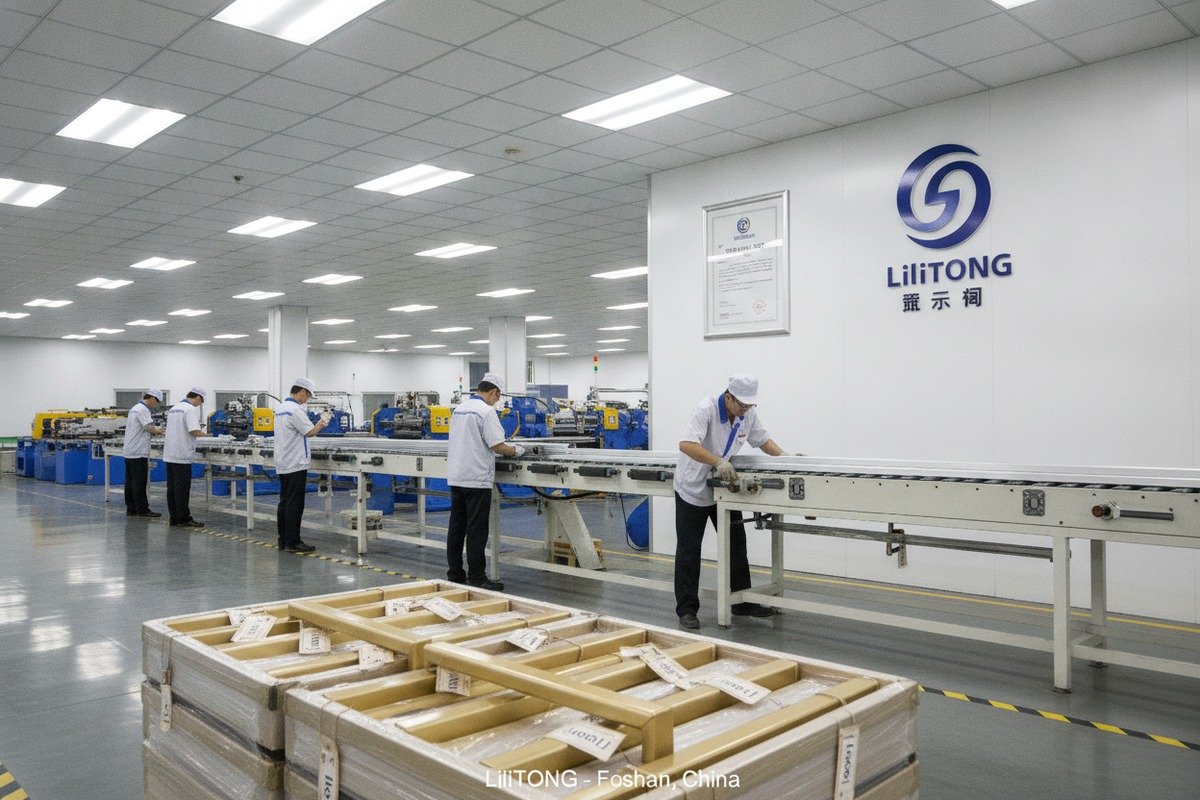
- Organized production areas. A factory running ISO 9001 should have clearly marked stations, clean floors, labeled storage, and visible work instructions at each workstation.
- Calibrated measuring tools. Look for calipers, micrometers, and surface roughness testers on the quality inspection table. Ask when they were last calibrated.
- Traceability systems. Can the factory trace a finished handle back to the raw material batch? Even a simple batch numbering system counts.
- Rejection and rework areas. A factory that never rejects anything is either lying or not inspecting. Look for a quarantine zone for nonconforming products.
Quality Control Stages for Aluminum Furniture Handles
| Stage | What Is Checked | Method |
|---|---|---|
| IQC (Incoming) | Aluminum alloy grade, billet dimensions, surface defects | Spectrometer analysis, visual inspection, dimensional gauges |
| IPQC (In-Process) | Extrusion profile tolerance, anodizing film thickness, color consistency | Profile projector, coating thickness gauge, color comparison cards |
| FQC (Final) | Handle dimensions, surface finish, screw hole alignment, packaging integrity | Go/no-go gauges, visual standards, drop test for packaging |
Third-Party Inspections
Hiring an independent inspection company—such as SGS, Bureau Veritas, or Asia Inspection—to audit the factory or inspect your shipment adds a layer of objectivity that internal documents cannot provide. A pre-shipment inspection (PSI) 10 checks a random sample from your actual order against your agreed specifications. This is standard practice for furniture hardware imports and costs far less than dealing with a defective shipment after it arrives.
Digital Traceability as a Quality Signal
Some factories now use ERP or MES systems to log every production batch, inspection result, and material source digitally. If a supplier can pull up real-time production data during a video call, that is a strong sign their QMS is not just paperwork. At our facility in Foshan, we tag each batch with a traceable ID that links raw material records to the final packing list—this kind of transparency is becoming the industry standard for mid-to-high-end exporters.
What Are the Common Red Flags I Should Watch Out for When Reviewing a Supplier's ISO Documentation?
Over 18 years of exporting aluminum furniture handles, we have seen nearly every trick in the book—from borrowed certificates to scope statements that have nothing to do with hardware manufacturing.
Common red flags include receiving only a cropped or low-resolution certificate image, a certificate number that returns no results in public databases, a company name mismatch between the certificate and business license, an expired or suspended certificate status, a scope that does not mention manufacturing, and a supplier that refuses third-party audits or live video tours.
The Most Frequent Warning Signs
Let me walk through the red flags that experienced importers prioritize:
1. Partial or cropped certificate images. If the supplier sends you a logo, a badge, or a heavily cropped image instead of the full certificate page, ask why. A legitimate certificate holder has nothing to hide.
2. Unverifiable certificate number. You enter the certificate number into the certification body's portal and get no result. Either the number is fake, the CB does not exist, or the certificate has been withdrawn.
3. Company name mismatch. The name on the ISO certificate says "Foshan ABC Trading Co., Ltd." but the business license and export invoice come from "Foshan XYZ Hardware Manufacturing Co., Ltd." Without a clear legal explanation—such as a parent-subsidiary relationship—this is a serious discrepancy.
4. Expired or suspended status. Certificates lapse if the company fails a surveillance audit or does not renew. An expired certificate is not a valid certificate.
5. Irrelevant scope. The scope reads "wholesale and retail of building materials" or "design consulting services." This does not cover factory-floor production of aluminum handles. The supplier may be a trading company reselling products from uncertified workshops.
6. Refusal to allow verification. A supplier that pushes back when you ask for a factory video tour, a third-party audit, or direct contact with the certification body is signaling that something is off.
7. Too many certifications with no supporting evidence. Some supplier websites display ISO 9001, ISO 14001, OHSAS 18001, SGS, TÜV, CE, and more—all as image badges with no traceable certificate numbers. Marketing claims are starting points, not proof.
Trading Company vs. Direct Manufacturer
This is a subtle but important red flag. If the "factory" is actually a trading company or a showroom with no production equipment, then their ISO 9001 certificate—even if valid—certifies their trading operations, not the manufacturing process. Your aluminum handles are being made elsewhere, possibly at a subcontractor with no quality system at all.
Ask direct questions:
- Do you own the factory where these handles are made?
- Is the factory address on the ISO certificate the same address where production happens?
- Do you subcontract any part of the manufacturing, such as extrusion, anodizing, or packaging?
Quick Red Flag Checklist
| Red Flag | What to Do |
|---|---|
| Only a logo or badge provided, no full certificate | Request the complete certificate PDF immediately |
| Certificate number not found in any public database | Ask the supplier to clarify the issuing body and provide a direct verification link |
| Company name on certificate differs from business license | Request legal documentation explaining the relationship |
| Certificate expired more than 30 days ago | Ask for the renewal certificate or current audit report |
| Scope mentions trading or services, not manufacturing | Clarify whether the supplier is a factory or a middleman |
| Supplier refuses video tour or third-party audit | Consider this a deal-breaker for quality-sensitive orders |
| Multiple certification logos with no certificate numbers | Request traceable details for each claimed certification |
A Balanced Perspective on ISO 9001
ISO 9001 is a useful baseline. It signals that the company has documented processes for production, inspection, corrective action, and customer complaint handling. It is worth asking for. But it is necessary, not sufficient. Especially for aluminum furniture handles—where dimensional consistency, surface finish quality, corrosion resistance, and packaging integrity directly affect your customer satisfaction—you need to combine certificate verification with sample evaluation, factory assessment, and shipment inspection.
Think of ISO 9001 as the foundation. Build your supplier confidence on top of it with practical checks. About 92% of top Chinese furniture factories hold some form of quality management certification, so the certificate itself does not differentiate a great supplier from an average one. What differentiates them is how deeply the system is embedded in daily operations.
Conclusion
Verifying a Chinese supplier's ISO 9001 certification requires more than accepting a PDF—cross-check every detail through official databases, confirm the scope covers aluminum handle manufacturing, and validate real implementation through audits, samples, and inspections.
Footnotes
1. Authoritative source for ISO 9001 QMS and certification verification. ↩︎
2. Discusses how to find ISO 9001 registered companies and mentions registrars’ databases. ↩︎
3. Provides information about CNCA, the body overseeing certification in China. ↩︎
4. Official website of the International Accreditation Forum. ↩︎
5. Authoritative guide on CAPA processes in quality management. ↩︎
6. Official website of China’s national accreditation body. ↩︎
7. Explains the Unified Social Credit Code and its verification in China. ↩︎
8. Direct link to the official global database for accredited certifications. ↩︎
9. Defines and explains what a Quality Management System is in the context of ISO 9001. ↩︎
10. Defines and explains the procedure and importance of pre-shipment inspection. ↩︎