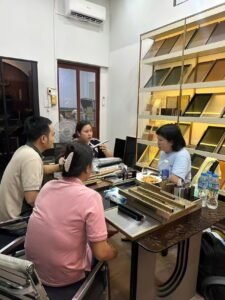
Many buyers order aluminum handles from China and expect them to work perfectly in Vietnam right away — then struggle when the finish yellows, the hole spacing is off, or the style just doesn’t sell.
To request supplier cooperation for product adaptation testing in Vietnam, you should ask your aluminum handle manufacturer for custom sample iterations, finish durability testing for humid climates, low-MOQ trial runs, and documentation support — framing it as a joint commercialization effort rather than a simple quality check.
Vietnam’s kitchen furniture market 1 is projected to reach USD 401.30 million by 2031, and the demand for localized hardware components is rising fast. In this article, we break down exactly how to structure your supplier request so your aluminum furniture handles are tested, adapted, and ready for the Vietnamese market before you commit to large volumes. Let’s walk through each step.
How can I request custom samples from my supplier to test their compatibility with Vietnamese furniture styles?
When we ship handles to Vietnamese distributors, we often see that what sells in the Middle East or Europe does not automatically match what Vietnamese cabinet makers want in terms of size, profile, and color tone.
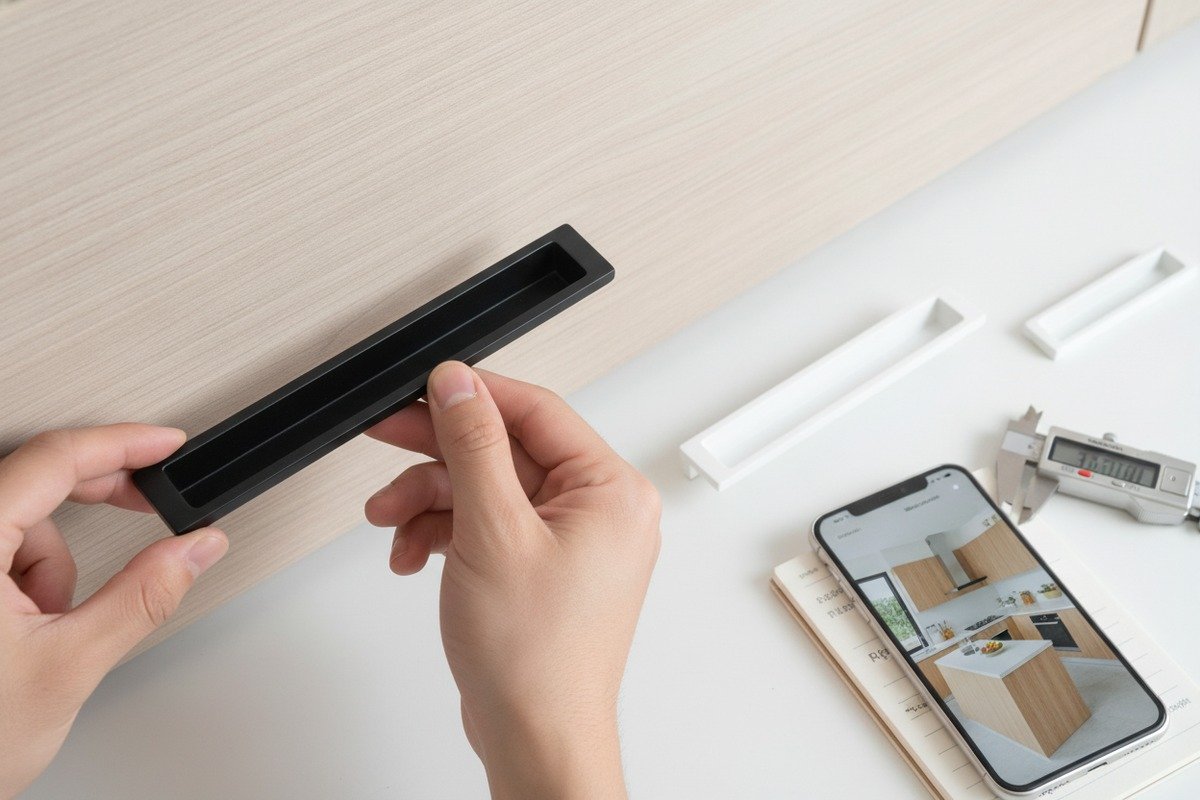
You should request custom samples by providing your supplier with specific Vietnamese cabinet dimensions, preferred finishes like matte black or champagne gold, local mounting standards, and photos of target furniture styles — then ask for at least two rounds of sample revision before confirming the design.
Why Vietnamese Furniture Styles Require Specific Handle Profiles
Vietnamese kitchen and wardrobe cabinets tend to follow compact, modern designs. Door panel thicknesses, overlay dimensions, and screw hole spacing can differ from Western or Middle Eastern standards. A recessed handle that fits a 22 mm European panel may not sit flush on an 18 mm Vietnamese MDF door 2. That mismatch creates installation headaches for your furniture factory buyers.
From our production line in Foshan, we regularly adjust the L-shaped cross-section depth by 1–2 mm or change screw spacing from 96 mm to 128 mm just to match Vietnamese installation habits. These are small changes, but they make a big difference in how the handle looks and functions on the finished cabinet.
What to Include in Your Sample Request
Your sample request should be detailed. Vague requests like "send me some handles" waste time. Here is what to include:
| Item to Specify | Example Detail | Why It Matters |
|---|---|---|
| Handle length | 128 mm, 256 mm, 400 mm | Must match Vietnamese cabinet widths |
| Mounting hole spacing | 96 mm or 128 mm center-to-center | Ensures compatibility with pre-drilled panels |
| Finish type | Matte black, brushed aluminum, champagne gold anodized | Must match local aesthetic preferences |
| Profile depth / height | 18 mm recess depth, 35 mm total height | Must sit flush on Vietnamese panel thicknesses |
| Edge radius | Sharp edge vs. 0.5 mm radius | Affects hand feel and perceived quality |
| Screw specification | M4 x 25 mm | Must match local screw availability |
How Many Sample Rounds Should You Expect?
Do not treat the first sample as the final product. In our experience, most Vietnamese market adaptations require two to three rounds. The first round tests basic fit and visual appearance. The second round addresses feedback from your local furniture factory or distributor — maybe the color is slightly too warm, or the grip channel is too shallow for comfortable daily use.
A good supplier will not charge you for every round. At our facility, the first sample set is typically free; subsequent rounds may carry a small fee depending on whether tooling changes are needed. Always ask upfront: "How many sample rounds are included, and what are the charges for modifications?"
Start with Your Best-Selling Cabinet Style
A practical tip: send your supplier a photo of the most popular cabinet style in your local market. Include the door dimensions, color, and material. This gives the factory a visual reference that eliminates guesswork. We have found that a single clear photo saves more back-and-forth than three pages of text specifications.
What technical support should I expect from my manufacturer when conducting local product adaptation trials?
Our engineering team regularly supports buyers who run adaptation trials in Vietnam, and the biggest gap we see is that many buyers do not realize how much technical help a capable supplier can actually provide.
You should expect your manufacturer to provide engineering support for design modifications, finish durability test reports including salt spray and humidity resistance data, material declarations, certification documentation, and clear communication on tooling costs and lead times for each adaptation stage.

Engineering Support for Design Tweaks
A reliable aluminum handle manufacturer should be able to adjust hole spacing, edge radius, profile thickness, handle length, and screw specifications without requiring a completely new mold. Extrusion-based handles 3 are relatively flexible in this regard. At our Foshan facility, minor profile adjustments can be completed within 3–7 days, which keeps your adaptation timeline tight.
Ask your supplier directly: "Can your engineering team modify the existing die to change the handle depth by 2 mm?" If they say they need a brand-new mold for every small change, that is a red flag — either their tooling capability is limited, or they are trying to charge unnecessary fees.
Environmental and Finish Testing
Vietnam's climate is hot and humid, especially in southern regions and coastal cities like Ho Chi Minh City, Da Nang, and Nha Trang. Aluminum handles with poor anodizing or low-quality powder coating 4 will show corrosion, discoloration, or peeling within months. Your supplier should be able to provide test data for the following:
| Test Type | What It Measures | Minimum Standard to Request |
|---|---|---|
| Salt spray test (ASTM B117) 5 | Corrosion resistance | 200+ hours without visible corrosion |
| Cross-cut adhesion test (ASTM D3359) | Coating adhesion to substrate | Rating 4B or higher |
| Humidity resistance test | Finish stability in high-moisture conditions | 500+ hours at 95% RH without blistering |
| Abrasion resistance | Surface scratch durability | 500+ cycles without visible wear |
| Color fastness (UV exposure) | Resistance to fading | Grade 4 or higher on grey scale |
| Fingerprint resistance | Smudge visibility on matte finishes | Visual inspection pass |
If your supplier cannot provide these test reports, ask them to conduct the tests or arrange third-party testing. This is not an unusual request — it is standard practice for mid-to-high-end hardware exporters.
Documentation for Project Approvals
Vietnam's construction and furniture sectors are increasingly influenced by green building standards like LOTUS. Projects registered under LOTUS may require low-VOC material declarations 6 and lifecycle documentation. Even if your buyers are not directly involved in green-certified projects today, having material datasheets and finish specifications ready gives you a competitive edge.
Ask your manufacturer for: material composition certificates, RoHS compliance declarations 7, finish specification sheets with color codes and thickness data, and any available GREENGUARD or equivalent certifications 8. These documents help your Vietnamese buyers pass project review processes faster, which makes you a more valuable supplier to them.
Co-Development Cost Clarity
Technical support is not always free. Be upfront about cost expectations. Ask: "What are the tooling charges for a modified die? Who pays for test samples? What is the lead time for each engineering revision?" A transparent supplier will give you a clear breakdown. We typically provide a cost sheet that separates mold fees, sample fees, and testing fees so the buyer knows exactly what each adaptation step costs.
Can I arrange a low-MOQ trial run to evaluate how the aluminum handle finishes perform in the Vietnamese climate?
We get this question from nearly every new Vietnamese distributor we work with. The fear is simple: committing to a large order before knowing if the product will survive Vietnam's humidity and heat.
Yes, you can and should arrange a low-MOQ trial run. Ask your supplier for a pilot production batch of 200–500 pieces in your target finishes, then distribute these to local furniture factories or installers for real-world performance testing over 30–90 days before scaling up.

Why a Pilot Order Beats Lab Testing Alone
Lab tests tell you how a finish performs under controlled conditions. A pilot order tells you how it performs in real life — installed on actual cabinets, used by real people, exposed to real kitchen humidity, cooking steam, and daily wear. Both are important, but the pilot order gives you data that lab tests cannot replicate.
For example, we had a buyer in Ho Chi Minh City who ordered a matte champagne gold handle. It passed all our lab tests. But after three months installed in a Vietnamese kitchen, the handles near the stove showed slight discoloration from cooking oil vapor. We adjusted the sealing process on the anodizing line, and the problem disappeared in the next batch. That kind of insight only comes from real-world use.
How to Structure a Low-MOQ Trial
Here is a practical framework:
| Step | Action | Timeline |
|---|---|---|
| 1. Sample approval | Approve 2–3 samples after revision rounds | Week 1–3 |
| 2. Pilot order placement | Order 200–500 pieces in approved finishes | Week 4 |
| 3. Production and shipping | Factory produces and ships pilot batch | Week 5–7 |
| 4. Local distribution | Distribute handles to 3–5 test sites (furniture factories, showrooms, installed kitchens) | Week 8 |
| 5. Monitoring period | Observe finish performance, installation feedback, customer reactions | Week 8–16 |
| 6. Feedback collection | Gather data on corrosion, color stability, hand feel, installation ease | Week 16–17 |
| 7. Scale-up decision | Confirm design and place full production order | Week 18+ |
Negotiating Low-MOQ Terms
Not every supplier will accept a 200-piece order. Standard MOQs 9 for custom aluminum handles can range from 500 to 2,000 pieces depending on the finish and profile. Here is how to negotiate:
- Offer to pay a slightly higher unit price for the trial batch. This compensates the factory for the shorter production run.
- Commit to a target volume for the follow-up order if the trial succeeds. Saying "If this trial works, I plan to order 5,000 pieces per month" gives the supplier motivation to support you.
- Choose stock finishes for the trial if possible. Matte black, brushed silver, and champagne gold are common finishes that most factories keep in production rotation. Custom colors may push MOQs higher.
At our facility, we maintain over 300 tons of ready-to-ship inventory in popular finishes. This means we can fulfill small trial orders from existing stock without requiring a full custom production run, which keeps the MOQ low and the lead time short — often within 48 hours for stock items.
What to Monitor During the Trial
Focus your observation on these areas:
- Finish consistency: Do all pieces look the same, or are there color variations?
- Corrosion signs: Any white spots, pitting, or discoloration after 30, 60, and 90 days? Corrosion signs 10
- Fingerprint resistance: How easily do matte finishes show smudges in daily use?
- Installation feedback: Do furniture factory workers find the handles easy to mount? Are the screw holes aligned?
- Customer perception: Do end consumers comment on the handle's look and feel?
Document everything with photos and notes. This feedback becomes the foundation for your next conversation with the supplier.
How do I communicate my local market feedback to ensure the supplier makes the right design adjustments for my customers?
After running product trials with our Vietnamese partners, we noticed that the most successful adaptation cycles happen when the buyer sends structured, specific feedback — not vague comments like "the handle doesn't look right."
To ensure your supplier makes the right adjustments, send organized feedback with photos, specific measurements, test site conditions, installer comments, and clear priority rankings for each issue — then confirm the changes in writing before the next sample or production round.

The Problem with Vague Feedback
Telling a factory "the color is wrong" does not help. Wrong how? Too dark? Too warm? Too glossy? Does it look different under LED light versus natural light? Without specifics, the factory guesses — and guessing wastes time and money.
We once received feedback from a Vietnamese distributor that said: "Customers don't like the handle." After three rounds of questions, we learned the actual issue was that the finger grip channel was 2 mm too shallow for Vietnamese users who tend to pull with their fingertips rather than wrapping their whole hand around the handle. A simple 2 mm depth increase solved the problem. But it took two weeks of back-and-forth to identify a 2 mm issue — because the initial feedback was too vague.
How to Structure Your Feedback
Use a simple format for every piece of feedback:
- Issue description: What exactly is wrong? Be specific.
- Photo evidence: Take clear, well-lit photos showing the issue. Include a ruler or reference object for scale.
- Test conditions: Where was the handle installed? Kitchen, bathroom, wardrobe? Indoor or outdoor? How long was it in use?
- User comments: What did the installer or end customer actually say?
- Priority: Is this a deal-breaker, or a nice-to-have improvement?
- Suggested fix: If you have an idea of what might solve it, share it. The factory can confirm if it is feasible.
Use a Shared Communication Channel
WhatsApp works well for quick updates, but for formal feedback rounds, send a structured document — even a simple spreadsheet. This creates a written record that both sides can reference. We recommend a format like this:
| Issue # | Description | Photo Attached | Priority (High/Med/Low) | Suggested Action | Supplier Response |
|---|---|---|---|---|---|
| 1 | Champagne gold finish too warm under LED light | Yes | High | Shift color 5% cooler | Pending |
| 2 | Screw holes 1 mm off-center on 256 mm handle | Yes | High | Re-align die | Pending |
| 3 | Finger grip channel too shallow (16 mm, need 18 mm) | Yes | Medium | Increase depth by 2 mm | Pending |
| 4 | Packaging box too flimsy for retail display | Yes | Low | Upgrade to rigid box | Pending |
This format lets the factory respond to each item individually. It prevents miscommunication and ensures nothing gets lost.
Confirm Changes Before Production
After the supplier agrees to your adjustments, ask for a written confirmation — even a simple WhatsApp message that says "We will adjust items 1, 2, and 3 as discussed. New samples will ship in 5 days." Then inspect the revised samples against your original feedback list before approving production.
Build a Feedback Loop, Not a One-Time Event
The best supplier relationships involve continuous feedback. After your first successful order, keep sharing market data. Tell your supplier which finishes sell fastest, which lengths are most popular, and what new trends you see in Vietnamese furniture design. This turns your supplier into a partner who anticipates your needs rather than just reacting to orders.
Our team at the Foshan facility actively tracks finish preferences by region. When we notice that Vietnamese buyers are shifting from brushed silver to matte black, we adjust our stock production accordingly. But we can only do this if our buyers share that market intelligence with us. The relationship works both ways.
Conclusion
Successful product adaptation in Vietnam starts with treating your supplier as a commercialization partner, not just a factory. Request specific samples, demand technical documentation, run low-MOQ trials, and send structured feedback to build handles that truly fit your market.
Footnotes
1. Provides market size, projections, and growth drivers. ↩︎
2. Explains properties and construction of MDF doors. ↩︎
3. Describes the manufacturing process of aluminum extrusion. ↩︎
4. Explains the process and benefits of powder coating. ↩︎
5. Details the standard method for corrosion resistance testing. ↩︎
6. Explains the importance and standards for low volatile organic compound materials. ↩︎
7. Explains the directive restricting hazardous substances in electronics. ↩︎
8. Describes a certification for low chemical emissions. ↩︎
9. Defines minimum order quantity in manufacturing. ↩︎
10. Describes visual indicators of aluminum corrosion. ↩︎