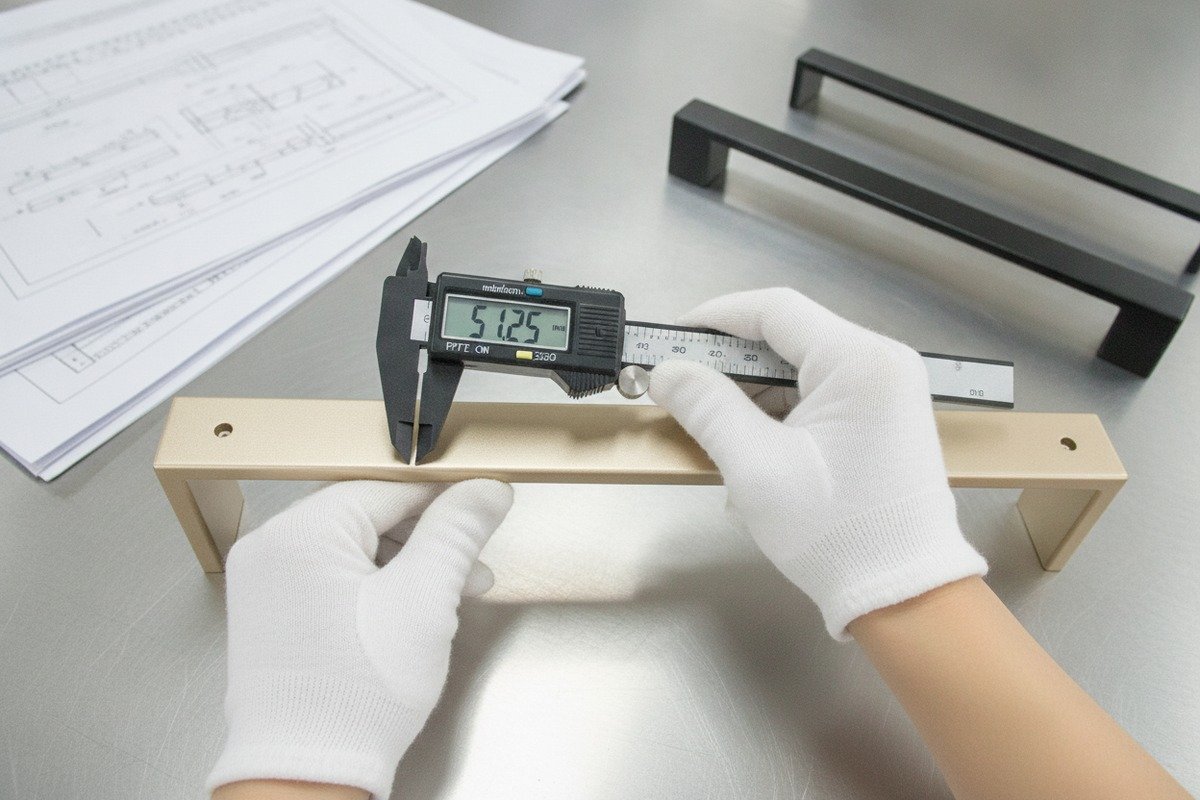
Over the past 18 years on our production floor in Foshan, we have seen the same problem repeat itself hundreds of times screw thread type 1. A furniture factory orders a beautiful batch of aluminum handles 2, only to discover on installation day that the screw holes do not line up. The screws are too short. The threads do not match. Suddenly, a simple hardware swap becomes a costly production delay. This is the quiet headache of handle sourcing that nobody talks about until it is too late.
When sourcing aluminum furniture handles, you must verify center-to-center hole spacing against industry-standard increments (32 mm, 96 mm, 128 mm, etc.), confirm screw thread type and length for your panel thickness, and ensure all mounting hardware is included and compatible with your specific furniture system.
This article breaks down the four most common standardization traps we see buyers fall into, and exactly how to avoid each one. Whether you are replacing handles on existing cabinets or specifying hardware for a new production run, the details below will save you time, money, and frustration.
How Do I Ensure the Center-to-Center Hole Spacing of My Aluminum Handles Matches International Furniture Standards?
Every week, our sales team fields calls from distributors who measured the overall length 3 of a handle instead of the distance between screw holes. That single mistake is the number one reason for returns in our industry.
To ensure compatibility, always measure center-to-center (C-C) hole spacing, not overall handle length. Common international standards include 32 mm, 64 mm, 96 mm, 128 mm, 160 mm, 192 mm, 256 mm, and 320 mm. Confirm this measurement against your existing drill pattern or factory template before ordering.
Why Center-to-Center Is the Only Measurement That Matters
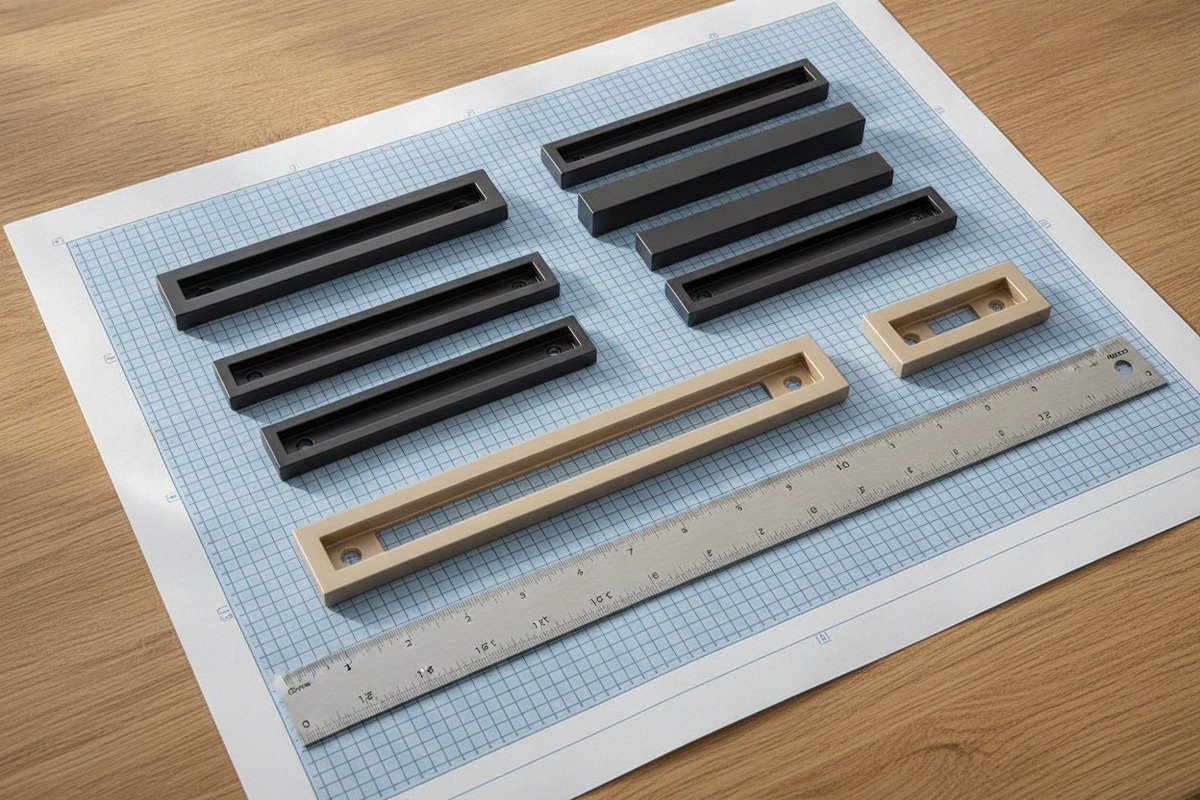
The overall length of a handle tells you how it looks on the drawer face. But the center-to-center distance 4 tells you whether it will physically mount. These are two completely different numbers. A handle that is 150 mm long might have a C-C spacing of 96 mm or 128 mm depending on the design. If you order based on overall length alone, you are guessing.
On our production line, we stamp the C-C spacing on every handle's packaging and engrave it into the technical drawing 5. We recommend that every buyer request a dimensioned drawing before confirming any order.
The Standard Spacing Chart You Need
Here is a reference table of the most common hole spacings used across global furniture markets:
| C-C Spacing (Metric) | C-C Spacing (Imperial Approx.) | Common Application |
|---|---|---|
| 32 mm | 1.26 in | Small knobs, European system drilling |
| 64 mm | 2.52 in | Compact drawer pulls |
| 96 mm | 3.78 in | Standard kitchen/bathroom cabinet pulls |
| 128 mm | 5.04 in | Mid-size cabinet and dresser pulls |
| 160 mm | 6.30 in | Wide drawer pulls |
| 192 mm | 7.56 in | Large kitchen cabinet pulls |
| 256 mm | 10.08 in | Wide wardrobe handles |
| 320 mm | 12.60 in | Full-width drawer or appliance pulls |
Most of the orders we process at our Foshan facility fall within the 96 mm to 192 mm range. These sizes cover the vast majority of kitchen cabinets, bathroom vanities, and bedroom furniture worldwide.
Metric vs. Imperial: Where Confusion Creeps In
In Vietnam and the Middle East — two of our primary export markets — metric measurements dominate. But buyers who also serve the North American market often deal in imperial units 6. A "3-inch pull" is roughly 76.2 mm, which is not the same as a 96 mm pull. A "5-inch pull" is about 127 mm, close to 128 mm but not identical.
This is where rounding errors cause real problems. A 1 mm gap might seem trivial, but on a pre-drilled cabinet door, even half a millimeter of misalignment means the screw will not seat flush. Always confirm the exact millimeter measurement with your supplier, regardless of what the catalog says in inches.
Replacement vs. New Installation
For replacement projects, measure the existing holes on the furniture. Use a ruler or caliper from the center of one hole to the center of the other. Do not measure from hole edge to hole edge.
For new furniture production, choose a spacing that balances aesthetics and future replaceability. A general design guideline is that the handle pull should be roughly one-third the width of the drawer front. So a 450 mm wide drawer looks balanced with a 128 mm or 160 mm pull.
What Screw Length and Thread Specifications Should I Provide to My Supplier to Avoid Mounting Issues on My Boards?
When we ship our aluminum handles with standard screws, we know those screws fit a typical 18 mm panel. But not every panel is 18 mm thick. This is where things go wrong for buyers who never specify their board thickness.
Provide your supplier with your exact panel thickness, desired screw thread type (commonly M4 or 8-32), and whether you use backplates or spacers. Screw length should equal panel thickness plus the handle's mounting depth plus 2–3 mm of thread engagement. This prevents loose handles and stripped holes.
How Screw Length Is Calculated
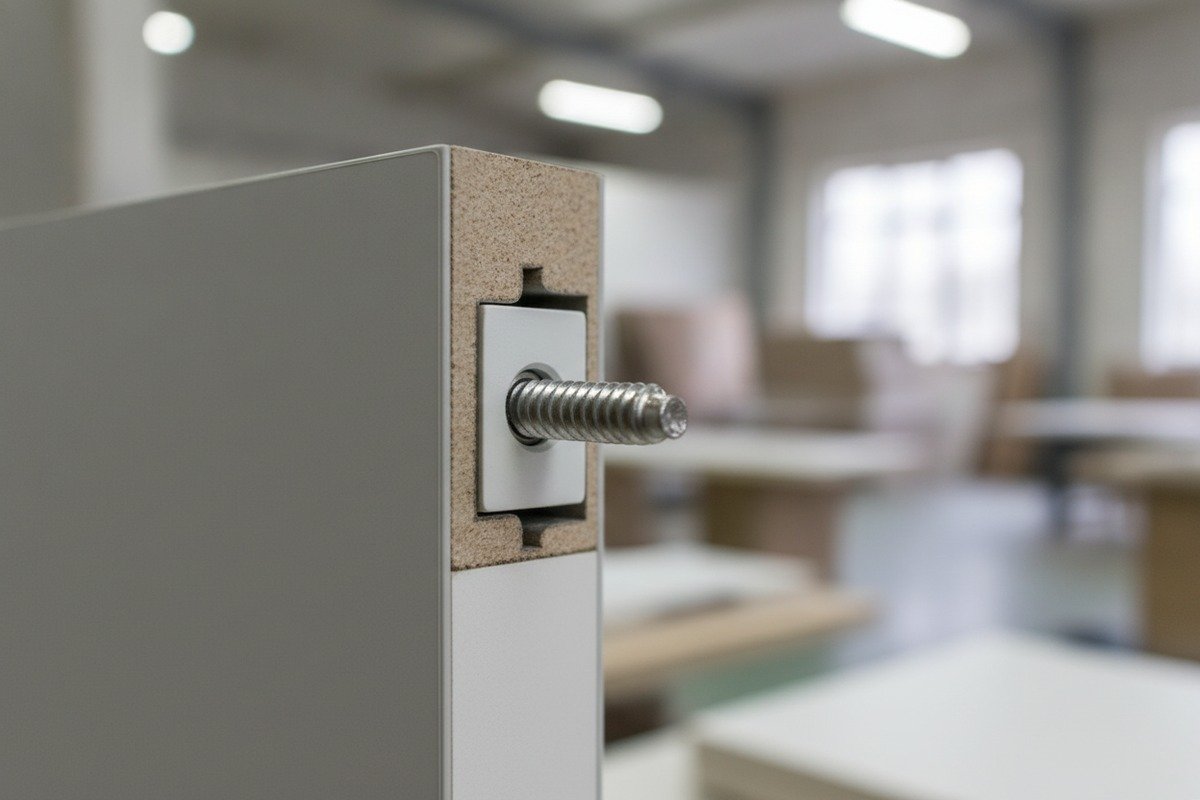
The formula is simple. Take the thickness of your door or drawer front. Add the depth of the handle's mounting post or threaded sleeve. Then add 2–3 mm for secure thread engagement. That total is the screw length you need.
For example, if your MDF panel 7 is 18 mm thick and the handle's rear post is 8 mm deep, you need a screw that is at least 28–29 mm long. A 25 mm screw would be too short. A 35 mm screw would poke through the inside of the drawer face.
Common Screw and Thread Specifications
| Specification | Metric Standard | Imperial Standard |
|---|---|---|
| Thread type | M4 (4 mm diameter, 0.7 mm pitch) | 8-32 (approx. 4.16 mm, 32 TPI) |
| Common lengths | 20 mm, 25 mm, 30 mm, 35 mm | 3/4 in, 1 in, 1-1/4 in |
| Head style | Flat countersunk or pan head | Flat countersunk or truss head |
| Material | Steel (zinc-plated) or stainless | Steel (zinc-plated) or stainless |
In our experience exporting to the Middle East, most clients use M4 screws because their furniture systems are metric. Vietnamese factories also lean metric. If you serve a mixed market, always confirm the thread standard before we cut production.
The Hidden Problem: Dissimilar Metals
An aluminum handle body looks great, but the screws, threaded inserts, and rear nuts are often steel or zinc alloy. This creates a potential issue. When dissimilar metals are in direct contact, especially in humid environments, galvanic corrosion 8 can develop over time. The steel screw corrodes faster because of the electrochemical reaction with the aluminum.
For standard indoor furniture, this is rarely a problem within the product's expected life. But for bathroom vanities or coastal installations, consider stainless steel screws 9 or nylon washers as an isolation barrier. We stock stainless steel screw options for clients who specify them.
What Happens When You Get It Wrong
A screw that is too long will push through the panel face. A screw that is too short will not engage enough thread, causing the handle to loosen over weeks of use. The wrong thread type — say, an M4 screw forced into an 8-32 threaded insert — will strip the insert on the first installation. All of these are avoidable with a simple specification sheet shared before production begins.
We always recommend that buyers send us a sample panel or at minimum a cross-section drawing showing the panel thickness, any applied edge banding, and the expected gap between the handle's base and the panel surface. That gives our engineers enough information to select the correct screw from our inventory or manufacture a custom length within our 3–7 day turnaround window.
Can I Request Custom Hole Spacing for My OEM Aluminum Handles to Fit My Specific Factory Production Line?
Our team handles custom spacing requests almost every week. Sometimes it is a Vietnamese furniture factory whose CNC drilling program is set to 117 mm centers. Other times it is a Middle Eastern distributor whose client has an older European cabinet system with 132 mm spacing. Both are perfectly doable.
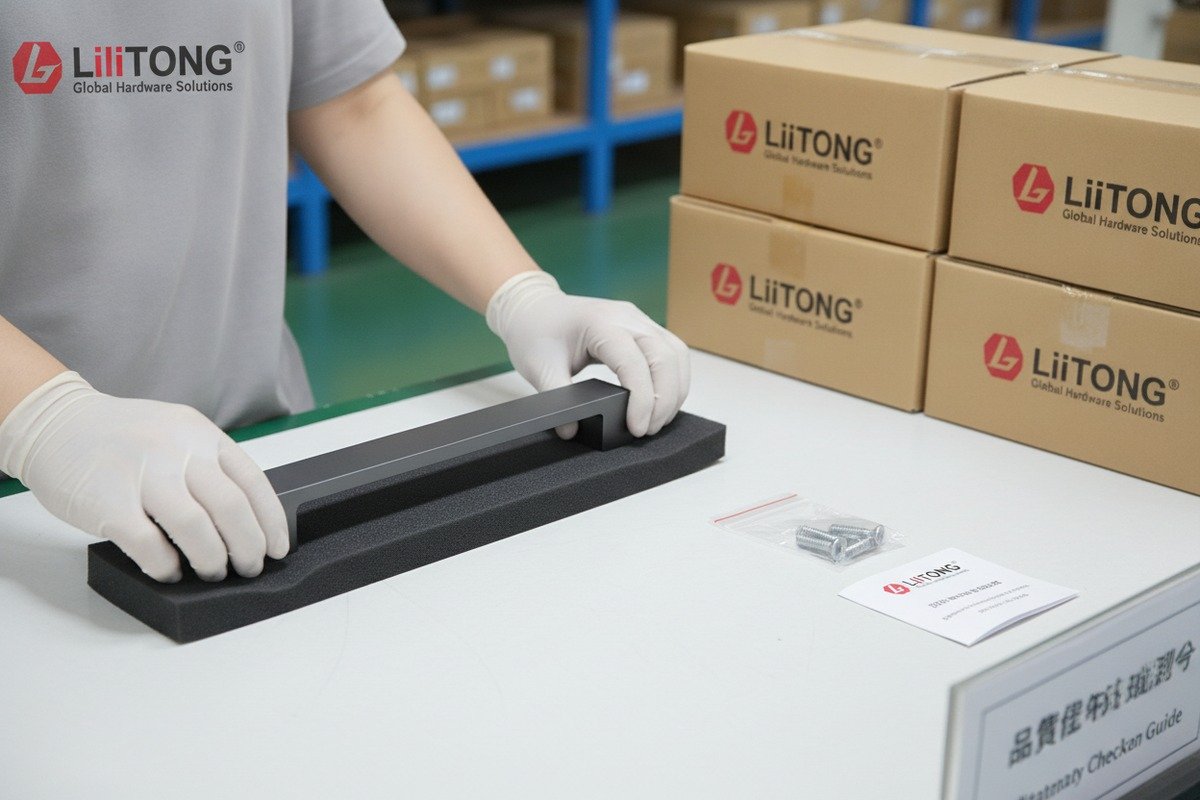
Yes, most experienced aluminum handle manufacturers can produce custom center-to-center hole spacing for OEM orders. You need to provide exact C-C dimensions, screw thread specifications, and panel thickness. At our facility, custom spacing orders typically ship within 3–7 days with reasonable minimum order quantities.
When Custom Spacing Makes Sense
Custom spacing is necessary in several situations. Your factory's CNC machines are programmed for a non-standard drilling pattern. You are retrofitting handles on imported furniture that uses regional standards. Or your designer has specified a unique handle length that does not align with any standard C-C distance.
In all these cases, forcing a standard handle to fit a non-standard hole pattern leads to sloppy results. Elongated screw holes weaken the panel. Off-center mounting makes the handle sit crooked. It is always better to match the handle to the hole than to modify the hole to fit the handle.
What Information Your Supplier Needs
When you request custom spacing, provide the following:
- Exact C-C distance in millimeters (not inches, not approximate)
- Screw hole diameter on the handle base
- Thread type and size (M4, M5, 8-32, etc.)
- Panel material and thickness
- Desired handle profile, finish, and length
- Order quantity
At our facility, we use extruded aluminum profiles 10 that can be cut and drilled to virtually any C-C spacing. The extrusion die determines the handle's cross-section shape and finish, but the hole placement is a secondary machining step. That means custom spacing does not require a new extrusion die — just a new CNC drilling program.
MOQ and Lead Time Realities
Many buyers worry that custom spacing means huge minimum orders. In our case, we can accommodate custom drilling on orders as low as a few hundred pieces, depending on the profile. Our 300-ton ready stock of raw extruded profiles means we are not starting from zero. We cut, drill, and finish from existing stock, which is why our custom turnaround is 3–7 days instead of weeks.
However, if your custom request requires a completely new extrusion profile — a different cross-section shape, not just different hole placement — then lead times and MOQs increase. That is a tooling investment. We always clarify this distinction upfront so there are no surprises.
Balancing Custom vs. Standard
There is a real trade-off here. Custom spacing solves your immediate production need, but it can create a supply chain dependency. If you ever need replacement handles in the future, only a supplier who can replicate that exact custom spacing will work. Standard spacings like 96 mm or 128 mm are universally available and easy to source from multiple vendors.
Our recommendation to factory owners: use standard spacing whenever your production system allows it. Reserve custom spacing for projects where the design or existing furniture absolutely requires it.
How Do I Check if the Mounting Hardware Provided with My Bulk Handle Order Meets My Durability and Installation Requirements?
We once had a distributor in the UAE return an entire shipment — not because of the handles themselves, but because the included screws were 5 mm too short for the thick solid wood doors his client was using. The handles were perfect. The hardware kit was not. That single oversight cost weeks and thousands of dollars.
Inspect every bulk hardware kit for screw length, thread compatibility, material quality, and corrosion resistance. Request a sample kit before full production. Test-mount at least one handle on your actual panel material to verify fit, tightness, and long-term hold before approving the shipment.

Your Pre-Shipment Inspection Checklist
Before you approve any bulk handle order, verify these items on a sample from the production batch:
- Screw length — Does it match your specified panel thickness plus mounting depth?
- Thread type — Is it M4, M5, 8-32, or whatever you specified?
- Thread engagement — Does the screw fully engage the handle's threaded insert without bottoming out?
- Head style — Does the screw head sit flush inside the cabinet, or does it protrude and interfere with drawer contents?
- Material and finish — Are the screws zinc-plated steel, stainless steel, or black oxide? Does the finish match the handle?
- Quantity per set — Are there enough screws, washers, and spacers for every handle in the box?
Testing for Durability
A quick pull test tells you more than any specification sheet. Mount the handle on a sample panel using the provided screws. Then pull the handle firmly — harder than any normal user would. If the screws hold without loosening or the panel cracking, you have a good kit.
For ongoing durability, the critical factor is the threaded connection. Machine screws into threaded inserts (common on aluminum handles) hold better than wood screws into particle board. If your furniture uses particleboard or MDF, consider adding a threaded insert or T-nut on the back side of the panel for a more secure connection.
Common Hardware Kit Failures
| Failure Type | Root Cause | Prevention |
|---|---|---|
| Handle loosens after weeks | Screw too short, insufficient thread engagement | Specify screw length based on actual panel thickness |
| Screw strips the handle insert | Wrong thread type (metric vs. imperial mismatch) | Confirm thread spec on technical drawing |
| Screw head visible from inside | Wrong head style or no countersink | Request flat countersunk screws or pan heads as needed |
| Corrosion around screw holes | Dissimilar metals in humid environment | Use stainless screws or nylon washers for wet areas |
| Handle sits crooked | Hole diameter too large for screw shaft | Verify screw shaft diameter matches hole tolerance |
Surface Treatment Effects on Fit
This is a detail that most buyers overlook. When an aluminum handle is anodized or powder coated, the finish adds a thin layer of material — typically 10–25 microns for anodizing and 60–80 microns for powder coating. On the exterior surfaces, this is purely cosmetic. But inside the screw holes, that added thickness can reduce the hole diameter just enough to make a screw bind or refuse to thread properly.
At our facility, we mask screw holes during coating or re-tap them after finishing to ensure clean thread engagement. But not every manufacturer does this. When you receive samples, always test-thread a screw by hand before tightening with a tool. If the screw feels tight going in by hand, the hole may be undersized due to coating buildup.
Request a Complete Kit, Not Just Handles
The best practice we recommend to all our wholesale clients: always order the complete mounting kit as part of the handle order. Do not assume you will source screws locally. The cost of including matched screws in the handle package is minimal — usually a few cents per set. The cost of discovering a mismatch after the handles reach your warehouse or your client's job site is significant.
We include matched screws with every handle we ship. If your panel thickness is non-standard, tell us during the quoting stage and we will swap in the correct screw length at no extra charge. That is a small detail that eliminates a large category of installation complaints.
Conclusion
Sourcing aluminum furniture handles is straightforward once you control three variables: center-to-center hole spacing, screw thread and length specifications, and complete hardware kit verification. Get these right, and every handle mounts perfectly the first time. If you need help specifying the right combination for your production line, reach out to our team at Al**************@********************************************te.com — we are happy to review your drawings and recommend the exact match.
Footnotes
1. Wikipedia is an authoritative source providing a comprehensive list and overview of various screw thread standards. ↩︎
2. Provides general information about aluminum and its applications. ↩︎
3. Defines common hardware measurement terms, including overall length. ↩︎
4. Provides a clear definition of center-to-center measurement specifically in the context of cabinet hardware, which is highly relevant to the article. ↩︎
5. Explains the principles and standards of technical drawings in engineering. ↩︎
6. Details the history and usage of imperial and metric measurement systems. ↩︎
7. Describes the composition, properties, and uses of Medium-Density Fibreboard. ↩︎
8. Explains the phenomenon of galvanic corrosion between different metals. ↩︎
9. Details the characteristics and applications of stainless steel fasteners. ↩︎
10. Describes the process and applications of aluminum extrusion. ↩︎