Every week, our sales team fields the same question from new buyers: “Why does this sample cost so much, and why does it take that long?” It is a fair question. When you are comparing three or four potential suppliers for aluminum furniture handles 1, the sampling stage can feel like a black box — unclear timelines, unexplained fees, and no easy way to tell whether you are getting a good deal or being overcharged.
A supplier’s sampling speed is reasonable when it matches the complexity of your handle design, the need for tooling, and the supplier’s production capacity. Sampling fees are reasonable when they reflect whether the sample is a stock item, a modified profile, or a fully custom mold — plus finishing and shipping costs.
The truth is, “fast” and “cheap” mean nothing in isolation. A three-day turnaround on a stock pull handle is normal. A three-day turnaround on a brand-new extruded profile with custom anodizing 2 would be suspicious. This article breaks down exactly how to judge both speed and cost so you can negotiate from a position of knowledge, not guesswork.
How can I tell if a 3 to 7-day turnaround for my custom aluminum handle samples is fast enough for my project?
When we schedule sample runs on our production floor, we know exactly which steps eat up time and which ones can be compressed. Yet many buyers treat every sample request the same way, expecting a single universal timeline regardless of what they are asking for.
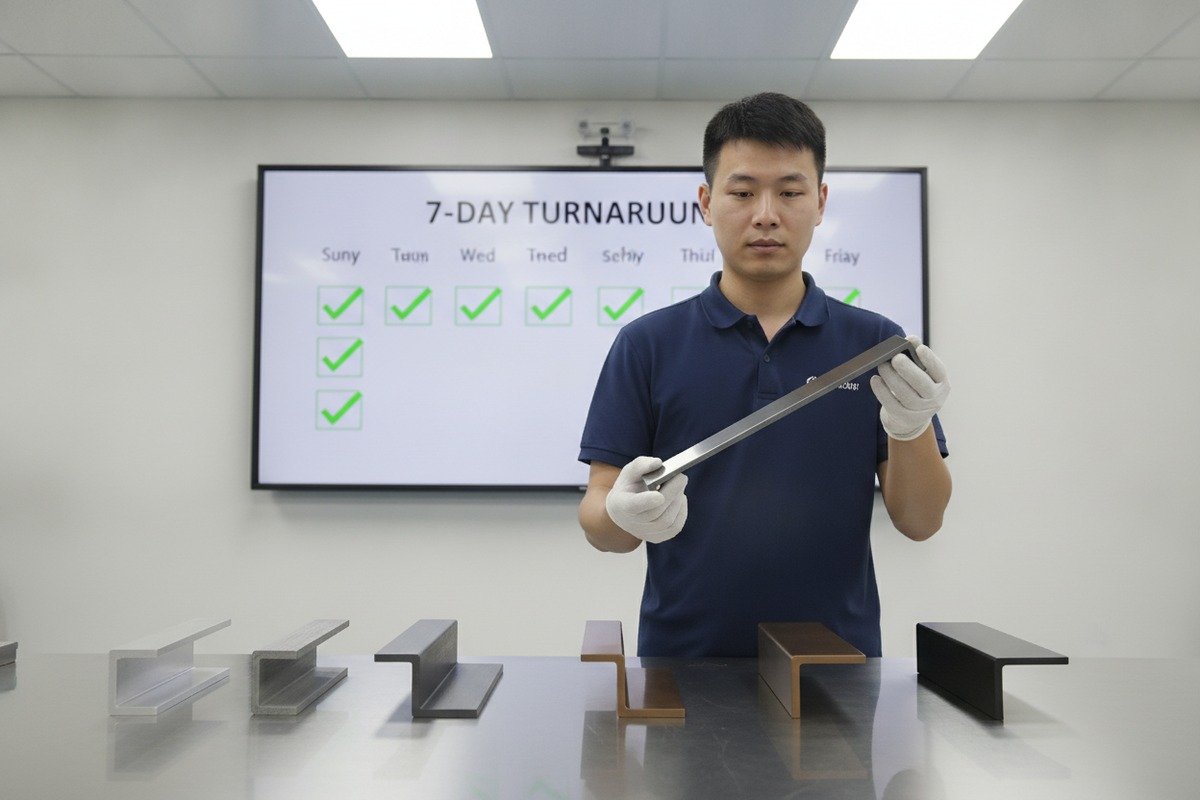
A 3 to 7-day turnaround is fast enough for most custom aluminum handle samples when the supplier already has compatible tooling and standard finishing capabilities. Fully new mold designs or unusual surface treatments may reasonably push the timeline to 10–15 days or more.
Why timelines vary so much
Not all samples are created equal. The single biggest factor that determines sampling speed is whether the supplier needs to create new tooling. A stock handle sitting in our warehouse can ship within 48 hours. A modified version of an existing profile — say, a different length cut or a new anodized color — typically takes 3 to 7 days. A completely new cross-section that requires a fresh extrusion die 3 can take 10 to 20 days, and that is perfectly normal.
Breaking down the sample process step by step
Here is what actually happens behind the scenes when you request a custom sample:
- Design confirmation — You send a drawing or reference image. The supplier confirms dimensions, tolerances, and finish.
- Tooling check — The factory determines if existing dies work or if a new mold is needed.
- Extrusion or machining — The aluminum is extruded, cut, and shaped.
- Surface finishing — Anodizing 4, powder coating, or brushing is applied.
- Quality inspection — Dimensional checks and visual inspection happen before packing.
- Packing and shipping — The sample is boxed and sent via express courier.
Each step has its own lead time. When a buyer asks for a sample in three days, they are really asking the supplier to compress or skip steps. Sometimes that is possible. Sometimes it is not.
A quick reference table for expected timelines
| Sample Type | Tooling Needed? | Typical Timeline | Notes |
|---|---|---|---|
| Stock catalog handle | No | 1–2 days | Ships from existing inventory |
| Modified length or color | No (minor adjustment) | 3–7 days | Uses existing die, new finish or cut |
| New profile, existing die family | Possibly minor | 5–10 days | Die adjustment + trial extrusion |
| Fully custom new design | Yes, new mold | 10–20 days | Die fabrication + trial run + finishing |
| Custom design + special finish | Yes | 15–25 days | Adds anodizing trials or color matching |
What to ask your supplier
Before judging whether a timeline is too slow, ask these questions:
- Do you have an existing die that fits my profile dimensions?
- Is the surface finish I want part of your standard process, or does it require a trial run?
- Can you send me a photo of the sample at each production stage?
A supplier who answers clearly and gives you a day-by-day breakdown is far more trustworthy than one who simply promises "fast delivery" without details. In our experience exporting to the Middle East and Vietnam, buyers who understand these steps tend to get better results — because they set realistic deadlines and avoid rushed, low-quality samples.
Red flags on timing
Be cautious if a supplier promises a fully custom extruded sample in under three days. Either they are sending you something from existing stock that does not truly match your design, or they are skipping quality checks. Both scenarios cost you time later.
What are the typical sample fees for bespoke aluminum profiles and how do I know if I am being overcharged?
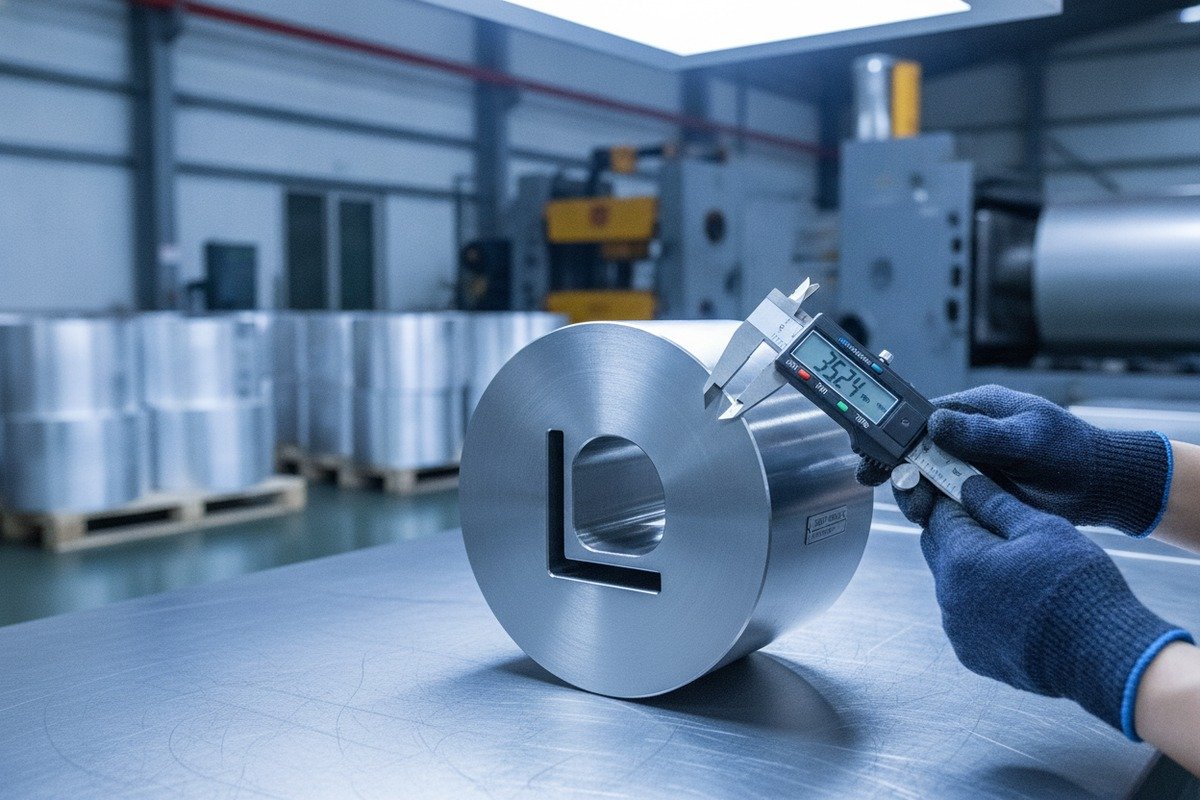
Running our extrusion lines for a single sample piece uses the same setup labor as running a batch of 500 pieces. That reality surprises many first-time buyers, but it is the core reason sample fees exist — and the core reason those fees vary so widely.
Typical sample fees for bespoke aluminum furniture handles range from free for stock items to $50–$300 for custom profiles, depending on whether a new mold is required, the surface finish complexity, and shipping method. You are being overcharged if the supplier cannot itemize these costs.
What makes up a sample fee
A sample fee is not one cost. It is a bundle of smaller costs that the supplier either absorbs, passes through, or marks up. Here is what goes into it:
- Material cost — Raw aluminum alloy 5 (typically 6063-T5 for furniture handles).
- Machining or extrusion cost — Running the press or CNC machine for a short run.
- Surface treatment — Anodizing, electrophoresis 6, powder coating, or brushing.
- Labor — Setup, handling, inspection, and packing.
- Mold or die cost — Only applies if a new extrusion die is fabricated.
- Shipping — Express courier (DHL, FedEx) to your location.
Fee ranges by sample type
| Sample Type | Typical Fee Range | Mold Cost Included? | Refundable Against Bulk Order? |
|---|---|---|---|
| Stock catalog sample | Free – $20 | No mold needed | Usually free; shipping may apply |
| Color or finish variation of stock | $20 – $80 | No | Sometimes credited |
| Modified profile (existing die) | $50 – $150 | No | Often credited partially |
| New custom profile (new die) | $150 – $500+ | Yes, die cost separate | Die cost usually credited at MOQ |
| Premium finish sample (special anodize) | $80 – $200 | Depends | Finish trial cost rarely credited |
How to tell if you are being overcharged
The simplest test is transparency. A trustworthy supplier will break the fee into line items. When we quote a sample, we separate the material cost, the finishing cost, the mold charge (if any), and the courier fee. If your supplier gives you a single lump number and cannot explain what is inside it, that is a warning sign.
Other signs of overcharging:
- The sample fee is higher than the per-unit price at bulk volume, with no mold involved.
- The supplier charges full mold cost for a minor modification of an existing die.
- Shipping cost is bundled in at a rate far above actual courier rates.
- No mention of whether the fee is credited against a future order.
The mold cost question
New extrusion dies for aluminum profiles 7 typically cost between $200 and $800, depending on the cross-section complexity and the die manufacturer. This is a real cost. A good supplier will quote it separately and credit it back to you once your bulk order reaches a certain volume. If a supplier hides the mold cost inside the sample fee, you will never know what you actually paid for — and you will lose leverage in negotiation.
Negotiation tips
Ask up front: "If I place a bulk order of X pieces, will the sample fee and mold cost be credited?" Most mid-to-high-end suppliers, including our own team, offer partial or full credit as standard practice. If the supplier refuses to credit any portion, make sure the sample quality and service justify the premium.
How should I evaluate if a supplier's prototype quality accurately reflects the final bulk production of my furniture handles?
On our production floor, we have a saying: "The sample is a promise." If the sample looks great but the bulk order does not match, the supplier broke that promise. We have seen competitors ship beautiful one-off samples and then deliver inconsistent bulk runs. Buyers need tools to spot this before it happens.
A prototype accurately reflects bulk production when the supplier uses the same extrusion die, the same alloy grade, and the same finishing process for both the sample and the production run. Ask for material certificates, dimensional reports, and process documentation to verify consistency.
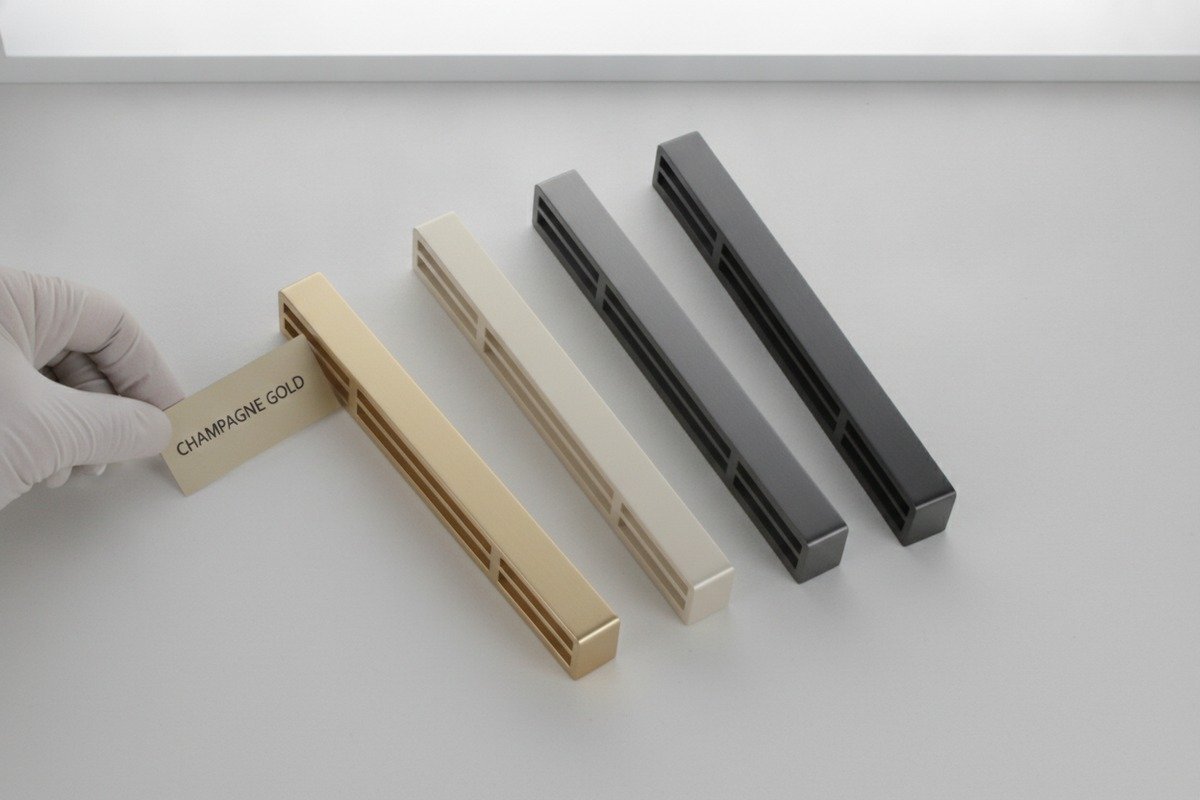
The gap between sample and bulk
Why do samples sometimes look different from bulk orders? There are several common reasons:
- Different production method — The sample was CNC-machined from billet, but bulk production uses extrusion. The surface texture and tolerances will differ.
- Different finish batch — Anodizing color varies between batches if the supplier does not control electrolyte concentration and temperature precisely.
- Hand-finished sample — Extra polishing or deburring was done on the sample but is not economically feasible at scale.
- Different alloy — The sample used a higher-grade alloy, while bulk uses a cheaper substitute.
What to check on every sample
Here is a practical checklist:
Dimensional accuracy
Measure the sample against your drawing. Check the profile cross-section, hole spacing, screw positions, and overall length. Use calipers for critical dimensions. A variation of ±0.1 mm on an extruded profile is acceptable under EN 12020 tolerances 8. Anything larger should be discussed.
Surface finish consistency
Look at the anodized or coated surface under natural light. Check for color uniformity, micro-scratches, and coating thickness. If you have a specific color reference (RAL or Pantone), hold the sample against it. Ask the supplier for a coating thickness report — typical anodized layers for furniture handles are 10–15 microns.
Material verification
Request a material test certificate 9 (MTC) showing the alloy grade and temper. For furniture handles, 6063-T5 is the standard. If the supplier references ASTM B221 10 or EN 12020 compliance, ask for documentation, not just a verbal claim.
Process documentation
The best suppliers will tell you exactly how the sample was made. If it was extruded on the same press that will handle bulk orders, that is a strong indicator of consistency. If it was machined as a one-off, the bulk product may look and feel different.
A comparison table: what good vs. risky suppliers disclose
| Quality Indicator | Reliable Supplier | Risky Supplier |
|---|---|---|
| Production method for sample | States extrusion die number or CNC file used | Vague: "standard process" |
| Alloy grade | Provides MTC with 6063-T5 or equivalent | Says "aluminum" with no grade detail |
| Finish specification | States anodize thickness, color code | "Gold color" with no spec |
| Dimensional report | Supplies inspection report with tolerances | No report offered |
| Standards referenced | Cites ASTM B221, EN 12020, ISO 9001 | No standards mentioned |
| Bulk consistency guarantee | Written commitment to match sample within tolerance | Verbal promise only |
Ask for a production-intent sample
If your order volume is significant, request a production-intent sample — one made using the actual bulk production tooling and process. This costs slightly more and takes a few extra days, but it eliminates the guesswork. At our facility, we encourage buyers placing orders above a certain threshold to approve a production-intent sample before we lock in the run. It protects both sides.
What to do if the bulk order does not match
Agree on acceptance criteria before production starts. Define the allowable tolerance range for dimensions, color delta (ΔE value for anodized finish), and surface defect limits. Put it in writing. If the bulk shipment falls outside those criteria, you have grounds for a claim or replacement — but only if the criteria were documented.
Why is it important for my supplier to offer both ready-to-ship stock samples and rapid custom development services?
When we built our 300-ton ready-to-ship inventory, it was not because we wanted a warehouse full of handles. It was because our buyers told us they needed two things at once: speed for proven designs and flexibility for new ones. Suppliers who can only do one or the other create bottlenecks in your product development cycle.
A supplier offering both stock samples and rapid custom development lets you test proven designs immediately while developing unique handles in parallel. This dual capability shortens your total sourcing timeline, reduces risk, and gives you options if your custom project hits delays.
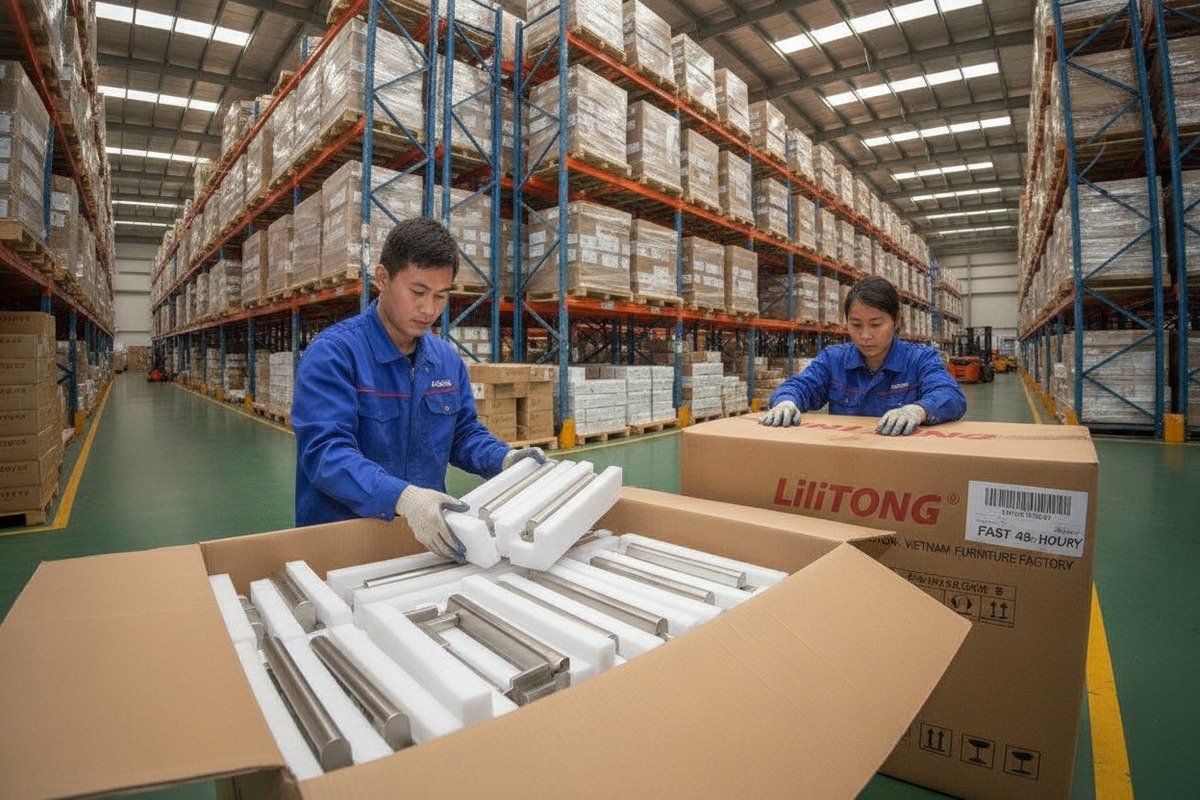
The two-track sourcing advantage
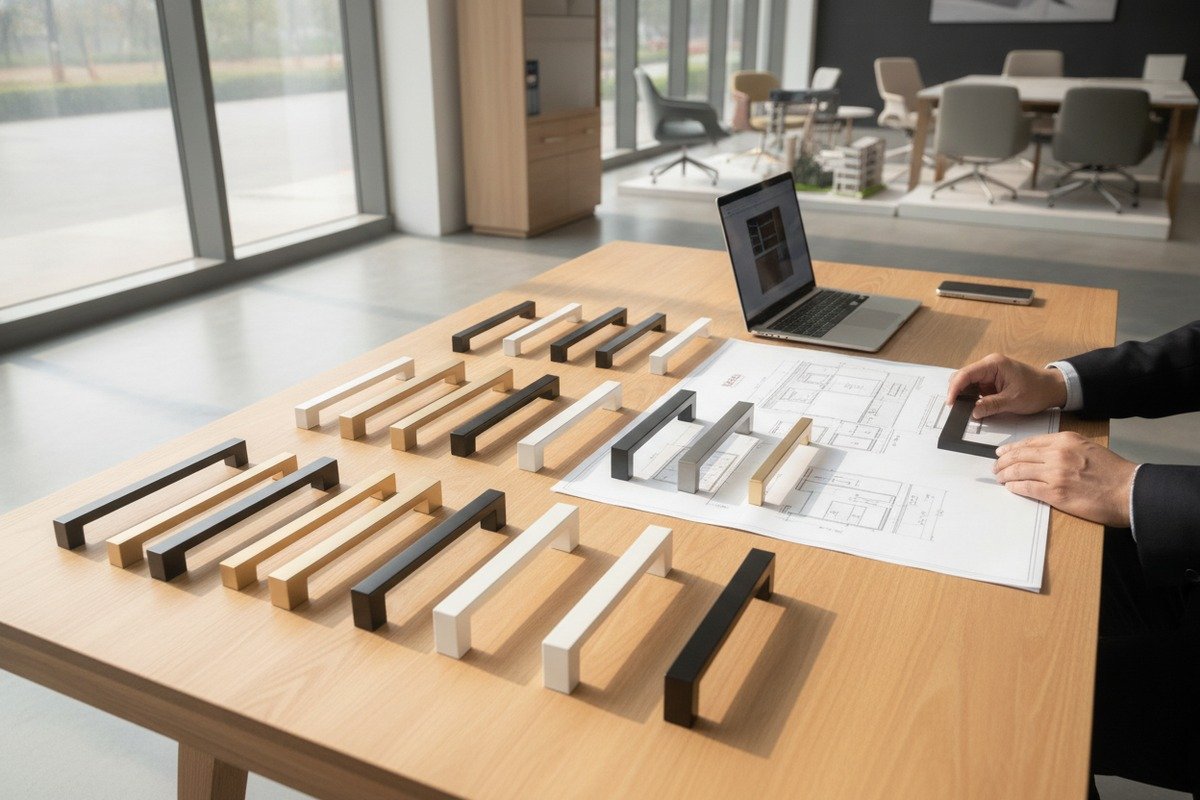
Think of it as running two lanes on the same road. In lane one, you order stock samples of existing handles — the modern recessed pulls in matte black, champagne gold, charcoal grey — and within 48 hours they are on their way to your office. You can physically test them, show them to your end customers, and confirm that the supplier's quality meets your standards. In lane two, you submit your custom design — maybe a specific channel depth, a unique length, or a proprietary finish — and the supplier begins development.
If your custom design hits a snag (a finish trial fails, a mold revision is needed), you still have stock handles moving through your pipeline. Your furniture production or your wholesale catalog does not stall.
What "ready-to-ship" really means
Not every supplier who claims stock availability actually keeps inventory. Some use the term loosely to mean "we can produce it quickly." True ready-to-ship means:
- The handle exists in finished form in the warehouse.
- It has passed quality inspection already.
- It can be packed and dispatched within 24–48 hours.
- Multiple finishes and lengths are available without minimum order constraints for samples.
This matters because a stock sample serves a specific purpose: it lets you evaluate the supplier's baseline quality without waiting for production. If the stock sample is good, you have confidence that the factory's processes, materials, and finishing are sound. That confidence carries over when you commission a custom design.
What "rapid custom development" really means
Rapid custom development is not just about speed. It means the supplier has:
- In-house die design and fabrication capability.
- The ability to run small trial extrusions without disrupting main production.
- Finishing lines that can handle one-off color or treatment tests.
- Engineers who can read your drawings, suggest improvements, and turn around revisions quickly.
- A response time of 24 hours or less for technical questions.
When we work on custom handle development for furniture factories in Vietnam or the UAE, the process typically involves two to three rounds of sample revision. A supplier with a streamlined custom development workflow can compress those rounds into days rather than weeks.
Why this dual capability signals a strong supplier
A supplier who offers both stock and custom services is telling you several things at once:
- They invest in inventory, which means they have financial stability and confidence in their product range.
- They invest in tooling and engineering, which means they can grow with your design needs.
- They understand that different buyers — and different projects — need different speeds.
- They can support you whether you are restocking a proven bestseller or launching a new furniture line.
If a supplier only offers stock items, they may struggle when you need a unique design. If they only do custom work, you will wait longer for every sample, even when you just need to see a basic pull handle. The best sourcing relationships are built with suppliers who handle both lanes smoothly.
How to test this before committing
Place a small stock sample order and a custom sample request at the same time. Track how the supplier handles both. Do they ship the stock sample quickly? Do they communicate clearly on the custom timeline? Do they provide separate quotes and timelines for each? If yes, you are working with a supplier who understands how professional buyers operate.
Conclusion
Evaluating a supplier's sampling speed and fees comes down to understanding what you are asking for and what the supplier is actually doing to deliver it. Match the timeline to the complexity, demand itemized pricing, verify that samples reflect real production processes, and choose a supplier who can serve you on both stock and custom tracks. That approach turns sampling from a cost center into a strategic advantage.
Footnotes
1. Alibaba is a major global B2B platform for sourcing aluminum furniture handles and hardware. ↩︎
2. Provides details on the anodizing process and its customization. ↩︎
3. Describes the function and creation of an extrusion die. ↩︎
4. Explains the anodizing process for aluminum. ↩︎
5. Provides a general overview of aluminum alloys and their properties. ↩︎
6. Describes the electrophoresis coating process. ↩︎
7. The World Bank monitors global trade flows, including industrial materials like aluminum profiles. ↩︎
8. Defines the European standard for aluminum extrusion tolerances. ↩︎
9. NIST provides standardized reference materials and guidelines for accurate material testing and certification. ↩︎
10. Provides information on the ASTM standard for aluminum extrusions. ↩︎