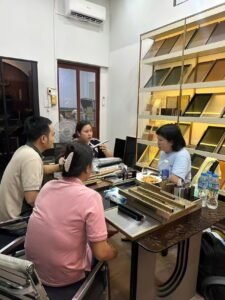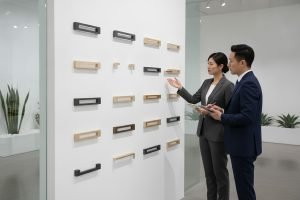
Over the past 18 years running our Foshan production lines 1, we have watched countless buyers get burned by suppliers who looked great on paper but failed on delivery, finish quality, or consistency.
To evaluate an aluminum furniture handle supplier’s reputation, look beyond price and marketing claims. Verify their years in business, inspect product samples for finish durability, review customer feedback patterns, confirm production capacity, check export history, and assess warranty and after-sales support before committing to any order.
This guide breaks down the exact steps you can take to separate real credibility from empty promises OEM and ODM requirements 2. Whether you run a building material wholesale business or manage procurement for a furniture factory, the framework below will help you make confident sourcing decisions.
How can I verify if a Foshan aluminum handle manufacturer has the 18 years of industry experience they claim?
Every supplier's website says they have decades of experience CNC machining equipment 3. But when our team visits trade shows in Guangzhou and Ho Chi Minh City, we often meet companies whose actual factory history tells a very different story.
To verify a Foshan manufacturer's claimed experience, cross-check their business registration date on China's National Enterprise Credit Information System, request historical export records, ask for dated project photos, and look for consistent appearances at industry trade shows over multiple years.
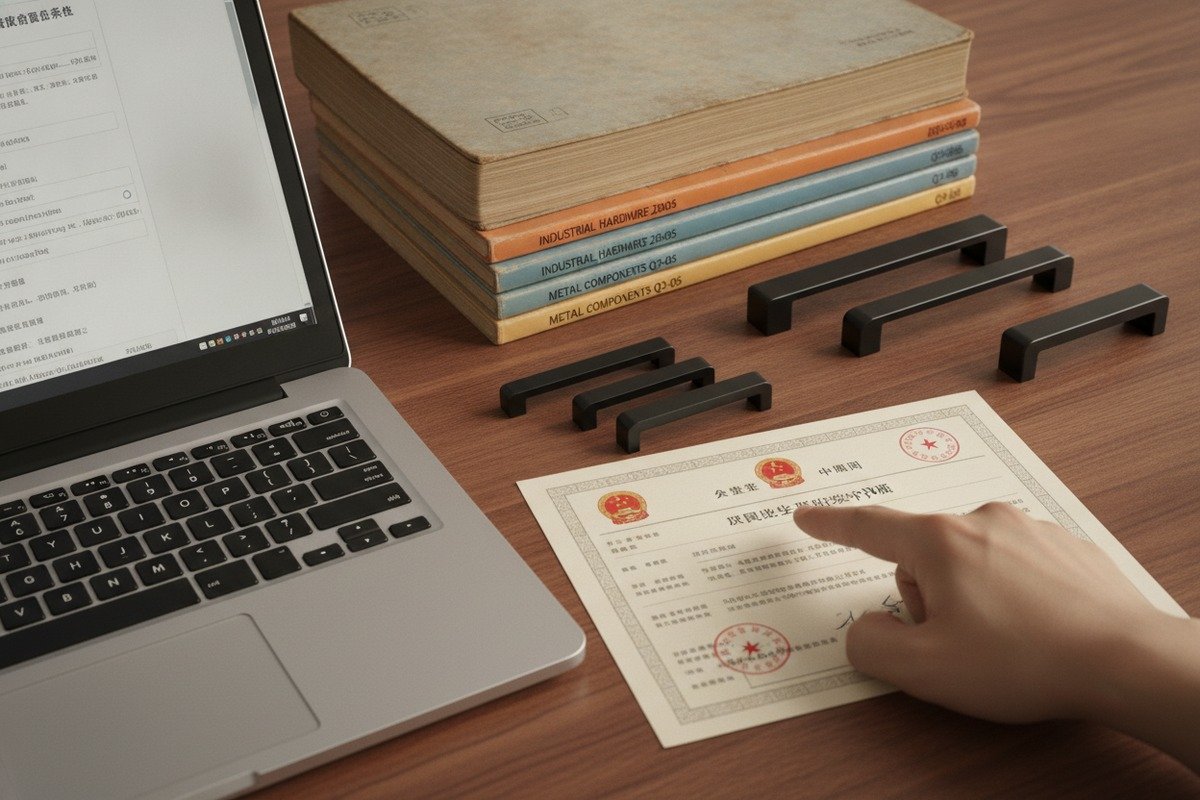
Why claimed experience matters
A manufacturer that has truly operated for 18 years has survived multiple market cycles, raw material price swings 4, and shifting buyer demands. That kind of resilience usually means the company has built stable supplier relationships, refined its quality control, and developed the institutional knowledge needed to handle complex orders. However, some companies rebrand or restructure and then count the years of a predecessor entity aluminum alloy grade 5. Others simply inflate numbers because they know buyers value longevity.
How to cross-check business registration
China's National Enterprise Credit Information Publicity System (NECIPS) is a free, publicly accessible database. You can search by company name or unified social credit code. The registration date will show when the legal entity was formally established. This does not prove the company made aluminum handles 6 from day one, but it gives you a factual baseline.
Additional verification steps
| Verification Method | What It Reveals | Difficulty Level |
|---|---|---|
| NECIPS business registration lookup | Legal entity founding date | Easy — free online |
| Requesting dated factory photos or catalogs | Whether the company had products in earlier years | Moderate — requires supplier cooperation |
| Trade show attendance records (Canton Fair, CIFF) | Consistency of industry presence over time | Moderate — check fair exhibitor archives |
| Asking for references from long-term clients | Real relationship history | Harder — requires client willingness |
| Checking old export customs data 7 via third-party tools | Actual export activity history | Moderate — may require paid data services |
What experience alone does not guarantee
A long operating history is a useful signal of stability, but it does not automatically mean the supplier produces high-quality aluminum handles today. Equipment gets outdated. Management changes. A company that was excellent ten years ago may have declined. That is why experience verification should be just one part of your overall evaluation. Pair it with product sampling, facility visits, and quality testing to get the full picture.
When we onboard new wholesale partners, we always encourage them to visit our Foshan facility in person. Seeing 30 team members working across extrusion, anodizing, and packaging lines tells you more than any certificate on a wall.
What indicators should I look for to ensure my supplier can handle complex custom OEM and ODM requirements?
When our engineering team receives a custom handle sketch from a furniture factory in Dubai, the first question is never about price. It is about whether the design can be extruded cleanly, anodized evenly, and produced at scale within a 3-to-7-day turnaround.
Look for suppliers with in-house mold design capability, CNC machining equipment, a documented surface treatment process, sample turnaround under seven days, and a clear workflow from design review through mass production. These indicators prove a manufacturer can truly deliver custom OEM and ODM orders, not just accept them.
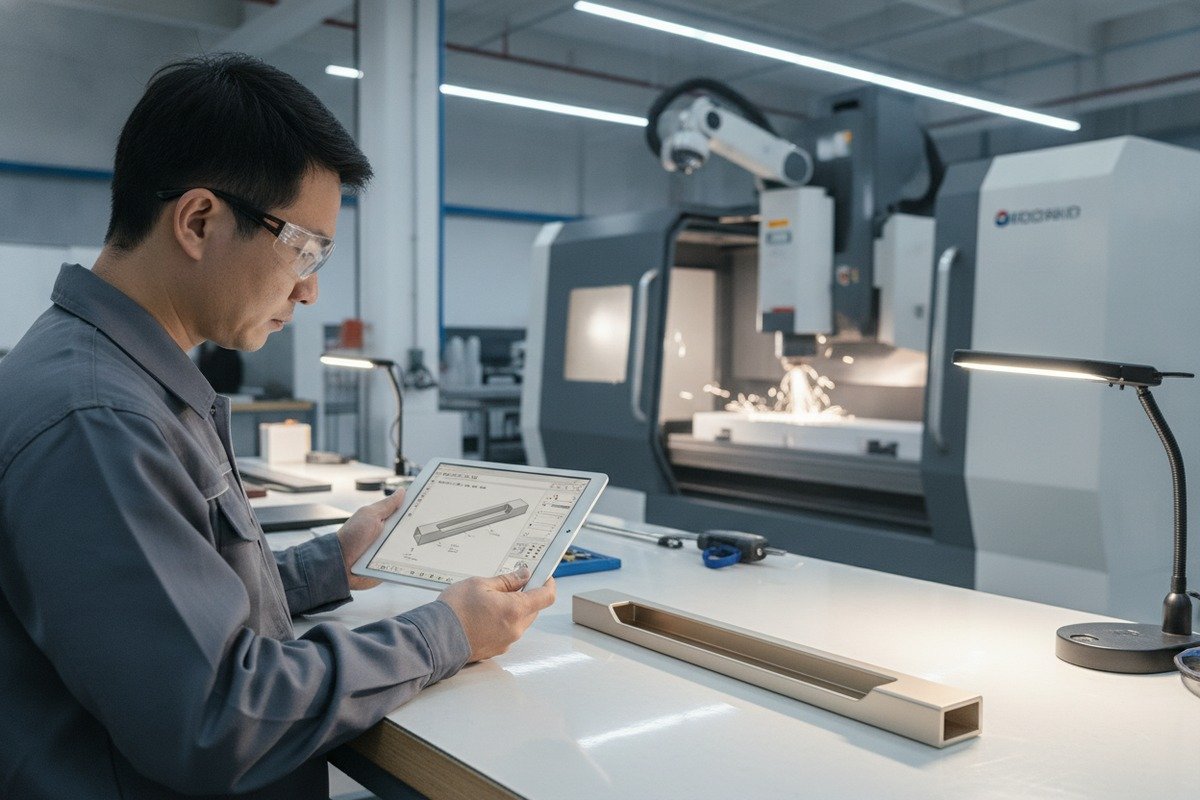
The difference between accepting custom orders and executing them well
Many suppliers will say "yes" to any custom request because they want your order. The real test is what happens after you say "go." A capable OEM/ODM partner will have a structured process: design review, mold feasibility check, prototype production, sample approval, and then mass production. If the supplier skips steps or cannot explain the workflow, that is a red flag.
Key capability indicators
| Capability | What to Ask For | Why It Matters |
|---|---|---|
| In-house mold design | CAD files, mold drawings, mold material specs | Ensures the supplier controls quality from the start |
| CNC machining | Equipment list, tolerance specs | Critical for precision handles with tight dimensional requirements |
| Surface treatment options | Anodizing, powder coating, electrophoresis samples | Determines finish durability and aesthetic range |
| Sample turnaround time | Days from design approval to physical sample | Reflects production agility and prioritization |
| Salt spray test reports | Hours of salt spray resistance, test lab name | Proves corrosion resistance, especially for humid markets like Vietnam |
| Load and cycle testing | Pull-force data, open-close cycle counts | Confirms the handle will perform in daily furniture use |
Why aluminum-specific checks matter here
Aluminum is roughly one-third the weight of stainless steel, which makes it ideal for furniture applications where lightweight hardware is preferred. But aluminum's softness compared to steel means that poor extrusion, inadequate anodizing thickness, or incorrect alloy grade selection can lead to scratches, fading, or deformation under daily use. A credible OEM/ODM supplier should be able to tell you the exact aluminum alloy grade 8 they use (such as 6063-T5 for furniture handles), the anodizing layer thickness in microns, and the powder coating adhesion standard they follow.
How to test custom capability before a large order
Request a single custom sample first. Specify a non-standard length, a particular finish color like champagne gold or matte charcoal, and a specific mounting hole pattern. If the supplier delivers an accurate sample within the promised timeframe, that is strong evidence of real capability. If there are delays, miscommunications, or quality gaps between the sample and your spec, reconsider before scaling up.
Our team handles this kind of request daily. From recessed cabinet pulls with deep geometric channels to slim architectural profiles with L-shaped cross-sections, each design demands a slightly different extrusion die and surface treatment approach. The ability to manage that variety is what separates a true OEM/ODM partner from a trading company reselling generic stock.
How do I evaluate if a supplier's ready-to-ship inventory is sufficient for my wholesale business needs?
One problem we hear about constantly from our wholesale partners in Vietnam is this: they place an order, get promised a two-week delivery, and then wait six weeks because the supplier had to produce everything from scratch. That gap between "in stock" claims and reality can cost you customers and contracts.
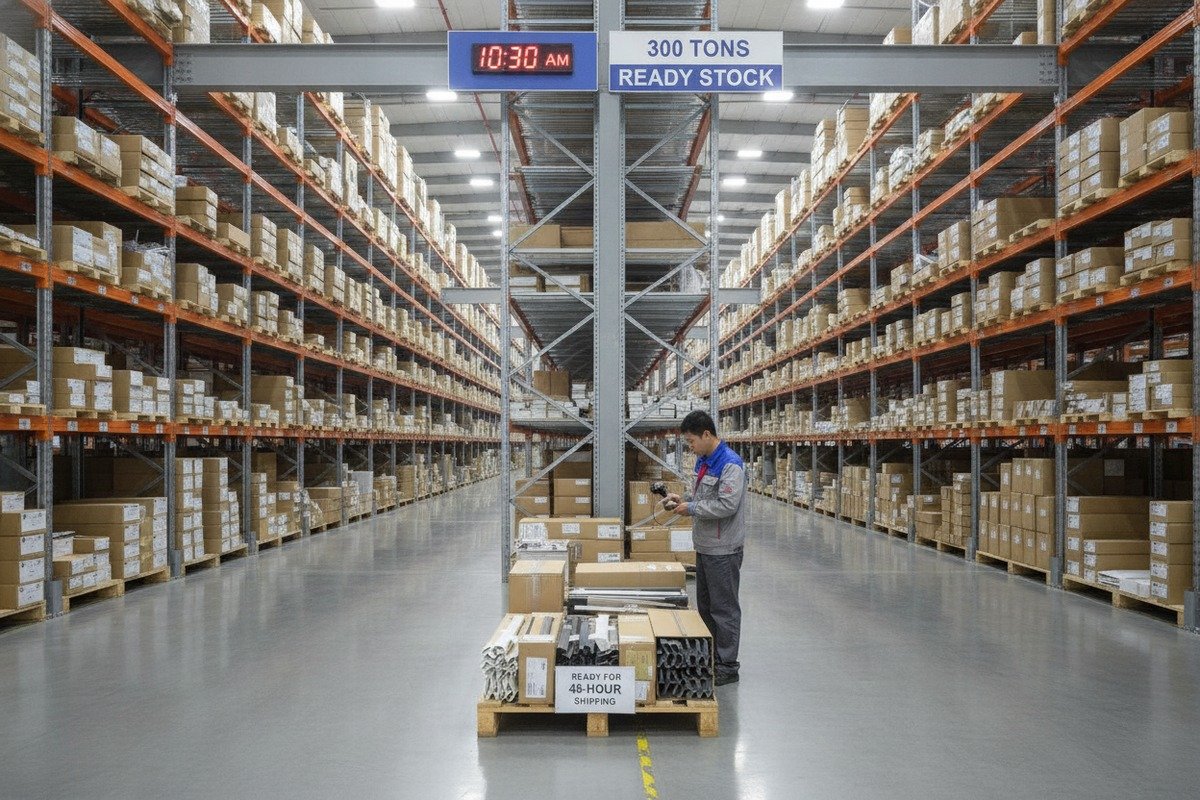
Evaluate a supplier's inventory by requesting a current stock list with SKU quantities, asking for warehouse photos or video tours, confirming 48-hour dispatch capability for standard items, and placing a small test order to measure actual fulfillment speed against their stated lead time.
Why inventory depth matters for wholesale buyers
If you are a building material distributor serving furniture factories, your buyers expect fast replenishment. They do not want to hear that the handles they need are "in production." A supplier with genuine ready-to-ship inventory — we maintain around 300 tons at our Foshan warehouse — can fill orders within 48 hours for stock items. That speed gives you a competitive edge in your local market.
How to verify inventory claims
Start by asking for a detailed stock list. A credible supplier should be able to provide a spreadsheet or catalog showing current quantities by SKU, finish, and size. Then ask for a live video call or recent photos of the warehouse. Look for organized racking, labeled bins, and visible product volume. If a supplier hesitates to show their warehouse, that is a warning sign.
The test order method
Place a small order for a mix of popular SKUs. Track the time from order confirmation to dispatch. If the supplier ships within the promised window, that is a strong positive signal. If there are delays or substitutions, you now have real data about their inventory reliability.
| Evaluation Step | What to Look For | Red Flag |
|---|---|---|
| Request stock list | SKU-level quantities, updated regularly | Vague responses like "we have many in stock" |
| Warehouse video tour | Organized storage, labeled product, visible volume | Refusal to show warehouse or only showing production area |
| Small test order | Dispatch within stated lead time (e.g., 48 hours) | Delays, partial shipments, or item substitutions |
| Ask about restock frequency | How often popular SKUs are replenished | No clear restocking schedule |
| MOQ for stock items | Low or flexible MOQ for in-stock products | High MOQ even for items claimed to be in stock |
Balancing stock items and custom orders
A strong supplier manages both ready-to-ship inventory and custom production capacity. For your wholesale business, the ideal partner stocks your best-selling finishes and sizes — matte black, champagne gold, charcoal grey in standard cabinet pull lengths — while also offering a 3-to-7-day turnaround for custom dimensions or special finishes. This dual capability means you can serve routine orders instantly and handle special projects without switching suppliers.
What "sufficient" inventory looks like for different buyer types
A small furniture workshop ordering 200 handles per month has different inventory needs than a national distributor ordering 10,000 pieces per month. Before evaluating a supplier's inventory, define your own replenishment cycle, peak-season volume, and SKU variety. Then match those numbers against what the supplier can actually hold and ship. The goal is not to find the supplier with the biggest warehouse. It is to find one whose inventory model aligns with your demand pattern.
What steps can I take to confirm a manufacturer's actual market standing in the Vietnam and Middle East regions?
When we first started exporting to Ho Chi Minh City and later to the UAE and Saudi Arabia, we quickly learned that market standing in these regions is built on relationships, delivery track records, and word-of-mouth among local distributors — not just on having a nice website.
To confirm a manufacturer's market standing in Vietnam and the Middle East, ask for verifiable references from buyers in those regions, check export customs data for shipment history, look for regional trade show participation, and contact local distributors directly to ask about their experience with the supplier.

Why regional market standing is different from global brand recognition
A supplier may be well known in China but completely unknown in Vietnam or the UAE. Market standing in a specific region means the company has active buyers there, understands local preferences (such as gold and champagne finishes popular in Middle Eastern markets), and has a logistics chain 9 that delivers reliably to those destinations. Generic brand strength does not automatically translate to regional credibility.
Practical steps for verification
Step 1: Ask for regional buyer references
Request contact details for two or three current clients in Vietnam or the Middle East. A supplier with genuine market standing in these regions will have buyers willing to confirm the relationship. If the supplier cannot provide any references, their regional presence may be overstated.
Step 2: Check export data
Third-party trade data platforms 10 like ImportGenius, Panjiva, or local customs databases can show whether a manufacturer has consistent export shipments to Vietnam, the UAE, or Saudi Arabia. Look for frequency and volume, not just a single shipment.
Step 3: Look for regional trade show presence
Suppliers active in Vietnam often attend VietBuild or the Vietnam International Furniture & Home Accessories Fair. Those active in the Middle East may participate in Index Dubai or The Big 5. Past exhibitor lists are sometimes available online, or you can ask the supplier for photos and booth records from these events.
Step 4: Contact local distributors
If you know other distributors or furniture factory owners in your region, ask them directly. Word-of-mouth is powerful in both Vietnamese and Middle Eastern business cultures. A supplier's real reputation often travels faster through WhatsApp groups and trade networks than through any marketing channel.
Regional preference awareness as a trust signal
A supplier with real market experience in Vietnam and the Middle East should understand regional preferences without being told. For example, matte finishes and minimalist designs tend to be popular in Vietnamese modern furniture. Champagne gold and light bronze anodized finishes are in high demand across Gulf markets. If a supplier proactively mentions these preferences or stocks relevant SKUs, that signals genuine regional engagement rather than superficial export claims.
Interpreting online reviews with regional context
Online reviews from platforms like Google, Trustpilot, or Alibaba can reveal useful patterns. Look for reviews specifically from buyers in your target region. Pay attention to recurring complaints — delivery delays to Southeast Asia, incorrect finish colors for Middle Eastern orders, or poor communication across time zones. A pattern of the same issue appearing in multiple reviews is far more telling than any single negative comment.
| Verification Step | Evidence of Strong Standing | Warning Sign |
|---|---|---|
| Regional buyer references | Supplier provides 2-3 contacts willingly | Refusal or inability to provide any references |
| Export customs data | Consistent shipments over multiple years | Only one or two shipments on record |
| Trade show participation | Booth photos, exhibitor records from VietBuild or Index Dubai | No evidence of regional event participation |
| Local distributor feedback | Positive word-of-mouth, repeat orders mentioned | No one in your network has heard of the supplier |
| Regional SKU awareness | Stocks finishes and styles popular in your market | Only offers generic or China-domestic styles |
Reputation is not a replacement for your own due diligence
Even a supplier with strong market standing in Vietnam and the Middle East can have a bad quarter, a staffing change, or a quality control slip. That is why we always tell new partners: verify the reputation, then validate it with your own sample order, inspection, and first shipment review. Trust should be built on evidence, not on claims alone.
Conclusion
Evaluating an aluminum furniture handle supplier takes more than reading a website. Verify experience, test custom capability, confirm inventory depth, and check regional market presence with real evidence before committing to a partnership.
Footnotes
1. Provides context on Foshan’s industrial base and manufacturing history. ↩︎
2. Defines OEM and ODM concepts in manufacturing and their differences. ↩︎
3. Explains the principles and applications of Computer Numerical Control machining. ↩︎
4. World Bank tracks global raw material and commodity price trends. ↩︎
5. Explains different aluminum alloy grades and their industry designations. ↩︎
6. Offers general information about aluminum, its properties, and uses. ↩︎
7. Provides resources for accessing international trade data and statistics. ↩︎
8. PubMed research on properties of different aluminum alloy grades. ↩︎
9. World Bank index measuring international logistics chain performance. ↩︎
10. WTO provides official international trade data and statistics. ↩︎