
Every week, our sales team at the Foshan factory receives dozens of vague catalog requests that slow everything down RAL or Pantone codes 1. Buyers write “send me your catalog” with no details, and then wait days for materials that don’t match what their clients actually need. The result? Wasted time, mismatched colors, and lost deals. This problem is avoidable if you know how to ask the right questions upfront.
To get useful catalogs and color swatches from Chinese aluminum handle suppliers, specify your product category, preferred finish, alloy type, and intended use in your first message. Request a digital catalog for quick screening, then ask for physical color swatches and handle samples before presenting options to your clients.
Below, we break down exactly how to request physical swatches, digital catalogs, sample kits, and stock availability information so you can impress your clients and close deals faster Original Equipment Manufacturer 2. Each section includes templates and checklists you can use right away.
How should I ask for physical color swatches to ensure the finish matches my client's requirements?
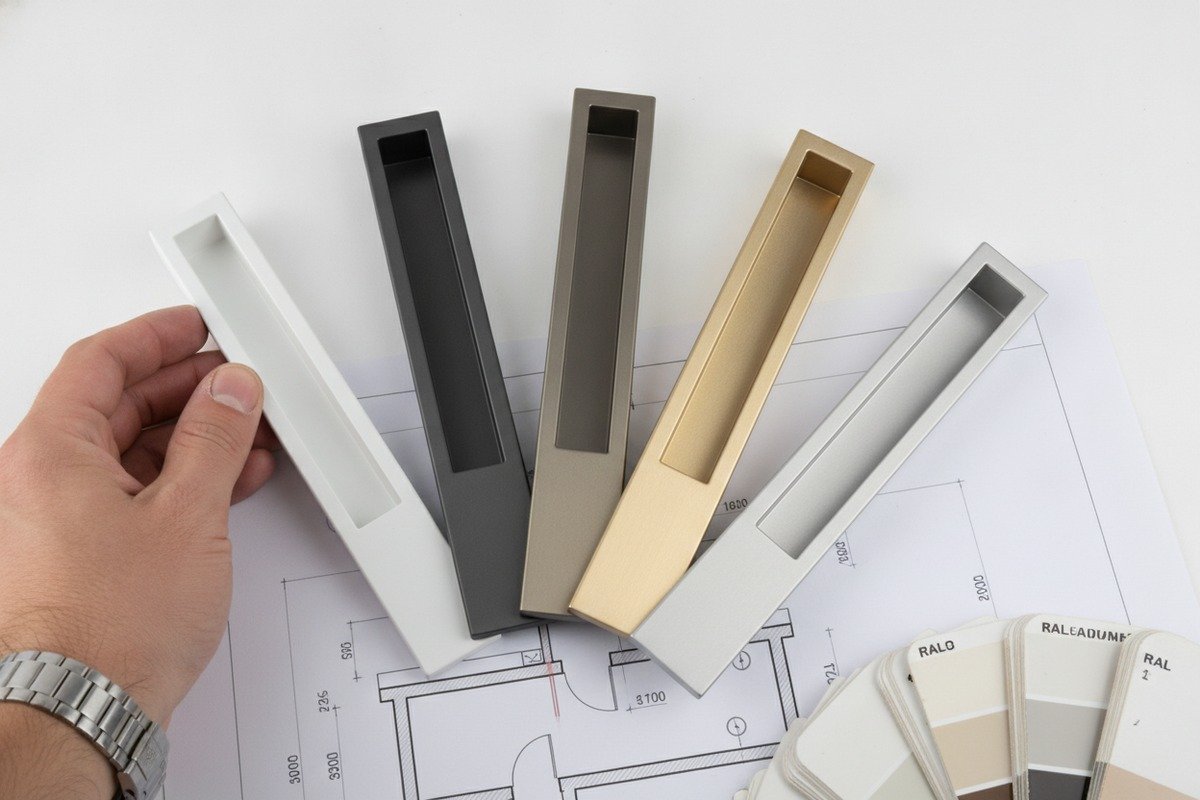
Color mismatch is one of the most common complaints we hear from furniture factories after they place bulk orders CAD files 3. A screen image never tells the full story when your client cares about matte texture, reflectivity, or exact shade under showroom lighting.
Ask your supplier for a physical swatch card or finish sample set that includes every available surface treatment. Specify the color standard you need, such as RAL or Pantone codes, and request that swatches be sent on the actual aluminum alloy used in production so you can verify real-world appearance.
Why Screen Colors Are Not Enough
When we ship our recessed cabinet handles in champagne gold, charcoal grey, or matte black, the anodized finish 4 looks different depending on the lighting. A photo on a laptop screen can shift warm tones cool, or make a brushed texture look completely smooth. If your client approves a color based on a digital image alone, you risk a dispute when the bulk shipment arrives minimum order quantities 5.
Physical swatches solve this. They let your client hold the actual finish, see it under their own lighting, and compare it against their furniture panels or cabinet boards.
What to Include in Your Swatch Request
Here is a checklist for your first email to the supplier:
- State the product type: furniture handles, cabinet pulls, wardrobe handles, or kitchen pulls lead times 6.
- List the finishes you want to see: anodized, powder-coated 7, brushed, polished, or painted.
- Mention specific colors: champagne gold, matte black, light beige, white, charcoal grey.
- Ask if they can match a RAL or Pantone code your client has provided.
- Ask whether the swatch is made from the same 6000 series aluminum alloy 8 used in production.
- Request that swatches are labeled with finish name and code for easy reordering.
Sample Email You Can Copy
Subject: Request for Physical Color Swatch Set — Aluminum Furniture Handles
Hi [Supplier Name],
We are sourcing aluminum recessed furniture handles for our furniture factory clients. Could you please send us a physical color swatch set that includes all available finishes (anodized, powder-coated, brushed)?
We need swatches on actual aluminum material, not printed cards. If possible, please include champagne gold, matte black, charcoal grey, white, and light beige.
Our client may also need a custom RAL color match. Can you confirm if this is possible?
Please advise on swatch shipping cost and delivery time to [your country].
Thank you,
[Your Name]
Swatch Types Compared
| Swatch Type | Best For | Limitation |
|---|---|---|
| Printed color card | Quick first look at color range | Does not show texture or reflectivity |
| Metal swatch stick | Verifying actual finish on aluminum | May not show full handle shape |
| Actual handle sample | Final client approval | Higher cost and longer lead time |
Always ask for metal swatch sticks at minimum. Printed cards are useful for narrowing options, but they cannot replace the real thing when your client's decision depends on touch and appearance.
How to Avoid Color Mismatch Between Swatch and Bulk Order
Ask the supplier if they use a spectrophotometer 9 or other color measurement tool to ensure batch-to-batch consistency. Also ask for salt spray test results or abrasion resistance data. These details matter when your client sells premium furniture and expects the handles to look the same across hundreds of units.
In our experience shipping to Vietnam and the Middle East, we always recommend that buyers approve a pre-production sample after the swatch stage. The swatch confirms the color direction. The pre-production sample confirms the color on the actual handle profile, with the correct dimensions and edge finish.
What questions should I ask to get a digital catalog that highlights OEM customization for my buyers?
When our team prepares digital catalogs, we notice that most buyers never ask about customization details. They download the standard PDF and assume that is all we offer. The truth is, a generic catalog only scratches the surface.
Ask the supplier for a digital catalog that includes OEM customization options such as custom lengths, finishes, logo engraving, and packaging. Specifically request product sheets with dimensions, alloy specifications, minimum order quantities for custom runs, and lead times so your buyers can see the full scope of what is possible.
The Difference Between a Standard Catalog and an OEM Catalog
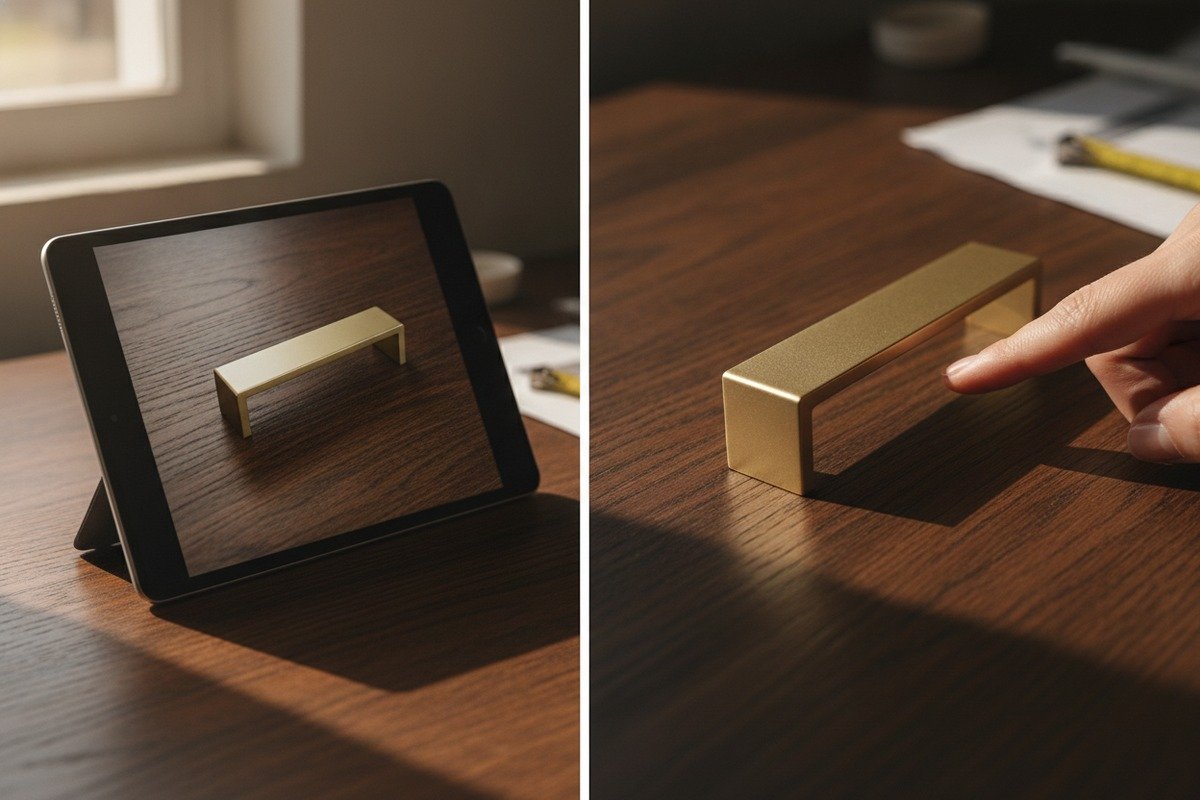
A standard catalog shows the supplier's existing product line: models, sizes, and stock finishes. An OEM catalog goes further. It shows what the supplier can change for you: custom colors, modified dimensions, private labeling, and special packaging.
Most Chinese aluminum handle manufacturers can do both, but they will only send the OEM-focused version if you ask for it. Here is what to request:
Key Questions for Your Supplier
- Can you send a catalog that shows which handle models are available for OEM customization?
- What dimensions can be modified? Can you adjust handle length, depth, or cross-section?
- What surface treatments are available beyond your standard lineup?
- Can you engrave or print our client's logo on the handles?
- What is the MOQ for a custom color or custom size run?
- Can you provide 3D renders 10 or CAD files for custom designs before production?
- Do you offer custom packaging with our client's branding?
- What is the lead time for a custom order versus a stock order?
What a Good OEM Catalog Should Include
| Catalog Element | Why It Matters |
|---|---|
| Product photos with dimensions | Buyers need exact sizes for furniture panel cutouts |
| Material specification (e.g., 6063-T5 aluminum) | Confirms strength, corrosion resistance, and weight |
| Available surface treatments | Lets buyers see full customization range |
| MOQ per model and per custom finish | Helps buyers plan order volumes |
| Lead time for stock vs. custom | Critical for production scheduling |
| Packaging options | Important for branded resale |
| Contact info and communication channels | WhatsApp, WeChat, or email for quick follow-up |
How to Evaluate the Catalog You Receive
When the catalog arrives, check for these signals of a truly custom-capable supplier:
- Multiple finish examples per model. If a handle is shown in five or more colors, the supplier likely has flexible finishing lines.
- Dimensional options. Handles offered in 64mm, 96mm, 128mm, 160mm, and custom center-to-center distances show production versatility.
- Application photos. Images of handles installed on wardrobes, kitchen cabinets, and bathroom vanities suggest the supplier understands furniture-specific requirements.
- Technical data sheets. Alloy grade, hardness, weight per unit, and surface treatment specs indicate engineering depth.
If the catalog is just a list of photos with model numbers and no technical detail, push back. Ask for a version that includes material data and customization parameters. Suppliers who invest in detailed catalogs are usually more reliable partners for OEM work.
At our facility in Foshan, we maintain both a quick-reference PDF and a detailed OEM specification document. The quick PDF helps buyers browse. The OEM document helps procurement managers write accurate purchase orders. Ask for both.
How can I request a sample kit of aluminum handles to be delivered quickly for my factory's production?
Speed matters when a furniture factory is waiting on handle samples to finalize a production run. We have seen buyers lose orders because samples took three weeks instead of three days. The key is to communicate urgency and provide complete information from the start.
To get a fast sample kit, send the supplier a detailed request that includes exact model numbers, finishes, quantities, your shipping address, and your deadline. Ask if stock samples can ship within 24–48 hours, confirm courier options, and offer to pay sample and shipping fees upfront to eliminate delays.

Step-by-Step Process for a Fast Sample Request
Step 1: Pick your models from the catalog. Reference exact model numbers, dimensions, and finishes. Do not say "send me some handles." Say "I need model X in 128mm, champagne gold anodized, quantity 2 pieces."
Step 2: State your deadline clearly. Write: "We need samples to arrive by [date] for our client presentation on [date]." This gives the supplier a target.
Step 3: Confirm shipping method. Ask if they use DHL, FedEx, or UPS. For Southeast Asian markets, ask about regional couriers that may be faster and cheaper.
Step 4: Offer to pay upfront. Many suppliers will prioritize paid sample orders over free sample requests. A quick PayPal or bank transfer removes friction.
Step 5: Ask for a tracking number. Once shipped, the supplier should send tracking within 24 hours.
Sample Request Template
Subject: Urgent Sample Kit Request — Aluminum Recessed Handles
Hi [Supplier Name],
We need a sample kit for our factory's upcoming production run. Please send the following:
- Model A, 128mm, matte black anodized — 2 pcs
- Model B, 160mm, champagne gold anodized — 2 pcs
- Model C, 96mm, charcoal grey powder-coated — 2 pcs
Deadline: Samples must arrive at [address] by [date].
Please confirm sample cost, shipping cost, and courier. We can pay immediately via PayPal.
Thank you,
[Your Name]
What Affects Sample Delivery Speed
| Factor | Fast Outcome | Slow Outcome |
|---|---|---|
| Handle is in stock | Ships in 24–48 hours | — |
| Handle requires custom finish | — | 3–7 days production time |
| Buyer pays upfront | Supplier prioritizes order | Supplier may delay |
| Buyer provides complete specs | No back-and-forth needed | Days lost to clarification |
| Shipping method | Express courier (2–4 days) | Sea freight (weeks) |
Stock Samples vs. Custom Samples
If your factory needs samples fast, always ask first: "Are these models available from your current inventory?" Suppliers with ready stock, like our 300-ton inventory in Foshan, can dispatch samples the same day the order is confirmed. Custom-finish samples take longer because the surface treatment must be applied to order.
For a quick client presentation, start with stock finish samples. If the client approves the design but wants a different color, then order the custom-finish sample as a second step. This two-stage approach saves you days.
Also ask the supplier about sample kits they may already have prepared. Some manufacturers keep pre-made sample boxes with their top-selling handles in all standard finishes. These kits ship faster because they are already packed and labeled.
What is the best way to ask if the catalog items are in stock for my 48-hour shipping needs?
Furniture factory owners and distributors often work on tight timelines. When a client confirms an order, you may need handles shipped within 48 hours. But many buyers assume every catalog item is in stock, then discover a two-week wait after placing the order.
Ask the supplier directly which catalog items are currently in stock and ready to ship within 48 hours. Request a real-time stock list with model numbers, available finishes, quantities on hand, and the maximum order size they can fulfill immediately without entering a production queue.

Why You Need a Stock List, Not Just a Catalog
A catalog shows everything the supplier can make. A stock list shows what they have right now. These are two very different things. If your business depends on fast turnaround, you must distinguish between the two early in your supplier relationship.
At our Foshan warehouse, we maintain around 300 tons of ready-to-ship inventory across our most popular handle profiles and finishes. But not every supplier operates this way. Some produce strictly to order. Asking the right questions up front prevents nasty surprises.
Questions to Ask About Stock Availability
- Which handle models from your catalog are currently in stock?
- What finishes are available for immediate shipment?
- What is the maximum quantity you can ship within 48 hours?
- How often do you update your stock list?
- Can I receive a weekly or monthly stock update by email or WhatsApp?
- If an item is out of stock, what is the restocking lead time?
- Do you keep safety stock for repeat customers?
How to Structure Your Inquiry for Speed
When writing to the supplier, organize your request so they can answer quickly:
Subject: Stock Availability Check — Aluminum Furniture Handles
Hi [Supplier Name],
We have clients who need handles shipped within 48 hours of order confirmation. Could you please confirm:
- Which of the following models are in stock right now?
- Model A, 128mm, matte black
- Model B, 160mm, champagne gold
- Model C, 96mm, white
- How many pieces of each are available?
- Can you ship via DHL/FedEx within 48 hours?
We plan to place orders regularly, so a standing stock arrangement would be very helpful.
Thank you,
[Your Name]
Building a Long-Term Stock Arrangement
If you order the same handles repeatedly, ask the supplier about a stock-holding agreement. This means they keep a set quantity reserved for you at all times. When you place an order, it ships the same day.
Here is what a stock arrangement discussion should cover:
- Minimum commitment volume per quarter
- Which models and finishes to hold
- Payment terms for reserved stock
- Notification process when stock runs low
- Priority shipping for reserved inventory
Red Flags That a Supplier Cannot Meet 48-Hour Shipping
Watch for these warning signs:
- The supplier avoids confirming specific quantities in stock.
- Every inquiry response says "we need to check with the warehouse."
- Lead time estimates keep changing.
- They have no warehouse photos or inventory management system.
- They require full custom production for standard catalog items.
A reliable supplier will give you clear, specific answers about stock levels. If they cannot tell you how many matte black 128mm handles they have on hand today, they probably cannot ship in 48 hours.
Our approach is simple: we update stock lists regularly and share them with repeat buyers via WhatsApp. When a distributor in Vietnam or a factory in the Middle East needs handles fast, they check the list, confirm the order, and we ship the same day. This transparency builds trust and repeat business.
Conclusion
Getting the right catalogs, swatches, and samples from your aluminum handle supplier starts with asking specific, detailed questions. Be clear about finishes, alloys, deadlines, and stock needs. The more precise your request, the faster and more useful the supplier's response will be.
Footnotes
1. Official website for RAL Colors, an internationally recognized standard for color matching. ↩︎
2. Defines Original Equipment Manufacturer and its role. ↩︎
3. Defines CAD files and their use in design. ↩︎
4. Explains the anodizing process and its benefits. ↩︎
5. Defines minimum order quantity and its importance. ↩︎
6. Defines lead time in manufacturing and supply chain. ↩︎
7. Explains the powder coating process and its benefits. ↩︎
8. Provides a comprehensive overview of aluminum alloys. ↩︎
9. Explains how spectrophotometers are used for accurate color measurement and quality control in various industries. ↩︎
10. Explains 3D rendering as converting models to images. ↩︎