
Every week on our production floor in Foshan, we process dozens of custom aluminum handle orders simultaneously—and the difference between smooth fulfillment and costly confusion almost always comes down to information flow.
To evaluate a supplier’s digital management level, assess whether their systems provide real-time order tracking, transparent quality documentation, version-controlled specifications, and consistent communication across sales, production, and logistics teams. Strong digital maturity reduces sourcing risk, prevents specification errors, and gives buyers decision confidence throughout the entire order cycle.
This article breaks down what digital management actually means in aluminum furniture handle sourcing, what to look for, and what red flags to avoid real-time order tracking 1. Let’s walk through each critical area step by step.
How can I use a supplier's digital tracking system to monitor my aluminum handle production status in real-time?
When we first built our internal tracking system, the goal was simple: stop buyers from having to ask "where is my order?" over and over again on WhatsApp.
A supplier's digital tracking system should let you monitor production milestones—extrusion, machining, anodizing or finishing, quality inspection, and packaging—through a portal, shared dashboard, or structured status updates sent at each stage, so you always know where your aluminum handles are in the pipeline.

Why Real-Time Tracking Matters for Aluminum Handles
Aluminum furniture handles are not generic commodities transparent quality documentation 2. They are precision-extruded profiles with tight dimensional tolerances 3, specific surface finishes like matte champagne gold or charcoal grey anodizing, and exact cross-sectional geometries. A recessed cabinet handle with a deep geometric channel for finger grip, for example, requires careful extrusion die control and consistent finishing across every piece in a batch version-controlled specifications 4.
If you cannot see where your order stands, you cannot catch problems early. A delay at the anodizing stage might push your entire shipment back by two weeks salt spray test records 5. A mismatch in profile dimensions discovered only at shipping means rework and lost time.
What Each Tracking Milestone Should Tell You
Here is what a well-structured digital tracking system should report at each stage:
| Production Milestone | What the System Should Show | Why It Matters to You |
|---|---|---|
| Order Confirmation | Confirmed specs, quantities, finish, delivery date | Prevents transcription errors before production starts |
| Extrusion | Start date, estimated completion, die status | Lets you know if raw profile production is on schedule |
| CNC Machining | Drilling, cutting, and hole patterns confirmed | Ensures installation fit before finishing begins |
| Surface Finishing | Anodizing or powder coating batch ID, color match status | Protects against visible finish inconsistencies |
| Quality Inspection | Pass/fail status, dimensional check results | Confirms product meets your specifications |
| Packaging | Packing method, carton count, gross weight | Helps you coordinate warehouse receiving |
| Shipping | Tracking number, carrier, estimated arrival | Enables downstream planning for your own customers |
What "Real-Time" Actually Means in Practice
Let me be honest: "real-time" does not always mean a live dashboard updating every second. For most aluminum handle suppliers, including us, real-time means structured updates at each milestone, sent within hours of completion. Some suppliers use ERP systems 6 that generate automatic notifications. Others use shared spreadsheets or cloud-based project boards.
The key question is not which software a supplier uses. The key question is whether you can see progress without having to chase it. If you find yourself sending three WhatsApp messages just to learn whether extrusion has started, that supplier's digital tracking is not working for you.
Asking the Right Questions During Supplier Evaluation
Before placing your first order, ask these questions:
- Can you show me a sample order status report?
- How often will I receive updates during production?
- Do you use any system to track work-in-progress internally?
- If a delay happens, how quickly will I be notified?
The answers will tell you more about a supplier's digital maturity than any marketing claim on their website.
What specific digital tools should I look for to ensure transparency in my custom furniture handle quality reports?
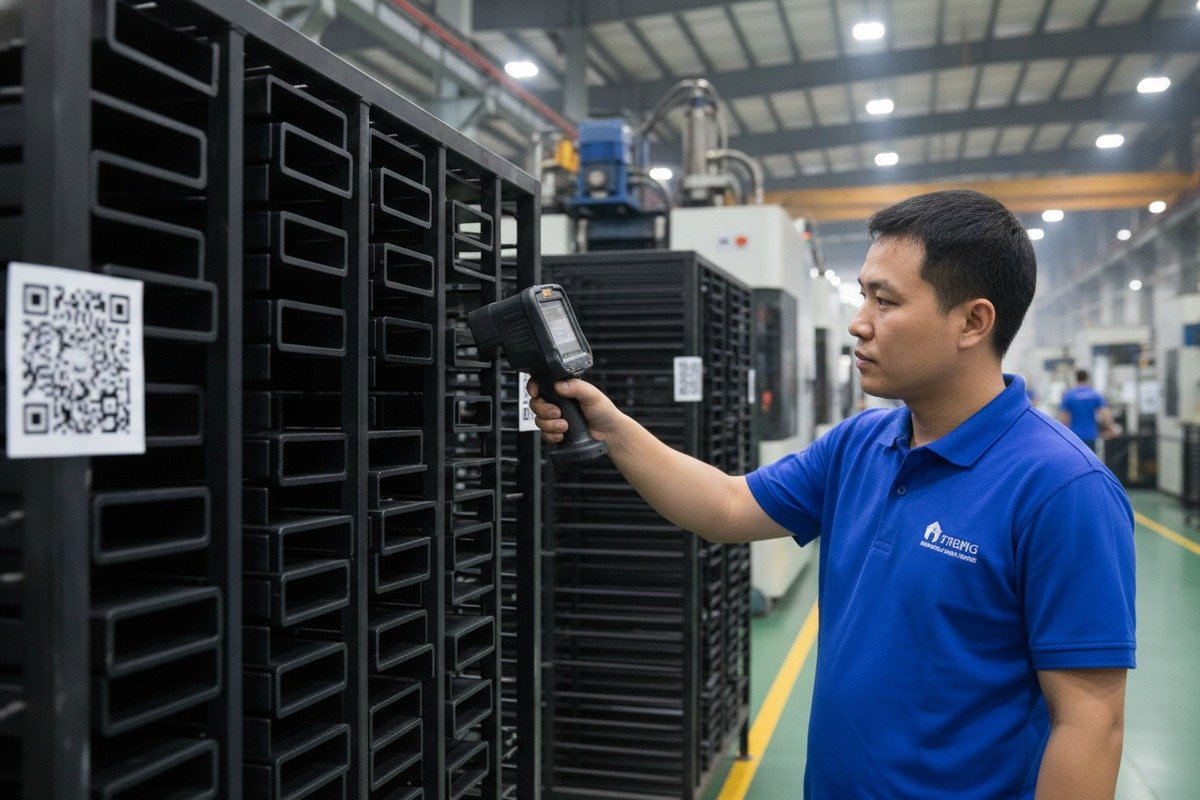
On our production line, we inspect every batch of aluminum handles for dimensional accuracy, surface finish uniformity, and anodizing thickness—but those results are only useful if you, the buyer, can actually access and verify them.
Look for suppliers who provide digitally generated inspection reports with batch-traceable data, including dimensional measurements, surface finish test results, salt spray test records, and photographic evidence—all stored in retrievable digital formats rather than handwritten notes or verbal confirmations.
The Problem with Manual Quality Reporting
Many aluminum handle suppliers still rely on paper-based inspection forms or informal quality checks. The issue is not that paper inspections are inherently bad. The issue is that they are hard to share, easy to lose, and nearly impossible to audit months later when a customer raises a complaint about a batch delivered six months ago.
When quality records are digital, you gain three things: traceability, comparability, and accountability. You can trace a specific handle back to its production batch. You can compare quality data across multiple orders. And you can hold the supplier accountable to documented standards.
Key Digital Quality Tools to Look For
| Digital Tool or Feature | What It Does | Buyer Benefit |
|---|---|---|
| Digital inspection forms | Records dimensional checks, finish readings, and defect counts electronically | Eliminates handwriting errors, enables instant sharing |
| Photo and video documentation | Captures surface finish, packaging, and labeling at inspection | Provides visual proof before shipment |
| Salt spray and impact test logs | Records test parameters, duration, and results digitally | Confirms compliance with durability standards |
| Batch/lot identification system | Assigns unique IDs to each production run | Enables trace-back if a defect appears later |
| Cloud-based document sharing | Stores reports, certificates, and drawings in accessible format | Lets you retrieve records anytime without chasing the supplier |
| Version-controlled drawings | Tracks changes to handle profiles, dimensions, and finishes | Prevents production based on outdated specifications |
Why This Matters for Aluminum Handles Specifically
Consider the product context: a collection of modern, minimalist recessed cabinet handles in matte finishes—white, charcoal grey, black, champagne gold, and light beige. These handles have sharp, clean edges and a low-profile L-shaped cross-section. The precision-engineered extruded aluminum profile features a sophisticated champagne gold anodized finish with a smooth, matte texture.
Now imagine ordering 5,000 pieces of this handle for a hotel furniture project. If even 2% have a visible color variation in the anodized finish, that means 100 handles that do not match. In a high-visibility application like cabinetry or architectural trim, that mismatch is unacceptable.
Digital quality tools make these issues detectable and documented before the shipment leaves the factory. Without digital records, you are relying on trust alone.
What "Transparency" Really Means
Transparency is not just receiving a PDF report after the fact. True transparency means:
- You can request records for any specific batch at any time.
- Inspection data includes actual measured values, not just "pass" or "fail."
- You can see deviation reasons if something fell outside tolerance.
- Change logs show if the supplier modified a drawing or specification during production.
We have found that buyers who receive detailed, digitally formatted quality reports are far more confident placing repeat orders. The data builds trust over time.
How does a supplier's digital management level affect the lead times for my wholesale aluminum profile orders?
One of the most common frustrations we hear from furniture factory owners and distributors is unpredictable lead times—orders that were promised in 15 days but arrive in 25.
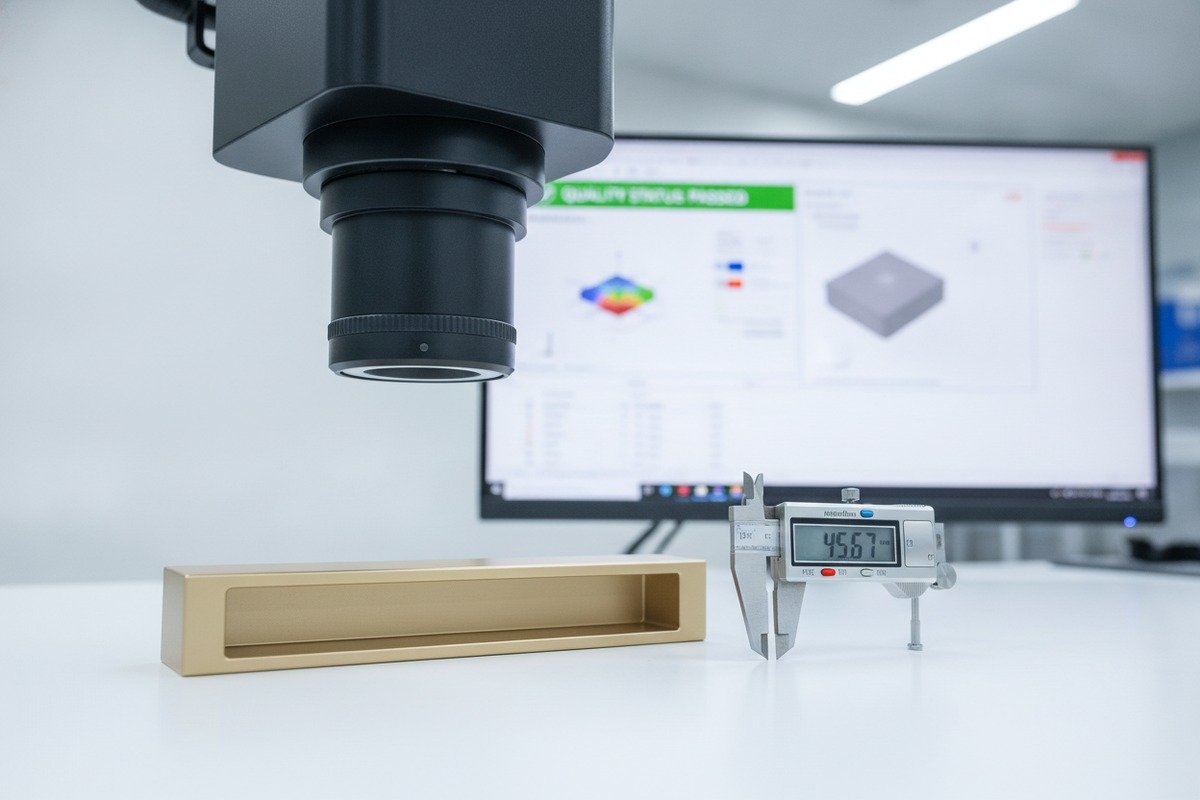
A supplier with strong digital management can reduce lead times by eliminating manual bottlenecks in order entry, production scheduling, and shipping coordination. Digital systems enable faster spec confirmation, more accurate scheduling, and earlier detection of delays, which typically shortens overall turnaround by 15–30% compared to fully manual workflows.
Where Lead Time Gets Lost
Lead time is not just factory production time. It includes everything from the moment you send an inquiry to the moment your handles arrive at your warehouse. Here is where delays typically hide:
- Slow quotation because specs are confirmed by back-and-forth emails instead of structured forms.
- Order entry errors that require correction and re-confirmation.
- Production scheduling conflicts that nobody noticed until a machine was unavailable.
- Finishing delays because the anodizing line was already committed to another batch.
- Shipping document preparation that takes days instead of hours.
Each of these steps can be shortened or eliminated with digital tools.
How Digital Systems Compress Each Stage
| Order Stage | Without Digital Management | With Digital Management | Time Saved |
|---|---|---|---|
| Quotation and spec confirmation | 3–5 days of email exchanges | 1–2 days via structured digital forms | 1–3 days |
| Order entry and BOM creation | Manual entry, error-prone | Auto-populated from confirmed quote | 0.5–1 day |
| Production scheduling | Planner checks manually, conflicts discovered late | System flags conflicts, optimizes sequence | 1–2 days |
| Surface finishing queue | First-come-first-served, no visibility | Scheduled with production, buyer notified of slot | 1–3 days |
| Shipping document prep | Manual paperwork, slow invoice generation | Auto-generated from order data | 0.5–1 day |
In total, digital management can realistically save 4–10 days on a typical wholesale order. For our standard stock items, we already ship within 48 hours because our inventory and logistics systems are digitally coordinated. For custom orders, we maintain a 3–7 day turnaround, which would be impossible without digital scheduling.
The Connection Between Inventory Visibility and Lead Time
A digitally managed warehouse knows exactly what is in stock, what is committed to existing orders, and what needs to be produced. This matters for aluminum furniture handles because many buyers want a mix of stock items and custom pieces. If the supplier cannot tell you quickly what is available versus what needs production, your lead time estimate is unreliable.
With 300 tons of ready-to-ship inventory in our Foshan warehouse, our system can instantly confirm availability for standard profiles and finishes. That speeds up the quoting process and eliminates unnecessary production runs for items already on the shelf.
Predictability Is as Valuable as Speed
Even if a supplier cannot promise the fastest lead time, digital management gives you predictability. You know when to expect each milestone. You can plan your own production or distribution schedule around reliable dates. And when disruptions happen—raw material shortages, equipment maintenance, shipping delays—a digitally managed supplier can communicate the impact earlier and more clearly.
In the global furniture handles market 8, now valued at approximately USD 8.4 billion and projected to reach USD 12.7 billion by 2033, competition among distributors and manufacturers is intense. Predictable lead times are a competitive advantage for your business, and your supplier's digital maturity directly enables that advantage.
Can a digitally integrated supply chain help me reduce communication errors during my OEM handle development process?
OEM development 9 is where communication errors hurt the most. Our engineering team has seen cases where a single misunderstood dimension on an aluminum handle profile led to an entire batch of unusable product—because the spec change was buried in a long email thread nobody re-read.
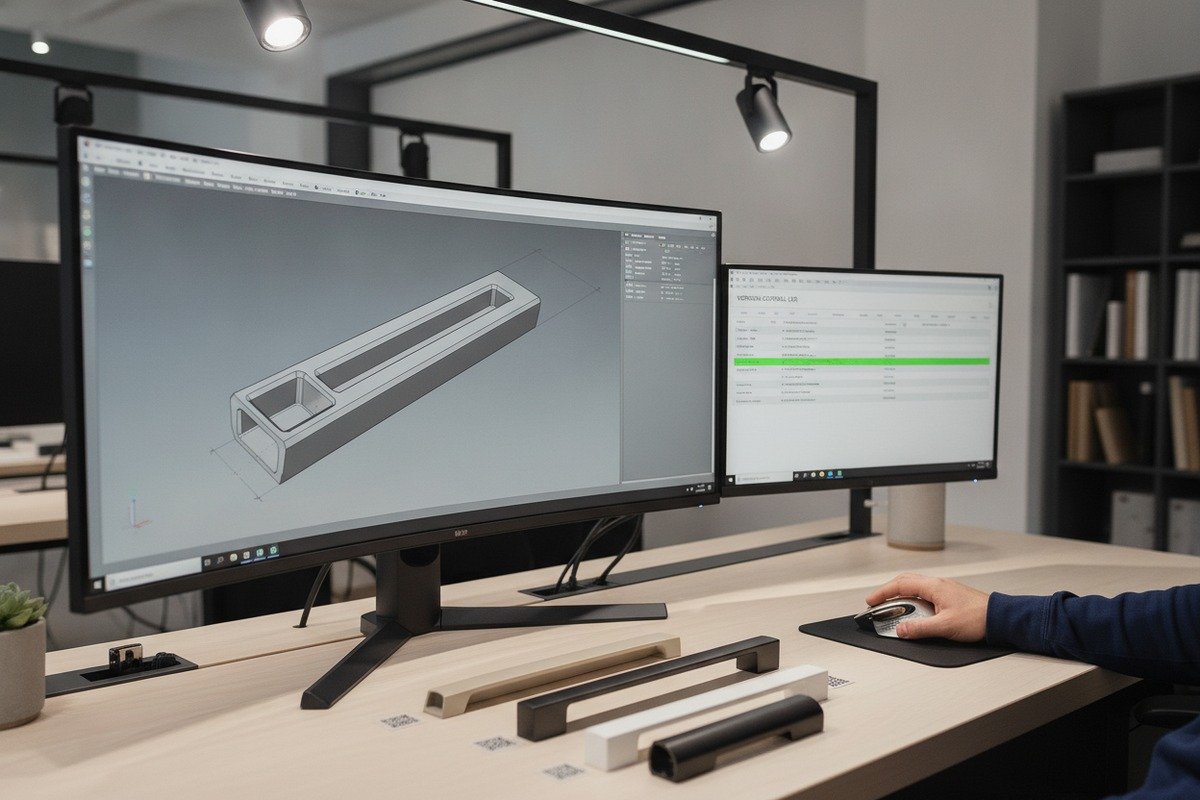
Yes, a digitally integrated supply chain significantly reduces communication errors during OEM handle development by centralizing specifications, drawings, and revision histories in a single controlled system. This eliminates version confusion, ensures all teams reference the same approved data, and creates an auditable trail for every design change.
Why OEM Handle Development Is Error-Prone
Custom aluminum furniture handles involve multiple variables: profile geometry, channel depth, mounting hole placement, surface finish type, color code, edge treatment, length options, and packaging requirements. During OEM development, these variables are discussed, revised, and finalized through multiple rounds of communication.
Without a digital system to manage this, here is what typically goes wrong:
- The sales team confirms one version of the drawing, but the production team works from an older version.
- A finish color is described verbally ("something like champagne gold") and interpreted differently by different people.
- Dimensional tolerances are agreed upon in one email but not carried over to the final production order.
- Packaging instructions are mentioned in a phone call but never documented.
Each of these errors causes delays, rework, or outright rejection of finished product.
How Digital Integration Prevents These Errors
A digitally integrated supply chain 10 connects the buyer, sales team, engineering team, production floor, quality department, and logistics team through shared data. Here is how each connection reduces errors:
Version Control for Drawings and Specs
Every revision of a handle profile drawing should be saved with a version number, date, and change description. When production starts, the system should lock the approved version so nobody can accidentally use an outdated file. This is especially critical for handles with precise geometries like the low-profile L-shaped cross-section seen in modern recessed pulls.
Centralized Communication Logs
Instead of scattered WhatsApp messages, emails, and phone call notes, a digital system keeps all communication about a specific order or development project in one place. If a dispute arises about whether a change was approved, the log provides clear evidence.
Automated Spec Transfer
When an OEM order moves from development to production, the approved specifications should transfer automatically into the production order. Manual re-entry is where transcription errors happen. Digital transfer eliminates that risk.
Common Communication Errors and Their Digital Solutions
| Communication Error | Root Cause | Digital Solution |
|---|---|---|
| Wrong profile dimensions in production | Outdated drawing used | Version-controlled drawing system with locked approvals |
| Incorrect finish applied | Verbal color description misinterpreted | Digital color code library with visual references |
| Missing mounting holes | Spec detail lost in email thread | Centralized spec sheet linked to production order |
| Wrong quantity produced | Manual order entry mistake | Auto-populated production order from confirmed quote |
| Packaging mismatch | Instructions given by phone, not recorded | Digital packaging spec attached to order record |
The Bigger Picture: Consistency Across Repeat Orders
OEM development is not a one-time event. Once a handle design is finalized, it often becomes a repeat order item. Digital systems ensure that every future order references the exact same approved specifications. Without this, subtle variations can creep in—a slightly different anodizing thickness, a marginally shifted hole pattern—that create consistency problems across large furniture projects.
In our experience shipping to Vietnam and the Middle East, repeat order consistency is one of the top concerns for building material distributors. Their end customers expect every handle to look and feel identical. Digital spec management is the most reliable way to deliver that consistency.
What to Ask Your Supplier About OEM Communication
- How do you manage drawing revisions during development?
- Where are approved specifications stored?
- How does the production team receive the final confirmed order details?
- Can I see a change log if I request one?
- What happens if I request a modification after production has started?
If the supplier cannot answer these questions clearly, their digital integration may not be strong enough to support complex OEM development without errors.
Conclusion
A supplier's digital management level is not just an IT feature—it is a practical sourcing criterion that directly affects your order visibility, quality confidence, lead time reliability, and communication accuracy when buying aluminum furniture handles.
Footnotes
1. Explains the importance and benefits of real-time tracking in supply chain management. ↩︎
2. Details the role and types of quality documentation in manufacturing for transparency. ↩︎
3. This URL from Xometry provides detailed information on manufacturing standards and general tolerances, which is highly relevant to dimensional tolerances. ↩︎
4. Explains version control in engineering, its benefits, and how it prevents errors. ↩︎
5. Provides information on the ASTM B117 standard for salt spray corrosion testing. ↩︎
6. Defines ERP systems and their benefits for manufacturing operations and efficiency. ↩︎
7. Outlines key stages and milestones in the manufacturing process for effective tracking. ↩︎
8. This URL provides an overview of the furniture hardware market size and forecast, offering relevant market insights without being a restricted market report. ↩︎
9. Guides through the product development lifecycle for Original Equipment Manufacturers (OEMs). ↩︎
10. Explores the benefits and components of a digital supply chain for enhanced efficiency. ↩︎