
Every week, our sales team in Foshan fields calls from first-time buyers who feel overwhelmed by the sheer variety of aluminum handles on the market. aluminum furniture handles 1 They see hundreds of shapes, finishes, and sizes — and they freeze. The wrong choice means drilling misaligned holes, mismatched aesthetics, or handles that corrode within months in a humid bathroom. That frustration is entirely avoidable once you know how to read the basic product categories.
Aluminum furniture handles are classified by mounting style, shape, alloy grade, dimensions, surface finish, and intended application. Novice buyers should focus on understanding handle form, center-to-center hole distance, profile thickness, alloy type, and finish durability to make informed sourcing decisions that satisfy end-client expectations.
This guide walks you through the four most common questions we hear from new buyers. Each section breaks down a critical aspect of aluminum handle sourcing so you can speak confidently with any supplier and avoid costly mistakes. Let us start with the finish — the first thing your clients will see and touch.
How Can I Distinguish Between Different Aluminum Handle Surface Treatments to Ensure Long-Term Durability for My Clients?
When we run quality inspections on our production floor, surface finish 2 is the single most returned category. A handle can be the right shape and size, yet still disappoint if the coating peels or fingerprints show within weeks. Knowing the difference between treatments saves you returns and protects your reputation.
The most common aluminum handle surface treatments are anodizing, powder coating, brushing, polishing, and matte finishing. Anodizing and powder coating offer the strongest protection against corrosion and scratching, while brushed and matte finishes balance modern aesthetics with moderate durability for indoor furniture use.
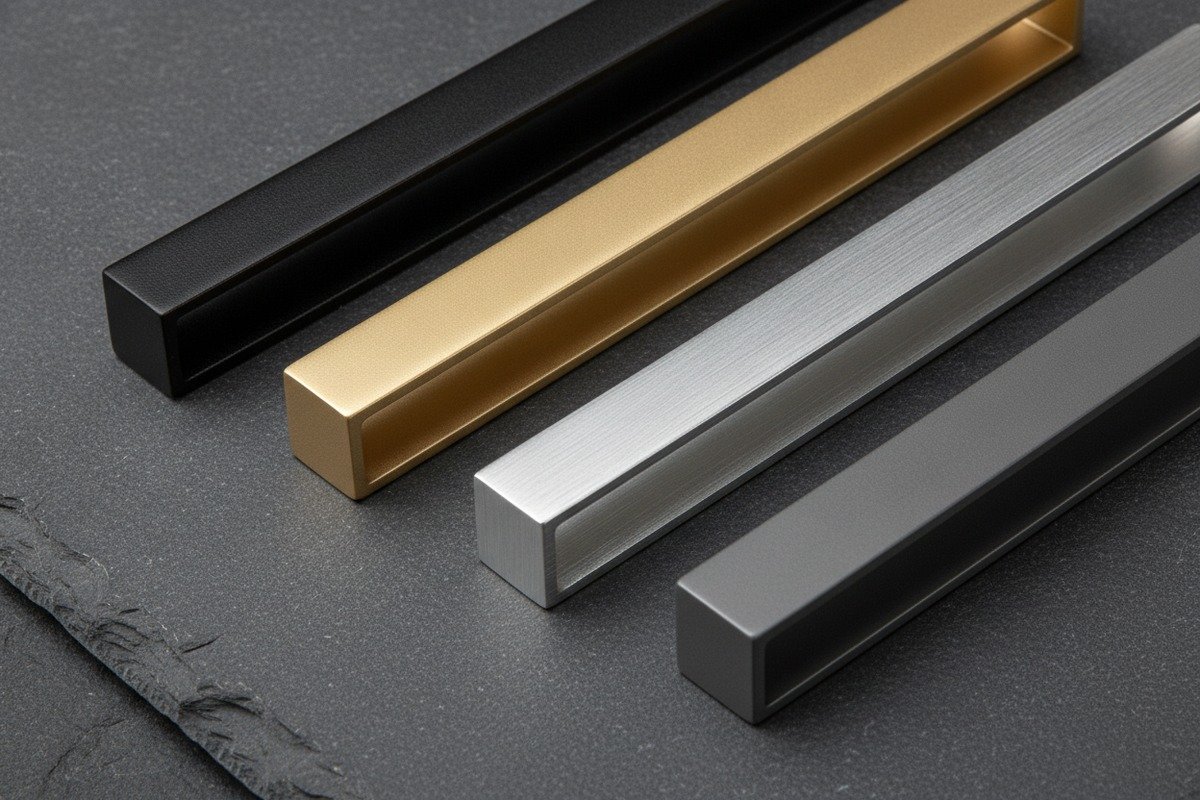
Surface treatment is not just cosmetic. It forms a protective barrier between the raw aluminum and the environment. In kitchens, handles face grease, steam, and cleaning chemicals. In bathrooms, humidity is constant. The wrong finish in the wrong room means visible wear within a year.
Anodized Finish
Anodizing is an electrochemical process 3 that thickens the natural oxide layer on aluminum. The result is a hard, scratch-resistant surface that will not peel or flake. Our champagne gold and light bronze handles, for example, achieve their color through anodizing rather than paint. This means the color is part of the metal itself.
Anodized handles work especially well in mid-to-high-end kitchen and wardrobe projects. They resist fingerprints better than polished surfaces and hold up against mild household cleaners.
Powder Coating
Powder coating 4 sprays dry powder onto the handle and then cures it under heat. It creates a thick, even layer that can be any color. This is the go-to method when your client wants white, charcoal grey, black, or custom RAL colors.
One thing to watch: not all powder coatings are equal. Ask your supplier about the coating thickness. A good furniture handle should have a powder coat layer of 60–80 microns for adequate protection.
Brushed, Polished, and Matte
Brushed finishes use abrasion to create fine parallel lines on the surface. They hide small scratches well and feel smooth to the touch. Polished finishes are mirror-like and eye-catching, but they show fingerprints easily. Matte finishes sit between the two — low-reflection and contemporary.
Surface Treatment Comparison Table
| Treatment | Scratch Resistance | Fingerprint Visibility | Color Options | Best For |
|---|---|---|---|---|
| Anodized | High | Low | Metallic tones (gold, bronze, silver) | Kitchens, wardrobes, high-traffic areas |
| Powder Coated | High | Low to moderate | Any RAL color | Custom color projects, bathrooms |
| Brushed | Moderate | Low | Natural aluminum tones | Modern kitchens, office furniture |
| Polished | Low to moderate | High | Mirror silver, chrome look | Decorative accents, low-touch areas |
| Matte | Moderate | Very low | Neutral tones | Minimalist interiors, contemporary design |
How to Test Finish Quality Before Bulk Orders
Always request samples. At our facility, we encourage buyers to run three simple tests. First, rub the surface firmly with a dry cloth ten times and check for any color transfer. Second, apply a small amount of household cleaner and wipe after five minutes — no discoloration should occur. Third, scratch the back of the sample with a coin. A good anodized or powder-coated surface should resist light coin scratches.
These quick checks take five minutes and can save you from a container of defective product.
What Are the Standard Hole Distance Specifications I Need to Know When Sourcing Aluminum Handles for Custom Cabinetry?
Our engineering team has seen orders go wrong simply because the buyer assumed "standard" meant the same thing everywhere. Hole distance 5 — or center-to-center spacing — is the most critical measurement when sourcing handles for existing or new cabinetry. Get it wrong by even 2 mm, and the handle will not fit.
Standard hole distances for aluminum cabinet handles typically range from 64 mm to 320 mm, with 96 mm, 128 mm, 160 mm, and 192 mm being the most commonly stocked sizes worldwide. Buyers must confirm the exact center-to-center measurement before ordering because there is no universal default, and drilling errors are irreversible.
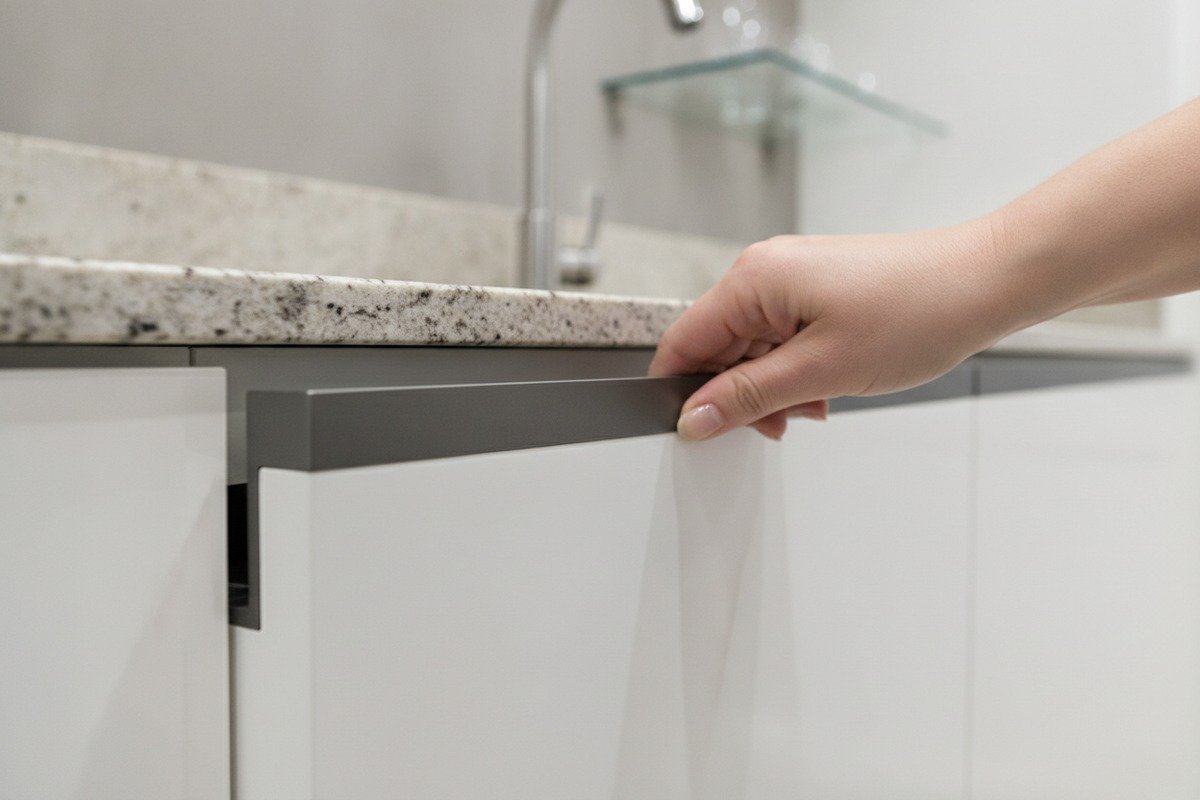
Center-to-center distance (often abbreviated as C/C) is the measurement between the centers of the two screw holes on the handle. This number must match the holes already drilled in the cabinet — or, for new builds, must be specified to the cabinet maker before production begins.
Common Standard Hole Distances
The furniture hardware industry has settled on a set of widely used C/C distances. Here is what you will encounter most often:
| C/C Distance (mm) | Typical Use | Common Handle Type |
|---|---|---|
| 64 mm | Small drawers, compact cabinets | Short bar pulls, knobs with backplate |
| 96 mm | Standard kitchen drawers, bathroom cabinets | Bar handles, T-bar handles |
| 128 mm | Medium kitchen cabinets, wardrobes | Bar handles, recessed pulls |
| 160 mm | Larger drawers, tall cabinets | Long bar handles, edge profiles |
| 192 mm | Wide drawers, kitchen base cabinets | Extended bar handles |
| 256 mm | Large wardrobe doors | Long pulls, architectural handles |
| 320 mm | Oversized doors, commercial cabinetry | Full-length bar handles |
Why Proportions Matter
A 64 mm handle on a 900 mm wide wardrobe door looks out of scale. A 320 mm handle on a small bathroom drawer feels clumsy. The general rule our design team recommends: the handle length should be roughly one-third to one-half the width of the door or drawer front. This creates visual balance.
Measuring Existing Holes
If your client is replacing old handles, the simplest approach is to measure from the center of one screw hole to the center of the other. Use a ruler or caliper. Do not measure from edge to edge of the holes — that gives a smaller number and leads to ordering the wrong size.
Projection, Width, and Thickness
Beyond C/C distance, three other dimensions matter. Projection is how far the handle sticks out from the cabinet face. For recessed handles, projection is zero or negative. For bar handles, it is usually 25–40 mm. Width and height affect grip comfort. And profile wall thickness — typically 1.0 to 2.5 mm in extruded aluminum 6 — determines structural strength.
Tolerances also matter. In our production, we hold tolerances of ±0.1 to ±0.3 mm on extruded profiles. Tighter tolerance means the handle fits cleanly into pre-drilled holes without wobble.
A Quick Pre-Order Checklist
Before confirming any handle order, verify these five numbers: C/C distance, overall length, projection depth, screw diameter, and screw length. If even one is wrong, the installation fails. We always recommend our buyers send us a simple sketch or photo with measurements before we ship.
How Do I Choose Between Solid and Hollow Aluminum Profiles Based on My Project's Budget and Weight Requirements?
When we quote a new handle project, one of the first technical decisions is whether the profile will be solid or hollow. This choice affects the price per piece, the feel in the hand, the weight on the cabinet door, and even how the handle is packaged and shipped. Many novice buyers overlook this completely.
Solid aluminum handles offer greater strength and a premium feel but cost more and weigh more. Hollow extruded profiles are lighter, use less material, reduce shipping costs, and suit most standard furniture applications. The right choice depends on balancing your project's durability needs, aesthetic expectations, and total landed cost.
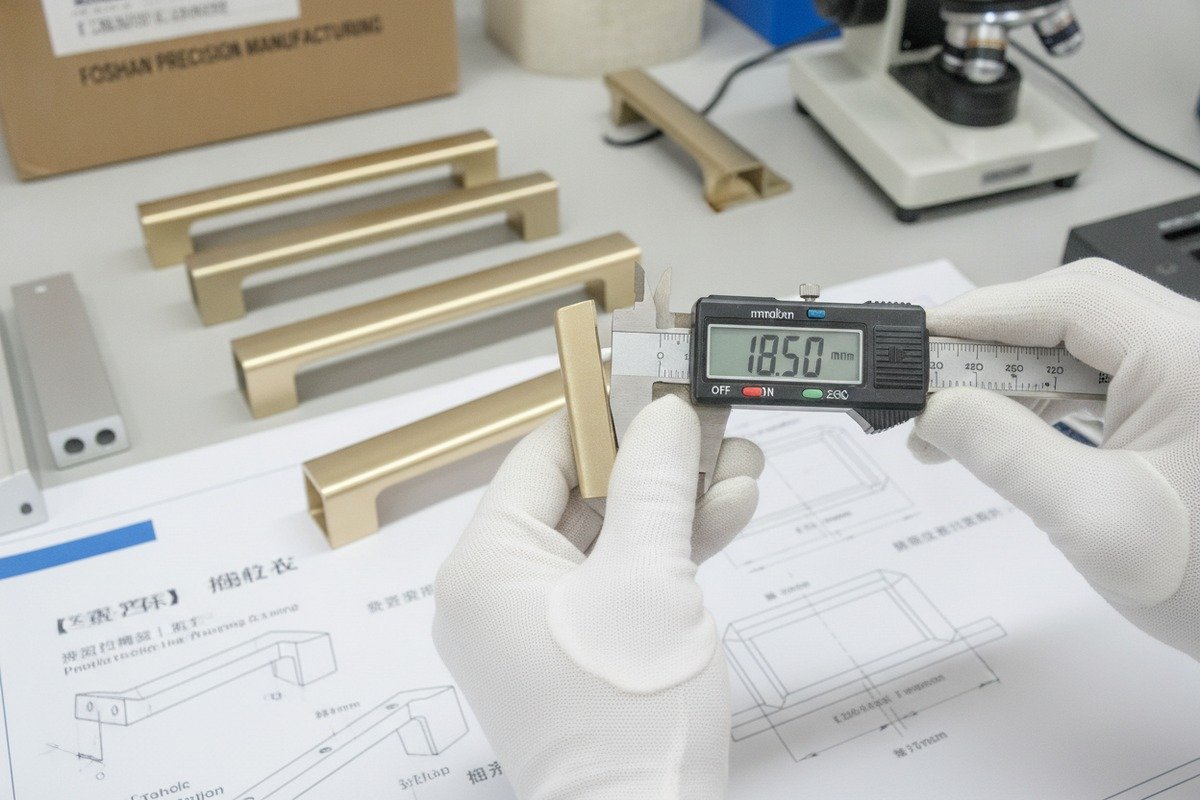
The distinction is simple in concept. A solid handle is a continuous piece of aluminum with no internal cavity. A hollow handle has one or more internal voids, created during the extrusion process. Both can look identical from the outside.
Weight and Material Cost
Hollow profiles use 30% to 60% less aluminum by weight compared to solid profiles of the same outer dimensions. Since aluminum is priced by weight, this translates directly into lower material cost. For a large order — say 5,000 handles — the savings are significant.
From a shipping perspective, lighter handles mean lower freight costs, especially for sea shipments charged by volume-to-weight ratio.
Strength and Rigidity
Solid handles are stronger. That is a fact. But the real question is: does your application need that extra strength? For a standard kitchen drawer opened five to ten times a day, a well-designed hollow profile with 1.5 mm wall thickness is more than adequate. Solid profiles make sense for heavy commercial doors, high-traffic public areas, or oversized handles with long unsupported spans.
Alloy Grade Matters Here Too
The alloy affects this decision. Our most common handle alloy, 6063 7, extrudes beautifully into complex hollow shapes and delivers excellent surface quality for anodizing. For buyers who need more strength in a hollow profile, 6061 offers better mechanical properties 8. And for extreme strength requirements — rare in furniture — 7075 is available but adds cost and limits finishing options.
| Factor | Solid Profile | Hollow Profile |
|---|---|---|
| Weight | Heavier | 30–60% lighter |
| Material cost per piece | Higher | Lower |
| Structural strength | Very high | Adequate for most furniture |
| Suitable alloys | 6061, 6063, 7075 | 6063 (most common), 6061 |
| Wall thickness range | N/A (full solid) | 1.0–2.5 mm typical |
| Best applications | Heavy doors, commercial use, long spans | Kitchen cabinets, drawers, wardrobes |
| Shipping cost impact | Higher freight | Lower freight |
| Premium feel in hand | Heavier = perceived quality | Lighter but can feel "thin" if poorly designed |
The Perception Factor
Here is an honest trade-off our buyers often face. In some markets — particularly the Middle East — end consumers associate heavier handles with premium quality. A hollow handle that is technically perfect may feel "cheap" to a customer used to solid brass or stainless steel hardware. In those cases, we sometimes recommend a thicker-walled hollow profile (2.0–2.5 mm) that splits the difference: lighter than solid, but still has a satisfying heft.
Practical Advice for Budget-Conscious Projects
If your project budget is tight but your client expects decent quality, hollow 6063 profiles with a 1.5 mm wall thickness and an anodized or powder-coated finish deliver the best value. You get corrosion resistance, good looks, comfortable weight, and a price point that keeps your margins healthy.
For premium projects where the client specifically requests a heavier, more substantial handle, solid 6061 or thick-walled 6063 is the way to go. Always ask your supplier for both options with pricing so you can present choices to your client.
What Should I Look for in a Supplier's Customization Capabilities to Ensure My Unique Handle Designs Are Feasible?
Over our 18 years in Foshan, we have learned that the gap between a buyer's design idea and a manufacturable product is where most projects stall. A beautiful sketch does not always translate into an extrudable profile. Knowing what to ask your supplier upfront prevents weeks of back-and-forth and prototype failures.
When evaluating a supplier's customization capabilities, focus on five areas: their ability to create custom extrusion dies, their range of available surface finishes, minimum order quantities for custom runs, turnaround time from design to sample, and whether they offer OEM/ODM engineering support to refine your design for manufacturability.
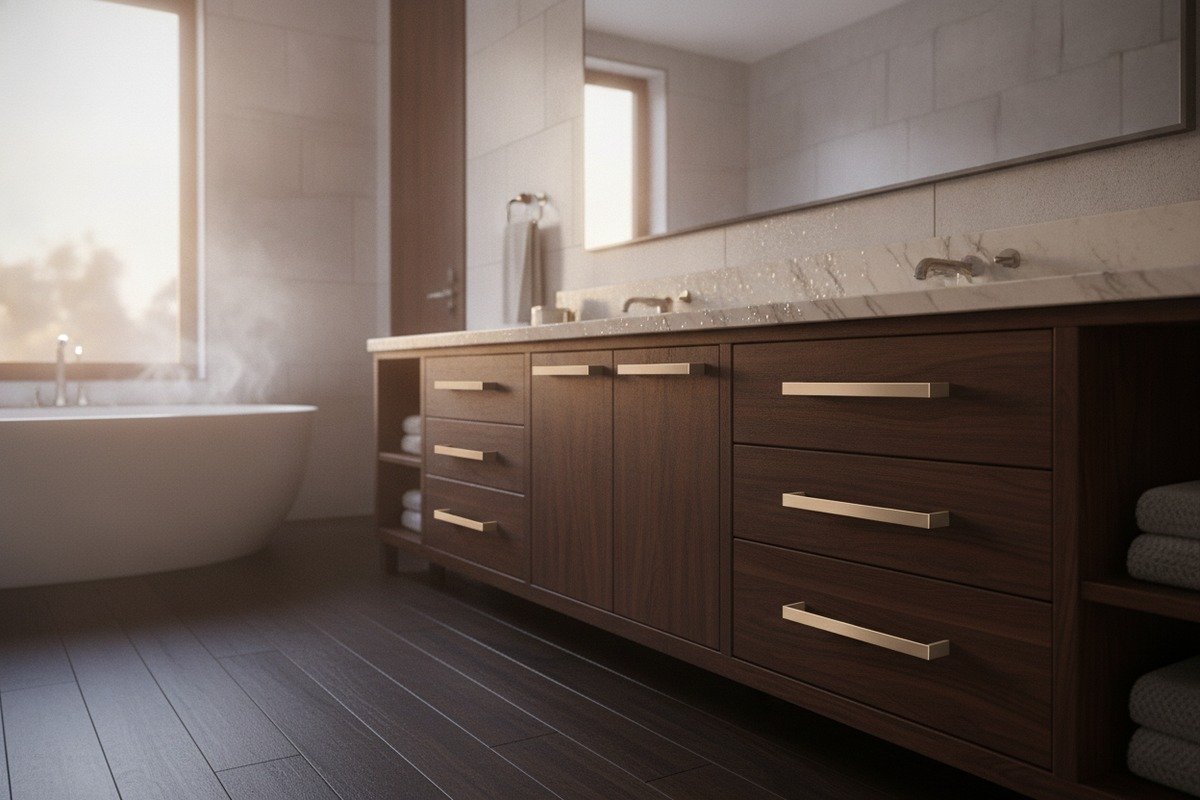
Customization in aluminum handles covers a wide spectrum. At the simplest end, it means cutting a standard profile to a non-standard length. At the complex end, it means designing a brand-new cross-section shape, developing a custom die, selecting a specific alloy, and applying a unique finish combination. Understanding where your project falls on this spectrum helps you choose the right supplier.
Custom Extrusion Dies
Every unique handle profile starts with a die — a steel tool through which heated aluminum is pushed. custom extrusion dies 9 Creating a new die costs money and takes time. Ask your supplier how much a custom die costs (typical range: $300–$1,500 depending on complexity) and how long it takes to produce (usually 5–15 days).
A good supplier will review your cross-section drawing and tell you honestly whether the shape is extrudable. Not every design works. Very thin walls, extreme asymmetry, or overly complex internal chambers may be impossible or prohibitively expensive to extrude.
Minimum Order Quantities
Custom runs have higher MOQs than stock items because the supplier must set up the extrusion line, mount the die, and run material. In our experience, custom handle MOQs typically start at 200–500 kg of aluminum, which translates to roughly 500–2,000 pieces depending on the handle weight and length.
If your order volume is low, look for suppliers who maintain a library of semi-custom profiles — existing shapes that can be adapted through length cutting, finish variation, or minor machining.
Engineering and Design Support
This is where suppliers differ dramatically. Some will simply say "send us a drawing and we will quote." Others — and this is the level of service we provide — will actively collaborate on your design. That means suggesting wall thickness adjustments to improve strength, recommending alloy changes to improve finish quality, or proposing small profile modifications to reduce die cost.
Ask potential suppliers these questions:
- Can you convert my 2D sketch into a technical CAD drawing 10?
- Will your engineers review my design for manufacturability before I pay for a die?
- Can you produce a prototype or sample before I commit to a full production run?
- What is your sample turnaround time?
At our facility, we typically deliver custom samples within 3–7 days, which lets buyers evaluate the design quickly before scaling up.
Finish and Post-Processing Flexibility
A supplier's customization capability is not just about the raw profile shape. It also includes what they can do after extrusion. Can they anodize in your specific color? Can they powder coat to a custom RAL code? Do they offer CNC machining for precise hole drilling or countersinking? Can they laser-engrave your brand logo?
The more post-processing capabilities a supplier has in-house, the faster and cheaper your custom order will be. Outsourced finishing adds lead time, cost, and quality risk.
Red Flags to Watch For
Be cautious of suppliers who accept every design without questions. A responsible manufacturer will push back on designs that are not practical. If a supplier never asks clarifying questions, they may be planning to modify your design silently or deliver a product that does not match your expectation.
Also watch for vague lead time promises. "About two weeks" is not the same as "7 working days from sample approval to production completion." Get specific timelines in writing.
Sustainability and Recyclability
More buyers are asking about sustainability. Aluminum is one of the most recyclable materials on earth — it can be recycled indefinitely without losing quality. Ask your supplier whether they use any recycled aluminum content and whether their production processes minimize waste. This information is increasingly important for European and North American end markets.
Conclusion
Understanding aluminum handle classifications, surface treatments, hole distances, profile types, and supplier capabilities gives you the foundation to source confidently. Start with samples, verify measurements, and choose suppliers who guide you through the technical details rather than leave you guessing.
Footnotes
1. Provides general information on aluminum alloys commonly used for handles and their properties. ↩︎
2. Explains the importance of surface finish in manufacturing, its parameters, and measurement. ↩︎
3. Wikipedia provides a comprehensive explanation of anodizing as an electrochemical process. ↩︎
4. Describes the powder coating process, including electrostatic application and curing. ↩︎
5. Clarifies the definition and importance of hole spacing (center-to-center) for cabinet hardware. ↩︎
6. Explains the fundamental process of aluminum extrusion and how profiles are formed. ↩︎
7. Provides properties, fabrication, and applications of aluminum alloy 6063, commonly used for extrusions. ↩︎
8. Details the mechanical properties of 6061 aluminum alloy, including strength and workability. ↩︎
9. Explains the manufacturing of custom extrusion dies and their role in creating unique profiles. ↩︎
10. Wikipedia offers an authoritative overview of Computer-Aided Design (CAD) and its use in creating technical drawings. ↩︎