
Every week, our sales team in Foshan fields calls from Vietnam-based furniture factories asking the same thing: how do we prove these aluminum handles are truly “green” Cradle to Cradle (C2C) certification 1? The pressure is real. Vietnam’s furniture export industry now demands environmental proof at every tier of the supply chain 2, and small components like handles are no longer exempt from scrutiny.
When sourcing aluminum furniture handles for Vietnam, focus on recycled aluminum content percentage, RoHS and REACH restricted-substance compliance, surface treatment chemistry including VOC levels, carbon footprint data, wastewater controls, and third-party eco-certifications such as ISO 14001 to build a credible, auditable green sourcing profile.
Below, we break down the most critical environmental indicators into practical steps Environmental Product Declaration (EPD) 3. Whether you run a furniture factory in Ho Chi Minh City or distribute building materials across the Mekong Delta, this guide will help you ask the right questions and get the right documents from your Chinese supplier.
How do I verify if my aluminum furniture handles comply with RoHS and REACH standards for the Vietnam market?
Many Vietnam-based furniture buyers assume that if aluminum handles look good and feel solid, they must be safe. RoHS and REACH standards 4 But our export team has seen shipments held at customs because buyers could not produce restricted-substance test reports. The cost of that assumption is high.
To verify RoHS and REACH compliance, request third-party lab test reports (such as SGS or TÜV) from your supplier that confirm the aluminum handle's base metal and surface coating are free of lead, cadmium, hexavalent chromium, mercury, and other restricted substances listed under both directives.

Why RoHS and REACH Matter for Vietnam
Vietnam's domestic furniture market is growing fast, but a large portion of its furniture production is export-oriented. Buyers shipping to the EU, the US, or Japan must meet strict chemical safety rules. RoHS restricts six hazardous substances in electrical and electronic equipment, but many furniture buyers use it as a general safety benchmark for metal hardware. REACH goes even further. It tracks over 200 substances of very high concern (SVHCs) 5 and requires documentation across the entire supply chain.
Even if your handles stay in Vietnam, the downstream furniture factory likely exports. That means your handles need to pass the same chemical screening as the finished product.
What Documents to Ask For
Here is a simple checklist for your procurement team:
| Document | What It Proves | Who Issues It |
|---|---|---|
| RoHS Test Report | Base metal and coating are free of 6 restricted substances | Third-party lab (SGS, TÜV, Intertek) |
| REACH SVHC Declaration | Product does not contain substances of very high concern above 0.1% w/w | Supplier self-declaration or third-party lab |
| Material Safety Data Sheet (MSDS) | Chemical composition and hazard data for coatings | Coating material supplier |
| Supplier Compliance Letter | Written commitment to meet RoHS/REACH for every shipment | Your handle supplier |
How to Spot Weak Compliance Claims
Some suppliers will say "our products meet RoHS" without any report. That is not enough. Always ask: which lab tested it? What date? Which specific product model? A valid test report should name the exact product, list the substances tested, show the test method, and carry the lab's accreditation stamp.
In our facility, we keep updated test reports for our standard handle lines and can issue new reports within five business days when a buyer requests testing on a custom finish or alloy. This is what serious compliance looks like. If your supplier cannot do the same, consider it a red flag.
Common Pitfalls
One mistake we see often: buyers test the aluminum body but forget the coating. A handle might use compliant 6063 aluminum alloy, but the paint or electroplating layer could contain lead or hexavalent chromium. Always test the finished product, not just the raw material.
Another pitfall is relying on expired reports. RoHS and REACH substance lists are updated periodically. A report from three years ago may not cover newly added SVHCs. Ask for reports dated within the past 12 months.
What specific eco-friendly certifications should I request from my Chinese supplier to satisfy green building requirements?
When our team first started shipping to Vietnam-based furniture factories supplying LEED-certified projects, we realized that a good product alone was not enough. The project needed paperwork — specific certifications that auditors could verify.
Request ISO 14001 for environmental management, look for products contributing to LEED or Vietnam's LOTUS green building credits, ask for Cradle to Cradle (C2C) certification where available, and demand recycled-content declarations with verifiable percentages to satisfy green building and sustainable procurement requirements.

The Certification Landscape for Aluminum Hardware
Green building rating systems like LEED (used globally) and LOTUS (Vietnam's own system) award points for using materials with verified environmental credentials. Aluminum handles can contribute to credits in categories like "Materials & Resources" and "Indoor Environmental Quality." But the handle itself does not need a LEED certificate — what matters is that it comes with the right documentation to support the project's overall rating.
Key Certifications and What They Mean
| Certification / Standard | What It Covers | Why It Matters for Vietnam |
|---|---|---|
| ISO 14001 6 | Supplier's environmental management system | Shows the factory controls waste, emissions, and resource use systematically |
| Cradle to Cradle (C2C) | Material health, circularity, renewable energy, water stewardship, social fairness | Gold standard for circular economy claims; recognized in LEED v4 |
| EPD (Environmental Product Declaration) | Lifecycle environmental impact data based on ISO 14025 | Provides transparent, comparable data for green building credit submissions |
| FSC / Recycled Content Declaration | Percentage of recycled material in the product | Directly supports LEED MR credits and buyer sustainability targets |
| ISO 9001 | Quality management system | Not an environmental cert, but often required alongside ISO 14001 as baseline quality proof |
How to Use Certifications Strategically
Not every handle order needs every certification. Here is a practical approach:
- For standard wholesale to Vietnam distributors: ISO 14001 from the supplier plus a recycled-content declaration is usually enough to differentiate your product.
- For furniture factories exporting to green-building projects: Add an EPD or at minimum a product carbon footprint 7 statement, plus low-VOC finish documentation.
- For premium or flagship projects: Cradle to Cradle certification adds the strongest credibility but requires significant investment from the supplier.
At our Foshan facility, we hold ISO 14001 and can provide recycled-content declarations for our standard aluminum handle lines. For custom orders, we work with buyers to prepare the specific documentation their end projects require. This flexibility matters because green building requirements vary by project and by rating system version.
Watch Out for Greenwashing
A common problem: suppliers print "eco-friendly" on their catalog without any backing. If you see vague claims like "green product" or "environmentally conscious" without a certificate number, test report, or third-party verification, treat it with skepticism. Real certifications have audit trails. Ask for the certificate, check the issuing body's website, and confirm the certificate is current.
How can I ensure the surface treatment of my aluminum handles doesn't release harmful VOCs into the environment?
Our production engineers spend a lot of time optimizing finish quality — the matte texture, the champagne gold tone, the smooth anodized surface. But behind that beauty is a chemistry question that directly affects whether your product qualifies as "green."
To ensure aluminum handle finishes do not release harmful VOCs, prioritize powder coating or anodizing over solvent-based wet painting, request VOC emission test reports from accredited labs, and confirm the supplier's facility uses closed-loop air filtration and compliant wastewater treatment systems.
Understanding the Three Main Surface Treatments
Aluminum furniture handles typically receive one of three surface treatments: anodizing 8, powder coating 9, or electroplating (including chrome plating). Each has a very different environmental profile.
| Surface Treatment | VOC Emission Level | Key Environmental Concerns | Best Green Use Case |
|---|---|---|---|
| Anodizing | Very low / near zero | Wastewater from acid baths; energy for electrolysis | Premium matte or metallic finishes (champagne gold, silver) |
| Powder Coating | Zero VOC during application | Oven curing energy; powder overspray waste | Matte white, black, charcoal grey, beige finishes |
| Solvent-Based Wet Paint | High VOC | Air pollution, hazardous waste solvents | Avoid for green projects |
| Chrome Plating | Low VOC but high chemical risk | Hexavalent chromium, heavy metal wastewater | Only if trivalent chrome is used; otherwise avoid |
Why Powder Coating and Anodizing Win
Powder coating uses no solvents. The powder is electrostatically applied and then heat-cured. There are no VOCs released during application. Overspray powder can be collected and reused, which reduces waste. This is why most of our matte-finish handles — the whites, charcoal greys, blacks, and light beiges that are popular in Vietnam — use powder coating.
Anodizing is an electrochemical process that creates a hard oxide layer on the aluminum surface. It produces the elegant champagne gold and light bronze finishes that architects love. The process itself generates almost no VOCs. However, the acid baths used in anodizing create wastewater that must be properly treated. At our facility, we use a closed-loop wastewater treatment system that neutralizes acid rinse water before discharge, meeting China's national discharge standards.
What to Ask Your Supplier
Go beyond asking "is this low-VOC?" Here are specific questions:
- What coating method do you use — powder, wet paint, or electroplating?
- Can you provide a VOC emission test report for the finished product?
- What is your air emission control system in the coating workshop?
- How do you treat wastewater from anodizing or pretreatment lines?
- Do you use hexavalent chromium in any plating or conversion coating step?
If the supplier uses solvent-based wet paint for standard production, that is a concern. There are legitimate reasons to use liquid paint for certain specialty finishes, but for standard furniture handles, powder coating and anodizing deliver better environmental performance and usually better durability too.
Indoor Air Quality Angle
For furniture factories and distributors, VOCs matter beyond the factory floor. If a handle outgasses VOCs after installation, it affects indoor air quality in the end user's home or office. This is especially relevant for handles going into green-certified buildings. Low-VOC and zero-VOC finishes help furniture products meet indoor air quality standards like GREENGUARD or the "Indoor Environmental Quality" credits in LEED and LOTUS.
Our recessed cabinet handles, for example, feature a deep geometric channel and a low-profile L-shaped cross-section. The entire surface is powder-coated or anodized, meaning zero VOC contribution after installation. This is a quiet but powerful selling point for buyers targeting the premium residential segment in Vietnam.
Is it possible for me to source 100% recyclable aluminum hardware that aligns with Vietnam's sustainable furniture trends?
One question we hear repeatedly from Vietnam buyers is this: "Can I tell my customers this handle is fully recyclable?" The short answer is yes. But the full answer involves understanding the difference between recyclable and recycled — and why both matter.
Yes, aluminum furniture handles are inherently 100% recyclable without quality loss. To align with Vietnam's sustainability trends, go further by sourcing handles made from high-percentage recycled aluminum, requesting recycled-content declarations, and verifying your supplier's scrap recovery and circular manufacturing practices.

Recyclable vs. Recycled: A Critical Distinction
Every aluminum handle is recyclable. Aluminum can be melted down and reformed indefinitely without losing its structural properties. That is a fact of material science, not a marketing claim. But "recyclable" only describes end-of-life potential. "Recycled content" describes what actually went into making the handle. The second metric carries far more weight in sustainability assessments.
Primary vs. Recycled Aluminum: The Carbon Gap
This is arguably the single biggest environmental decision point for aluminum handles. The energy difference is dramatic:
| Aluminum Type | Energy Use (Approx.) | CO₂e per Ton (Approx.) | Water Use | Key Consideration |
|---|---|---|---|---|
| Primary (Virgin) Aluminum | ~170 GJ/ton | ~12–16 tons CO₂e | High (bauxite mining + refining) | Highest environmental impact |
| Post-Industrial Recycled | ~8–10 GJ/ton | ~0.5–1.0 tons CO₂e | Low | Factory scrap remelted; common in extrusion |
| Post-Consumer Recycled | ~8–10 GJ/ton | ~0.5–1.0 tons CO₂e | Low | End-of-life products remelted; strongest green claim |
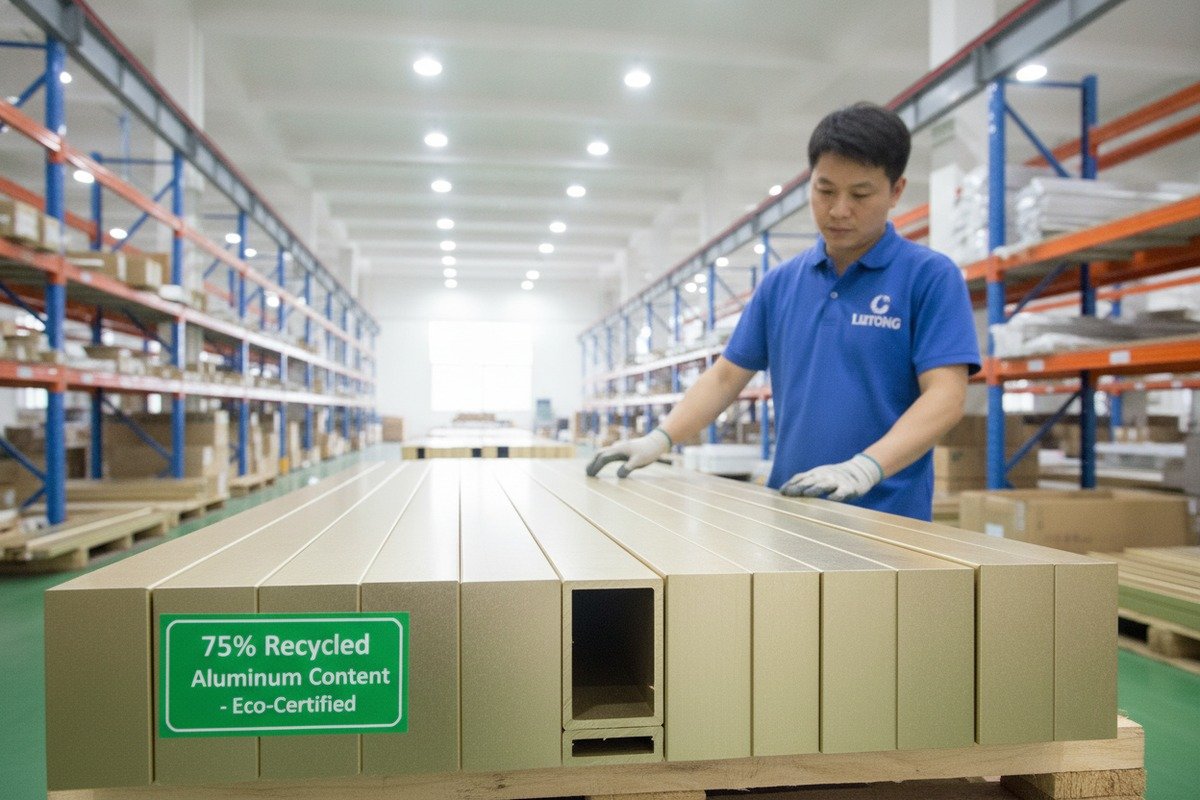
Recycled aluminum 10 uses roughly 95% less energy than primary aluminum. That translates directly into a massively lower carbon footprint. When we source our aluminum billets, we prioritize suppliers who use a high percentage of recycled input. We can state the recycled-content percentage in our product documentation, which gives Vietnam buyers a clear number to pass along to their customers or project auditors.
How Vietnam's Market Is Shifting
Vietnam's furniture industry is worth billions and growing. E-commerce is accelerating demand for stylish, affordable furniture. At the same time, both domestic consumers and international buyers are asking harder questions about sustainability. Furniture factories exporting to Europe, North America, and Japan face pressure to demonstrate green supply chains at the component level — including hardware like handles.
This creates a commercial opportunity. A distributor who can offer aluminum handles with documented recycled content, clean finishes, and compliance certificates is no longer just selling metal. They are selling a sustainability story that makes the entire furniture SKU more marketable.
Scrap Recovery and Circular Practices
At our Foshan production facility, aluminum extrusion generates cutting scrap and trim waste. We collect 100% of this scrap and send it back to our billet supplier for remelting. This closed-loop scrap recovery is standard good practice, but not every factory does it rigorously. Ask your supplier:
- What percentage of production scrap is recovered and recycled?
- Do you have a documented scrap management procedure?
- Can you provide data on your facility's overall material yield rate?
A high yield rate (above 85–90%) means less waste. Combined with full scrap recovery, it demonstrates efficient, low-waste manufacturing.
Packaging and End-of-Life Thinking
Sustainability extends to packaging. We use recyclable cardboard packaging and avoid expanded polystyrene foam wherever possible. For bulk shipments to Vietnam, we optimize packing density to reduce shipping volume, which lowers the carbon footprint of transportation.
The handle itself, at end of life, goes back into the aluminum recycling stream. Because our handles are mono-material (all aluminum, no plastic inserts or mixed materials in most designs), they are easy to recycle without disassembly. This mono-material design is a deliberate choice that supports circularity.
Lifecycle Durability as a Green Metric
A handle that lasts 15 years is greener than one that lasts 3 years, even if the short-lived handle was made from recycled aluminum. Durability reduces replacement cycles, which reduces total material throughput over time. Our precision-engineered extruded aluminum profiles with anodized or powder-coated finishes are designed for long service life. The hard anodic layer resists scratching and corrosion. The powder coat resists UV fading. These are not just quality features — they are environmental features.
Conclusion
Green sourcing of aluminum furniture handles for Vietnam is not optional anymore — it is a competitive requirement. Focus on recycled content, clean surface treatments, restricted-substance compliance, carbon data, and verifiable certifications to build a credible, market-ready green supply chain.
Footnotes
1. Official website for the globally recognized standard for products designed for a circular economy. ↩︎
2. Explains the coordination of production flow from raw materials to delivery. ↩︎
3. Official government information on EPDs as standardized, third-party-verified labels for environmental impact. ↩︎
4. Authoritative resource explaining compliance and materials risk for manufacturing under both directives. ↩︎
5. Replaced with a comprehensive Wikipedia article defining SVHCs, an authoritative source for general information. ↩︎
6. Official US EPA information on the international standard for environmental management systems. ↩︎
7. Defines carbon footprint as the total CO2 emissions associated with activities, products, or entities. ↩︎
8. Explains anodizing as a water-based process with no VOCs, enhancing aluminum’s durability and recyclability. ↩︎
9. Replaced with an article from an industry source (AZZ Inc.) discussing the environmental benefits and sustainability of powder coating. ↩︎
10. Details how recycled aluminum saves 95% of energy compared to new aluminum, significantly reducing carbon emissions. ↩︎