
Every week, our sales team in Foshan fields the same question from furniture factory owners and building material wholesalers: “Does it really matter which aluminum alloy you use for my handles?” The short answer is yes—but the longer answer is where the money, the aesthetics, and the durability risks all hide.
To compare 6063 and 6061 for aluminum furniture handles, evaluate them across six criteria: strength, surface finish quality, extrusion complexity, corrosion resistance, machinability, and cost. For most decorative handles, 6063 is the better default. Choose 6061 only when your design demands higher structural strength or aggressive post-machining.
Below, we break down each factor so you can walk into your next supplier negotiation with clarity—not guesswork aluminum alloy grades 1. Let’s start with the finish, because that is what your end customer sees first.
How Does the Choice Between 6063 and 6061 Affect the Final Anodized Finish of My Furniture Handles?
When we run anodizing lines for handle batches, the alloy grade is one of the first variables our surface treatment engineers check copper and silicon content 2. A beautiful handle design can look dull or blotchy if the wrong alloy sits underneath the anodized layer.
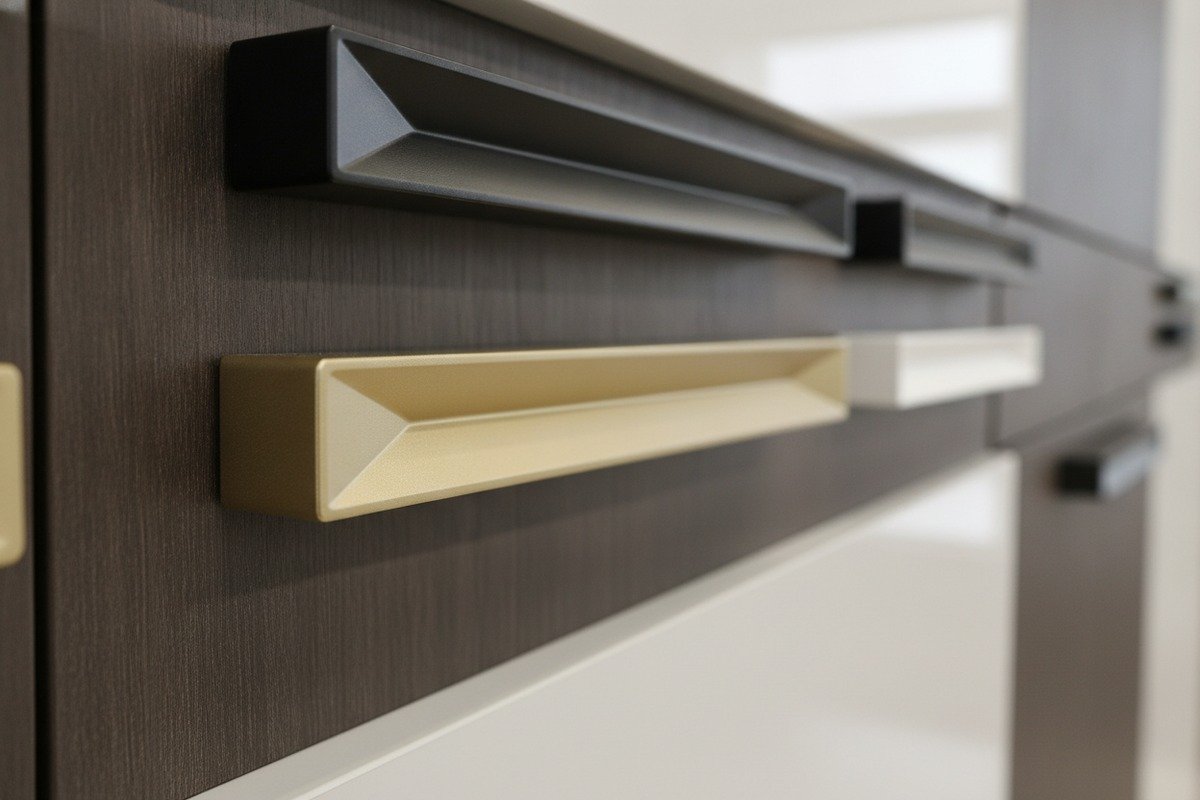
6063 consistently produces a smoother, more uniform anodized finish than 6061. Its lower copper and silicon content allows the oxide layer to form evenly, resulting in cleaner matte, brushed, or champagne gold finishes—exactly the premium look that furniture handles demand in retail and showroom settings.
Why 6063 Wins on Surface Appearance
The reason comes down to chemistry. 6063 contains less copper and slightly different proportions of magnesium and silicon compared to 6061 artificial aging 3. Copper, even in small amounts, can create micro-level color inconsistencies during anodizing. When you are producing a batch of 5,000 minimalist cabinet pulls in matte black or champagne gold, even a slight color shift between pieces becomes a quality complaint.
Our quality control team has rejected batches before—not because the dimensions were wrong, but because the anodized color varied across handles within the same order. In almost every case, the root cause traced back to alloy composition inconsistencies or the wrong alloy choice for the desired finish.
Chemical Composition and Its Effect on Finish
| Element | 6063 (Typical %) | 6061 (Typical %) | Impact on Anodized Finish 4 |
|---|---|---|---|
| Silicon (Si) | 0.20–0.60 | 0.40–0.80 | Higher Si can cause a slightly grayer tone |
| Magnesium (Mg) | 0.45–0.90 | 0.80–1.20 | Higher Mg increases strength but can reduce gloss |
| Copper (Cu) | ≤0.10 | 0.15–0.40 | Higher Cu causes color inconsistency and reduces corrosion resistance of the anodized layer |
| Iron (Fe) | ≤0.35 | ≤0.70 | Higher Fe can introduce surface specks |
When 6061 Anodizing Is Acceptable
This does not mean 6061 cannot be anodized. It can. But the result tends to be slightly less uniform, and achieving a bright or champagne tone requires tighter process control. If you plan to powder coat your handles instead of anodizing them, the alloy difference matters less for appearance. Powder coating covers the metal surface entirely, so the underlying alloy's anodizing behavior becomes irrelevant.
However, for the recessed architectural pulls and slim rectangular handles popular in modern kitchens—where buyers specifically request matte anodized finishes with sharp, clean edges—6063 is the safer, more cost-effective choice. You get a premium surface without paying for extra anodizing process steps.
Practical Tip for Buyers
When you request samples from your Chinese supplier, always ask for anodized samples made from the exact alloy and temper they will use in production. A sample made from 6063-T5 will look different from one made from 6061-T6, even if the color code is nominally the same.
Should I Prioritize 6061 Over 6063 if My Furniture Handles Require Higher Structural Strength?
On our production floor, we see handle designs getting longer and slimmer every year. A 600mm bar handle with minimal wall thickness looks stunning—but it also bends more easily under repeated use if the alloy cannot handle the stress.
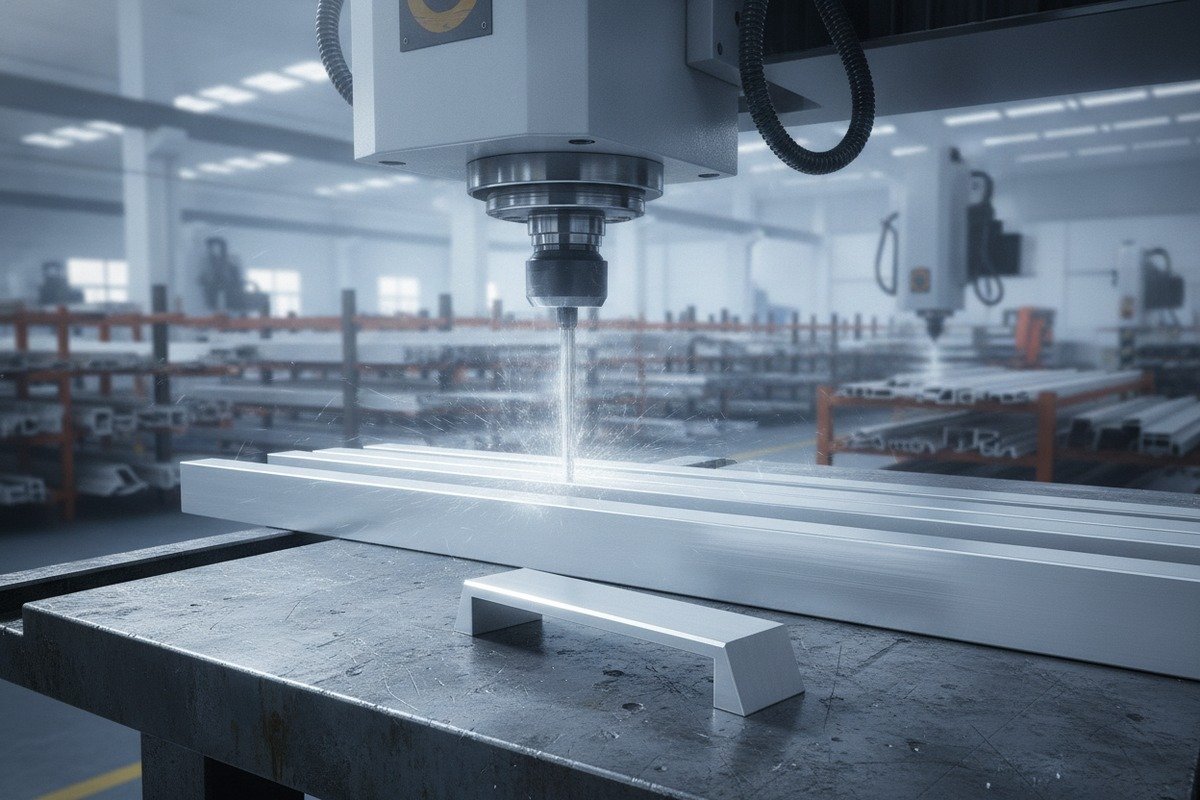
Yes, prioritize 6061-T6 when your furniture handles must resist bending, heavy pulling forces, or cyclic stress. 6061-T6 offers roughly 40% higher tensile strength and significantly better yield strength than 6063-T5, making it the right choice for long spans, commercial furniture, or high-traffic installations.
Strength Numbers: 6061 vs. 6063
Let's put real numbers on the table. These are the values our engineers reference when advising clients on alloy selection.
| Property | 6063-T5 | 6063-T6 | 6061-T6 |
|---|---|---|---|
| Ultimate Tensile Strength 6 (MPa) | ~185 | ~240 | ~310 |
| Yield Strength (MPa) | ~145 | ~215 | ~275 |
| Elongation at Break (%) | ~12 | ~12 | ~12–17 |
| Brinell Hardness 7 | ~60 | ~73 | ~95 |
These numbers matter. A handle with a 400mm span that gets pulled 50 times a day in a commercial setting—think hotel wardrobe pulls or restaurant cabinet handles—needs the yield strength 8 margin that 6061-T6 provides. If the handle bends even slightly after months of use, it looks cheap. And it creates warranty claims.
When 6063 Is Still Strong Enough
For most residential cabinet handles under 300mm in span, 6063-T5 or T6 provides more than enough strength. The pull force on a kitchen drawer handle is typically under 30 Newtons. At that load, 6063 handles will not deform, bend, or fail.
The critical question is not "which alloy is stronger" but "does my handle design actually need that extra strength?" If you are making a 150mm recessed pull for a bathroom vanity, 6061 is overkill. You pay more for material and potentially sacrifice surface finish quality—for strength you will never use.
The Temper Matters as Much as the Alloy
One point many buyers overlook: the temper designation 9 (T5, T6) can shift performance more than the alloy grade itself. A 6063-T6 handle is actually closer in strength to 6061-T6 than many people assume. The T6 temper involves solution heat treatment 10 and artificial aging, which significantly boosts hardness and yield strength compared to T5.
So before you automatically upgrade to 6061 for strength, ask your supplier: "Can we use 6063-T6 instead of 6063-T5?" That single temper change might give you the structural margin you need without switching alloys.
Real-World Decision Framework
- Residential drawer pulls under 300mm → 6063-T5 is fine.
- Kitchen bar handles 300–500mm → 6063-T6 recommended.
- Commercial or hospitality handles over 500mm → Consider 6061-T6.
- Handles with thin cross-sections or minimal wall thickness → 6061-T6 provides better deformation resistance.
How Do These Different Aluminum Grades Impact My Overall Procurement Costs When Ordering from Chinese Factories?
In our quoting process, we often see buyers assume that 6061 is dramatically more expensive than 6063. The reality is more nuanced—and understanding where the cost actually accumulates can save you thousands on a large order.
The raw material price difference between 6063 and 6061 is typically small—often 5–15% per kilogram. However, the total cost gap widens when you factor in extrusion efficiency, die wear, scrap rates, surface treatment complexity, and post-machining requirements. For extruded decorative handles, 6063 almost always delivers the lower total landed cost.
Where the Real Cost Differences Hide
Raw material price is just one line item. Here is how the two alloys compare across the full production cost chain.
| Cost Factor | 6063 | 6061 | Notes |
|---|---|---|---|
| Raw billet price | Lower | 5–15% higher | 6061 billets cost more due to higher alloying element content |
| Extrusion speed | Faster | Slower | 6063 flows better, so the press runs faster and produces more per hour |
| Die wear | Lower | Higher | 6061's higher strength wears extrusion dies faster |
| Scrap rate | Lower | Higher | 6063 is more forgiving during extrusion, producing fewer rejected profiles |
| Anodizing cost | Standard | Higher | 6061 may need extra process steps for uniform color |
| Post-machining cost | Higher per part | Lower per part | 6061 machines more cleanly, so CNC steps are slightly faster |
| Minimum order flexibility | Better | Slightly worse | More factories stock 6063 billets, so smaller MOQs are easier |
The Extrusion Efficiency Factor
This is the cost factor most buyers miss. When our extrusion press runs 6063 billets, the material flows smoothly through the die at higher speeds. This means more handles per hour, less energy per handle, and less wear on the die. Over a 10,000-piece order, these efficiency gains compound.
With 6061, the press must run slower. The material is harder, so it resists flow. Dies wear out faster and need to be replaced or repaired more often. Our production planners factor this into the quote, and it shows up as a higher per-piece price—even if the raw material cost difference is only a few percent.
When 6061's Extra Cost Is Justified
If your handle design requires significant CNC machining—think custom mounting holes, threaded inserts, or precision-milled decorative features—6061 can actually save machining time. It cuts cleaner and produces better chip formation than 6063. So the machining cost per piece may be lower with 6061, partially offsetting the higher extrusion cost.
For handles that are purely extruded with minimal post-processing, 6063 wins on cost at every step. For handles that need heavy secondary machining, 6061 might break even or even come out ahead on total cost.
Sourcing Questions That Reveal True Cost
When you get quotes from Chinese suppliers, do not just compare the unit price. Ask these questions:
- "What is the extrusion scrap rate for this profile in 6063 vs. 6061?"
- "Does the anodizing price change if we switch alloys?"
- "What is the die life expectancy for each alloy?"
- "Can you provide a cost breakdown showing material, extrusion, finishing, and machining separately?"
These questions signal to the supplier that you understand the production process—and they make it harder for anyone to pad the quote with hidden margins.
Which Aluminum Alloy Grade Offers Better Flexibility for My Custom Handle Designs and Complex Extrusion Profiles?
Over eighteen years of developing custom handle profiles, our engineering team has learned one thing clearly: the alloy you choose directly limits—or expands—what shapes you can actually produce at scale.
6063 is the superior choice for complex extrusion profiles and custom handle designs. Its excellent flow characteristics allow it to fill intricate die shapes with thin walls, sharp edges, and deep channels consistently. If your handle features a slim L-shaped cross-section, a recessed finger grip, or decorative contours, 6063 will produce fewer defects and tighter tolerances than 6061.

Why Extrudability Matters for Handle Design
Extrusion is the process of pushing heated aluminum billet through a steel die to create a continuous profile shape. The softer and more fluid the alloy is at extrusion temperature, the more easily it fills every corner and thin section of the die. 6063 is known in the industry as the premier extrusion alloy precisely because it behaves this way.
Consider the modern recessed cabinet handles that are trending in European and Middle Eastern markets right now—the ones with a long, slim rectangular form and a deep geometric channel for finger grip. These profiles have thin walls, sometimes under 1.5mm, and sharp internal corners. Pushing 6063 through that die produces clean, consistent results. Pushing 6061 through the same die often results in incomplete fills, rough surface texture at the thin sections, or micro-cracking at sharp corners.
Design Freedom Comparison
Here are the design parameters where alloy choice creates real differences:
- Minimum wall thickness: 6063 can be extruded down to approximately 1.0mm walls for small profiles. 6061 typically needs 1.5mm or more to extrude reliably.
- Corner sharpness: 6063 fills sharp internal corners better. 6061 tends to round off or leave voids at tight radii.
- Profile complexity: Multi-cavity and hollow profiles are much easier to produce in 6063.
- Surface smoothness off the die: 6063 comes off the extrusion press with a smoother surface, reducing the amount of finishing work needed.
The Die Design Connection
When our die designers create a new extrusion die for a custom handle, they factor in the alloy. A die designed for 6063 can have thinner tongues, tighter gaps, and more aggressive geometries. If the client later asks to switch the same profile to 6061, we often need to modify the die—widening channels, adding radii, or thickening sections—to avoid production problems. This means design changes, new die costs, and potential compromises to the original aesthetic.
When 6061 Makes Sense for Custom Designs
There is one scenario where 6061 can be the better choice for custom designs: when the handle is not primarily extruded but instead CNC machined from bar stock or plate. In that case, extrudability is irrelevant. 6061's better machinability and higher strength make it the natural choice for machined handles with complex 3D geometry that cannot be produced by extrusion alone.
Think of a handle that has sculpted curves, internal cavities, or features on multiple faces—these are often CNC-milled rather than extruded. For those designs, 6061 gives the machinist cleaner cuts, better thread quality, and a stronger finished part.
Matching Alloy to Manufacturing Method
| Manufacturing Method | Best Alloy | Reason |
|---|---|---|
| Standard extrusion | 6063 | Superior flow, thinner walls, smoother surface |
| Complex multi-cavity extrusion | 6063 | Fills intricate die shapes consistently |
| CNC machining from billet/bar | 6061 | Cleaner cuts, better thread tapping, higher strength |
| Extrusion + light CNC finishing | 6063 | Good extrudability with acceptable machinability for simple holes and chamfers |
| Die-cast or forged handles | Neither | Different alloy families are used (e.g., A380 for casting) |
The bottom line for custom handle design: start with 6063 unless your manufacturing method or structural requirements specifically demand 6061. Your design options will be wider, your production will run smoother, and your per-piece cost will be lower.
Conclusion
For most aluminum furniture handles, 6063 is your best starting point—it delivers superior finish, easier extrusion, and lower cost. Reserve 6061 for long-span, high-stress, or heavily machined designs where structural strength genuinely matters.
Footnotes
1. Provides a comprehensive comparison of 6061 and 6063 aluminum alloy grades, including composition, mechanical properties, and applications. ↩︎
2. Compares the chemical composition of 6061 and 6063, highlighting copper and silicon. ↩︎
3. Details the artificial aging process used to enhance mechanical properties of aluminum. ↩︎
4. From an authoritative source (Aluminum Anodizers Council), this page explains what an anodized finish is, the electrochemical process, and its benefits. ↩︎
5. Wikipedia provides a comprehensive explanation of aluminum oxide, including its natural formation as a protective layer and how it’s enhanced by anodizing. ↩︎
6. Provides a reference chart for tensile strength of various aluminum alloys and tempers. ↩︎
7. Compares Brinell Hardness values for 6061 and 6063 aluminum alloys. ↩︎
8. Explains yield strength and provides values for 6061 aluminum in different tempers. ↩︎
9. Describes different temper designations (T4, T6, T7X) and their relation to heat treatment. ↩︎
10. Explains the process and purpose of solution heat treatment for aluminum alloys. ↩︎