
Over the past 18 years on our production line in Foshan, we have seen the same problem repeat itself hundreds of times Anodized aluminum 1. A furniture factory orders beautiful aluminum handles 2, the finish is perfect, the price is right — and then the handles fail on the panel. Not because the handle was defective, but because nobody checked whether the handle design matched the panel material. This mismatch is the single biggest source of warranty claims and installation complaints we hear from our wholesale partners.
When sourcing aluminum furniture handles, you must evaluate four compatibility layers: mechanical fit with the panel thickness, fastener holding power in the specific substrate, surface and finish compatibility to avoid cosmetic damage, and electrochemical compatibility to prevent corrosion at the handle-panel interface. Ignoring any one of these layers leads to premature failure.
This guide breaks down each compatibility layer and shows you exactly how to avoid the most common sourcing mistakes. We will walk through screw length selection, finish chemistry, lightweight panel installation, and design matching — all based on real production and export experience.
How do I select the correct screw length to ensure my aluminum handles fit my specific panel thickness?
Getting the screw length wrong is the fastest way to ruin an otherwise perfect installation. We ship over 300 tons of aluminum handles from our Foshan warehouse, and screw-length mismatch remains the number one issue our distributors report from the field.
To select the correct screw length, measure your panel thickness precisely, then add the handle's base plate depth and subtract 1–2 mm so the screw tip does not penetrate the visible face. For standard 18 mm panels, M4 × 25 mm screws usually work; for 16 mm panels, switch to M4 × 22 mm screws.
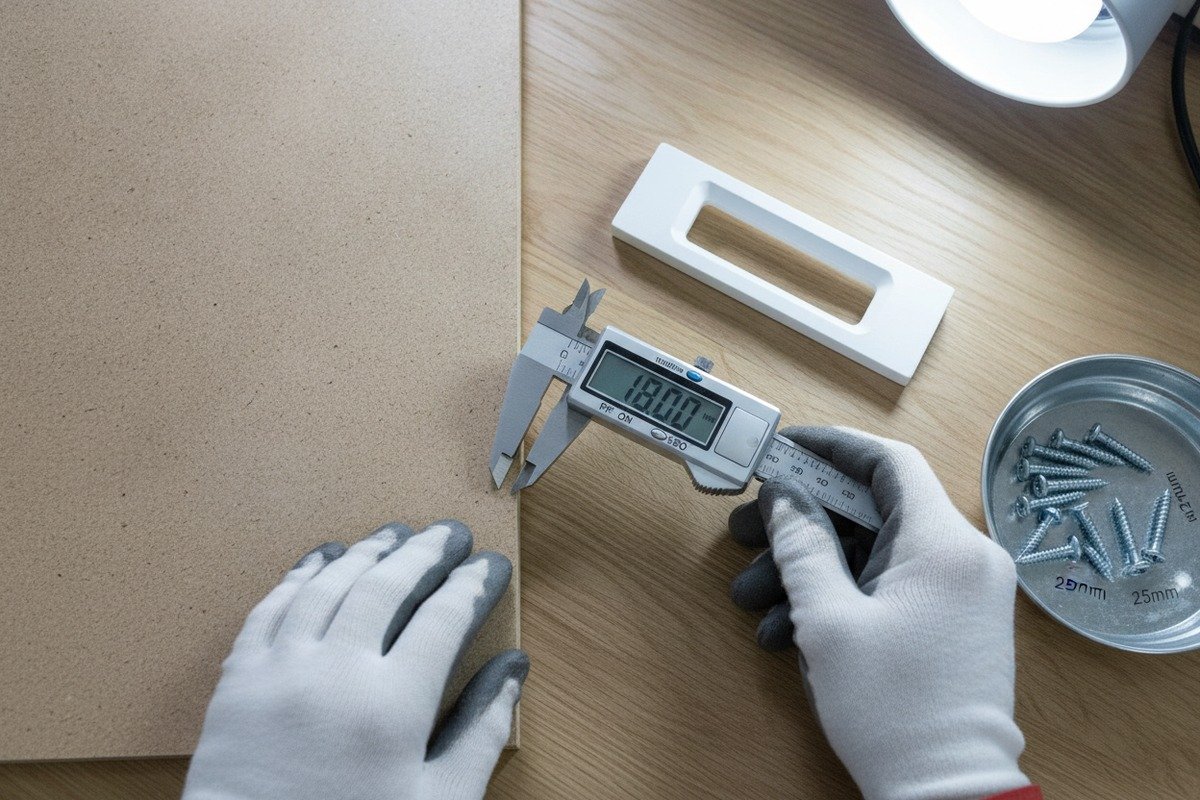
Why Panel Thickness Is the Starting Point
Most aluminum tab pulls and recessed handles on the market are designed around the industry-standard 18 mm (approximately 3/4-inch) cabinet panel. When your factory or your end customer uses a different thickness — 16 mm, 22 mm, or even 25 mm for premium cabinetry — the stock screws that come in the box may be too long or too short. A screw that is too long pokes through the panel face. A screw that is too short has poor thread engagement and will loosen under repeated pulling force.
The Simple Formula
Here is the calculation we recommend to our OEM partners:
Ideal screw length = Panel thickness + Handle base depth − 2 mm safety margin
For example, if you have an 18 mm MDF panel 3 and the handle base plate is 9 mm deep, the total stack is 27 mm. Subtract 2 mm, and you need a 25 mm screw. This keeps the screw tip safely buried inside the panel without any risk of face penetration.
Screw Length Reference Table
| Panel Thickness 4 | Handle Base Depth | Recommended Screw Length | Common Screw Size |
|---|---|---|---|
| 16 mm | 8 mm | 22 mm | M4 × 22 |
| 18 mm | 9 mm | 25 mm | M4 × 25 |
| 22 mm | 9 mm | 29 mm | M4 × 30 |
| 25 mm | 10 mm | 33 mm | M4 × 35 |
| 30 mm | 10 mm | 38 mm | M4 × 40 |
Substrate Density Matters Too
Screw length alone does not guarantee holding power. A 25 mm screw in solid plywood behaves very differently from a 25 mm screw in low-density particleboard 5. In softer substrates like particleboard or lightweight MDF, the threads have less material to grip. This means you may need to increase the screw diameter from M4 to M5, or switch to a coarse-thread wood screw instead of a machine screw. In our experience exporting to the Middle East, where particleboard is common in budget cabinetry, we always recommend coarse-thread screws and include them in our packaging at no extra charge.
When Through-Bolting Is the Safer Option
For heavy-duty commercial applications — hotel vanity handles, retail fixture pulls, or office storage — we often suggest through-bolting 6. A bolt passes completely through the panel and is secured by a nut or a threaded insert on the back side. This eliminates any risk of pull-out, regardless of substrate density. The trade-off is a visible fastener on the interior, but in commercial settings, durability wins over aesthetics every time.
Pre-drilling is also critical. Drilling a pilot hole that is slightly smaller than the screw shank prevents splitting in hardwood and cracking in MDF. We supply drilling templates with our custom handle orders so that hole spacing matches perfectly.
Will the chemical finish on my aluminum handles react negatively with my lacquered or high-gloss furniture panels?
This question comes up frequently from our furniture factory partners in Vietnam, where high-gloss lacquered panels are extremely popular. They invest heavily in achieving a perfect mirror finish on the panel, and the last thing they want is a handle that stains, discolors, or damages that surface over time.
Anodized and powder-coated aluminum handles are chemically stable and generally will not react with lacquered or high-gloss panels. However, raw or uncoated aluminum can oxidize at the contact surface, leaving grey marks on light-colored lacquer. Always specify a sealed finish — anodized, powder-coated, or electrophoretic — to prevent any chemical transfer.
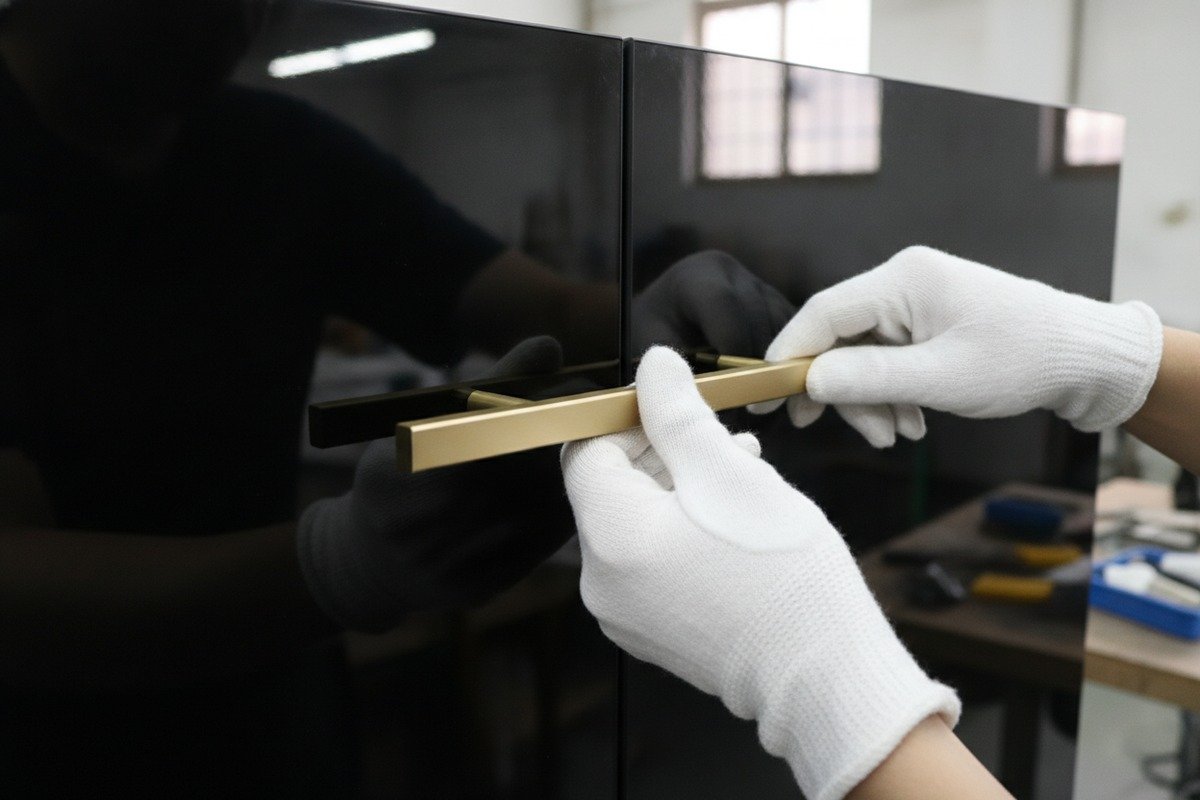
Understanding Aluminum Finish Types
Not all aluminum handles are finished the same way. The finish determines how the handle's surface interacts with adjacent materials over months and years. Here is a breakdown of the most common finishes we produce at our Foshan facility:
| Finish Type | Process | Chemical Stability | Best For |
|---|---|---|---|
| Raw / Mill Finish | No treatment | Low — oxidizes over time | Industrial or hidden applications |
| Anodized (Clear or Color) | Electrochemical oxide layer | High — sealed and inert | Residential and commercial cabinets |
| Powder Coated | Electrostatic spray + oven cure | High — durable polymer barrier | Color-matched projects, outdoor use |
| Electrophoretic (E-coat) 7 | Electrodeposition of paint | Very high — uniform, thin coating | Premium furniture, high-gloss panels |
| PVD (Physical Vapor Deposition) | Vacuum metallic coating | Very high — extremely hard surface | Luxury hardware, champagne gold finishes |
The Real Risk: Contact Staining
When a raw aluminum surface presses against a lacquered panel, moisture from the environment can trigger a mild oxidation reaction. The aluminum oxide residue — a fine grey powder — transfers onto the lacquer. On white or light-colored panels, this staining is highly visible and difficult to remove without damaging the gloss layer. We learned this the hard way early in our export history and now default to anodized or powder-coated finishes for all handle orders destined for high-gloss applications.
Cleaning Agent Compatibility
Another overlooked issue is how cleaning products interact with the handle-panel junction. Alkaline cleaners can attack both the aluminum finish and the lacquer layer simultaneously. Acidic cleaners can etch anodized surfaces. We recommend neutral pH cleaners for maintenance and include a care guide with bulk orders. This small addition reduces warranty claims significantly for our distributor partners.
Adhesive and Sealant Interactions
Some installers apply a thin bead of silicone or adhesive between the handle base and the panel surface for extra grip or to prevent micro-movement. If the adhesive contains acetic acid (common in cheap silicone sealants), it can corrode aluminum and cloud the lacquer finish. Always specify neutral-cure silicone if an adhesive is used at the interface.
Thermal Cycling and Finish Stress
In kitchens, the area around ovens and cooktops experiences significant temperature swings. Aluminum expands and contracts at a different rate than MDF or particleboard. Over time, this differential movement can cause micro-abrasion between the handle base and the panel surface, wearing through a thin lacquer layer. Powder-coated handles with a slightly textured finish reduce this friction compared to smooth anodized handles, making them a better choice for heat-adjacent installations.
How can I securely install aluminum handles on my lightweight honeycomb panels without compromising structural integrity?
Honeycomb panels 9 are becoming a standard choice for large-format cabinetry, sliding doors, and retail fixtures because of their exceptional weight-to-strength ratio. Our team produces both aluminum handles and aluminum honeycomb panels, so we see both sides of this installation challenge every day.
To install aluminum handles on honeycomb panels securely, you must reinforce the mounting area with solid edge banding or internal blocking before drilling. The honeycomb core has almost zero screw-holding capacity, so fasteners must anchor into a solid wood, MDF, or aluminum insert placed within the panel at the handle location during panel fabrication.
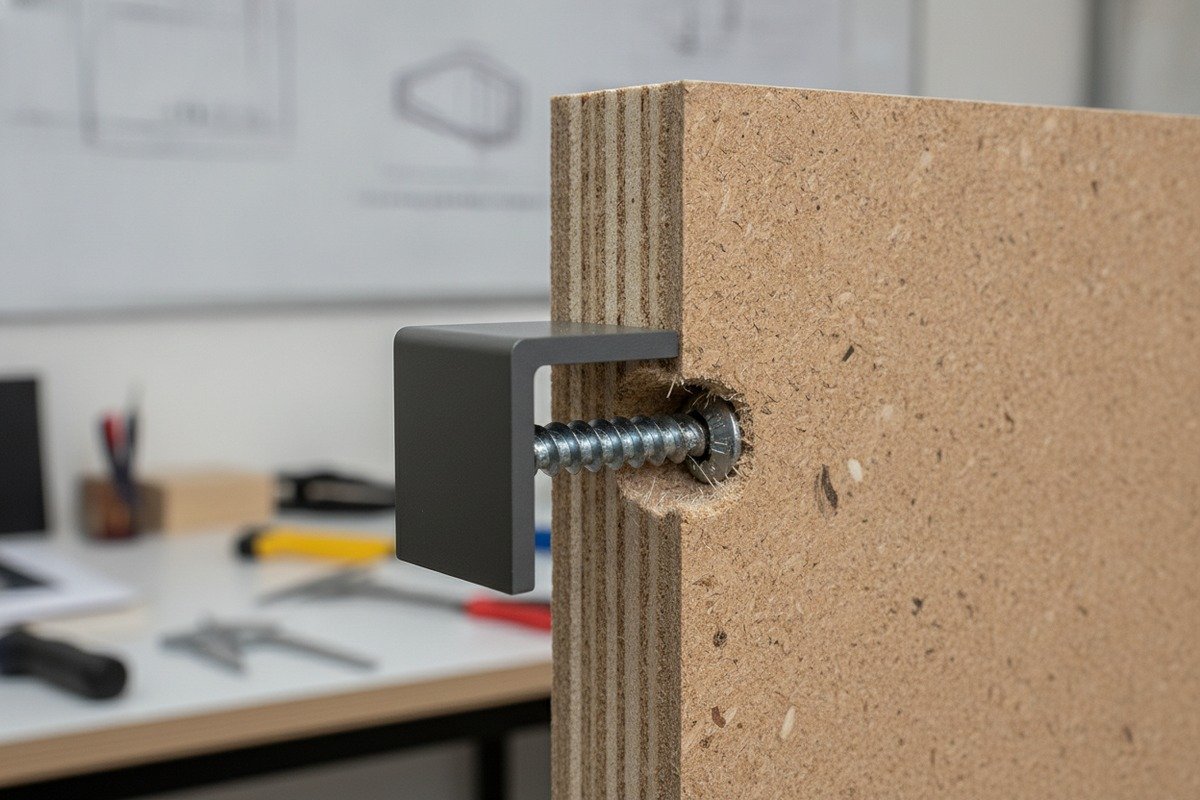
Why Honeycomb Panels Are Different
A standard honeycomb panel consists of two thin face sheets (typically 3 mm MDF, plywood, or aluminum) bonded to a paper, aluminum, or polypropylene honeycomb core. The core is mostly air. If you drive a screw directly into this core, it grabs nothing. The screw spins freely, the handle wobbles, and eventually the face sheet delaminates around the hole. This is not a defect in the panel — it is a fundamental property of honeycomb construction that demands a different installation approach.
Reinforcement Methods
There are three proven methods we recommend to our factory partners:
Method 1: Solid Edge Banding
The panel manufacturer installs a solid strip of MDF, plywood, or hardwood along the edge where the handle will be mounted. This strip replaces the honeycomb core in that zone and provides a solid substrate for screws. This is the most common method and should be specified at the time of panel ordering.
Method 2: Internal Blocking
A solid block of material is embedded inside the panel at the exact handle location before the face sheets are bonded. This is used for surface-mounted handles where the screw enters the face rather than the edge. The block must be thick enough to provide at least 10 mm of thread engagement.
Method 3: Through-Bolt with Backing Plate
A bolt passes through the entire panel and is secured on the opposite face with a washer and nut or a metal backing plate. This method distributes the pull force across a larger area of the face sheet, preventing localized delamination. It works well for heavy commercial handles.
Reinforcement Method Comparison
| Method | Best Handle Type | Requires Pre-Planning | Load Capacity | Visible Hardware |
|---|---|---|---|---|
| Solid Edge Banding 10 | Edge-mounted pulls, tab pulls | Yes — during panel fabrication | High | No |
| Internal Blocking | Surface-mounted knobs and bar pulls | Yes — during panel fabrication | Medium to High | No |
| Through-Bolt with Backing Plate | Heavy commercial handles | Can be done post-fabrication | Very High | Yes (on interior face) |
Common Mistakes We See
The biggest mistake is treating honeycomb panels like solid MDF. A procurement manager orders handles with standard M4 × 25 mm screws, the installer drives them into the edge, and the handle falls off within weeks. We have seen entire hotel renovation projects delayed because this compatibility check was skipped at the sourcing stage.
Another common error is drilling too close to the edge of the solid banding strip. If the screw lands partially in the honeycomb core, holding power drops dramatically. We recommend a minimum of 15 mm inset from the edge banding boundary for any screw location.
Practical Tip for Buyers
When you order honeycomb panels and aluminum handles from different suppliers, send the handle's drilling template to the panel manufacturer before production. This ensures the reinforcement zones are placed precisely where the handles will be mounted. At our facility, when clients order both panels and handles together, we coordinate the reinforcement placement internally, which eliminates this risk entirely. This is one of the advantages of working with a one-stop supplier — the handle design and the panel construction are aligned from the beginning.
What design principles should I follow to match my aluminum handle finishes with various wood grain and stone textures?
Getting the engineering right is only half the battle. The other half is making sure the handle looks like it belongs on the furniture. When we develop new handle profiles and finishes for our OEM catalog, our design team spends as much time on visual compatibility as on mechanical specifications.
To match aluminum handle finishes with wood grain and stone textures, follow the contrast-or-complement rule: use warm-toned finishes like champagne gold or light bronze with warm wood grains, cool-toned finishes like brushed nickel or matte grey with cool stones and painted surfaces, and matte black as a universal accent that works across nearly all materials.

The Contrast-or-Complement Rule
Every successful handle-panel pairing follows one of two strategies. Either the handle contrasts sharply with the panel to create a deliberate focal point, or it complements the panel's tone and texture for a seamless, integrated look. Problems arise when the pairing falls in between — not quite matching, not quite contrasting — which looks accidental rather than intentional.
Warm vs. Cool Tone Matching
Wood grains carry warm undertones: reds, oranges, yellows, and browns. Stone textures tend toward cool undertones: greys, blues, whites, and blacks. Aluminum handles come in a wide range of finishes, and each one falls on this warm-cool spectrum.
| Panel Material | Undertone | Recommended Handle Finishes | Finishes to Avoid |
|---|---|---|---|
| Oak / Walnut veneer | Warm | Champagne gold, light bronze, matte black | Cool silver, bright chrome |
| White oak / Ash | Neutral-warm | Brushed nickel, satin gold, matte black | Rose gold, bright brass |
| White / Grey laminate | Cool | Brushed nickel, matte charcoal, matte black | Warm bronze, antique brass |
| Marble / Sintered stone | Cool | Polished chrome, matte grey, matte black | Warm gold tones |
| High-gloss lacquer (any color) | Varies | Match the undertone; matte handle finishes reduce visual competition | Glossy handle finishes that create a "double shine" effect |
Matte Black: The Universal Connector
In our export markets — Vietnam, the UAE, and Saudi Arabia — matte black handles outsell every other finish by a significant margin. The reason is simple: matte black is visually neutral. It does not fight with warm woods or cool stones. It creates a clean, graphic line that reads as modern and intentional regardless of the panel material. For distributors who serve diverse furniture factories, stocking matte black handles minimizes inventory risk because they pair with almost everything.
Texture Matching: Matte With Matte, Gloss With Gloss
Beyond color temperature, surface texture plays a critical role. A brushed aluminum handle on a high-gloss panel creates an interesting textural contrast that can look very sophisticated. But two competing glossy surfaces — say, a polished chrome handle on a mirror-gloss lacquer panel — can create visual noise and fingerprint problems. Our general recommendation is to pair matte handles with gloss panels and allow the panel to be the visual star, or pair textured handles with textured wood grains for a cohesive tactile experience.
Profile Shape and Panel Style
The handle's physical form also needs to match the design language of the furniture. Our recessed channel pulls with their deep geometric finger grip and slim rectangular profile work best with minimalist, flat-panel cabinetry. Placing them on a traditional raised-panel door would create a style conflict that no finish matching can fix. Similarly, a round knob on an ultra-modern slab door looks dated regardless of its color. The design principle is straightforward: the handle shape must echo the panel's design era and style intent.
Sample-Before-Commit Policy
We always encourage our wholesale partners to request physical samples before committing to a large order. Digital images on screens shift color temperature depending on the monitor. A champagne gold finish that looks perfect on a laptop screen may appear too yellow against the actual panel in the showroom. We offer sample handles at minimal cost with 48-hour shipping from our Foshan stock, specifically so buyers can hold the handle against the real panel material before placing a production order. This single step eliminates the most common aesthetic mismatch complaints.
Conclusion
Aluminum handle compatibility goes far beyond appearance. Panel thickness, substrate density, finish chemistry, and reinforcement planning all determine whether your handles perform reliably over years of daily use. Specify carefully, test with samples, and choose a supplier who understands both the handle and the panel — that is how you avoid costly mistakes.
Footnotes
1. Details the electrochemical process of anodizing aluminum, enhancing durability and corrosion resistance. ↩︎
2. Explains the manufacturing process, properties, and applications of aluminum alloy handles. ↩︎
3. Provides detailed information on MDF material composition, properties, and applications in furniture. ↩︎
4. Discusses MDF panel thickness, properties, and common uses in furniture manufacturing. ↩︎
5. Replaced with a Wikipedia link providing a comprehensive overview of particleboard, including its types, uses, and properties, from an authoritative source. ↩︎
6. Explains through bolts, their uses, and benefits for securing structures with exceptional strength. ↩︎
7. Explains electrophoretic coating (E-coat) process, its benefits, and applications for durable metal protection. ↩︎
8. Outlines the step-by-step process of powder coating aluminum, emphasizing surface preparation and curing. ↩︎
9. Introduces honeycomb panels, their construction, materials, and applications as lightweight building materials. ↩︎
10. Defines edge banding, its purpose in wood manufacturing, and benefits for aesthetics and protection. ↩︎