
Every year, our production team ships over 300 tons of aluminum furniture handles 1 to wholesalers and factories across Vietnam and the Middle East. One thing we hear often from new procurement buyers is this: “I found a great supplier, but I don’t know how to convince my team.” That gap between finding a good supplier and getting internal approval is where most sourcing decisions stall or die.
To recommend an aluminum furniture handle supplier internally, present it as a risk-managed business decision. Show quality evidence through samples, prove delivery reliability with lead-time data, highlight customization flexibility, and frame cost in terms of total value rather than unit price alone.
This article walks you through the exact steps. Each section below targets a different stakeholder in your company — your manager, your team, your design department, and your procurement director 2. By the end, you will have a clear framework to pitch your supplier with confidence. Let’s start with the toughest audience first: your quality-focused manager.
How do I prove to my manager that this aluminum handle supplier meets our strict quality standards?
When we run anodizing lines and extrusion presses 3 here in Foshan, we see quality problems from the inside out. Your manager sees them from the outside in — as customer complaints, returns, and rework costs. That difference in perspective is exactly why you need to speak their language.
Prove quality to your manager by presenting physical samples with finish and dimension checks, verifying the supplier's quality management systems, reviewing defect rate data, and comparing sample performance against your existing product standards side by side.
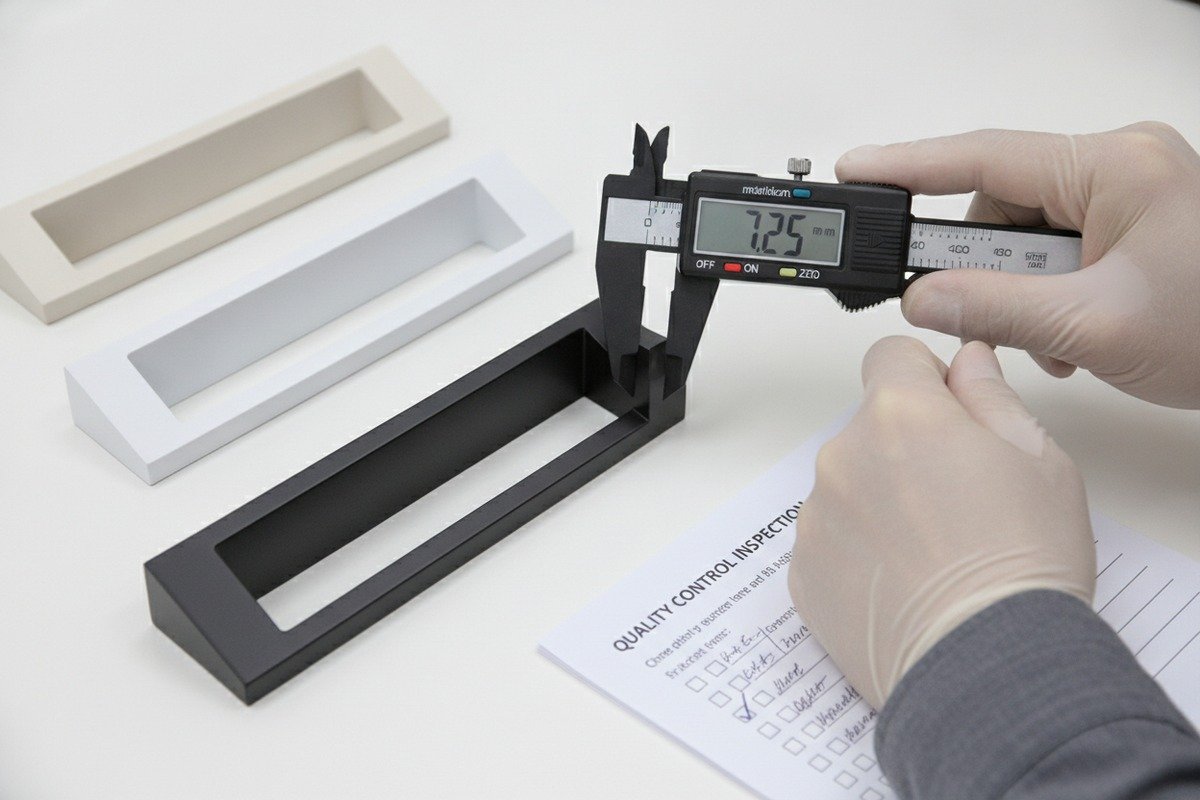
Start with physical samples, not brochures
The single most convincing piece of evidence you can bring to a quality discussion is a real sample. Ask your supplier to send multiple samples in different finishes. Our experience shipping handles in matte white, charcoal grey, black, champagne gold, and light beige taught us that color consistency and surface smoothness vary between finishes. Your manager will want to touch the handle, check the finger grip channel, and test how it fits a cabinet panel. A brochure cannot do that.
When you present the sample, include a short quality checklist you filled in yourself. This shows initiative and rigor.
Build a quality evidence file
Before the meeting with your manager, prepare a folder — physical or digital — with these items:
| Evidence Type | What It Shows | Where to Get It |
|---|---|---|
| Physical samples (2–3 finishes) | Surface quality, grip comfort, dimensional accuracy | Request from supplier |
| Anodizing thickness test report | Durability of finish under daily use | Supplier's QC department |
| Dimensional tolerance sheet | Whether handles fit your cabinet specs | Supplier's engineering team |
| Defect rate 4 data from recent orders | Consistency across production batches | Supplier's sales or QA manager |
| Photos of production line and QC station | Capacity and process control | Supplier or factory visit |
This table gives your manager a structured view instead of scattered claims.
Address the "sample versus bulk" concern
One objection managers raise is: "The sample looks great, but will bulk orders match?" This is a fair concern. You can address it by asking the supplier about their tolerance control in extrusion and their anodizing process consistency. Suppliers with reinforced extrusion walls and standardized anodizing lines tend to maintain better batch-to-batch uniformity. You might also propose a small pilot order 5 — say, 200 to 500 pieces — before committing to a full production run. This reduces risk and builds trust on both sides.
Frame quality as cost avoidance
Managers care about budgets. So connect quality to money. Every defective handle means rework time, wasted material, delayed shipments, and possibly a lost customer. If a supplier can hold a defect rate below 1%, that translates directly into fewer returns and less production downtime. Put that in dollar terms if possible. That is the language managers respond to.
What evidence should I show my team to prove this supplier can solve our lead time and inventory problems?
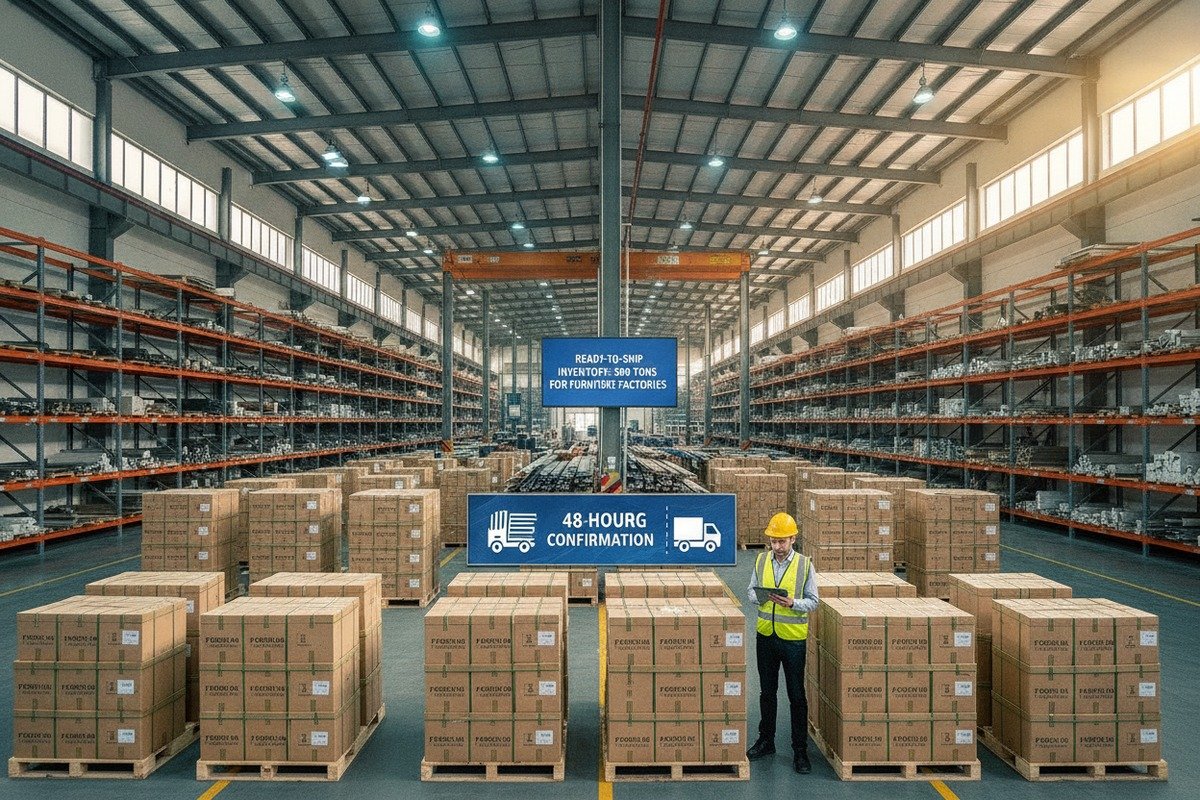
Long lead times 6 and overstocked warehouses are the two headaches that keep furniture factory managers up at night. From running our own 300-ton ready-to-ship inventory in Foshan, we learned that speed and stock availability are not luxuries — they are survival tools for our buyers.
Show your team the supplier's stock availability list, average shipping timeline for standard items, turnaround time for custom orders, and a side-by-side comparison of current lead times versus what the new supplier offers. Real numbers beat promises.
Map your current pain points first
Before presenting the new supplier, document the problems your team already faces. How many times in the last six months did a late delivery delay a project? How much warehouse space is tied up with slow-moving handle inventory you ordered in bulk because the old supplier had high MOQs? Write these down. They form the "before" picture that makes the "after" story compelling.
Present a lead-time comparison table
Nothing persuades a team faster than a clear comparison. Build a table like this:
| Metric | Current Supplier | New Supplier (Proposed) |
|---|---|---|
| Lead time for stock items | 10–15 days | 48 hours |
| Lead time for custom orders | 20–30 days | 3–7 days |
| Ready-to-ship inventory | Limited SKUs | 300+ tons across multiple styles |
| MOQ for stock items | 500 pcs | Lower, flexible |
| On-time delivery rate (estimated) | ~75% | Request data from supplier |
This table gives your team a concrete side-by-side view. It shifts the conversation from "why change?" to "why haven't we changed yet?"
Explain how ready stock reduces inventory risk
One of the biggest hidden costs in procurement is carrying excess inventory 7. If your current supplier requires large minimum orders and long lead times, you end up ordering more than you need — just in case. That ties up cash and warehouse space. A supplier with a large ready-to-ship inventory allows you to order smaller quantities more frequently. You get what you need, when you need it. Your warehouse stays lean, and your cash stays free.
Use a timeline visual
If possible, create a simple timeline graphic for your presentation. Show the current order-to-delivery cycle versus the proposed one. For example: current process takes 4 weeks from order to delivery; new supplier can do stock items in 48 hours and custom items in one week. Visual timelines make abstract lead-time numbers feel real and urgent.
Address the "new supplier risk" objection
Your team might worry that a new supplier is untested. Acknowledge that. Then propose a phased approach: start with a small stock order to test shipping speed and packaging quality. If it goes well, move to a custom order. If that checks out, negotiate a longer-term agreement. This step-by-step method reduces risk while building evidence.
How can I explain the benefits of this supplier's customization and OEM services to our design department?
Designers think in shapes, colors, textures, and user experience. When our R&D team develops new handle profiles — like the recessed L-shaped cross-section pulls with deep geometric finger grip channels — we think about the same things from the production side. Bridging these two worlds is your job as the procurement liaison.
Explain to your design team that the supplier offers OEM and ODM services, a wide range of mold options, custom finishes including anodized and matte coatings, flexible profile dimensions, and the ability to match unique cabinet designs — turning design concepts into production-ready handles.

Speak the designer's language
Designers do not care about MOQs or payment terms. They care about whether the handle looks right, feels right, and fits the cabinet correctly. When you present the supplier to the design department, lead with visuals. Show photos of the supplier's handle range — the minimalist recessed pulls in matte white, charcoal grey, and champagne gold. Show the deep geometric channel that provides a clean finger grip. Show the L-shaped cross-section and the sharp, clean edges. Let the product speak first.
Highlight the range of customization options
| Customization Area | What the Supplier Can Do | Why Designers Care |
|---|---|---|
| Profile shape | Custom extrusion dies for unique cross-sections | Enables exclusive handle designs for their projects |
| Surface finish | Anodized, matte, brushed, powder-coated, champagne gold, light bronze | Matches specific color palettes and material themes |
| Length and dimensions | Cut-to-order or custom lengths | Fits non-standard cabinet widths and drawer sizes |
| Grip channel depth | Adjustable based on ergonomic requirements | Improves user comfort and accessibility |
| Branding | OEM logo engraving or embossing | Supports private-label products for brand identity |
This table shows the design team that the supplier is not just selling off-the-shelf products. There is real flexibility here.
Explain OEM versus ODM in plain terms
Many designers are not familiar with procurement jargon. OEM means the supplier makes handles to your exact design specifications — your drawing, your dimensions, your finish. ODM means the supplier has existing designs that can be modified and branded as yours. Both paths have value. If the design team has a very specific vision, OEM is the right path. If they want to move fast and choose from proven designs, ODM saves time and tooling costs 8. Explain both options so the designers can choose what fits their project timeline and creative needs.
Address the "will it look like the rendering?" concern
Designers often worry that the finished product will not match their digital rendering. This is a valid concern. You can mitigate it by requesting color samples and finish swatches before production. A supplier with 18 years of experience and hundreds of existing molds is likely to deliver consistent results, but verification is still essential. Suggest a simple three-step process: design review, sample approval, then batch production. This keeps the design team in control at every stage.
Talk about architectural and minimalist trends
Modern cabinetry and wardrobes increasingly favor clean, low-profile handles. The recessed channel design — where the handle integrates almost seamlessly into the door panel — is one of the strongest trends in European and Middle Eastern interior design right now. If the supplier specializes in these profiles, that is a design advantage worth highlighting. It means the design team has access to trendy, functional hardware without needing to source from expensive European brands.
What key points should I use to justify the cost and MOQ of this new supplier to my procurement director?
Our sales team hears this question from every new buyer: "Can you lower the price?" But after 18 years in the aluminum handle business, we have seen what happens when buyers choose the cheapest option — rework, delays, customer complaints, and ultimately higher total costs. Your procurement director needs to hear the same lesson, framed as a business case.
Justify cost and MOQ by presenting Total Cost of Ownership, not just unit price. Include savings from reduced defects, faster lead times, lower inventory carrying costs, and fewer emergency orders. Show that a slightly higher unit price from a reliable supplier costs less overall than a cheap, unreliable one.

Lead with Total Cost of Ownership
Procurement directors are trained to negotiate price. But smart ones know that unit price is only one part of the equation. Total Cost of Ownership 9 includes:
- Unit price
- Shipping and logistics costs
- Tooling and mold fees (if custom)
- Quality inspection costs
- Cost of defective units (rework, scrap, returns)
- Inventory carrying costs
- Emergency order surcharges when the regular supplier is late
- Communication and coordination time
When you add all of these up, the "cheap" supplier often costs more. Build a simple TCO comparison to make this visible.
Build a cost comparison that tells the full story
| Cost Factor | Cheap Supplier (Current/Alternative) | Proposed Supplier |
|---|---|---|
| Unit price per handle | $0.80 | $0.95 |
| Average defect rate | 5% | <1% |
| Cost of defective units per 10,000 pcs | $400 | <$95 |
| Lead time | 20–30 days | 48 hrs (stock) / 3–7 days (custom) |
| Emergency order frequency | 3–4 times/year | Rarely needed |
| Emergency order premium | +20% per incident | N/A |
| Inventory carrying cost (excess stock) | High (large MOQ) | Low (flexible MOQ, ready stock) |
| Estimated annual total cost (10,000 pcs) | Higher after hidden costs | Lower overall |
Adjust these numbers based on your real data. The point is to show that $0.15 more per handle can save hundreds or thousands in hidden costs over a year.
Address the MOQ concern directly
Procurement directors worry about MOQs because high minimums lock up cash and warehouse space. If the supplier offers flexible MOQs — especially for stock items — that is a major advantage. Frame it this way: "We can order 200 pieces now and reorder in two weeks, instead of ordering 2,000 pieces and storing them for six months." Smaller, more frequent orders improve cash flow and reduce obsolescence risk if designs change.
Show the value of supplier stability
A mid-to-high-end supplier with 18 years in business, a dedicated production team, and established export experience 10 to markets like Vietnam and the Middle East is not a risky bet. That stability means consistent pricing, reliable communication, and the ability to scale with your business. Mention this to your procurement director. Supplier stability reduces the hidden cost of constantly re-qualifying and re-negotiating with new vendors.
Propose a pilot order to reduce commitment risk
If your procurement director is still hesitant, suggest a small trial order. Pick two or three popular SKUs from the supplier's ready stock. Order a modest quantity. Track delivery speed, packaging quality, and product consistency. Then present the results. A successful pilot order is the strongest argument you can make. It turns theory into proof.
Frame the recommendation as risk reduction
Ultimately, your procurement director's job is to manage risk. A supplier who delivers on time, holds tight tolerances, offers flexible order quantities, and provides consistent quality is a risk-reduction tool. That is more valuable than saving a few cents per unit.
Conclusion
Recommending a supplier is not just about finding a good product. It is about building a case that your team can trust. Use samples for quality, data for delivery, visuals for design, and TCO for cost. Present evidence, not opinions, and your recommendation will stand.
Footnotes
1. Provides details on the manufacturing and applications of aluminum handle profiles. ↩︎
2. Explains the strategic role and responsibilities of a procurement director. ↩︎
3. Describes the fundamental steps and equipment involved in the aluminum extrusion process. ↩︎
4. Provides a clear definition, calculation, and impact of defect rates in manufacturing. ↩︎
5. Explains the concept and purpose of a pilot run in production and procurement. ↩︎
6. Explains the definition, types, and impact of lead times in supply chain management. ↩︎
7. The World Bank tracks supply chain efficiency, which impacts excess inventory. ↩︎
8. Wikipedia covers the industrial definition and economic impact of tooling costs. ↩︎
9. Wikipedia explains the financial estimate of total cost of ownership. ↩︎
10. The WTO provides frameworks and data regarding international trade and export. ↩︎