
Every week, our sales team in Foshan fields calls from Vietnamese wholesalers asking the same thing: should they keep importing aluminum handles 1 from China, or switch to a local Vietnamese supplier who quoted a lower price?
To properly compare Chinese and Vietnamese aluminum furniture handle suppliers, you must look beyond unit price. Calculate the total landed cost including tooling, shipping, tariffs, defect risk, lead time, and rework expenses. Chinese suppliers often deliver better total value for complex or high-volume orders, while Vietnamese suppliers may win on simpler specs and tariff-sensitive shipments.
This article breaks down the real cost and quality factors so you can make a clear, data-backed decision. Let’s walk through each comparison point step by step.
How do I evaluate if the quality of Chinese aluminum handles justifies the price difference compared to local Vietnamese suppliers?
When we run quality audits on handles returning from the field, the differences between sourcing origins show up fast. Scratches on anodized surfaces 2, loose tolerances on screw holes, and inconsistent color batches are the issues that cost real money after you have already paid the invoice.
Chinese aluminum handle manufacturers typically achieve 96–98% first-pass inspection rates, while leading Vietnamese factories average 90–94% and smaller Vietnamese suppliers around 85%. This gap means fewer rejects, less rework, and more reliable delivery when you source from a mature Chinese factory.
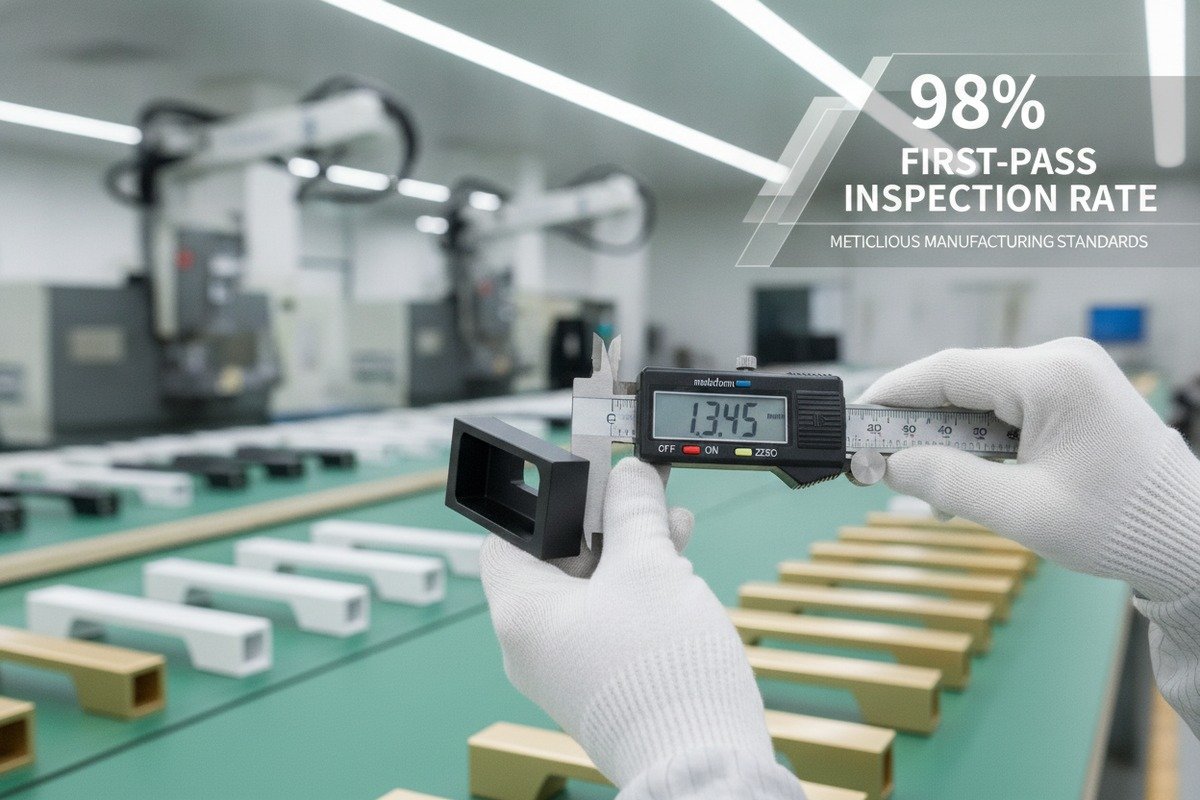
Why First-Pass Yield Matters More Than Unit Price
A handle that costs $0.50 but fails inspection 15% of the time is not cheaper than a handle that costs $0.55 with a 2% defect rate. You pay for the rejects in sorting labor, return shipping, production delays, and angry customers. For recessed cabinet handles with tight geometric channels and precision finger-grip profiles, even a 0.3 mm deviation can make the handle wobble in the routed slot. Our extrusion lines 3 in Foshan hold tolerances within ±0.1 mm consistently because the dies, presses, and inspection gauges have been refined over 18 years.
Surface Finish Is Where Gaps Become Visible
Aluminum furniture handles depend on finish quality. Whether it is matte champagne gold anodizing, charcoal grey powder coating 4, or a clean white finish, the surface must be uniform, scratch-free, and resistant to daily wear. Chinese factories with established anodizing lines control bath chemistry, temperature, and dwell time with automated systems. Many Vietnamese suppliers still rely on semi-manual anodizing setups or outsource finishing to third-party shops, which introduces variability between batches.
Quality Comparison at a Glance
| Quality Factor | Typical Chinese Supplier (Established) | Typical Vietnamese Supplier (Leading) | Typical Vietnamese Supplier (SME) |
|---|---|---|---|
| First-pass inspection rate | 96–98% | 90–94% | ~85% |
| Anodizing color consistency (batch-to-batch) | High | Moderate | Variable |
| Dimensional tolerance (extrusion) | ±0.1 mm | ±0.2–0.3 mm | ±0.3–0.5 mm |
| Surface scratch rate | <1% | 3–5% | 5–10% |
| Packaging damage on arrival | <0.5% | 1–3% | 3–7% |
The Hidden Cost of Inconsistency
If you are a wholesaler distributing to furniture factories across Vietnam, your buyers expect every carton to match the approved sample. When handles arrive with color shifts or dimensional drift, you absorb the cost of sorting, replacing, or discounting. We have seen Vietnamese distributors spend more on post-delivery quality management than they saved on the cheaper quote. The quality justifies the price difference when the product demands precision — and recessed architectural handles with deep geometric channels absolutely demand precision.
Can I achieve better lead times and lower MOQs by importing from a Foshan factory instead of sourcing within Vietnam?
One of the biggest surprises for our Vietnamese wholesale clients is that ordering from Foshan can actually be faster than ordering from a local factory. Our warehouse holds over 300 tons of ready-to-ship aluminum handle inventory, and stock items go out the door within 48 hours.
Yes, a well-stocked Foshan factory can offer 48-hour dispatch for standard handles and 3–7 day turnaround for custom orders, often beating Vietnamese suppliers whose lead times stretch to 15–30 days due to imported raw material delays and smaller production capacity. MOQs from Foshan are also frequently more flexible than expected.
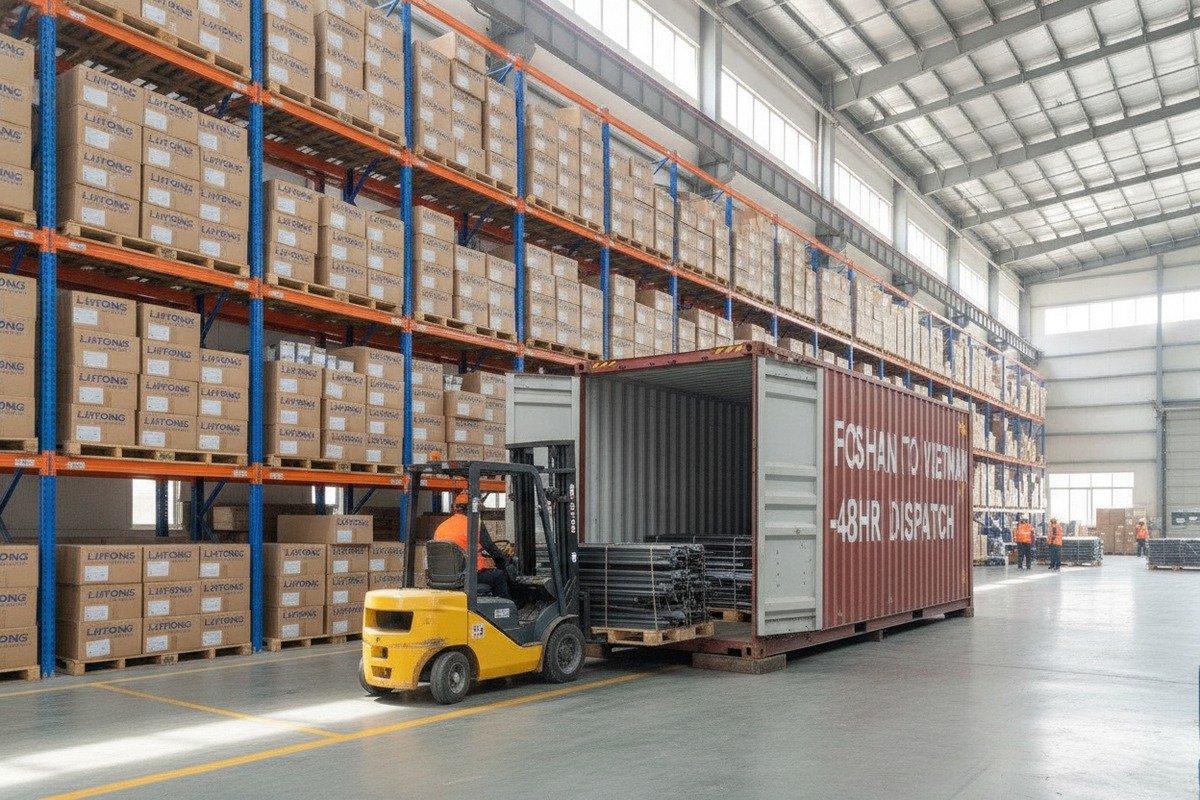
Why Foshan Factories Can Ship Faster
Foshan is the aluminum capital of China 6. Raw billets, extrusion presses, anodizing plants, powder coating lines, and packaging suppliers are all within a 30-kilometer radius. When you place an order, we do not wait weeks for material to arrive. The billet is in the warehouse. The die is on the shelf. The finishing line runs daily. This integrated supply chain 7 is what makes 3–7 day custom production possible.
Vietnamese factories, on the other hand, import roughly 70% of their aluminum raw materials 8 from China. That alone adds 7–14 days of shipping and customs clearance before production even starts. If the local supplier does not keep large raw material inventories, your lead time stretches to three or four weeks easily.
MOQ Realities
Many buyers assume that a local Vietnamese supplier will accept tiny orders. Some do, but at a steep per-unit premium. Foshan factories serve global markets and run high-volume lines, but we also understand that a Vietnamese wholesaler testing a new handle design does not want to commit to 10,000 pieces upfront. Our standard MOQ for stock handles is as low as 200 pieces per SKU. For custom extrusion profile 9s, we can start at 500 pieces once the die is made.
Lead Time and MOQ Comparison
| Factor | Foshan Factory (LiliTONG) | Vietnamese Leading Factory | Vietnamese SME Supplier |
|---|---|---|---|
| Stock item dispatch | 48 hours | 3–7 days (if in stock) | 7–14 days |
| Custom order turnaround | 3–7 days | 15–25 days | 20–30 days |
| Raw material sourcing delay | None (local supply) | 7–14 days (imported from China) | 10–21 days |
| MOQ for stock handles | 200 pcs/SKU | 300–500 pcs/SKU | 100–300 pcs/SKU |
| MOQ for custom handles | 500 pcs (after tooling) | 500–1,000 pcs | 200–500 pcs |
| Sample turnaround | 3–5 days | 7–14 days | 10–20 days |
Shipping Time From Foshan to Vietnam
Sea freight from Foshan to Ho Chi Minh City takes roughly 3–5 days. Add 2–3 days for customs clearance and inland delivery. Total door-to-door transit is about 7–10 days. Compare that with a Vietnamese factory that needs 15–30 days just to produce your order. In many cases, the Foshan order arrives at your warehouse before the Vietnamese factory even finishes production.
When Vietnam Wins on Lead Time
There is one scenario where a Vietnamese supplier beats Foshan on speed: when the Vietnamese factory has your exact handle in stock and you only need a small quantity for an urgent fill. In that narrow situation, local sourcing saves transit time. But for anything involving custom work, new finishes, or moderate-to-large volumes, the Foshan supply chain is hard to beat.
What are the key technical and customization advantages I should expect when choosing a Chinese manufacturer over a local one?
Our R&D team works with furniture factories across Southeast Asia and the Middle East to develop handles that do not exist in any catalog. Last quarter alone, we created 14 new extrusion die profiles for clients who needed handles to match specific cabinet designs. That kind of technical depth is where the real advantage lives.
Chinese manufacturers offer deeper customization capabilities including proprietary die design, multi-step surface treatments, color matching across large batches, and engineering support for fit and tolerance. These advantages matter most for architectural-grade handles, branded product lines, and projects where the handle must integrate precisely with cabinetry or furniture systems.

Die Design and Extrusion Flexibility
Every aluminum handle starts as an extrusion profile. The die determines the cross-section geometry — the L-shaped profile, the depth of the finger-grip channel, the wall thickness, and the mounting dimensions. In Foshan, die makers are specialists with decades of experience. They can cut a new die in 3–5 days, test it, refine it, and deliver production-ready profiles within a week. In Vietnam, die-making capability exists but is less mature. Complex cross-sections with tight internal radii or thin walls may require multiple iterations, each adding time and cost.
Surface Treatment Options
Chinese factories offer a broader menu of surface finishes. For the kind of sleek, minimalist recessed handles that are popular in modern kitchens and wardrobes, buyers often need matte anodizing in specific colors — champagne gold, light bronze, charcoal grey, or pure white. Our anodizing line can match Pantone references or physical samples with ΔE < 1.5 color deviation. We also offer dual-process finishes: sandblasted then anodized, brushed then powder-coated, or chemically etched then electrophoretically painted. Vietnamese suppliers can handle standard anodizing and powder coating well, but multi-step or precision color-matching processes are less commonly available.
Engineering Support
When a furniture factory client sends us a CAD drawing of a new cabinet door, our engineers can recommend the optimal handle profile, mounting method, and tolerance stack-up. We check whether the handle will fit the routed groove, whether the screw pattern aligns with standard hardware, and whether the anodized finish will resist the cleaning chemicals used in commercial kitchens. This is not just manufacturing — it is collaborative product development. Smaller Vietnamese factories typically do not have dedicated engineering teams for this level of support.
Customization Capability Comparison
| Customization Area | Chinese Manufacturer (Established) | Vietnamese Supplier (Leading) |
|---|---|---|
| New die design turnaround | 3–5 days | 7–14 days |
| Die complexity (thin walls, tight radii) | High capability | Moderate capability |
| Color matching (anodizing) | ΔE < 1.5 | ΔE 2.0–3.5 |
| Multi-step surface treatments | Standard offering | Limited availability |
| CAD engineering support | In-house team | Often outsourced or unavailable |
| Custom packaging and branding | Full service | Basic options |
| OEM/ODM development | Dedicated process | Case-by-case |
When Customization Matters Most
If you are selling standard satin-finish silver handles in bulk, the customization gap may not affect your decision. But if you are building a branded product line, developing handles for a specific furniture system, or supplying high-end residential projects where the champagne gold handle must perfectly match the cabinet frame, the technical depth of a Chinese manufacturer is a significant advantage. The handles we produce — those sleek, architectural recessed pulls with deep geometric channels and sharp, clean edges — require extrusion precision, consistent anodizing, and tight dimensional control that comes from a mature manufacturing ecosystem.
How do I calculate the total landed cost to see if importing handles from China is actually more profitable for my wholesale business?
We built an internal landed-cost calculator years ago because too many of our clients were making sourcing decisions based on the wrong number. They compared the ex-factory price from a Vietnamese supplier with our FOB price and assumed Vietnam was cheaper. Once they added all the real costs, the picture changed.
To calculate total landed cost, add the ex-factory unit price, tooling amortization, sample costs, packaging, inland freight, export charges, ocean freight, insurance, import duties, customs brokerage, inland delivery at destination, quality inspection, and expected rework or reject costs. Only this complete figure reveals which supplier is truly more profitable.

The Landed Cost Formula
Here is a simple breakdown of every cost element you should track:
- Unit price (ex-factory or FOB)
- Tooling / die cost (amortized over order quantity)
- Sample cost (including shipping)
- Packaging (inner box, carton, pallet, labeling)
- Inland freight to port (origin country)
- Export customs and documentation
- Ocean freight (or air freight if urgent)
- Marine insurance
- Import duties and tariffs (destination country)
- Customs brokerage at destination
- Inland freight to warehouse (destination)
- Quality inspection cost (pre-shipment or on-arrival)
- Rework / reject cost (based on historical defect rate)
- Communication and coordination overhead
A Worked Example: 5,000 Recessed Handles
Let's say you need 5,000 pieces of a 300 mm matte champagne gold recessed aluminum handle, delivered to your warehouse in Ho Chi Minh City.
| Cost Element | China (Foshan FOB) | Vietnam (Ex-Factory Local) |
|---|---|---|
| Unit price | $0.85 | $0.75 |
| Tooling (amortized) | $0.04 | $0.06 |
| Packaging | $0.03 | $0.03 |
| Inland freight (origin) | $0.02 | $0.01 |
| Ocean freight + insurance | $0.05 | N/A (local) |
| Import duties (Vietnam) | $0.04 | N/A |
| Customs brokerage | $0.01 | N/A |
| Inland freight (destination) | $0.02 | $0.02 |
| QC inspection | $0.02 | $0.02 |
| Rework/reject allowance (2% vs 8%) | $0.02 | $0.06 |
| Total landed cost per piece | $1.10 | $0.95 |
| Effective cost after quality-adjusted yield | $1.12 | $1.03 |
In this example, the Vietnamese supplier still comes out ahead by about $0.09 per piece. But notice how the gap shrank from $0.10 at the unit-price level to $0.09 at the landed-cost level, and would shrink further if the Vietnamese supplier's reject rate is higher than 8% or if a rework shipment is needed.
When China Becomes Cheaper
The math tips in China's favor when:
- Order size is large (over 10,000 pieces), where Chinese factories offer volume discounts that Vietnamese suppliers cannot match.
- The handle design is complex, requiring precision dies and multi-step finishes that Vietnamese factories quote at a premium or cannot produce consistently.
- Rework risk is high — if historical defect rates from the Vietnamese supplier exceed 10%, the reject and rework cost erases the unit price savings.
- Speed matters — if a delayed order from a Vietnamese supplier forces you to air-freight a partial shipment, one air freight bill can wipe out months of unit-price savings.
- You are re-exporting — if your Vietnamese wholesale business also exports to the Middle East or other ASEAN markets, the tariff picture changes and China's FOB price may already be competitive.
The Real Comparison Checklist
Before requesting quotes, send both suppliers the same specification sheet. Include the alloy grade (6063-T5 is standard for furniture handles), the exact surface finish, dimensional tolerances, screw-hole pattern, packaging requirements, and delivery terms. Ask each supplier to quote on identical terms. Then plug every cost element into the formula above. Do not compare FOB China to ex-factory Vietnam — that is apples to oranges.
Also ask each supplier for their typical first-pass inspection rate and request photos or reports from recent shipments. A supplier who shares this data confidently is usually one who has good numbers to share.
The Profitability Decision
For your wholesale business, profitability is not just about the cheapest handle. It is about the handle that arrives on time, matches the sample, fits the cabinet, and does not generate returns from your furniture factory clients. A $0.09 saving per piece means nothing if one bad shipment costs you a major account. Choose China when precision, speed, and consistency drive your margins. Choose Vietnam when the spec is simple, the volume is moderate, and tariff savings are significant.
Conclusion
The cheapest quote is never the cheapest supplier. Compare total landed cost, defect risk, lead time, and customization depth before deciding between Chinese and Vietnamese aluminum handle sources. When precision and consistency matter, Foshan's mature supply chain often delivers better total value for your wholesale business.
Footnotes
1. Provides detailed information on aluminum handle profiles for furniture, including technical specifications and applications. ↩︎
2. Authoritative explanation of anodizing as an electrochemical process for aluminum surfaces, detailing its benefits and applications. ↩︎
3. Explains the aluminum extrusion process and mentions the operation of an extrusion line. ↩︎
4. Describes the process of powder coating aluminum for durability. ↩︎
5. Defines First Pass Yield (FPY) as a key metric for manufacturing quality and efficiency, explaining its calculation and importance. ↩︎
6. Confirms Foshan’s status as a global hub for aluminum manufacturing. ↩︎
7. Defines integrated supply chain management and its coordination. ↩︎
8. Provides an overview of aluminum production and raw materials. ↩︎
9. Explains different types and uses of aluminum extrusion profiles. ↩︎
10. Defines total landed cost and its key components. ↩︎