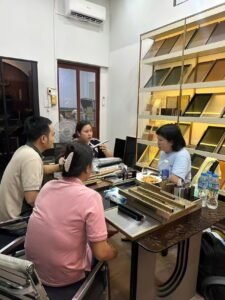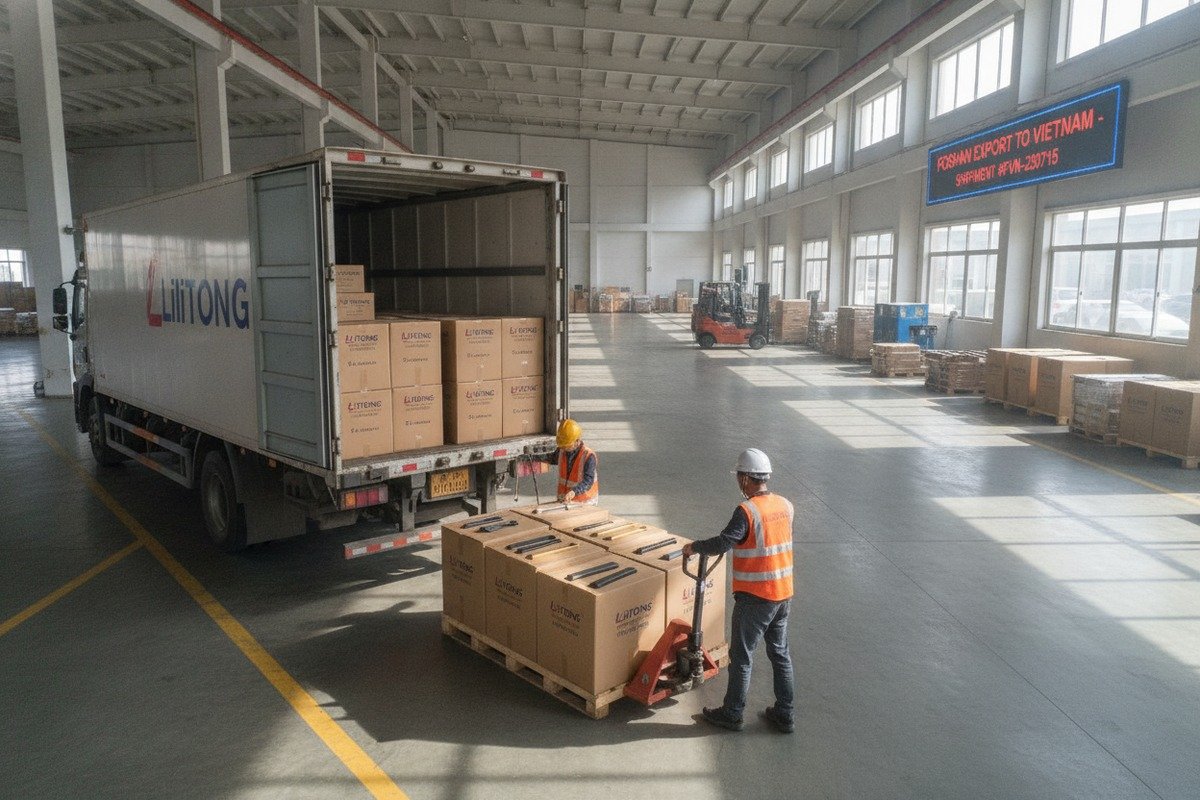
Every week, our warehouse team in Foshan processes shipments of aluminum handles bound for Vietnamese distributors, and the freight question always comes first.
For aluminum furniture handles shipped from China to Vietnam, land freight is typically the best default choice, offering a balance of speed, cost, and simplicity. Sea freight wins for large-volume orders where urgency is low, while rail freight remains a niche option due to limited routing flexibility on this corridor.
Choosing the wrong shipping method does not just cost you money Incoterms 1. It changes your lead time, your inventory burden, and even your packaging needs. Below, we break down each mode so you can match it to your actual order size, delivery timeline, and landed-cost targets.
How do I determine if land or sea freight is more cost-effective for my bulk aluminum handle imports?
Our export team runs cost comparisons for Vietnamese buyers almost daily, and the answer is rarely as simple as picking the cheapest rate per kilogram.
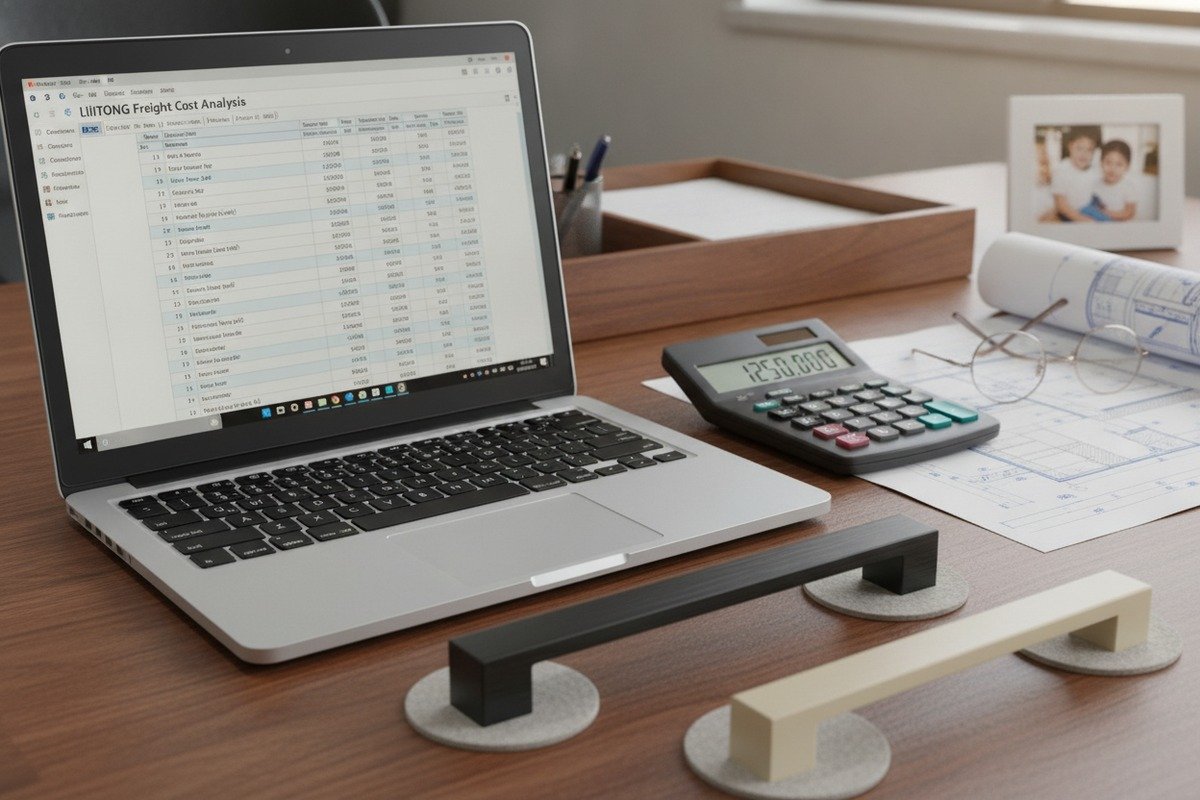
To determine whether land or sea freight is more cost-effective for bulk aluminum handle imports, compare the total landed cost per unit — including freight rate, port fees, customs handling, inland delivery, and inventory holding cost — not just the headline shipping price.
Why headline freight rates mislead buyers
Most buyers start by comparing a sea freight 2 rate to a land freight 3 rate. Sea freight almost always looks cheaper on paper. But aluminum furniture handles are small, light, and high in value density. A single carton of recessed cabinet pulls might weigh only 8–12 kg yet contain several hundred dollars of product. This means the per-unit freight cost is already low in absolute terms. The real cost difference shows up in the extras: terminal handling charges 4, port storage fees, customs broker fees at the port, and the inland trucking leg from the Vietnamese port to your warehouse.
Breaking down the cost layers
Here is a simplified comparison for a typical mid-sized shipment of aluminum handles from Foshan to Hanoi:
| Cost Component | Land Freight (Truck) | Sea Freight (LCL) |
|---|---|---|
| Base freight rate | Higher per kg | Lower per kg |
| Port / terminal fees | None | Yes — origin and destination |
| Customs handling complexity | Single land border | Port documentation + inland delivery |
| Inland last-mile delivery | Often included (door-to-door) | Separate cost from port to warehouse |
| Inventory holding cost | Lower (faster transit) | Higher (longer transit + port dwell) |
| Typical transit time | 3–6 days | 7–13 days |
| Minimum charge risk | Lower | Higher for small LCL lots |
For orders under about 3 CBM, land freight frequently wins on total landed cost 5 because it avoids the port-side complexity entirely. For orders filling a full 20-ft container or more, sea freight's lower per-unit rate starts to outweigh the extra handling costs.
The consolidation factor
When we ship handles together with other furniture hardware — aluminum profiles 6 for glass doors, honeycomb panel trim, edge banding — the combined volume can justify a sea container. If you are only ordering handles, the volume is usually too small for a dedicated container. In that case, you either pay LCL (less-than-container-load) 7 sea rates, which carry surcharges and more handling, or you use a truck and get a cleaner, faster delivery.
A practical rule of thumb
If your order value is under $5,000 and you need it within a week, land freight almost always gives you a better total cost. If your order fills half a container or more and you can wait two weeks, sea freight will save money on the freight line. The key is to calculate per-box or per-kilogram landed cost, not just the freight invoice.
Why should I consider land transport for faster delivery of my furniture hardware from China to Vietnam?
In our Foshan facility, we see a clear pattern: Vietnamese buyers who switch from sea to land freight cut their restock cycle nearly in half and reduce out-of-stock complaints.
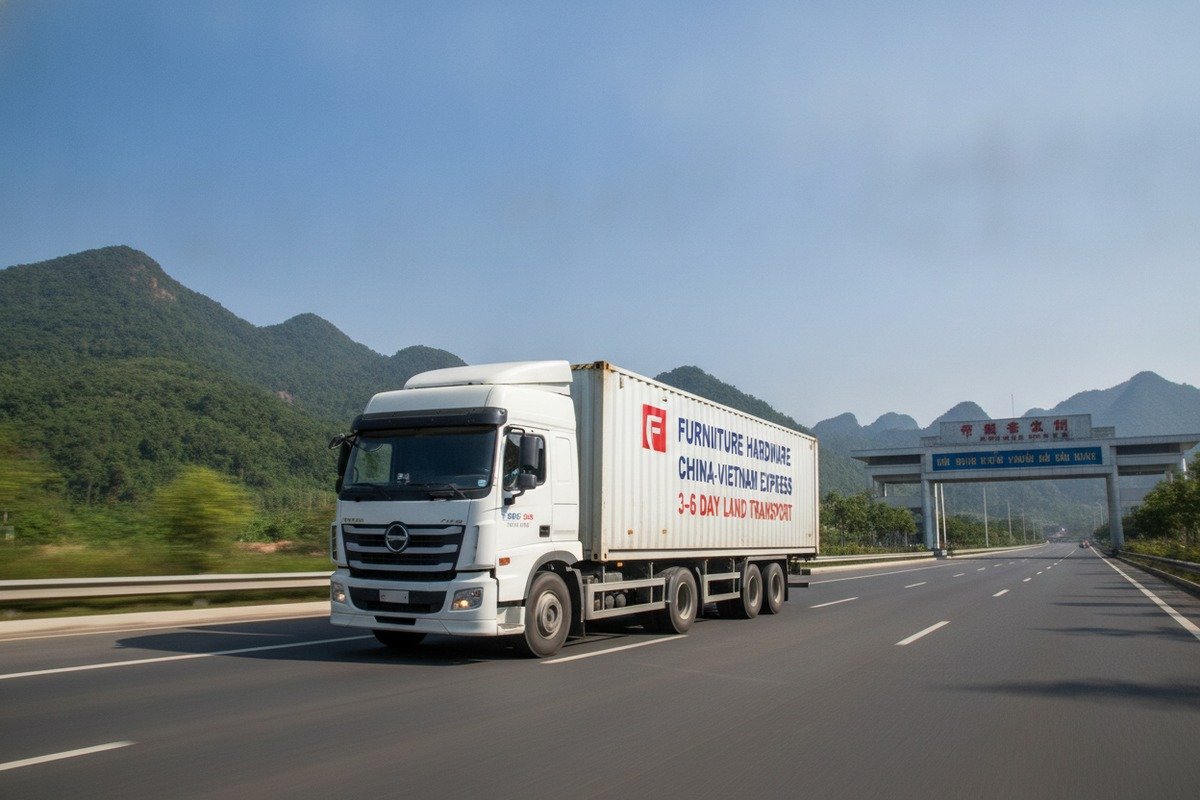
Land transport is the fastest practical option for furniture hardware from China to Vietnam, typically delivering in 3–6 days door-to-door, with simpler border customs, flexible scheduling, and lower risk of port congestion delays compared to sea freight.
Speed is not just about transit days
Transit time is only part of the equation. With sea freight, you also need to account for:
- Waiting for vessel space (carrier booking lead time).
- Container stuffing and port cut-off deadlines.
- Port dwell time at the destination before customs clearance.
- Inland trucking from the Vietnamese port to your facility.
These steps can add 3–7 extra days on top of the quoted sea transit time. Land freight eliminates most of them. A truck loaded at our Foshan warehouse can reach Hanoi in about 3–4 days, with customs clearance handled at the land border crossing in a single step.
Border crossings and customs simplicity
The China–Vietnam land border has well-established crossing points like Youyi Guan (Friendship Pass) and Dongxing–Mong Cai. For aluminum furniture handles, documentation is straightforward: commercial invoice, packing list, and certificate of origin. If you use a Form RCEP 8 or Form E under ACFTA, you can also claim preferential tariff rates. Land border customs officers process hardware shipments routinely, so delays are uncommon for properly documented goods.
Scheduling flexibility
Sea freight operates on fixed vessel schedules. If you miss the cut-off, you wait for the next sailing — sometimes a week later. Land freight is far more flexible. We can dispatch a truck on short notice when a buyer needs an urgent restock. This flexibility is especially valuable for buyers who operate on a just-in-time model or who serve furniture factories with tight production calendars.
Who benefits most from land freight speed?
| Buyer Profile | Why Land Freight Fits |
|---|---|
| Northern Vietnam distributors (Hanoi, Hai Phong region) | Closest to border crossings; fastest delivery |
| Furniture factories with tight production schedules | Cannot afford 2-week wait for sea freight |
| Buyers placing frequent small-to-medium reorders | Flexible scheduling and short cycle times |
| Wholesalers testing new handle designs | Quick sample and trial-order delivery |
For buyers in southern Vietnam — Ho Chi Minh City and surrounding areas — land freight is still competitive, though transit time extends to 5–6 days. Even so, this is often faster than sea freight's total cycle when you include port handling.
Packaging and damage considerations
Aluminum furniture handles with anodized or matte finishes, like our champagne gold and charcoal grey recessed pulls, are sensitive to surface scratches. Shorter transit and less handling mean less damage risk. Each handle should still be individually wrapped in protective film and packed in reinforced cartons, but the reduced number of loading and unloading events in truck transport lowers the chance of cosmetic defects reaching your warehouse.
How will my choice of shipping method affect the lead times for my custom-designed aluminum profiles?
When we receive a custom handle order — say a new recessed pull with a specific L-shaped cross-section and a unique champagne gold anodize — our production team needs 3–7 days to complete the run, and the shipping method you choose determines what happens after that.
Your shipping method directly impacts the total lead time from order confirmation to warehouse delivery. Land freight adds 3–6 days after production, sea freight adds 10–18 days, and rail adds 7–12 days, so the mode you choose can nearly double or triple your overall wait time for custom aluminum profiles.
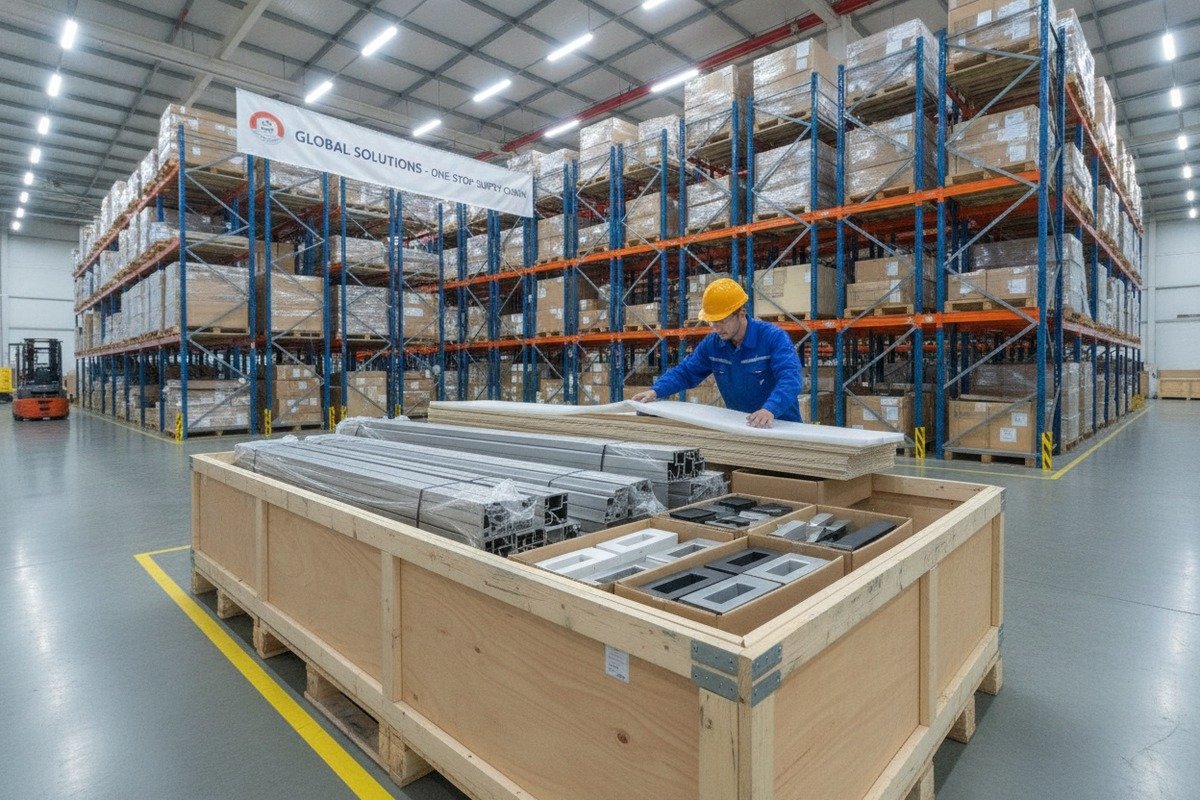
Understanding the full lead time chain
Total lead time for custom-designed aluminum handles includes several stages. Here is how they stack up with each shipping mode:
| Lead Time Stage | Duration | Notes |
|---|---|---|
| Order confirmation & deposit | 1–2 days | Same for all modes |
| Die/mold preparation (if new profile) | 5–7 days | Only for first-time custom profiles |
| Extrusion & surface treatment | 3–7 days | Depends on quantity and finish |
| Quality inspection & packing | 1 day | Same for all modes |
| Land freight transit | 3–6 days | Door-to-door |
| Sea freight transit (including port handling) | 10–18 days | Includes booking, port dwell, inland delivery |
| Rail freight transit | 7–12 days | Includes terminal transfers |
For a new custom profile, you are looking at roughly 10–17 days of production lead time before shipping even begins. If you choose land freight, total door-to-door lead time is about 13–23 days. If you choose sea freight, it jumps to 20–35 days. That difference matters when your furniture factory client is waiting for handles to complete a kitchen cabinet order.
Why custom orders amplify the shipping decision
Stock items can absorb shipping delays because they sit in inventory, ready to go. Custom orders do not have that buffer. Every day of transit is a day your production line or your customer's production line sits idle. This is why the majority of our Vietnamese OEM buyers choose land freight for custom runs. They get the handles into their workflow faster and avoid tying up working capital in goods floating on the ocean.
Rail freight for custom orders — a realistic assessment
Rail is sometimes positioned as a middle ground. In theory, it is faster than sea and cheaper than land for medium volumes. In practice, China–Vietnam rail corridors have limited frequency and require terminal transfers that add unpredictable time. New routes like Qinghai–Dong Nai are improving, but for most custom handle orders originating from Foshan in Guangdong province, the rail network does not connect as directly as a truck route. Unless your supply chain is already built around a rail corridor, road transport remains more predictable for custom goods.
Practical tips for reducing total lead time
- Submit final drawings early. Our engineering team can prepare extrusion dies while you finalize your order details, shaving days off the front end.
- Choose land freight for the first production run. Get your samples and initial batch fast. Switch to sea freight for large repeat orders once the design is proven.
- Consolidate custom and stock items. If you need both custom profiles and stock handles, we can pack them together for a single land shipment.
- Provide complete customs documents upfront. Delays at the border are almost always paperwork delays. Have your HS codes 9, invoices, and certificates of origin ready before the truck departs.
Can I optimize my logistics to take full advantage of the 48-hour shipping offered on stock items?
We maintain over 300 tons of ready-to-ship aluminum handle inventory in our Foshan warehouse specifically so that buyers can restock fast — but the logistics chain after dispatch determines whether that 48-hour promise translates into real speed at your end.
Yes, you can fully leverage 48-hour stock dispatch by pairing it with land freight, pre-clearing customs documents, and maintaining a standing logistics arrangement with a reliable freight forwarder who can schedule pickups on short notice from Foshan.

What 48-hour shipping actually means
When we say 48-hour shipping for stock items, we mean the goods leave our warehouse within 48 hours of order confirmation and payment. The handles are already extruded, anodized, inspected, and packed. Our team picks the order, labels the cartons, and prepares shipping documents within that window. But once the goods are on a truck or at a port, the transit timeline is governed by your chosen freight mode.
Matching the dispatch speed to the freight mode
Here is how total delivery time changes depending on your logistics setup:
| Logistics Scenario | Dispatch | Transit | Total to Hanoi |
|---|---|---|---|
| 48-hour dispatch + pre-arranged land freight | 2 days | 3–4 days | 5–6 days |
| 48-hour dispatch + ad-hoc land freight booking | 2 days | 4–6 days | 6–8 days |
| 48-hour dispatch + sea freight (LCL) | 2 days | 10–15 days | 12–17 days |
| 48-hour dispatch + sea freight (FCL, next sailing) | 2 days | 7–10 days | 9–12 days |
The difference is dramatic. With a pre-arranged land freight partner, you can go from order click to warehouse delivery in under a week. With sea freight, even the fastest scenario takes almost two weeks.
How to build a logistics setup for speed
To truly optimize around fast stock dispatch, consider these steps:
1. Establish a standing freight arrangement. Work with a freight forwarder who covers the Foshan–Hanoi or Foshan–HCMC route regularly. A standing arrangement means trucks are scheduled weekly or on-call, eliminating booking delays.
2. Pre-prepare customs documentation. Keep a template set of documents ready: your company's import license details, preferred HS codes for aluminum handles (commonly under HS 83024290 or 76109099 depending on classification), and a standing certificate of origin request. When an order ships, your forwarder fills in the quantities and values without starting from scratch.
3. Use Incoterms that match your speed goal. If you buy DAP (Delivered at Place) or DDP (Delivered Duty Paid), the supplier's logistics team handles more of the chain, which can speed things up if they have established routes. If you buy FOB or CIF, you control the freight booking — which is faster only if your forwarder is already set up.
4. Consolidate strategically. If you order handles every two weeks, align your order timing with your freight partner's truck schedule. Consolidating two small orders into one shipment saves cost and still arrives within your target window.
Inventory strategy and the 48-hour advantage
The real power of fast stock dispatch is that it lets you carry less inventory. Instead of ordering a three-month supply by sea and tying up warehouse space and cash, you can order a one-month supply by land and reorder when stock drops to a two-week threshold. This just-in-time approach reduces your carrying cost and lets you react faster to changes in handle style demand — especially important when you carry multiple finishes like matte black, charcoal grey, and champagne gold, where demand can shift by season or project.
Digital tracking and visibility
Modern freight forwarders offer real-time GPS tracking for land shipments. This means you can monitor your handles from Foshan to the border crossing to your Vietnamese warehouse. Combined with our dispatch confirmation and packing photos, you get end-to-end visibility. This is harder to achieve with LCL sea freight, where your cartons are mixed with other cargo and tracking granularity drops.
Conclusion
The right freight mode for your aluminum furniture handles depends on order size, urgency, and destination — not habit. Start with land freight as your default, use sea for bulk, and reserve rail for specific setups. Match your logistics to your inventory strategy, and the savings will show up in every landed-cost calculation.
Footnotes
1. Defines Incoterms as internationally recognized rules for trade responsibilities. ↩︎
2. Explains sea freight as a method for shipping goods across oceans. ↩︎
3. Defines land freight as the transportation of goods by road. ↩︎
4. Defines fees levied by terminal operators for cargo handling at ports. ↩︎
5. Explains total landed cost as the full expense of moving goods. ↩︎
6. Explains what aluminum profiles are and their manufacturing process. ↩︎
7. Explains LCL as sharing container space with other shippers. ↩︎
8. Describes the certificate of origin for preferential tariff treatment under RCEP. ↩︎
9. Explains HS codes as a global product classification system. ↩︎
10. Replaced with a working URL from the same domain, Project44, offering a detailed definition of rail freight transport. ↩︎