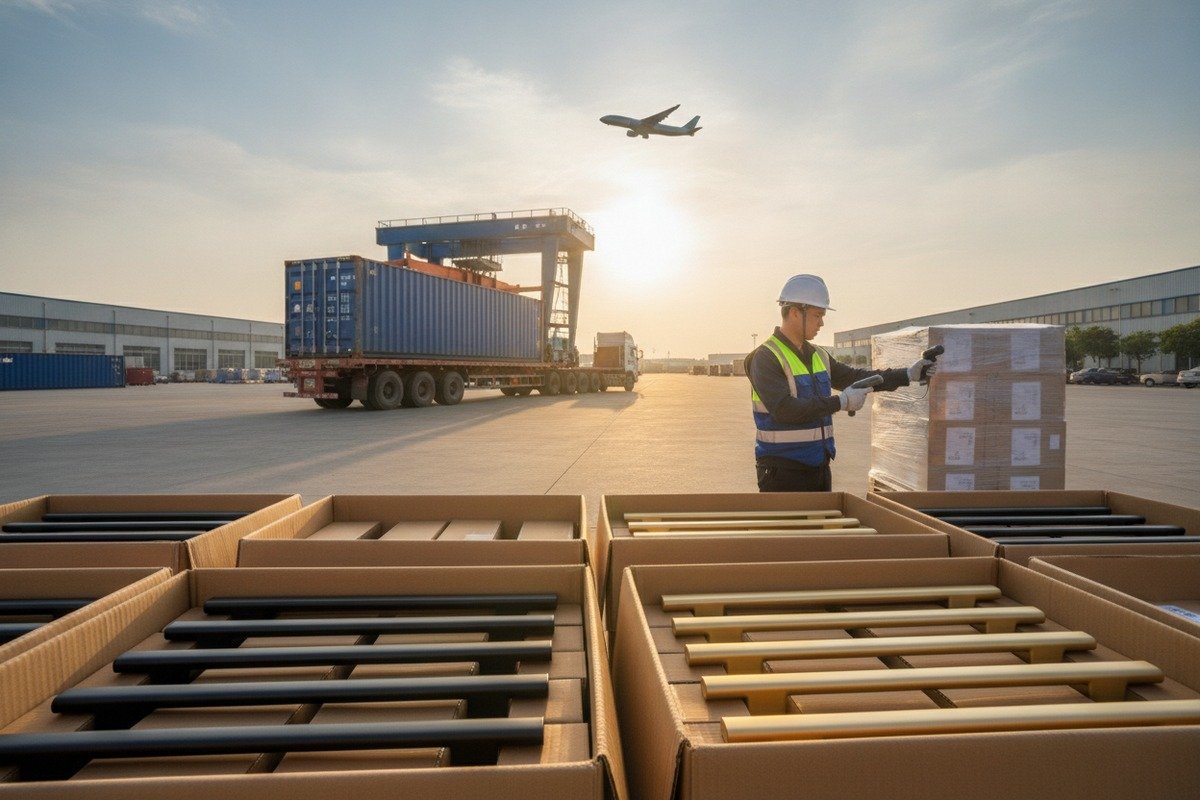
Every month, our Foshan warehouse ships hundreds of cartons of aluminum handles to furniture factories across Vietnam FCL and LCL 1. One thing we hear again and again from buyers is this: “I got three quotes, but they all seem to cover different things.” That confusion is not your fault. Shipping costs for small, dense hardware like cabinet handles are tricky because the final price depends on much more than just the freight rate.
When sourcing aluminum furniture handles from China to Vietnam, you should evaluate sea freight (FCL and LCL), air freight, express courier, and overland trucking. Total landed cost includes freight, origin handling, export clearance, import duties, VAT, and last-mile delivery. Matching your order size and urgency to the right shipping mode is the single biggest way to control cost.
Below, we break down each shipping method, the hidden costs that surprise first-time importers, and practical ways to keep your per-handle logistics cost as low as possible. Whether you run a furniture factory in Ho Chi Minh City or distribute building materials in Hanoi, this guide will help you make smarter freight decisions.
How do I choose between land and sea freight for my aluminum handle orders to Vietnam?
Our production base sits in Foshan, Guangdong, which gives us direct access to both southern China's seaports and the overland routes running through Guangxi province into northern Vietnam. Many of our Vietnamese buyers ask whether it is cheaper to ship by truck or by sea. The honest answer depends on where your factory is located and how much you are ordering.
For aluminum handle orders under 500 kg headed to northern Vietnam, overland trucking is often faster and similarly priced to sea LCL. For shipments to Ho Chi Minh City or southern Vietnam, sea freight almost always wins on cost, especially for orders above one cubic meter.

Understanding the Two Main Routes
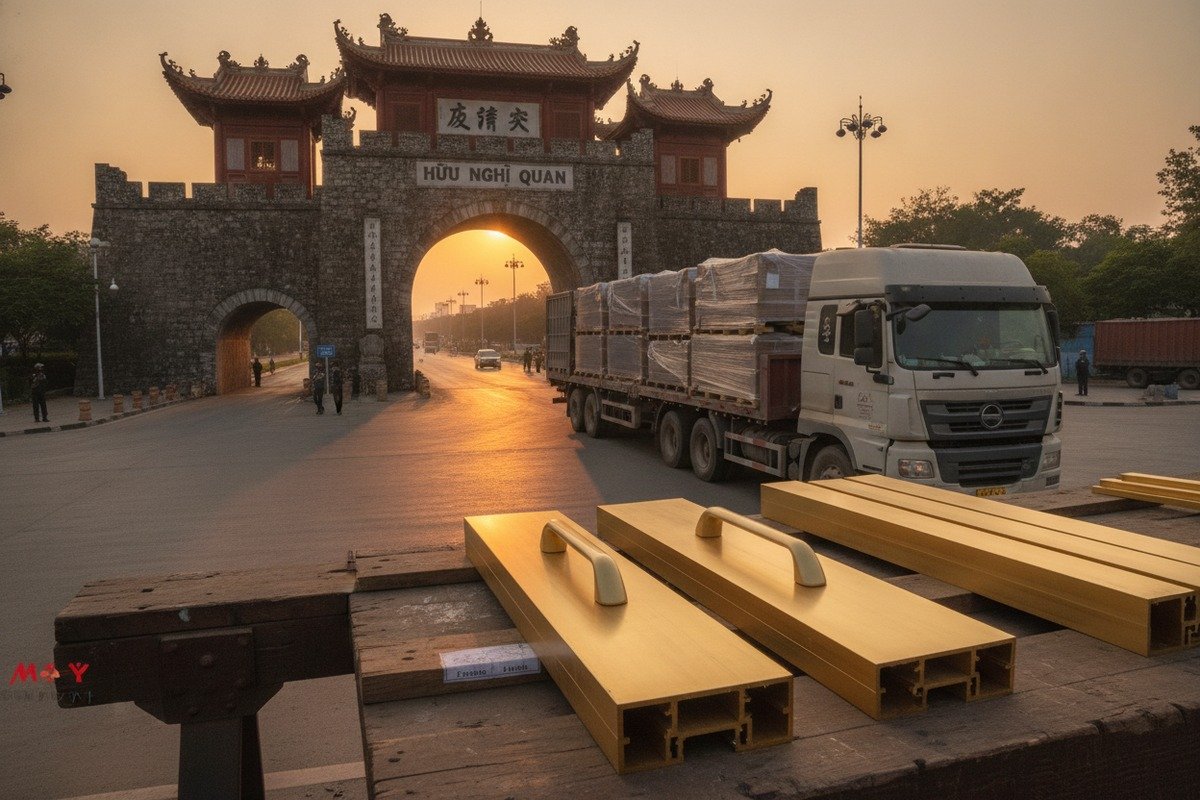
The China-to-Vietnam corridor has two natural logistics paths. The first is the sea route from ports like Nansha, Shekou, or Haiphong through to Ho Chi Minh City (Cat Lai) or Hai Phong port. The second is the land route, which typically runs from Foshan by truck through the Youyiguan–Huu Nghi border crossing into Lang Son, then onward to Hanoi or further south.
Sea freight 2 works on a volume basis. You pay per container (FCL) or per cubic meter (LCL). Since aluminum handles are small and dense, a 20-foot container can hold a very large quantity. A single pallet of our recessed cabinet handles might weigh 300 kg but occupy only 0.4 CBM. That density works in your favor with sea freight because you are not wasting space.
Land freight, on the other hand, often charges by weight. For dense metal products, this can make trucking more expensive per unit than sea LCL on longer routes. But for short-distance deliveries to Hanoi or northern industrial zones, trucking can be door-to-door in as little as 2–4 days.
Route Comparison Table
| Factor | Sea Freight (Foshan → HCMC) | Land Freight (Foshan → Hanoi) |
|---|---|---|
| Typical transit time | 5–8 days port-to-port | 2–4 days door-to-door |
| Cost structure | Per CBM (LCL) or per container (FCL) | Per kg or per truck |
| Best for | Southern Vietnam, bulk orders | Northern Vietnam, smaller urgent loads |
| Border clearance | Port customs at destination | Land border customs at Lang Son |
| Minimum practical size | 0.5 CBM (LCL) | 100 kg |
| Risk of delay | Port congestion, weather | Border queue times, holiday closures |
When Land Freight Makes Sense
If your factory is near Hanoi, Hai Phong, or Bac Ninh, and you are ordering a few hundred kilograms of stock handles, trucking through the Guangxi border can save you both time and money. We regularly arrange overland shipments for repeat customers who need fast replenishment. The key advantage is simplicity: one truck, one border crossing, and direct delivery to your door.
However, trucking rates fluctuate around Chinese holidays. Before Chinese New Year or during the October Golden Week, border queues can stretch for days. Plan your orders around these periods.
When Sea Freight Wins
For anything going to southern Vietnam, sea freight is the default. The Foshan-to-Cat Lai sea route is well-served by multiple shipping lines, and transit times are predictable. If your order fills even a quarter of a container, LCL consolidation through a forwarder is straightforward and cheap. For orders above about 12–15 CBM, booking a full 20GP container becomes more economical than paying per CBM.
One thing to keep in mind: sea freight transit times are port-to-port. You still need to add 1–3 days for customs clearance in Vietnam and another 1–2 days for inland trucking from the port to your factory. Total door-to-door time is typically 8–13 days.
What are the typical import duties and taxes I will face when sourcing from China?
We work closely with our Vietnamese buyers on documentation because getting the paperwork wrong can turn a good deal into an expensive headache. Many first-time importers focus only on the product price and the freight quote, then get surprised by the duties and taxes that hit at the destination port.
Aluminum furniture handles imported into Vietnam from China typically face an import duty of 0–5% under the ASEAN-China Free Trade Area (ACFTA) or RCEP, plus a standard 10% VAT on the CIF value plus duty. To qualify for reduced duty, you must provide a valid Certificate of Origin (Form E or RCEP form) and use the correct HS code.
The HS Code Matters
Aluminum furniture handles generally fall under HS code 3 8302.42 (base metal mountings and fittings suitable for furniture) or sometimes 7616.99 (other articles of aluminum). The exact classification affects your duty rate. Getting the HS code wrong can result in overpaying duty or triggering a customs audit, both of which cost time and money.
We always include the correct HS code on our commercial invoices and packing lists. If you are unsure, ask your customs broker in Vietnam to confirm before the shipment departs.
Duty Rates Under Trade Agreements
Vietnam and China are both members of ACFTA and RCEP 4. ASEAN-China Free Trade Area (ACFTA) 5 These agreements can reduce or eliminate import duties on qualifying goods. Here is how the rates typically break down:
| Tax/Duty Type | Rate Without FTA | Rate With ACFTA (Form E) | Rate With RCEP |
|---|---|---|---|
| Import duty | 15–20% | 0–5% | 0–5% |
| VAT | 10% on (CIF + duty) | 10% on (CIF + duty) | 10% on (CIF + duty) |
| Special consumption tax | Usually 0% for hardware | Usually 0% | Usually 0% |
| Anti-dumping duty | Unlikely for handles | N/A | N/A |
The key takeaway: always request a Certificate of Origin 6 from your supplier. Without it, Vietnam customs will apply the MFN (Most Favored Nation) rate, which is significantly higher. Our team issues Form E certificates as a standard part of our export documentation for Vietnamese orders.
How to Calculate Your Landed Cost
Your total landed cost 7 per handle is not just the product price. Here is a simplified formula:
Landed Cost = Product Cost + Freight + Insurance + Import Duty + VAT + Customs Brokerage + Last-Mile Delivery
For example, if you buy 5,000 aluminum recessed handles at $0.80 each (FOB Foshan), and your freight plus insurance to Ho Chi Minh City adds $0.05 per handle, your CIF value is $0.85. With a 0% ACFTA duty and 10% VAT, your duty-inclusive cost becomes about $0.935 per handle before customs brokerage and delivery fees.
Common Documentation Checklist
To clear customs smoothly, make sure you have:
- Commercial invoice with unit price, total value, and HS code
- Packing list with carton count, net weight, and gross weight
- Bill of lading (sea) or airway bill (air)
- Certificate of Origin (Form E for ACFTA or RCEP form)
- Quality inspection certificate if required by the buyer or customs
- Import license (not usually needed for aluminum handles, but verify)
Missing even one document can delay clearance by days, and port storage fees add up quickly.
How can I minimize my shipping expenses for bulk furniture hardware orders?
Over the past 18 years, our team has helped hundreds of buyers optimize their logistics from Foshan to destinations across Southeast Asia and the Middle East. The buyers who consistently pay the least per handle are not necessarily the ones with the biggest orders. They are the ones who plan ahead, consolidate smartly, and avoid the small mistakes that create big costs.
To minimize shipping costs for bulk aluminum handle orders, consolidate shipments to maximize container utilization, pack efficiently to reduce wasted cubic space, book freight well before peak seasons, use FOB terms to control your own logistics, and work with a freight forwarder experienced in the China-Vietnam corridor.
Consolidation Is Your Best Friend
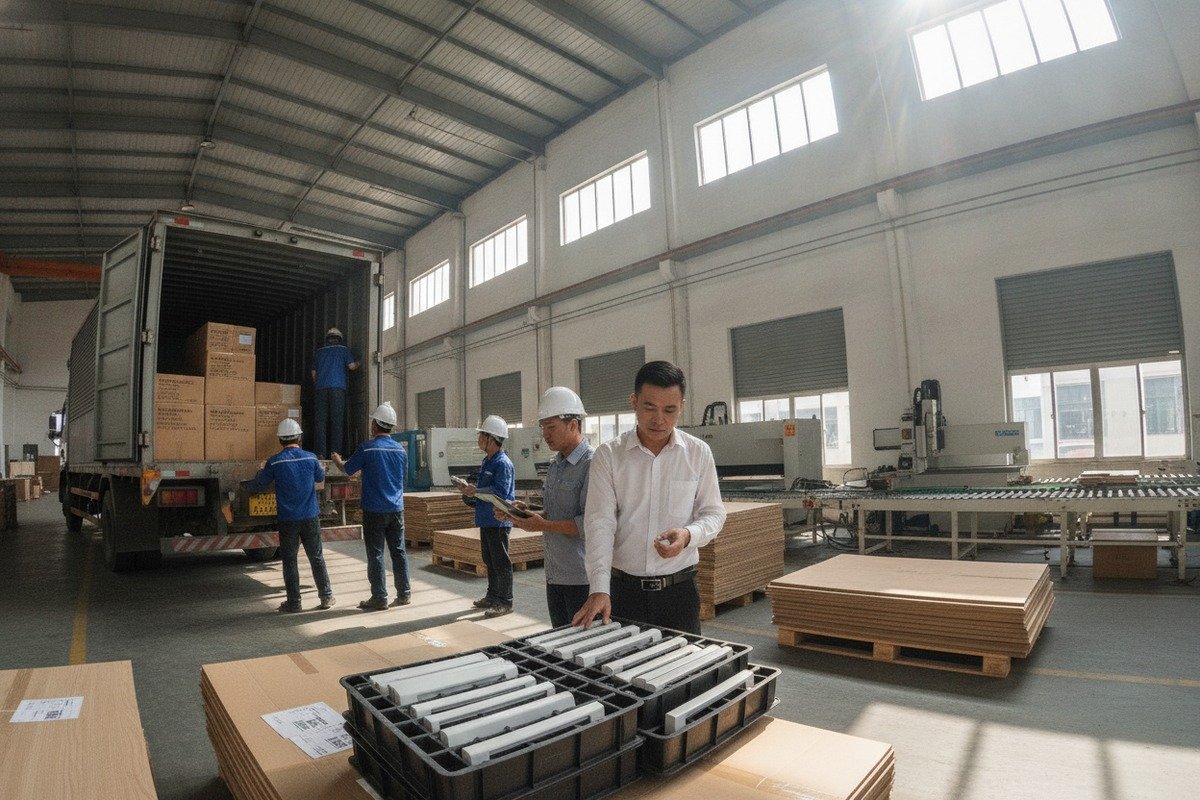
If you source handles from us and also buy hinges, drawer slides, or glass door profiles from other Foshan suppliers, a freight forwarder can consolidate everything into one LCL shipment or one shared container. This cuts the per-CBM rate because you are filling space that would otherwise go to waste.
We often coordinate with our buyers' forwarders to deliver goods to a local Foshan consolidation warehouse. This saves the buyer from paying multiple origin pickup fees.
Packaging Efficiency Directly Affects Freight Cost
Aluminum handles are dense. A single handle might weigh 150 grams but occupy very little space. The problem comes when packaging is inefficient. Oversized boxes, too much void fill, or irregular carton dimensions waste cubic space inside a container or LCL shipment.
Our standard packaging uses nested handle arrangements in compact cartons sized to stack neatly on pallets. This is not just about protecting the product. It is about making every cubic centimeter count.
Incoterms: Choose Wisely
The Incoterm 8 you agree on with your supplier determines who controls the freight and who pays for what. Here is a quick comparison:
| Incoterm | Seller Covers | Buyer Covers | Who Controls Freight? |
|---|---|---|---|
| EXW | Product only | Everything from factory gate | Buyer |
| FOB | Product + inland to port + export clearance | International freight + import | Buyer chooses forwarder |
| CIF | Product + freight + insurance to destination port | Import clearance + inland delivery | Seller chooses forwarder |
| DAP | Product + all freight to buyer's door | Import duties + taxes | Seller chooses forwarder |
| DDP | Everything including duties and taxes | Nothing | Seller handles all |
For experienced importers, FOB is often the sweet spot. You get to pick your own forwarder, negotiate your own rates, and consolidate shipments from multiple suppliers. CIF and DDP are convenient but give you less control. We offer all of these terms depending on what works best for each buyer.
Seven Practical Cost-Saving Tips
- Order in round container quantities. If your order nearly fills a 20GP, add a few more SKUs to avoid paying FCL rates for a half-empty box.
- Avoid peak shipping season. January (pre-Chinese New Year) and September–October see rate spikes. Place orders to ship in March–May or July–August.
- Request itemized freight quotes. Make sure your quote breaks out origin charges, ocean freight, destination charges, and customs brokerage separately. Hidden fees love bundled quotes.
- Use a China-based forwarder for origin handling. Local forwarders in Foshan or Guangzhou often have better rates for pickup and export clearance than international logistics companies.
- Negotiate packaging with your supplier. Ask if carton sizes can be adjusted to fit pallet dimensions more efficiently.
- Combine sample shipments with production orders. Instead of sending samples by express and the main order by sea separately, time them to ship together.
- Lock in freight rates early. Once you confirm the order, book the shipment immediately. Waiting even a week can mean a different rate.
What is the fastest way to get my custom aluminum profiles from Foshan to my factory in Vietnam?
When one of our Vietnamese furniture factory clients calls with an urgent order, the first thing we check is inventory. With over 300 tons of ready-to-ship stock in our Foshan warehouse, we can start packing within hours for standard handle profiles. For custom orders, our production turnaround is 3–7 days. But getting the product made is only half the equation. The shipping method you choose determines whether those handles reach your production line in two days or two weeks.
The fastest way to receive custom aluminum profiles from Foshan is to use air freight or express courier, which delivers in 1–5 days. For urgent orders under 100 kg, express services like DHL, FedEx, or SF Express offer door-to-door delivery to most Vietnamese cities within 2–3 business days. For larger urgent shipments, air freight to Tan Son Nhat or Noi Bai airport takes 3–5 days including clearance.
Express Courier: The Fastest Door-to-Door Option
Express courier 9 is the simplest and fastest option for small, urgent shipments. You do not need a freight forwarder. The courier company handles pickup, export clearance, international transport, import clearance, and delivery. For a 30 kg carton of custom aluminum recessed handles, you can expect delivery in 1–3 days to Ho Chi Minh City or Hanoi.
The downside is cost. Express rates for aluminum hardware typically run $5–$12 per kilogram depending on the courier, the exact weight, and whether you ship on the supplier's account or your own. For a 50 kg sample shipment, that means $250–$600 in shipping alone.
We frequently use express for sample sets, prototype handles for client approval, and emergency replacement orders. It is not economical for production quantities, but it keeps your factory line running when you cannot wait two weeks.
Air Freight: The Middle Ground for Urgency
Air freight 10 is faster than sea but cheaper than express for shipments above about 45–100 kg. The transit time from Guangzhou Baiyun Airport to Ho Chi Minh City is typically 1–2 days flight time, plus 1–3 days for export and import clearance on each end. Total door-to-door is usually 3–7 days.
Air freight uses chargeable weight, which is the higher of actual weight and volumetric weight. The formula is: Length (cm) × Width (cm) × Height (cm) ÷ 6000 = volumetric weight (kg). Since aluminum handles are dense, actual weight usually exceeds volumetric weight, which works in your favor. You pay for the real weight, not inflated dimensions.
Speed vs. Cost Comparison for Urgent Orders
| Method | Transit Time (Door-to-Door) | Cost for 50 kg | Cost for 300 kg | Best For |
|---|---|---|---|---|
| Express (DHL/FedEx) | 1–3 days | $250–$600 | $1,500–$4,500 | Samples, tiny urgent orders |
| Air freight | 3–7 days | $150–$400 | $500–$2,400 | Mid-size urgent orders |
| Overland truck (to Hanoi) | 2–4 days | $100–$200 | $450–$900 | Northern Vietnam, moderate urgency |
| Sea LCL | 9–17 days | $80–$150 | $200–$500 | Non-urgent, cost-sensitive |
| Sea FCL (20GP) | 8–13 days | Not practical | $225–$2,000 total | Large bulk orders |
A Practical Scenario
Let us say you are a furniture factory in Binh Duong province, near Ho Chi Minh City. You have a production run starting in 10 days, and you just realized you need 2,000 custom champagne gold anodized recessed handles. Here is what we would recommend:
- Day 1–3: We produce the custom handles at our Foshan factory.
- Day 3: Handles are packed and picked up by a freight forwarder for air shipment.
- Day 4–5: Air transit from Guangzhou to Tan Son Nhat Airport.
- Day 5–7: Import clearance and last-mile delivery to your Binh Duong factory.
Total time: about 7 days. Total shipping cost for roughly 300 kg of handles via air: approximately $500–$1,500, depending on the forwarder and the current rate.
If the same order ships by sea LCL, you save on freight but add 10–14 days. For a production deadline, that extra time costs more in factory downtime than the air freight premium.
Combining Speed and Economy
Smart buyers use a two-track approach. They ship the first batch by air to keep production moving, and the rest follows by sea at a lower cost. We help coordinate this split-shipment strategy regularly. It means paying a small air freight premium on 20–30% of the order while enjoying sea freight rates on the remaining 70–80%.
Conclusion
Shipping aluminum furniture handles from China to Vietnam is not complicated once you understand the trade-offs between speed, cost, and control. Match your shipping mode to your order size and timeline, use the right Incoterms, claim your preferential duty rates with a proper Certificate of Origin, and work with a forwarder who knows the China-Vietnam corridor. If you need help with documentation, packaging optimization, or coordinating shipments from our Foshan warehouse, reach out to our team at Al**************@********************************************te.com. We ship to Vietnam every week and can help you get the best landed cost for your next order.
Footnotes
1. Differentiates between Full Container Load and Less than Container Load shipping. ↩︎
2. Explains sea freight as a method for international goods transportation. ↩︎
3. Replaced with the official World Customs Organization (WCO) page, the most authoritative source for Harmonized System (HS) codes. ↩︎
4. Explains the Regional Comprehensive Economic Partnership free trade agreement. ↩︎
5. Provides an overview of the ASEAN-China Free Trade Area agreement. ↩︎
6. Details the purpose and types of Certificates of Origin in international trade. ↩︎
7. Defines total landed cost and its components in supply chain. ↩︎
8. Provides an official overview of Incoterms rules for international trade. ↩︎
9. Provides information on fast, door-to-door international express courier services. ↩︎
10. Describes air freight as a fast method for transporting goods by aircraft. ↩︎