
Every week, our sales team in Foshan fields the same question from buyers in Vietnam and the Middle East: “Should I pay you in dollars, renminbi, or my local currency?”
There is no single “best” settlement currency for aluminum furniture handles. Choose USD for simplicity and global benchmarking, RMB when your supplier prefers it and you can manage conversion costs, and VND only if your supply chain routes through a Vietnam-based intermediary. The right currency minimizes total landed cost, foreign-exchange risk, and payment friction for both sides.
Currency choice sounds like a back-office detail, but it quietly shapes your unit cost, your supplier relationship, and your profit margin on every shipment CNY (onshore RMB) 1. foreign-exchange risk 2 Below, we break down each option so you can make a confident decision on your next purchase order 3.
How do exchange rate fluctuations between USD and RMB impact my total sourcing costs for bulk aluminum handles?
Over the past 18 years of exporting aluminum profiles and furniture handles, our finance team has watched the USD/RMB rate swing enough to turn a profitable container into a break-even one overnight CNH (offshore RMB) 4.
Exchange rate movements between USD and RMB directly change your effective purchase price. A 5% weakening of the dollar against the yuan can add the equivalent of 5% to your cost per handle, eroding margins on bulk orders unless you hedge or lock in rates at the time of contract signing.
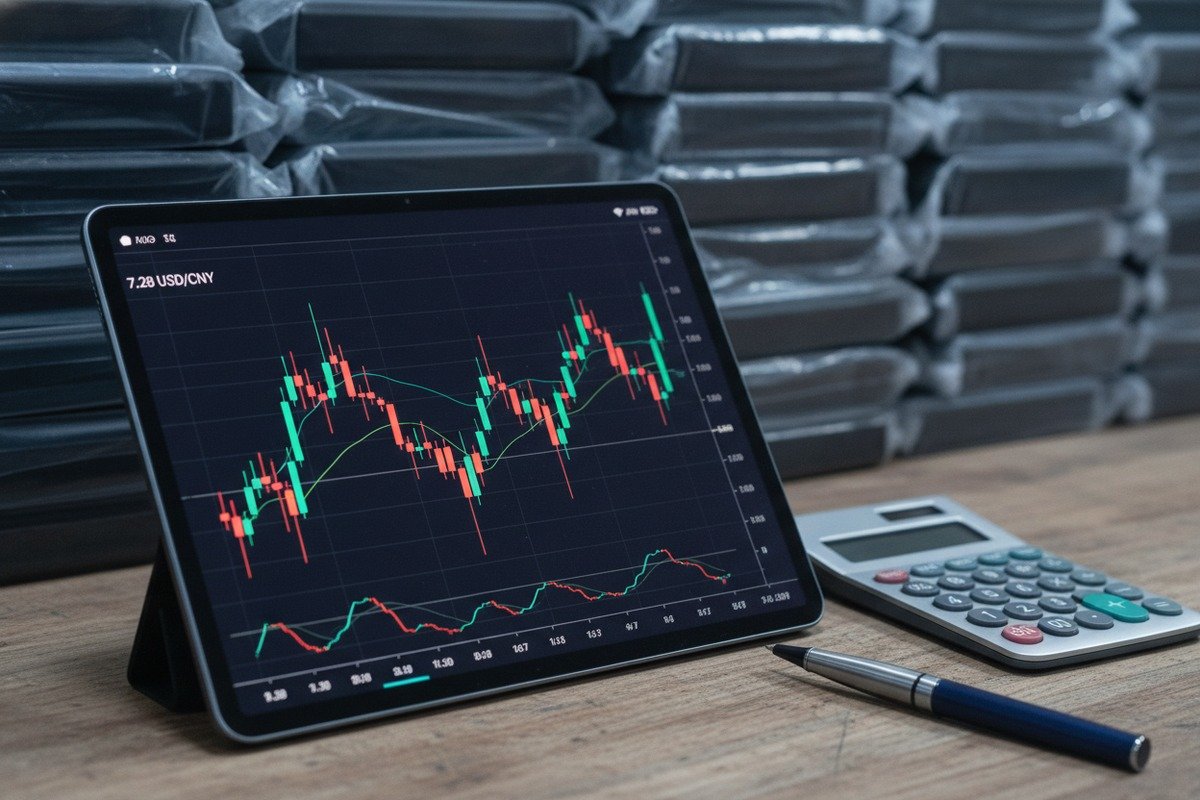
Why the Rate Matters More Than You Think
When you place a bulk order for, say, 10,000 recessed aluminum cabinet handles at $1.20 each, your total invoice is $12,000. If the dollar weakens by 3% between the date you sign the purchase order and the date you wire payment, the supplier receives fewer RMB than expected SWIFT (traditional wire) 5. That shortfall has to land somewhere. Either the supplier absorbs it, you renegotiate, or the next quote quietly includes a buffer.
In practice, most Chinese suppliers who quote in USD already build in a small currency cushion — often 1–3% — to protect themselves. That hidden buffer is money you are spending without realizing it.
A Simple Cost Comparison
| Scenario | USD/RMB Rate at Quote | USD/RMB Rate at Payment | Invoice (USD) | Effective Cost (RMB) | Change |
|---|---|---|---|---|---|
| Rate stays flat | 7.20 | 7.20 | $12,000 | ¥86,400 | 0% |
| USD strengthens 3% | 7.20 | 7.42 | $12,000 | ¥89,040 | +3.1% |
| USD weakens 3% | 7.20 | 6.98 | $12,000 | ¥83,760 | −3.1% |
For the buyer, a stronger dollar means you get more handles per dollar — good news. A weaker dollar means your effective cost rises. For the supplier, it is the opposite. This tug-of-war is constant.
Who Actually Bears the Risk?
If your supplier quotes in USD, they carry most of the FX risk between the quote date and the payment date. Many suppliers offset this by:
- Quoting with a wider margin.
- Shortening payment terms (asking for faster wire transfers).
- Adding a clause that allows re-pricing if the rate moves more than a set percentage.
If the supplier quotes in RMB, the risk shifts to you. You know exactly what the supplier expects, and you must convert your own currency into RMB at whatever rate your bank offers on the day you pay.
Practical Tips for Bulk Buyers
- Ask for a rate-lock window. Negotiate a clause that fixes the exchange rate for 7–14 days around the payment date.
- Compare the "all-in" cost. A lower unit price in one currency can be more expensive after conversion fees and bank spreads.
- Time your payments strategically. If you watch the USD/RMB rate and your payment terms allow flexibility, you can sometimes save 1–2% by wiring on a favorable day.
- Use forward contracts. Your bank can lock in a future exchange rate today, removing uncertainty on large orders.
Can I get better wholesale pricing from my Chinese supplier if I choose to settle my invoices in RMB?
When we prepare quotations for our regular buyers, the currency they choose does influence the final number on the proforma invoice — and the reason is simpler than most people expect.
Yes, settling in RMB can unlock slightly better pricing — typically 1–3% lower — because the supplier eliminates their own currency conversion cost and exchange rate risk. This saving is most likely when you buy in volume, maintain a repeat relationship, and your bank can handle RMB transfers without excessive fees.
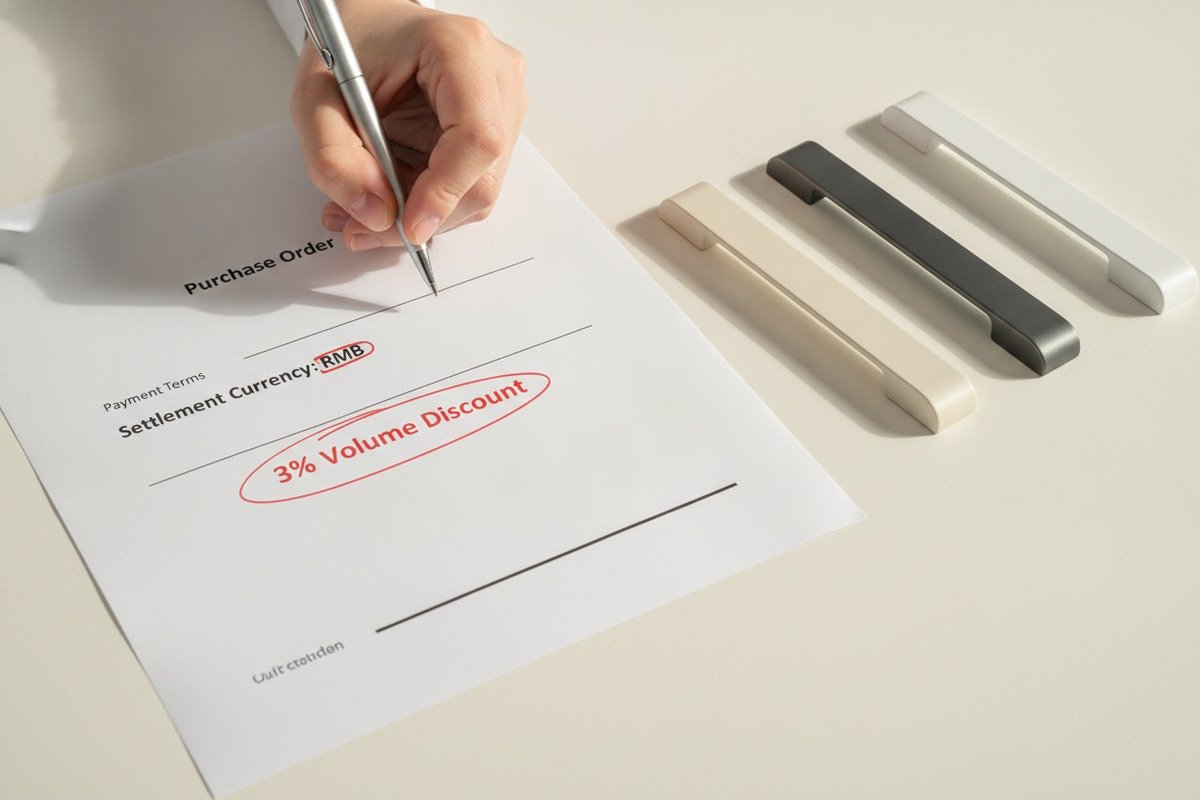
Why RMB Settlement Can Lower the Price
A Chinese aluminum handle manufacturer pays for raw aluminum ingots, anodizing chemicals, factory electricity, worker salaries, and domestic shipping — all in RMB. When a buyer pays in USD, the supplier must convert those dollars into RMB through their bank, incurring a conversion spread and sometimes a delay. To cover that cost and the risk of rate movement, the supplier pads the quote.
If you pay in RMB directly, that padding disappears. The supplier receives exactly what they need in the currency they spend. The result is a cleaner, often lower price.
How Big Is the Discount?
The size of the discount depends on several factors:
| Factor | Small Discount (0–1%) | Larger Discount (2–3%) |
|---|---|---|
| Order size | Under $5,000 | Over $10,000 |
| Relationship length | First order | Repeat buyer |
| Supplier's bank fees | Low (large export bank) | High (small local bank) |
| Current FX volatility | Low | High |
| Payment speed | Net 30+ days | T/T in advance or upon shipment |
The Catch: Your Own Conversion Cost
Paying in RMB does not automatically save money. You need to check what your own bank charges to convert your local currency into RMB. There are two flavors of RMB to understand:
- CNY (onshore RMB): The currency used inside mainland China. Regulated by the People's Bank of China.
- CNH (offshore RMB): Traded outside mainland China, often in Hong Kong. Slightly different exchange rate. More accessible to foreign buyers.
Most international buyers will actually send CNH, which the supplier's bank converts to CNY upon receipt. The spread between CNH and CNY is usually tiny, but your bank's markup on the conversion from USD or VND to CNH can vary widely.
When RMB Settlement Makes the Most Sense
- You source frequently from China and can open a multi-currency account 7 that holds RMB.
- Your bank or fintech platform offers competitive RMB conversion rates.
- Your supplier explicitly offers a lower RMB price and you have verified the total cost including your own conversion fees.
- You want to build goodwill with a supplier who clearly prefers RMB — this can help during tight-supply periods when they choose which customers to prioritize.
When It Does Not Help
- Your bank charges high fees for RMB wires, eating up any supplier discount.
- You cannot easily hedge RMB exposure and your revenue is in another currency entirely.
- The supplier's RMB price, once you add your conversion and transfer costs, ends up equal to or higher than their USD price.
What are the pros and cons of using VND versus USD when paying for my furniture hardware imports to Vietnam?
A large share of our aluminum handle shipments go to Vietnam, so we see this question come up constantly from distributors in Ho Chi Minh City and Hanoi who wonder if paying in dong would be simpler.
For Vietnamese importers buying aluminum furniture handles from China, USD remains the most practical settlement currency because Chinese suppliers rarely accept VND directly. VND settlement only makes sense when you purchase through a Vietnam-based trading intermediary or when the supplier has a specific VND-accepting structure in place.
Why VND Is Rarely Accepted by Chinese Suppliers
The Vietnamese dong is not a freely convertible currency 8 on global markets. Chinese banks do not commonly hold VND accounts, and the conversion infrastructure between VND and RMB is limited compared to USD/RMB. When a Chinese supplier receives a payment, their bank needs to convert it into RMB. If the incoming currency is VND, the conversion chain is longer, the spread is wider, and the settlement can take days instead of hours.
Most Chinese manufacturers — including our own facility — price and invoice in USD or RMB precisely because those currencies settle quickly and predictably.
A Side-by-Side Comparison
| Criteria | USD | VND |
|---|---|---|
| Supplier acceptance | Nearly universal | Very rare for direct China trade |
| Conversion steps for supplier | USD → RMB (1 step) | VND → USD → RMB or VND → RMB (2 steps, less liquid) |
| Bank fees for buyer | Standard international wire | Potentially higher due to exotic currency surcharges |
| Exchange rate transparency | High — easily tracked online | Lower — wider spreads, fewer published rates |
| Hedging availability | Excellent — forward contracts 9 widely available | Limited — fewer instruments, higher cost |
| Payment speed | 1–2 business days | 2–5 business days depending on intermediary banks |
| Use case | Direct sourcing from Chinese supplier | Vietnam-based intermediary or border trade structure |
When VND Can Work
There are a few scenarios where VND settlement is practical:
- You buy through a Vietnamese trading company that purchases from the Chinese supplier in USD or RMB and resells to you in VND. The intermediary handles all currency conversion.
- Border trade between Vietnam and China sometimes uses local-currency settlement channels set up by banks in Guangxi (China) and northern Vietnam. These channels exist but are niche and usually serve high-volume commodity flows.
- The supplier has a Vietnam subsidiary or bank account. Some larger Chinese manufacturers with Vietnam operations can invoice in VND for local delivery.
The Hidden Cost of VND Payment
Even if you find a route to pay in VND, be aware of these friction points:
- Wider spreads: Banks converting VND to RMB take a larger cut because the market is thinner.
- Slower settlement: More intermediary banks means more processing time and more opportunities for deductions.
- Regulatory complexity: Vietnam's State Bank has rules about foreign-currency use in domestic transactions, and China has its own cross-border payment regulations. Misalignment can cause delays.
Our Recommendation for Vietnamese Buyers
Keep your supplier payments in USD. It is the cleanest, fastest, and most transparent option. If your bank charges high USD wire fees, explore fintech platforms that offer lower-cost international transfers in USD. Reserve VND for your domestic transactions — paying your warehouse, your staff, and your local logistics — and let the supplier invoice in the currency that works best for cross-border trade.
Our accounting team reconciles incoming wires every week, and we regularly see buyers lose $50–$200 per transfer to intermediary bank charges they did not expect. Over a year of monthly orders, that is up to $2,400 in pure waste.
To minimize bank fees and hidden costs, use direct correspondent banking routes, avoid unnecessary currency conversions, batch smaller payments into fewer larger wires, and consider fintech platforms that offer transparent FX rates and flat transfer fees. Always compare the "all-in" cost — not just the headline exchange rate.
Where the Hidden Costs Live
International wire transfers involve several parties, and each one can take a cut:
- Your sending bank charges a wire fee (often $15–$50).
- Intermediary (correspondent) banks may deduct $10–$30 from the transfer amount as it passes through.
- The receiving bank in China may charge a fee on the supplier's end.
- FX conversion spread is the difference between the mid-market rate and the rate your bank actually gives you. This is often the single largest hidden cost.
A buyer might send $12,000 and the supplier receives $11,920. That $80 gap is real money — and it can cause confusion, short-payment disputes, or the supplier asking you to "top up" the difference.
How to Cut These Costs
Choose the Right Payment Rail
- SWIFT (traditional wire): Reliable but can involve intermediary banks. Ask your bank to send via a direct correspondent route to the supplier's bank if possible.
- Fintech platforms (Wise, Payoneer, OFX, etc.): Often offer mid-market or near-mid-market rates with flat fees. Good for transfers under $50,000.
- Multi-currency accounts: Some platforms let you hold USD, RMB (CNH), or other currencies and convert only when the rate is favorable.
Batch Your Payments
If you order aluminum handles monthly, consider combining two months of orders into one payment. One wire fee instead of two. One set of intermediary deductions instead of two.
Negotiate "OUR" Charges
When you instruct your bank, you can typically choose:
- OUR: You pay all fees on both ends. The supplier receives the full invoice amount.
- BEN: The supplier (beneficiary) pays all fees. They receive less than you sent.
- SHA: Fees are shared. Each side pays their own bank's charges.
For supplier relationships, OUR is often the best choice even though it costs you a bit more upfront. It prevents short-payment issues and builds trust.
A Fee Comparison Table
| Payment Method | Typical Fee (per transfer) | FX Spread | Speed | Best For |
|---|---|---|---|---|
| Traditional bank SWIFT | $25–$50 + intermediary fees | 0.5–2.0% | 1–3 business days | Large orders, established banking relationships |
| Fintech platform (e.g., Wise) | $5–$20 flat | 0.3–0.7% | 1–2 business days | Small to mid-size orders, cost-conscious buyers |
| Multi-currency account + timed conversion | Account fee varies | 0.1–0.5% (you choose timing) | Instant (internal) + 1–2 days (wire out) | Repeat buyers who want FX control |
| Letter of Credit (L/C) 10 | $100–$500+ (bank charges) | Varies | 5–15 business days | High-value orders, new supplier relationships |
Watch the Conversion Timing
If you hold a multi-currency account, you can convert your local currency to USD or RMB when the rate is favorable, then hold that balance until your payment is due. This separates the conversion decision from the payment decision and gives you more control.
Ask Your Supplier What They Actually Receive
This is a simple but powerful step. After your first wire, ask the supplier to confirm the exact amount that landed in their account. Compare it to what you sent. The difference tells you exactly how much the banking chain is costing you. Use that information to optimize your next payment.
The Digital Yuan — Worth Watching
China is piloting the e-CNY (digital yuan) for cross-border payments. It is not widely available for international trade yet, but if adoption grows, it could offer a more direct RMB payment channel with lower fees and faster settlement. For now, treat it as a future option, not a current solution.
Conclusion
Currency choice is a cost decision, not just an administrative one. Pick the settlement currency that gives you the lowest total landed cost — including FX spread, bank fees, and supplier pricing adjustments — and revisit that choice as your order volume and banking options evolve.
Footnotes
1. Clarifies CNY as the onshore Chinese Yuan, regulated within mainland China. ↩︎
2. Replaced with a Wikipedia article providing a comprehensive definition of foreign exchange risk. ↩︎
3. Replaced with a Procurify article defining purchase orders and how they work. ↩︎
4. Explains CNH as the offshore Chinese Yuan, traded outside mainland China. ↩︎
5. Replaced with a Wikipedia article providing an overview of SWIFT. ↩︎
6. Explains the causes and economic impact of exchange rate fluctuations. ↩︎
7. Explains how multi-currency accounts work and their benefits for international business. ↩︎
8. Provides the IMF’s definition of a freely usable currency. ↩︎
9. Defines forward contracts as financial instruments for hedging currency risk. ↩︎
10. Replaced with a Wikipedia article defining a Letter of Credit. ↩︎