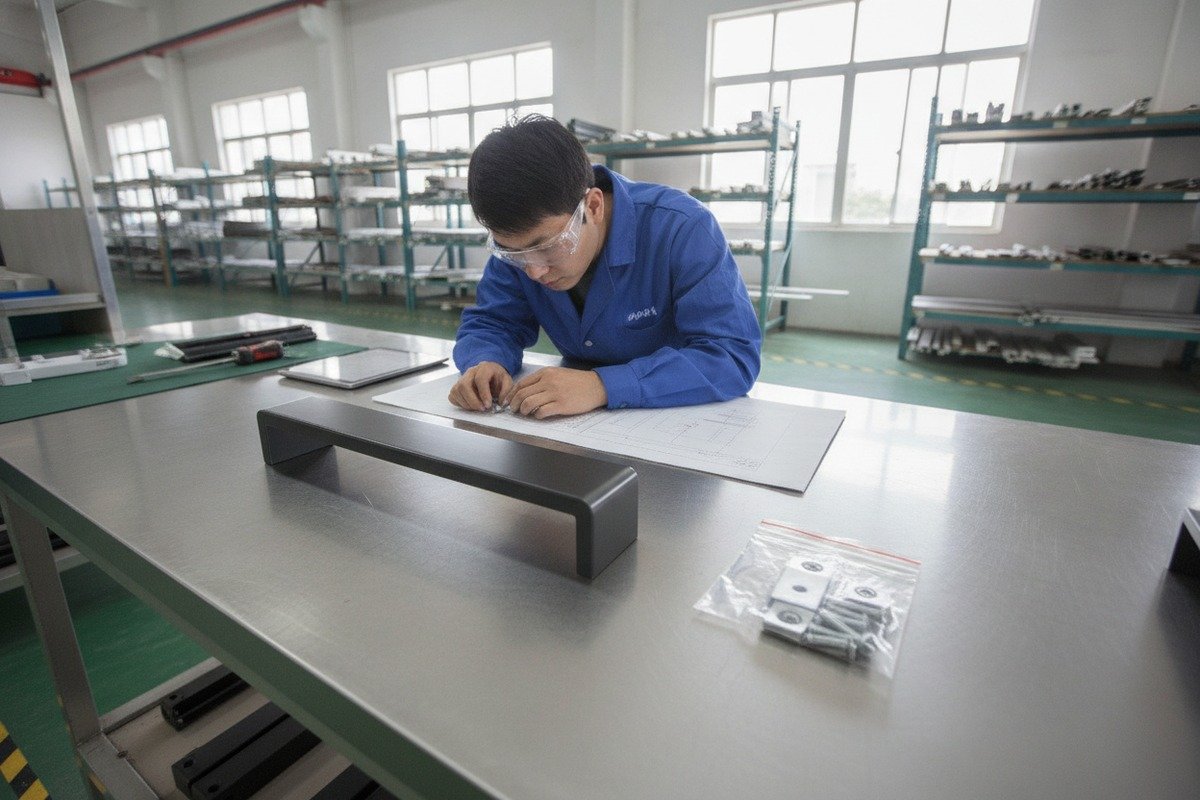
Over 18 years of shipping aluminum handles 1 from our Foshan factory, one recurring issue keeps catching overseas buyers off guard. They receive beautifully finished handles—only to realize the screws, bolts, or brackets needed for installation are nowhere in the box Foshan factory 2. That missing bag of hardware can stall an entire furniture production line.
Yes, you absolutely need to confirm whether your China supplier ships mounting accessories with the handles. Many suppliers sell handles as standalone products without screws or brackets. Clarifying this before ordering prevents installation delays, mismatched parts, and unexpected extra costs at your factory.
This article breaks down exactly what to ask, what to watch for, and how to ensure every handle arrives ready to install production throughput 3. Let’s walk through the key questions every furniture hardware buyer should address before placing an order.
Can I Find a China Supplier That Offers a One-Stop Solution for Both My Aluminum Handles and Matching Mounting Screws?
When we first started bundling mounting screws with our aluminum profile handles years ago, it was because a long-term distributor in Vietnam kept reporting the same complaint from his furniture factory clients. Handles arrived on time, but nobody could install them without a separate screw order.
Yes, many China suppliers—especially integrated manufacturers with in-house extrusion and finishing lines—offer complete handle-plus-hardware kits. Look for suppliers that manufacture both handles and furniture fittings, as they can bundle matching screws, bolts, and connectors into one shipment and one purchase order.
Why "One-Stop" Matters More Than You Think
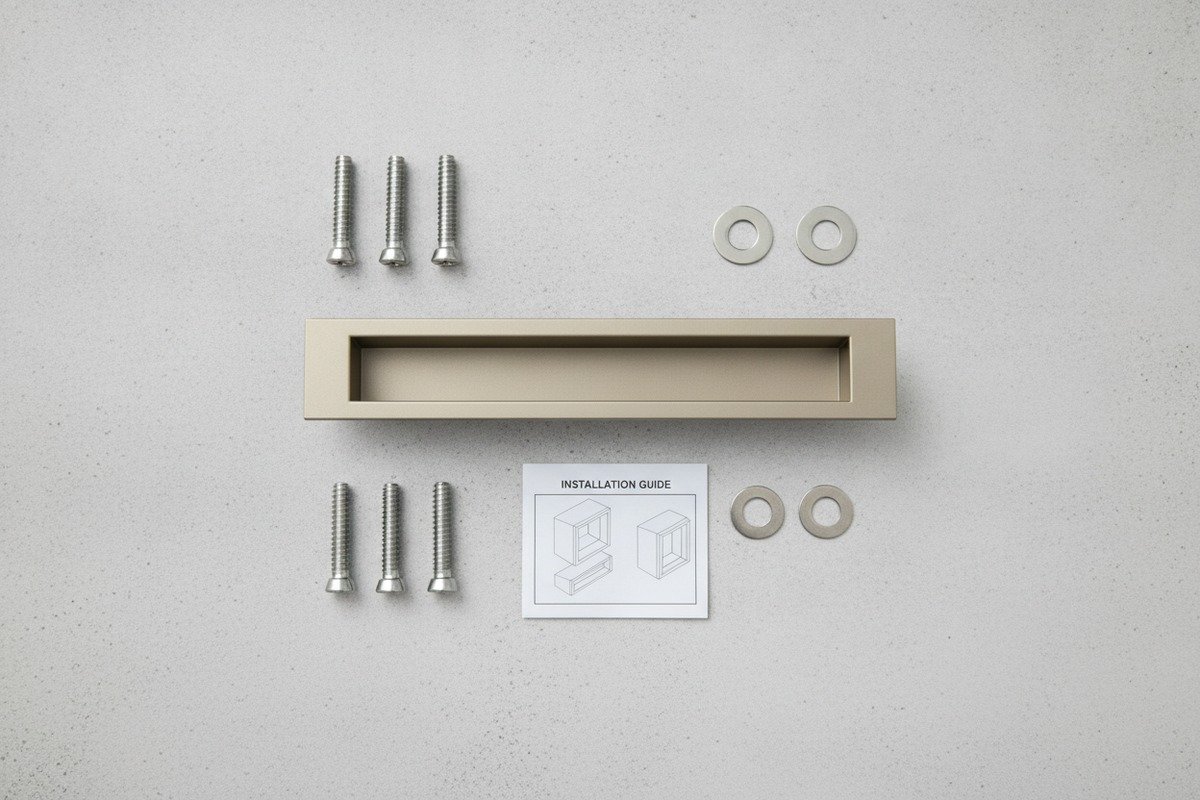
The phrase "one-stop solution 4" gets used loosely in B2B marketing. But in furniture hardware sourcing, it has a very specific meaning. It means one supplier takes responsibility for delivering every component needed to install the handle. That includes the handle body, the mounting screws (with correct thread and length), any washers or spacers, and sometimes even a template or jig for drilling.
When you source from a handle-only factory, you still need screws. You then have two options: buy screws locally or find a second Chinese supplier. Both add complexity. A second supplier means a second negotiation, a second quality check, a second shipping schedule, and a second invoice. If anything goes wrong with compatibility, neither supplier wants to take the blame.
How to Identify a True One-Stop Supplier
Not every factory that claims to be "one-stop" actually is. Here is a quick way to evaluate:
| Evaluation Criteria | One-Stop Supplier | Handle-Only Supplier |
|---|---|---|
| Sells handles with matching screws | Yes, bundled by default or on request | No, handle body only |
| Can customize screw length and thread | Yes, based on your panel thickness | Not applicable |
| Packs accessories with each handle unit | Yes, in individual sets or bulk bags | Not applicable |
| Provides complete packing list on invoice | Handles + all accessories itemized | Handles only |
| Handles QC for fit between handle and hardware | Yes, tested before shipping | No responsibility for accessories |
When you receive a quotation, check whether the line items include accessory details. If the quote only mentions "aluminum handle, 160mm center-to-center, champagne gold anodized" with no mention of screws, that is a handle-only quote. Ask directly: "Does this price include mounting screws? If yes, what size and material?"
Our Approach at the Factory
On our production floor in Foshan, we keep a standard screw inventory that matches every handle profile we produce. For our recessed channel handles—those sleek, minimalist pulls with the L-shaped cross-section and deep finger groove—we pair them with M4 flat-head screws 5 in lengths from 20mm to 35mm. If a buyer tells us their cabinet panels are 18mm thick, we select the right screw length automatically. That saves the buyer from having to figure it out on their own.
This kind of integrated service is not rare in China's furniture hardware manufacturing hub. But you do have to ask for it. It is rarely the default.
How Do I Ensure the Mounting Accessories Provided by My Supplier Will Fit My Specific Furniture Board Thickness?
In our experience exporting to the Middle East and Southeast Asia, board thickness 8 varies widely. Vietnamese furniture factories often use 16mm or 18mm MDF. Saudi projects sometimes call for 22mm or even 25mm solid panels. A screw that works perfectly for one will fail completely for the other.
To ensure fit, provide your supplier with the exact board thickness, handle mounting style (surface-mount or through-bolt), and any recessed channel depth. The supplier can then select or manufacture screws with the correct length, thread type, and head style to match your specific application.
The Math Behind Screw Length Selection
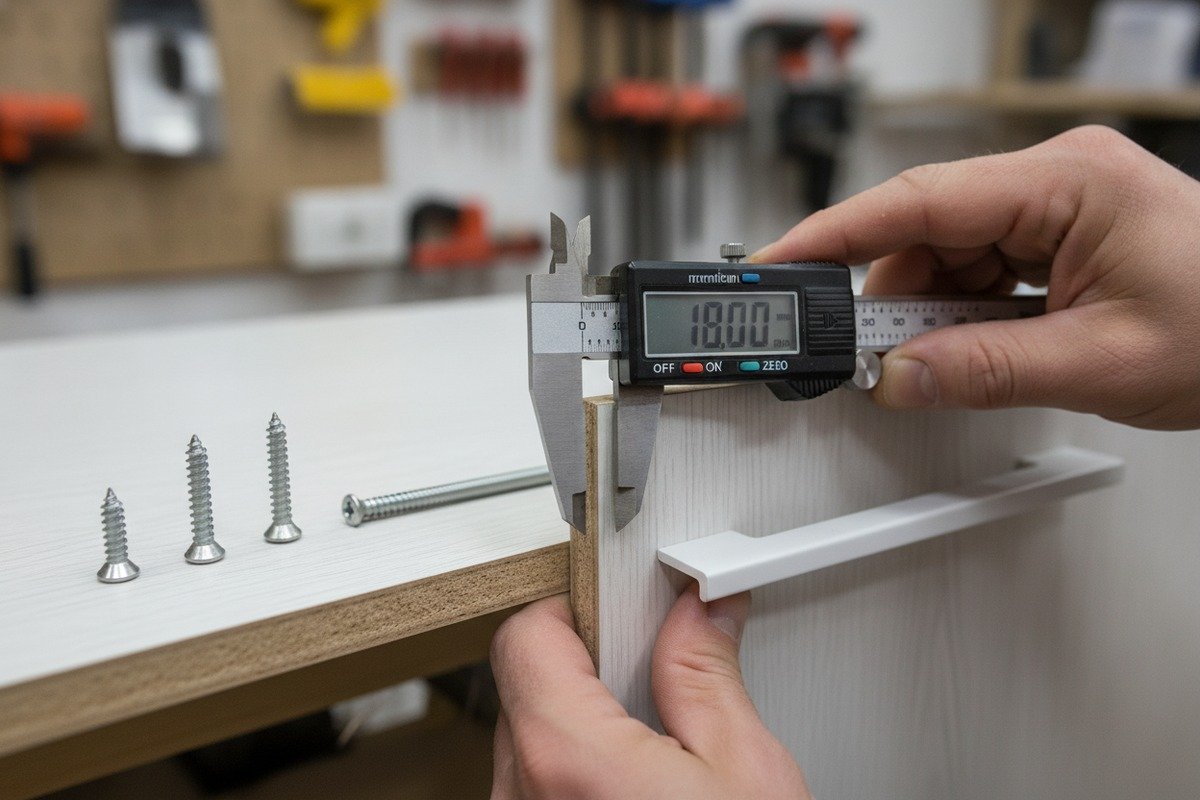
This is simpler than it looks. For a standard through-bolt mount, the screw passes through the cabinet panel and threads into the handle's tapped hole on the other side. The required screw length equals:
Board thickness + handle base depth + 2–3mm engagement margin
For example, if your panel is 18mm and the handle base has a 5mm threaded pocket, you need a screw that is at least 25mm long. Too short, and the screw will not grip. Too long, and the screw tip will protrude past the handle surface.
Common Board Thicknesses and Recommended Screw Lengths
| Board Thickness (mm) | Handle Base Depth (mm) | Recommended Screw Length (mm) | Thread Type |
|---|---|---|---|
| 15 | 5 | 22 | M4 |
| 18 | 5 | 25 | M4 |
| 20 | 5 | 27 | M4 |
| 22 | 6 | 30 | M4 |
| 25 | 6 | 33 | M4 or M5 |
These are general guidelines. The exact dimensions depend on the specific handle profile. Our recessed aluminum channel handles, for instance, have a deeper base structure because of their L-shaped cross-section, so we adjust accordingly.
What Happens When Screws Don't Match
Here is a real scenario. A furniture factory in Dubai ordered 5,000 matte black recessed pulls from a supplier. The screws included were 20mm long. But the factory used 22mm panels. Every single screw was too short. The handles could be placed on the surface but would not hold under daily use. The factory had to source 5,000 replacement screws locally at a premium price, and production stopped for four days.
This could have been avoided with one line in the purchase order: "Panel thickness: 22mm. Please provide screws accordingly."
How to Communicate Your Specs Clearly
Send your supplier a simple sketch or photo showing:
- The panel material and thickness
- Whether the handle mounts from the front or from behind
- Any countersink or recess requirements
- The finish you need on the screws (matching the handle finish or plain)
When we receive this information, we can confirm exact screw specifications within 24 hours. We also send a photo of the proposed handle-plus-screw assembly so the buyer can verify before we start packing.
Material Compatibility: A Detail Most Buyers Miss
If your handles are anodized aluminum and the screws are plain carbon steel, you risk galvanic corrosion 9 over time—especially in humid environments. Stainless steel screws or zinc-plated screws are safer choices. Always ask your supplier what material the screws are made from, not just what size they are.
Will Sourcing My Handles and Accessories From Different Vendors Increase My Total Procurement Costs and Lead Times?
We have watched this situation play out dozens of times. A buyer finds a great price on handles from one factory and decides to buy screws from a local hardware shop to save a few cents per unit. It sounds logical on paper. In practice, it almost always costs more.
Yes, splitting your handle and accessory sourcing across multiple vendors typically increases total costs through duplicate shipping fees, separate quality inspections, coordination overhead, and the risk of compatibility errors that cause production delays and rework expenses.
The Hidden Costs of Split Sourcing
The price per screw from a local vendor might be lower than what a Chinese handle manufacturer charges for a bundled kit. But that unit price comparison ignores several real costs.
First, there is the coordination cost. You now manage two supplier relationships instead of one. Two sets of emails, two payment cycles, two delivery schedules. If the screws arrive a week after the handles, your production line sits idle.
Second, there is the quality risk. Screws from a general hardware vendor are not tested against your specific handle profile. Thread pitch might differ slightly. Head diameter might not sit flush. Finish color might not match. Each mismatch creates rework or customer complaints downstream.
Third, there is the inventory management burden. Two separate SKUs from two sources means two receiving inspections, two storage locations, and two reorder cycles.
Cost Comparison: Bundled vs. Split Sourcing
| Cost Factor | Bundled Sourcing (One Supplier) | Split Sourcing (Two Suppliers) |
|---|---|---|
| Handle unit price | Slightly higher (includes accessories) | Lower (handle only) |
| Screw unit price | Included in bundle | Separate purchase required |
| Shipping cost | One shipment | Two shipments |
| Quality inspection | One inspection covers all parts | Two separate QC checks needed |
| Coordination time | Minimal | Significant |
| Compatibility risk | Low (supplier tests fit) | High (no cross-supplier QC) |
| Lead time risk | Synchronized | Dependent on two schedules |
| Total landed cost | Usually lower overall | Usually higher overall |
When Split Sourcing Might Make Sense
There are exceptions. If you already operate a standardized fastener system across all your furniture lines, and you buy M4 stainless steel screws in bulk regardless of handle supplier, then you may not need bundled accessories. In that case, your existing screw inventory covers every handle you source.
But this only works if your team has the technical knowledge to match screw specs to each new handle model. For most wholesalers and mid-size furniture factories, the safer and more cost-effective approach is to let the handle supplier bundle the correct accessories.
A Real Lead-Time Example
One of our regular buyers in Vietnam used to source handles from us and screws from a Hanoi-based fastener distributor. The handles shipped within 48 hours from our ready stock. The screws took 10 days because the local distributor had to special-order the right length. For 10 days, 3,000 handles sat on a shelf, useless. After switching to our bundled kits, the buyer's average order-to-installation time dropped from 14 days to 5 days.
How Can I Benefit From Receiving Fully Assembled Handle and Hardware Kits Directly at My Furniture Factory?
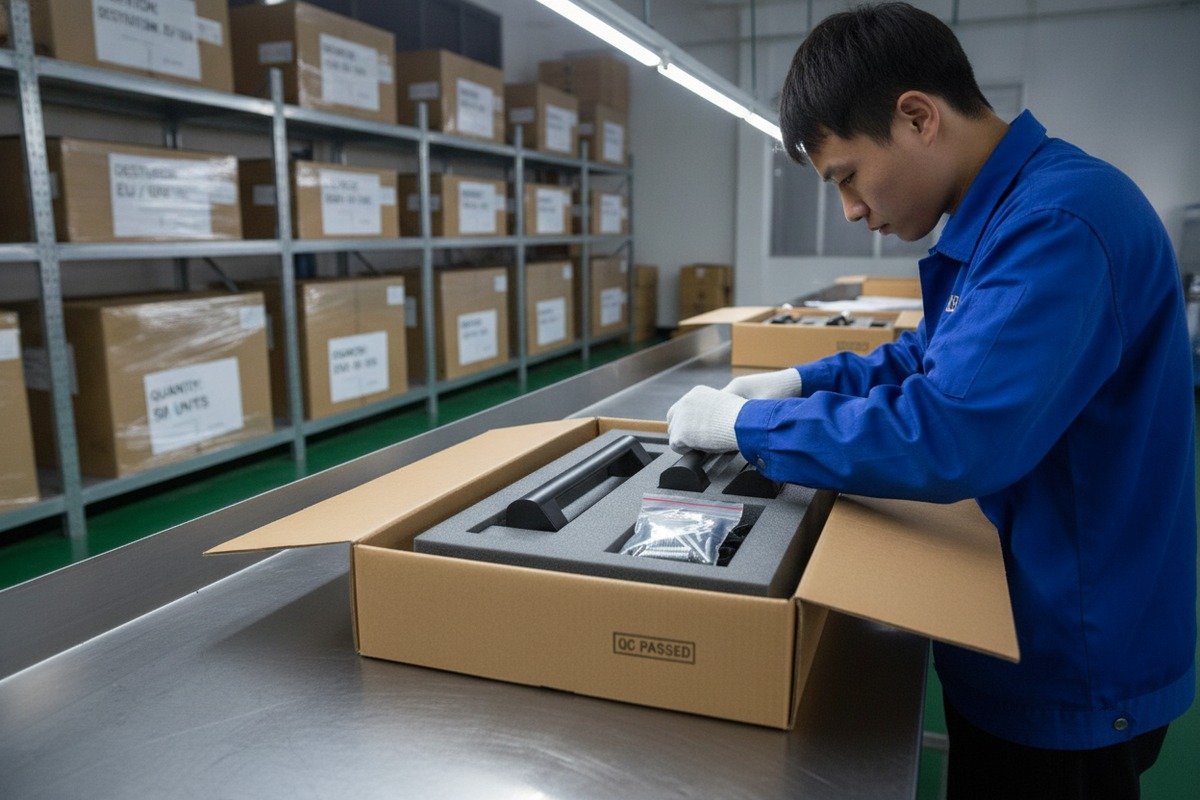
When we pack handle kits on our line in Foshan—each set containing one handle, two screws, and a small poly bag—we are not just packing products. We are packing time savings for the factory on the other end.
Receiving pre-assembled or pre-packaged handle kits means your factory workers can pick up a complete set and install it immediately, with zero time spent sorting, matching, or searching for parts. This directly reduces labor cost, eliminates assembly errors, and speeds up your production throughput.

What a "Ready-to-Install Kit" Looks Like
A proper kit is not just a handle tossed in a box with some loose screws. It is a deliberately packaged set. Here is what we typically include:
- One aluminum handle (wrapped in protective film to preserve the anodized finish)
- Two matching mounting screws (correct length, correct thread, correct finish)
- One small poly bag holding the screws, stapled or taped to the handle's packaging
- A label showing the handle model, screw size, and color code
For retail or distributor orders, we can add a printed instruction card or a branded sticker. For factory orders, we keep packaging minimal to reduce waste and cost.
How Kit Packing Impacts Factory Efficiency
Consider a furniture factory producing 200 cabinets per day. Each cabinet has 4 handles. That is 800 handle installations per day. If workers spend even 15 seconds per handle sorting through a bin of loose screws to find the right ones, that adds up to over 3 hours of wasted labor per day.
With pre-packed kits, each worker grabs one bag, opens it, and installs. The time per handle drops to essentially zero for the sorting step.
Kit Packing Options
There are several ways a supplier can pack kits. The right choice depends on your factory workflow and order volume.
Individual poly bags work best for factories with multiple handle models on the same production line. Each bag is self-contained. Workers never mix up parts.
Bulk-separated packing works for factories using a single handle model across all products. Handles are packed in one layer, screws in a separate labeled bag within the same carton. This is slightly cheaper to pack but requires one initial sorting step at the factory.
Master carton kits are used for large wholesale orders where the distributor repacks for their own clients. Each master carton contains a fixed quantity of complete sets.
Benefits Beyond Installation Speed
Receiving complete kits also improves your quality control 10. When every handle arrives with its matched hardware, your incoming inspection team can verify completeness in seconds. No need to cross-reference two separate shipments. No risk of discovering missing screws halfway through a production run.
It also simplifies your inventory. One SKU in your system represents one complete, install-ready unit. You track one stock level, set one reorder point, and manage one supplier relationship.
For after-sales service, kits are equally valuable. If a distributor's end customer needs a replacement handle, sending a complete kit ensures the customer can install it without hunting for compatible screws at a local hardware store.
Ask Your Supplier These Questions Before Ordering Kits
- How are the screws packed—individually with each handle or in bulk?
- Can you customize the kit contents based on my specifications?
- Will the kit label include model number and screw size for easy identification?
- Can you send a photo of a sample kit before mass production?
- Is there a minimum order quantity for kit packing versus loose packing?
At our facility, we offer kit packing at no extra charge for orders above our standard MOQ. For smaller orders, there may be a nominal packing fee. Either way, the cost is negligible compared to the labor and time savings at the receiving factory.
Conclusion
A handle without its mounting hardware is an incomplete product. Before you place your next order, confirm what is included, specify your board thickness, and request kit packing. These small steps save real time and money on your factory floor.
Footnotes
1. Explains the properties and uses of aluminum alloys in handles. ↩︎
2. Highlights Foshan’s significant role as a manufacturing hub in China. ↩︎
3. Defines and explains the concept of throughput in manufacturing operations. ↩︎
4. Replaced with a Wikipedia page providing a clear and authoritative definition of ‘one-stop shop’ as a business model. ↩︎
5. Provides detailed technical specifications for M4 metric screw threads. ↩︎
6. Provides a comprehensive overview of components used in furniture making. ↩︎
7. Details various types of fasteners and their applications in furniture. ↩︎
8. Details common thicknesses and uses of wood panels in furniture. ↩︎
9. Replaced with a Wikipedia page offering a comprehensive and authoritative explanation of galvanic corrosion. ↩︎
10. Explains the fundamental principles and importance of quality control in manufacturing. ↩︎