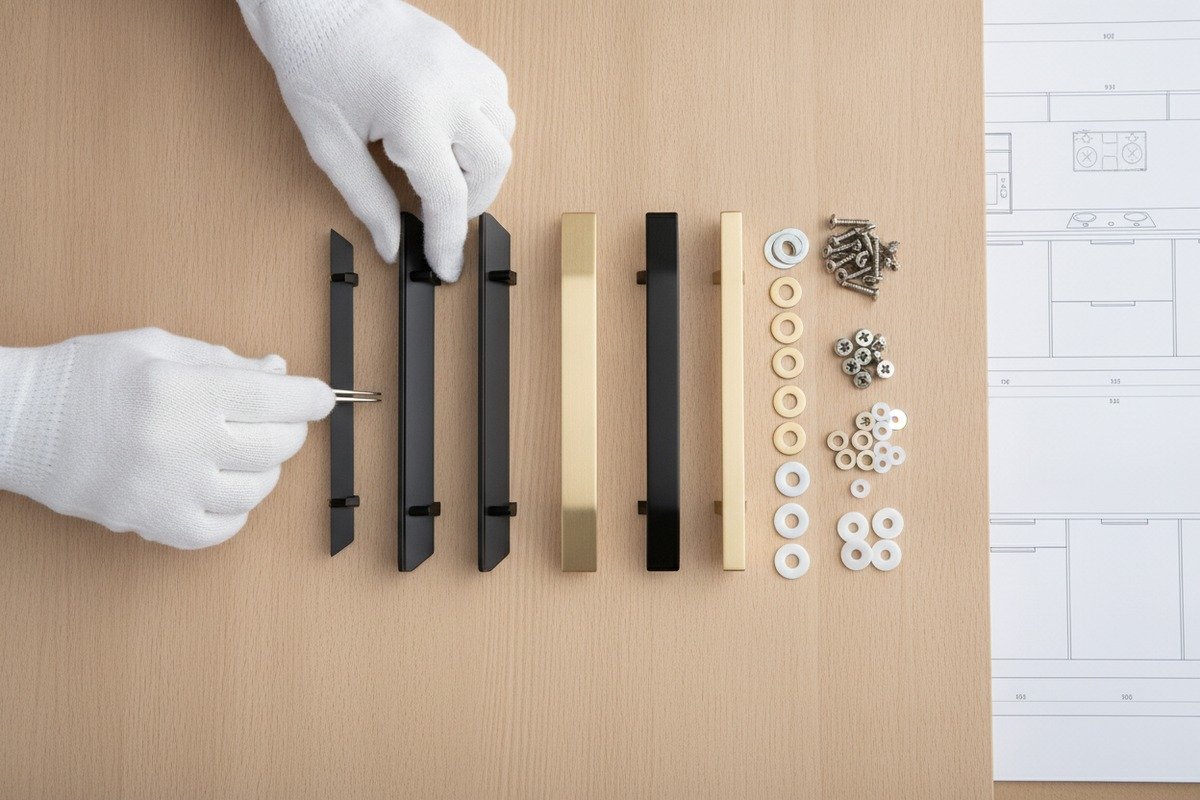
Over 18 years on our production lines in Foshan, we have seen countless handle installations go wrong — not because of poor handle quality, but because of mismatched screws, missing washers, or wrong thread types.
To ensure compatibility when purchasing aluminum furniture handles, you must match the screw length to your panel thickness, select fastener materials that resist galvanic corrosion with aluminum, confirm the thread pitch and screw head type for your handle profile, and verify that washers or spacers are included for a stable, flush fit.
This guide walks you through every step. Whether you run a furniture factory or distribute building materials, the details below will save you time, money, and rework on installation day M4 × 0.7 mm 1. Let’s start with the most common issue: screw length.
How do I determine the correct screw length based on my cabinet door thickness to avoid installation issues?
One problem we see regularly when shipping handles to furniture factories in Vietnam and the Middle East is that the supplied screws fit doors perfectly but fail on drawer fronts.
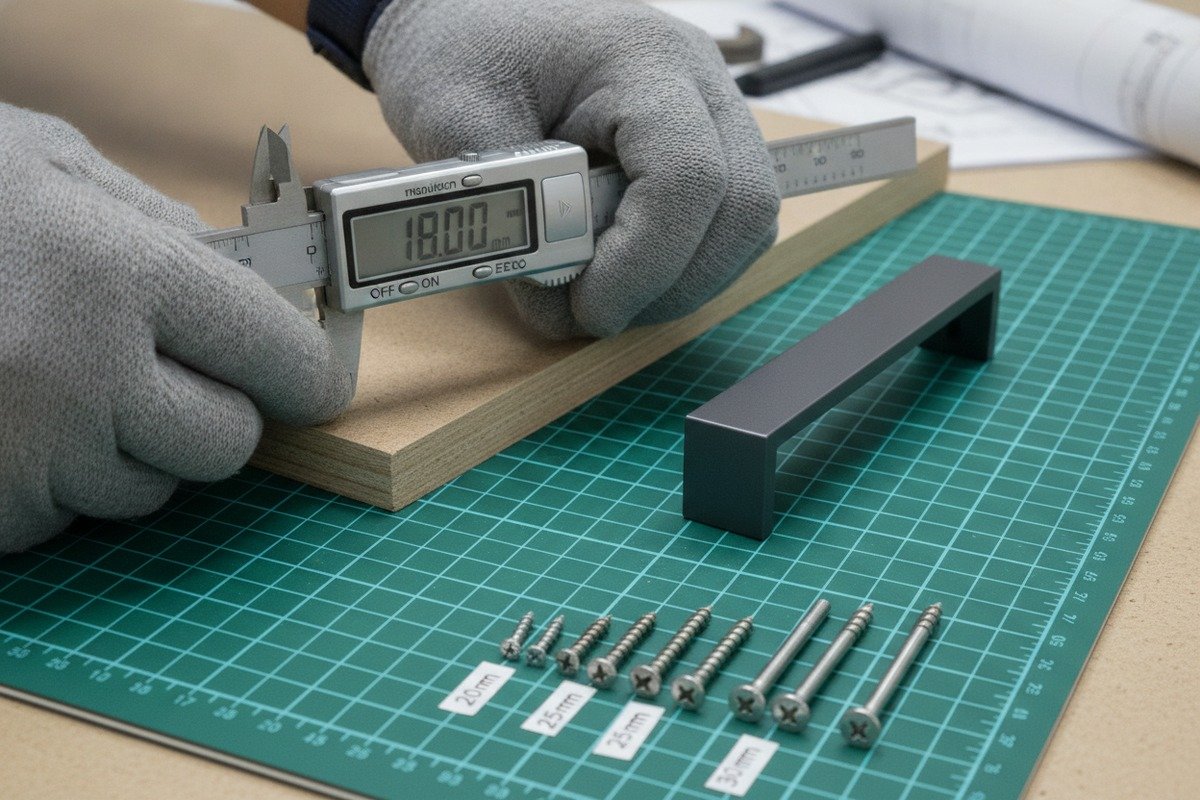
Measure your cabinet door or drawer front thickness first, then add the handle base depth and subtract 1–2 mm for safety. The correct screw length equals the panel thickness plus the handle base thickness, ensuring the screw tip does not protrude through the panel's back side or fall short of full thread engagement.
Why Panel Thickness Is Your Starting Point
Every handle installation begins with one number: the thickness of the material the handle mounts to. This could be an 18 mm particleboard door 2, a 20 mm MDF drawer front, or a 25 mm solid wood panel. If you skip this measurement, you are guessing. Guessing leads to screws that poke through the back of a door or screws that barely grip and loosen within weeks.
Our engineering team always recommends this formula:
Required screw length = panel thickness + handle base depth − 1 to 2 mm
The small subtraction prevents the screw tip from breaking through the visible back surface of the panel.
Doors vs. Drawers: A Common Trap
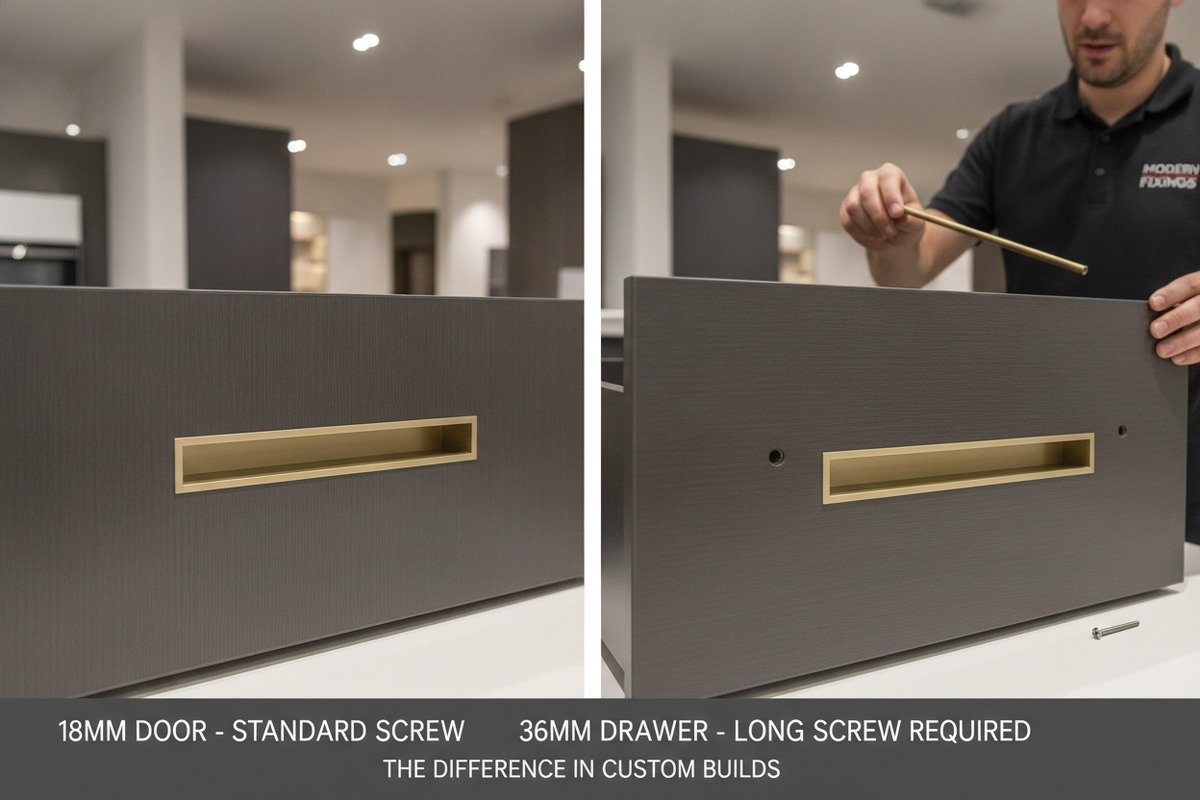
Cabinet doors and drawer fronts often look similar from the outside. But drawer fronts can be thicker. Some drawer boxes have a separate front panel laminated or screwed onto the box face. This double layer adds 5–15 mm of extra material. If the screws in the handle package were sized for a standard 18 mm door, they will be too short for a 30 mm drawer build-up.
Here is a quick reference table we share with our wholesale clients:
| Panel Type | Typical Thickness | Handle Base Depth | Recommended Screw Length |
|---|---|---|---|
| Standard MDF cabinet door | 18 mm | 2 mm | 18–19 mm |
| Thick solid wood door | 22 mm | 2 mm | 22–23 mm |
| Drawer front (single layer) | 18 mm | 2 mm | 18–19 mm |
| Drawer front (double layer) | 30–36 mm | 2 mm | 30–36 mm |
| Framed overlay door | 22–25 mm | 2 mm | 22–25 mm |
What Happens When Screws Are Wrong
A screw that is too long will punch through the back of the door. On a cabinet door, that means a sharp metal tip sticking into the cabinet interior. On a drawer front, it can interfere with the drawer box or scratch stored items. A screw that is too short gives weak thread engagement. The handle wobbles after a few weeks of daily use. The fix is simple: measure before you order.
Practical Tips
- Use a digital caliper 3 for accuracy. A tape measure works, but calipers give you the exact millimeter.
- Always measure at the screw hole location, not at the panel edge, because some panels have beveled or profiled edges that are thinner.
- If you order handles in bulk for a furniture factory, request two or three screw lengths in your hardware kit. This covers doors and drawers from the same handle batch.
- Dry-fit one handle before drilling all holes. This five-minute test can prevent hours of rework.
What material should I choose for washers and screws to prevent galvanic corrosion on my aluminum handles?
When we develop hardware kits for our aluminum handle lines, one of the first questions from our R&D team is about metal pairing — because the wrong combination silently destroys the handle from the inside out.
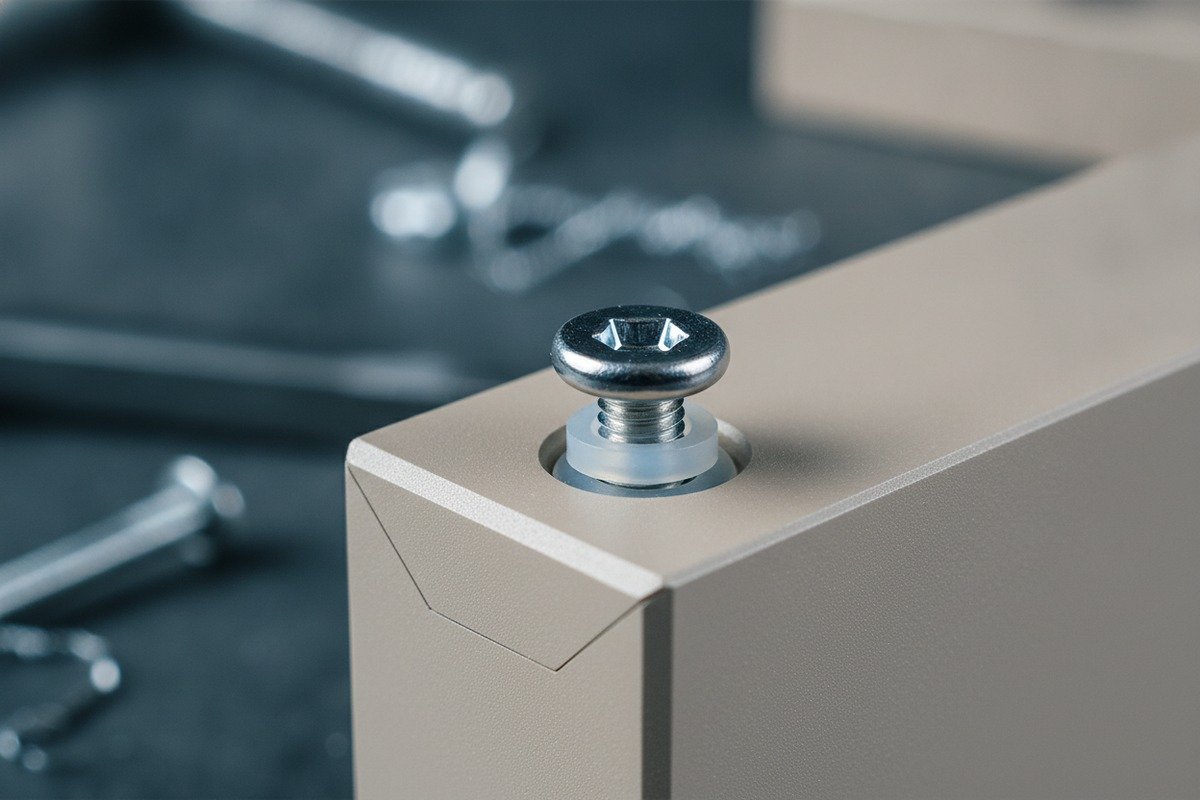
Choose stainless steel screws and washers for aluminum handles, especially in kitchens and bathrooms. Stainless steel has a similar galvanic potential to aluminum, reducing corrosion risk. Alternatively, use zinc-plated steel screws with nylon washers as insulators to break the metal-to-metal contact that triggers galvanic corrosion.
What Is Galvanic Corrosion?
Galvanic corrosion 4 happens when two different metals touch each other in the presence of moisture. The more reactive metal (the "anode") corrodes faster than it would on its own. Aluminum is a reactive metal. When you pair it with a very different metal — like bare carbon steel or brass — and add humidity, the aluminum starts to pit and discolor at the contact point.
In a kitchen, steam and condensation provide the moisture. In a bathroom, high humidity does the same. Even in a dry living room, occasional spills or cleaning products introduce enough liquid to start the process over time.
Fastener Material Comparison
Here is a comparison table we provide to our OEM clients when they are specifying hardware kits:
| Fastener Material | Galvanic Risk with Aluminum | Corrosion Resistance | Best Use Case | Relative Cost |
|---|---|---|---|---|
| Stainless steel 5 (304) | Low | Excellent | Kitchens, bathrooms, humid climates | Medium-high |
| Zinc-plated carbon steel | Moderate | Good in dry settings | Living rooms, bedrooms, dry environments | Low |
| Zinc-plated steel + nylon washer | Low (insulated) | Good | Any environment as a cost-effective option | Low-medium |
| Bare carbon steel | High | Poor | Not recommended for aluminum handles | Lowest |
| Brass | Moderate-high | Good on its own, risky with aluminum | Decorative only, not ideal for aluminum | High |
The Role of Washers
Washers do two jobs. First, they distribute the screw clamping force over a wider area. This prevents the screw head from digging into the cabinet panel or deforming the handle's mounting hole. Second, and more importantly for corrosion prevention, a nylon or plastic washer placed between the screw and the aluminum handle acts as an insulator. It physically separates the two metals. No metal-to-metal contact means no galvanic cell, and no corrosion.
For our recessed profile handles — the minimalist, low-profile designs with a deep geometric channel — we often recommend nylon washers because they sit invisibly inside the mounting area and add virtually no bulk.
When Material Choice Matters Most
If your market is the Middle East or Southeast Asia, humidity is a constant concern. We have shipped aluminum handles to distributors in the UAE and Vietnam for years. The feedback is consistent: stainless steel fasteners hold up. Zinc-plated steel screws work fine in air-conditioned interiors. But in semi-outdoor or high-moisture settings — like a kitchenette near an open window — stainless steel is the safer bet.
If you are budget-conscious, zinc-plated screws paired with nylon washers give you 80% of the corrosion protection at a fraction of the cost.
Can I customize the installation hardware kits when placing a bulk OEM order for my furniture factory?
From our production floor in Foshan, we have fulfilled thousands of OEM orders 6 where the client needed more than just handles — they needed a complete, ready-to-install system tailored to their specific cabinet designs.
Yes, most professional aluminum handle manufacturers offer customizable hardware kits for bulk OEM orders. You can specify screw lengths, thread types, washer materials, quantities per bag, and even packaging labels. This ensures every kit matches your furniture factory's panel thickness and installation workflow without requiring your workers to source or sort accessories separately.
Why Customized Kits Matter for Factories
When a furniture factory installs hundreds of handles per day, every second counts. If the screws in the box are the wrong length, the line stops. Workers search for alternatives. Supervisors make calls to local hardware stores. Production delays stack up. A customized hardware kit eliminates this waste entirely.
In our experience exporting to factory clients, the most requested customizations are:
- Multiple screw lengths in one kit — for example, 20 mm screws for doors and 35 mm screws for drawers, packed in separate labeled bags inside the same box.
- Specific washer types — nylon washers for humid-environment products, steel washers for standard cabinets.
- Pre-counted quantities — exact screw counts per handle unit, so there is no counting on the factory floor.
- Custom packaging labels — with the client's brand, screw specs, and installation diagrams printed directly on the bag.
What Can You Typically Customize?
| Component | Customization Options | Minimum Requirement |
|---|---|---|
| Screw length | Any length from 10 mm to 50 mm+ | Specify per product SKU |
| Screw material | Stainless steel, zinc-plated steel, black oxide | Specify per order |
| Thread type | M4, M5, M6 machine screw threads 7 | Must match handle insert |
| Washer material | Nylon, rubber, stainless steel, zinc-plated | Specify per order |
| Spacers | Aluminum, plastic, various thicknesses | Specify if handle mounts on uneven surface |
| Packaging | Individual poly bags, bulk bags, branded labels | Minimum order quantity applies |
How to Place a Customized Order
The process is straightforward. First, send your panel thickness specs and handle model numbers. Second, our team calculates the correct screw lengths and recommends washer types based on your intended environment. Third, we produce a sample hardware kit for your approval. Fourth, bulk production begins after you confirm the sample.
With our 3–7 day turnaround for custom products, even non-standard kits can ship quickly. For standard screw sizes that match our in-stock handles, we can include the hardware in our 48-hour shipment window.
The Cost Factor
Customizing hardware kits adds minimal cost per unit — usually just a few cents per handle. Compared to the labor cost of sorting, sourcing, or replacing wrong screws on a production line, the investment pays for itself on the first batch.
One of our furniture factory clients in Vietnam initially ordered handles with standard screws. After the first production run, they realized 40% of their drawer fronts needed longer screws. They spent two days sourcing local replacements. On the next order, they specified two screw lengths in the kit. The problem disappeared permanently.
How do I verify that the screw head type and thread pitch are compatible with my specific aluminum profile design?
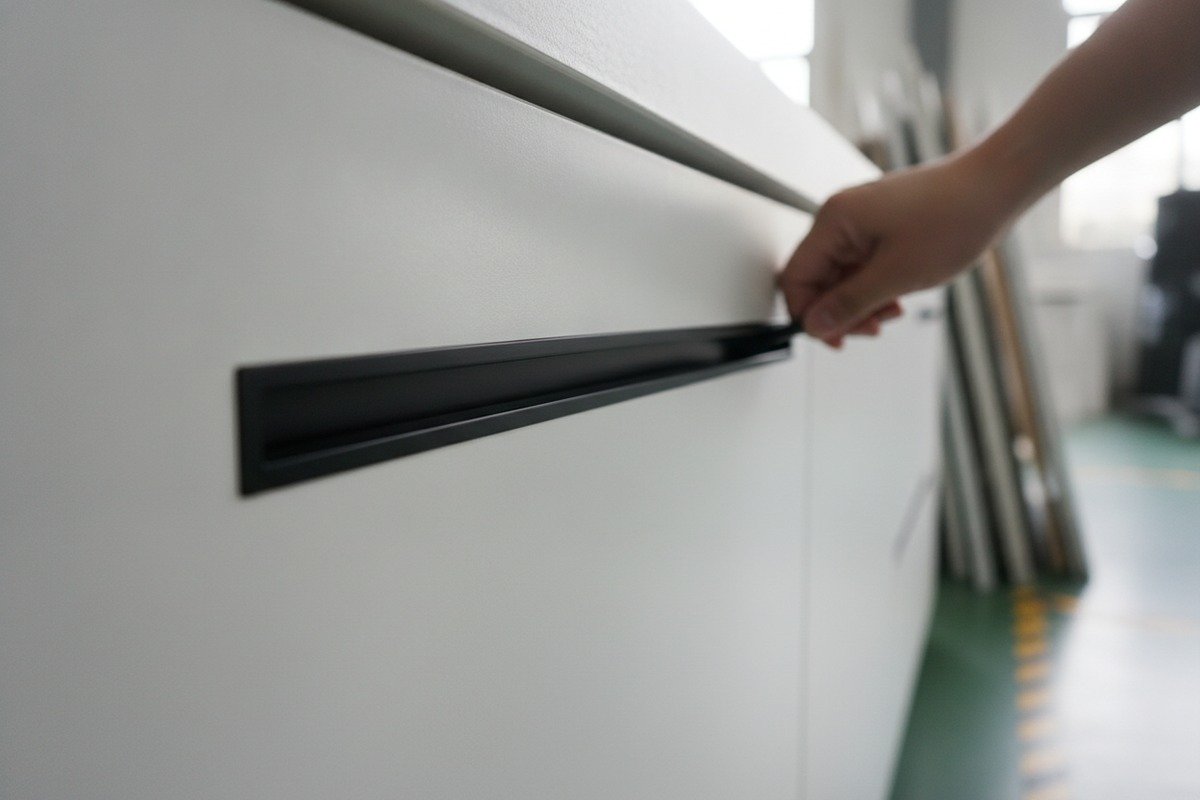
When we design new aluminum profile handles — like our recessed, L-shaped cross-section pulls — one of the first engineering decisions is the internal threading. Getting this wrong means every screw the end user tries will either strip the hole or spin freely.
To verify screw compatibility, check three things: the thread pitch must match the handle's internal threading (common sizes are M4 × 0.7 mm and M5 × 0.8 mm for furniture handles), the screw head must be flat or countersunk enough to sit flush within the handle's mounting recess, and the head diameter must not exceed the handle's countersink pocket. Request a spec sheet from your supplier before ordering.
Understanding Thread Pitch
Thread pitch 8 is the distance between one thread crest and the next, measured in millimeters. If the handle has M4 internal threading (0.7 mm pitch) and you use an M4 screw with a different pitch — say a fine-thread variant at 0.5 mm — the screw will cross-thread and destroy the handle's insert. The handle becomes unusable.
For aluminum furniture handles 9, the most common machine screw sizes are:
- M4 × 0.7 mm — standard for lightweight knobs and slim pulls
- M5 × 0.8 mm — common for medium-duty pulls and profile handles
- M6 × 1.0 mm — used on heavy-duty or extra-long pulls
Always confirm the exact thread specification with your supplier. Do not assume based on the screw diameter alone.
Screw Head Types and When to Use Them
The screw head must fit the handle's mounting geometry. Our recessed profile handles, for example, have a narrow internal channel. A pan-head screw would protrude and prevent the handle from sitting flat against the panel. A flat-head (countersunk) screw sits flush inside the recess.
Here are the main screw head types 10 and their suitability:
| Screw Head Type | Profile | Best For | Avoid When |
|---|---|---|---|
| Flat head (countersunk) | Tapers to sit flush with surface | Recessed handles, profile handles with countersink pockets | Handle has no countersink; head will sit proud |
| Pan head | Rounded dome with flat bearing surface | Surface-mounted handles with a flat base | Handle has a narrow channel or recess |
| Truss head | Wide, low-profile dome | Handles on soft substrates; distributes load | Space is limited behind the panel |
| Socket head (Allen) | Cylindrical with hexagonal recess | Heavy-duty commercial handles | Quick installation needed; requires Allen key |
How to Verify Before Ordering
- Request a technical drawing or spec sheet. Any serious manufacturer provides one. It shows the thread size, countersink diameter, and recommended screw head type.
- Order samples first. Before committing to a bulk order, get a sample handle and test-fit the screws on your actual cabinet panels.
- Use a thread gauge. If you already have handles but lost the documentation, a thread pitch gauge (an inexpensive tool) identifies the thread size in seconds.
- Check the screw head diameter against the handle's countersink pocket. The screw head must be equal to or smaller than the pocket. If it is larger, the screw will not seat properly and the handle will wobble.
Profile Handles Need Extra Attention
Profile handles — especially the modern, slim, extruded aluminum designs with an L-shaped cross-section — often mount differently than standard face-mounted pulls. Some slide onto the cabinet edge and are secured with set screws or clips rather than through-bolts. In these cases, the thread pitch of the set screw and the diameter of the locking hole in the profile are critical. A mismatch means the handle cannot be secured to the panel at all.
When we develop profile handles at our facility, we always include a detailed installation guide specifying the set screw dimensions, tightening torque, and recommended tools. If your supplier does not provide this, ask for it. It saves time and prevents damage.
Avoid Over-Torquing
Aluminum is softer than steel. Over-torquing a steel screw into an aluminum threaded insert can strip the threads permanently. Use a hand screwdriver or set your power drill to a low torque setting. A gentle, firm tightening is all you need. If the screw spins freely, the threads are already damaged and the handle or insert needs replacement.
Conclusion
Choosing the right installation accessories for aluminum furniture handles comes down to four checks: panel thickness, fastener material, thread compatibility, and the right washers or spacers. Get these right, and every handle installs cleanly on the first try.
Footnotes
1. Details the standard dimensions and pitch for M4 metric threads. ↩︎
2. Explains the composition, characteristics, and common uses of particleboard in furniture. ↩︎
3. Explains how to use digital calipers for accurate measurements of various dimensions. ↩︎
4. Explains the phenomenon of galvanic corrosion. ↩︎
5. Provides a comprehensive overview of stainless steel, its composition, and corrosion resistance. ↩︎
6. Defines Original Equipment Manufacturer (OEM) in the context of manufacturing and supply chains. ↩︎
7. Explains machine screw threads, common systems (Unified and ISO Metric), and their characteristics. ↩︎
8. Clearly defines thread pitch and its significance in screw mechanics. ↩︎
9. Discusses the benefits and properties of aluminum for furniture manufacturing. ↩︎
10. Illustrates and describes various screw head styles and their common applications. ↩︎