
Every week, our logistics team in Foshan fields calls from buyers who are stunned by their freight quotes dimensional weight 1. They locked in a great unit price on aluminum handles, only to discover that shipping nearly doubled the landed cost. The problem is almost never the weight of the handles themselves port handling 2. It is the space those handles occupy once they are boxed, padded, and palletized. This gap between what buyers expect and what carriers charge is where money quietly disappears.
When importing aluminum furniture handles from China, shipping costs are driven primarily by volumetric weight, packaging dimensions, and shipment mode rather than actual product weight alone. Buyers must understand chargeable weight calculations, optimize carton sizes, and choose the right freight method to avoid overpaying for wasted space.
Below, we break down the four questions buyers ask us most often inland trucking 3. Each section gives you the numbers, the formulas, and the practical steps to keep your freight bill under control.
How does the volumetric weight of my aluminum handle order affect the final shipping quote?
Many of our export customers assume aluminum is light, so freight should be cheap. That logic falls apart as soon as the carrier scans the carton dimensions.
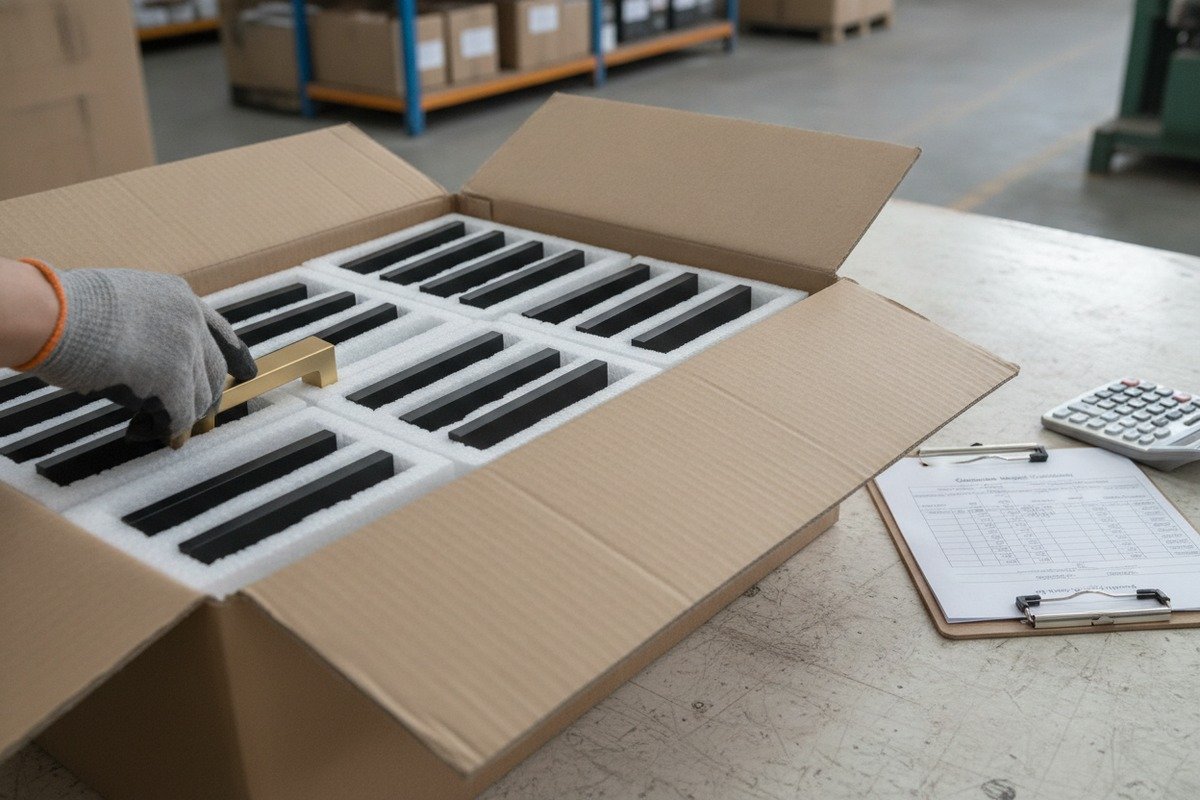
Volumetric weight compares a carton's size to its actual weight, and carriers charge whichever number is higher. For aluminum handles packed with foam inserts or blister trays, the volumetric weight often exceeds the actual weight by two to three times, making box dimensions the real cost driver.
What Is Volumetric Weight?
Volumetric weight 4, also called dimensional weight or DIM weight, is a pricing tool carriers use to account for space. A large, light box takes up room on a plane or truck that could hold heavier cargo. Carriers compensate by calculating a "weight" based on the box's volume.
The formula varies slightly by carrier, but the principle is the same:
Volumetric Weight (kg) = Length (cm) × Width (cm) × Height (cm) ÷ Divisor
The divisor depends on the shipping mode:
| Shipping Mode | Common DIM Divisor | Example Carton (60 × 30 × 25 cm) | Volumetric Weight |
|---|---|---|---|
| Air Freight 5 | 6,000 | 60 × 30 × 25 = 45,000 cm³ | 7.5 kg |
| Courier (DHL, FedEx) | 5,000 | 60 × 30 × 25 = 45,000 cm³ | 9.0 kg |
| Sea Freight 6 (LCL) | Priced per CBM | 0.045 CBM | Rate × 0.045 |
Why Handles Are Especially Vulnerable
Our recessed aluminum handles, for instance, weigh only about 80–120 grams each depending on length. A carton of 200 pieces might weigh 20 kg actual. But because each handle is a long, slim profile that needs separation to avoid scratches, the carton often measures 60 × 30 × 25 cm or larger. By air courier, that carton's volumetric weight is 9.0 kg, which is below the actual weight—so in this case actual weight wins. However, if you add foam dividers and the carton swells to 70 × 40 × 30 cm, the volumetric weight jumps to 16.8 kg by courier, which is now close to or may even exceed the actual weight. For lighter handle models or smaller order quantities per carton, volumetric weight almost always wins.
Actual Weight vs. Chargeable Weight
Carriers compare the actual gross weight of the carton to the volumetric weight. They charge you on whichever is higher. This is called the chargeable weight. When we prepare export quotes, our team always provides both numbers so buyers can see which one will determine the freight bill.
Here is a quick example from a recent shipment:
| Metric | Value |
|---|---|
| Handle model | 300 mm recessed pull, champagne gold anodized |
| Pieces per carton | 150 |
| Actual gross weight | 14.2 kg |
| Carton dimensions | 65 × 35 × 28 cm |
| Volumetric weight (air, ÷6000) | 10.6 kg |
| Volumetric weight (courier, ÷5000) | 12.7 kg |
| Chargeable weight (air) | 14.2 kg (actual wins) |
| Chargeable weight (courier) | 14.2 kg (actual wins) |
In this case the handles are dense enough that actual weight controls. But when we shipped a similar order of 600 mm long handles, the carton had to be 75 × 20 × 15 cm, and the volumetric weight exceeded actual weight by 40%. The lesson: longer handles need longer boxes, and longer boxes change the math.
How to Ask Your Supplier the Right Questions
Before you request a freight quote from any forwarder, get these numbers from your supplier:
- Net weight per piece
- Gross weight per carton (including all packaging)
- Outer carton dimensions (L × W × H in cm)
- Number of pieces per carton
- Number of cartons per order
With these five data points, you can calculate chargeable weight yourself and compare forwarder quotes accurately.
Can I reduce my logistics expenses by optimizing the packaging dimensions of my custom handles?
When our production team designs packaging for a new handle profile, the first question from our export department is always the same: "Can we make the carton smaller without risking damage?"
Yes, optimizing packaging dimensions is one of the most effective ways to cut logistics costs. By reducing void space, using tighter-fitting inserts, nesting handles, and choosing compact carton sizes, buyers can lower volumetric weight by 20–40% without sacrificing product protection.

Where the Wasted Space Hides
Packaging waste comes from three places: oversized master cartons, excessive internal padding, and poor handle orientation inside the box. Many suppliers default to a "one size fits all" carton. That means a 128 mm handle ships in the same width box as a 300 mm handle, with empty space filled by crumpled paper or foam blocks. Every cubic centimeter of air inside that box costs money.
Practical Packaging Optimization Strategies
Here are techniques we use at our Foshan facility to keep carton volume down:
Nesting and stacking. Our recessed channel handles have an L-shaped cross-section. We can nest them face-to-face so two handles share the same footprint. This nearly halves the width needed per layer.
Custom-cut foam trays. Instead of loose foam peanuts, we use die-cut EVA trays that hold each handle snugly. The tray matches the handle profile exactly, so no extra depth is needed.
Right-sized cartons. We stock multiple carton sizes. A 128 mm handle goes in a 35 × 25 × 20 cm carton. A 600 mm handle goes in a 65 × 15 × 12 cm carton. Each carton is designed for the specific handle length.
Removing unnecessary inner boxes. Some buyers request individual boxes per handle for retail display. If the handles are going to a furniture factory for production use, individual boxes add volume with no benefit. Switching to bulk tray packing can reduce carton volume by 30% or more.
The Cost Impact in Real Numbers
| Packaging Style | Carton Dimensions (cm) | Pieces per Carton | Vol. Weight (Courier ÷5000) | Actual Weight | Chargeable Weight |
|---|---|---|---|---|---|
| Individual retail box | 70 × 40 × 35 | 100 | 19.6 kg | 12.0 kg | 19.6 kg |
| Bulk tray, nested | 55 × 30 × 20 | 100 | 6.6 kg | 11.8 kg | 11.8 kg |
| Bulk tray, non-nested | 60 × 35 × 25 | 100 | 10.5 kg | 12.0 kg | 12.0 kg |
Look at the first row versus the second. Same 100 handles. The retail-boxed version has a chargeable weight of 19.6 kg because volumetric weight dominates. The nested tray version drops to 11.8 kg actual weight as the chargeable figure, because the carton is compact enough that actual weight wins. That is a 40% reduction in chargeable weight—and roughly 40% off the courier freight bill for that carton.
When to Discuss Packaging With Your Supplier
The best time to discuss packaging is before you place the order, not after. If you tell your supplier the shipping method you plan to use, a good supplier will adjust the packaging accordingly. For sea freight, heavier cartons are fine because you are paying for cubic meters. For air freight or courier, every centimeter matters. We routinely offer two packaging options—one for sea and one for air—so our buyers can choose based on their logistics plan.
Finish Protection vs. Volume Tradeoff
Aluminum handles with anodized or powder-coated finishes scratch easily. Champagne gold and matte black finishes show marks the most. So there is always a tension between compact packing and surface protection. The solution is not more padding—it is smarter padding. A thin PE film wrap on each handle plus a die-cut tray does more to prevent scratches than a thick layer of bubble wrap, and it takes up a fraction of the space.
Should I choose sea freight or air freight based on the total weight of my bulk handle shipment?
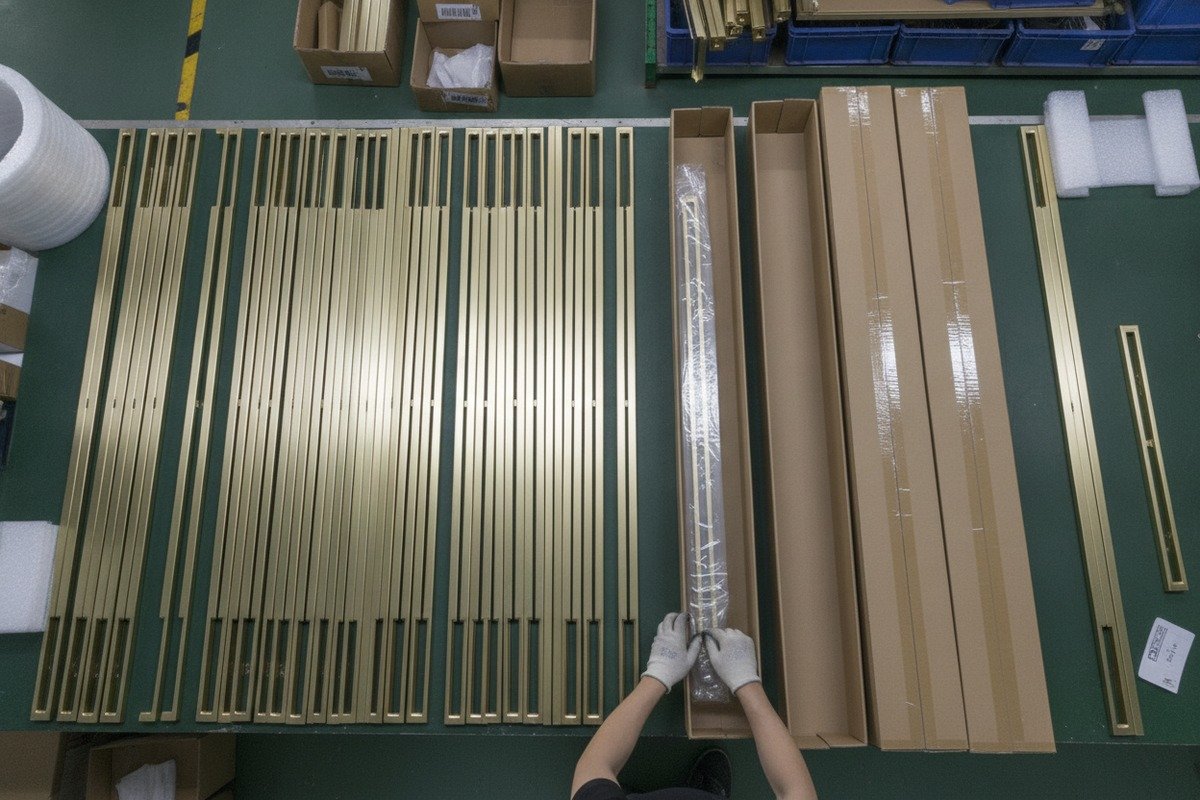
Our warehouse ships about 300 tons of aluminum profiles and handles per year. Some go by air to meet an urgent production deadline. Most go by sea because the economics make far more sense at scale. But the right choice depends on more than just weight.
Choose sea freight when your order fills at least several cubic meters and your timeline allows 25–40 days of transit. Choose air freight for urgent restocks or sample orders under 300 kg. The crossover point depends on total volume, chargeable weight, and how soon you need the goods on your production line.
Comparing Freight Modes Side by Side
The table below uses real-world rate ranges we have seen in 2024 for shipments from Foshan, China to common Middle East and Southeast Asian destinations:
| Factor | Sea Freight (FCL 7) | Sea Freight (LCL 8) | Air Freight | Courier (Express) |
|---|---|---|---|---|
| Best for | Large orders (5+ CBM) | Medium orders (1–5 CBM) | Urgent mid-size orders | Samples, small reorders |
| Typical cost basis | Per container or per CBM | Per CBM (min charge applies) | Per kg chargeable weight | Per kg chargeable weight |
| Rate range | $800–$2,500 per 20ft container | $40–$80 per CBM | $3–$6 per kg | $5–$12 per kg |
| Transit time | 15–35 days | 20–40 days | 3–7 days | 2–5 days |
| Weight sensitivity | Low (space matters more) | Medium | High (DIM weight applies) | Very high (DIM weight applies) |
| Handling at destination | Requires customs clearance agent | Same | Same, but faster | Often door-to-door |
How Weight and Volume Interact With Each Mode
Sea freight charges by the cubic meter for LCL or by the container for FCL. Actual weight matters only if it exceeds a weight cap per CBM (usually around 1,000 kg per CBM for LCL). Aluminum handles are dense enough that they rarely hit this cap. So for sea freight, your cost is driven by how many cubic meters your cartons occupy. Compact packaging saves money here too, just for a different reason.
Air freight uses the standard chargeable weight formula. The DIM divisor for air is typically 6,000. If your cartons are well-packed and dense, actual weight usually controls. But if cartons are oversized, volumetric weight takes over and costs spike.
Courier shipping uses a DIM divisor of 5,000, which is even more aggressive. It also imposes size limits. Most couriers cap individual packages at 70 kg and 120 cm on the longest side. If your handle cartons exceed these limits, the courier may refuse them or apply surcharges.
The Order Size Decision Framework
Here is a simplified guide we share with new buyers:
- Under 100 kg actual weight: Courier or air freight. Speed is the main advantage. Cost per kg is high but the total bill is manageable because the shipment is small.
- 100–500 kg: Air freight is usually cheaper than courier. Sea freight (LCL) starts to become competitive if you can wait 3–5 weeks.
- 500 kg–2,000 kg: LCL sea freight is almost always the best value. Air freight is only justified for truly urgent orders.
- Over 2,000 kg or over 10 CBM: FCL sea freight. You are filling a significant portion of a container, and the per-unit cost drops dramatically.
Do Not Forget the Hidden Costs
Choosing sea freight also means paying for customs brokerage 9, port handling, and inland trucking at the destination. These fees add $200–$600 depending on the port and country. For a large order, this is a small percentage of total cost. For a tiny LCL shipment, these fixed fees can make sea freight more expensive per unit than air.
Our advice: always compare the total landed cost, not just the freight rate. We help our buyers build a simple spreadsheet that includes product cost, packaging cost, freight, insurance, duties (aluminum handles typically fall under HS 8302.42 for furniture fittings), and destination handling fees.
What are the common pitfalls I should avoid when calculating shipping costs for oversized aluminum profiles?
In our 18 years of exporting aluminum hardware, we have seen buyers lose money on shipping mistakes that were entirely avoidable. The most painful ones involve oversized or oddly shaped packages that trigger surcharges nobody expected.
The most common pitfalls include underestimating how handle length affects carton dimensions, ignoring courier size limits that trigger surcharges or freight reclassification, failing to account for pallet overhang, and neglecting to confirm gross weight versus net weight with the supplier before requesting freight quotes.

Pitfall 1: Long Handles Create Long Boxes
A 900 mm recessed pull handle requires a carton at least 95 cm long. Most courier services charge an "oversize" surcharge when any single dimension exceeds 120 cm, and some carriers flag packages as oversize starting at 100 cm on the longest side. Even at 95 cm, the length-plus-girth calculation (length + 2 × width + 2 × height) can easily exceed 165 inches (419 cm), which is the cutoff for many parcel carriers. Once you cross that line, the shipment moves from parcel pricing to freight pricing—a completely different and often more expensive rate structure.
Pitfall 2: Confusing Net Weight and Gross Weight
Net weight is the product alone. Gross weight includes packaging, inserts, and the carton itself. For aluminum handles, packaging can add 15–25% to the net weight. If you quote freight using net weight, your actual freight bill will be higher than expected. Always ask for gross weight per carton.
Pitfall 3: Pallet Overhang and Stackability
When cartons are palletized for LCL or FCL sea freight, any overhang beyond the pallet edge creates wasted space and potential damage. Standard pallets are 120 × 100 cm. If your cartons are 65 cm long, two cartons side by side measure 130 cm—10 cm of overhang. A good supplier will adjust carton dimensions to fit pallet footprints cleanly.
Pitfall 4: Ignoring Freight Class for LTL Shipments
In the United States and some other markets, LTL (Less Than Truckload) freight is priced by freight class 10, which is determined by density (weight per cubic foot). Aluminum handles are relatively dense, so they usually qualify for a favorable freight class (Class 70–85). But if the packaging is bulky and the density drops below 6 lb per cubic foot, the freight class jumps and so does the rate.
Pitfall 5: Not Getting Carton Specs Before Ordering
Many buyers accept a unit price, place the order, and only then ask the supplier for carton details to arrange shipping. By that point, the packaging is already decided. If the cartons are oversized, it is too late to change them without delaying production. The fix is simple: request carton specifications as part of the initial quotation process.
A Quick Checklist Before You Confirm Your Order
- Confirm carton dimensions (L × W × H) for each handle SKU
- Confirm gross weight per carton
- Calculate volumetric weight using the appropriate divisor for your shipping mode
- Check whether any carton dimension exceeds courier oversize thresholds
- Verify that cartons fit standard pallet dimensions without overhang
- Ask the supplier if packaging can be adjusted for your preferred freight method
- Calculate chargeable weight and request freight quotes based on that number
- Include destination handling fees, duties, and insurance in your landed cost estimate
Conclusion
Shipping aluminum furniture handles from China is a packaging problem more than a weight problem. Get your carton specs early, calculate chargeable weight honestly, match your freight mode to your order size, and you will keep landed costs where they belong.
Footnotes
1. Defines dimensional weight and explains why carriers use it for pricing. ↩︎
2. An article providing a clear definition and explanation of port handling operations. ↩︎
3. Describes inland transport, its modes, and its role in connecting ports to destinations. ↩︎
4. Explains dimensional weight calculation and its importance in shipping costs. ↩︎
5. Provides a comprehensive definition and explanation of air freight in logistics. ↩︎
6. Explains sea freight, its importance, and how it works in global trade. ↩︎
7. Explains FCL shipping, its benefits, and how it differs from LCL. ↩︎
8. Defines LCL shipping, its benefits, and how it compares to FCL for cargo. ↩︎
9. Defines customs brokerage and its role in international trade. ↩︎
10. Defines freight class and its importance in LTL shipping, as set by NMFTA. ↩︎