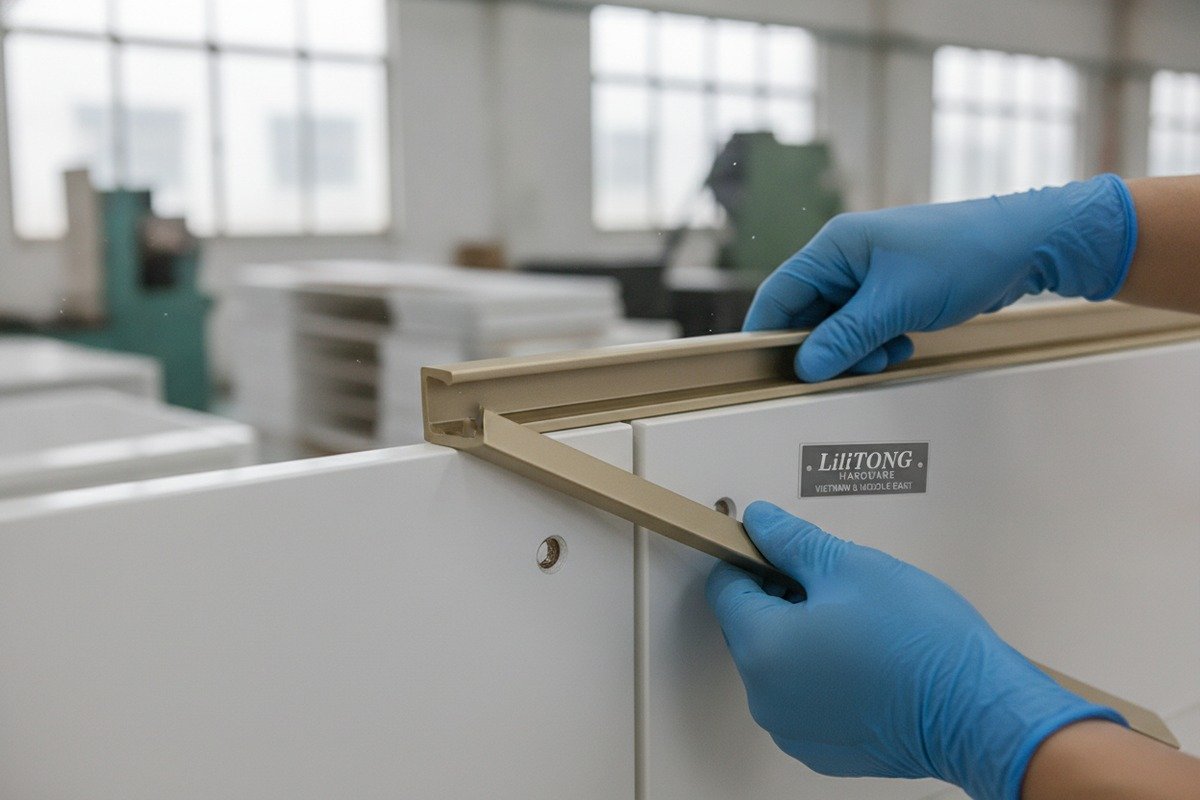
Over the past 18 years on our production line in Foshan, the most common complaint we hear from furniture factory buyers is this: the handles arrived, but they don’t fit the holes already drilled into the cabinets.
To ensure the hole spacing of aluminum furniture handles matches your existing furniture, measure the center-to-center (CTC) distance between pre-drilled holes in millimeters, then match that exact number to the handle’s listed hole spacing specification before ordering. Never rely on overall handle length alone.
This guide walks you through every step of measuring, verifying, customizing, and quality-checking hole spacing so your next order fits perfectly the first time. Let’s start with the most critical skill: accurate measurement.
How do I accurately measure the center-to-center distance of my existing furniture holes to ensure a perfect fit?
Many buyers focus on the handle's visual size or overall length. That approach causes fitting problems. The only measurement that determines whether a handle mounts correctly is the center-to-center hole distance.
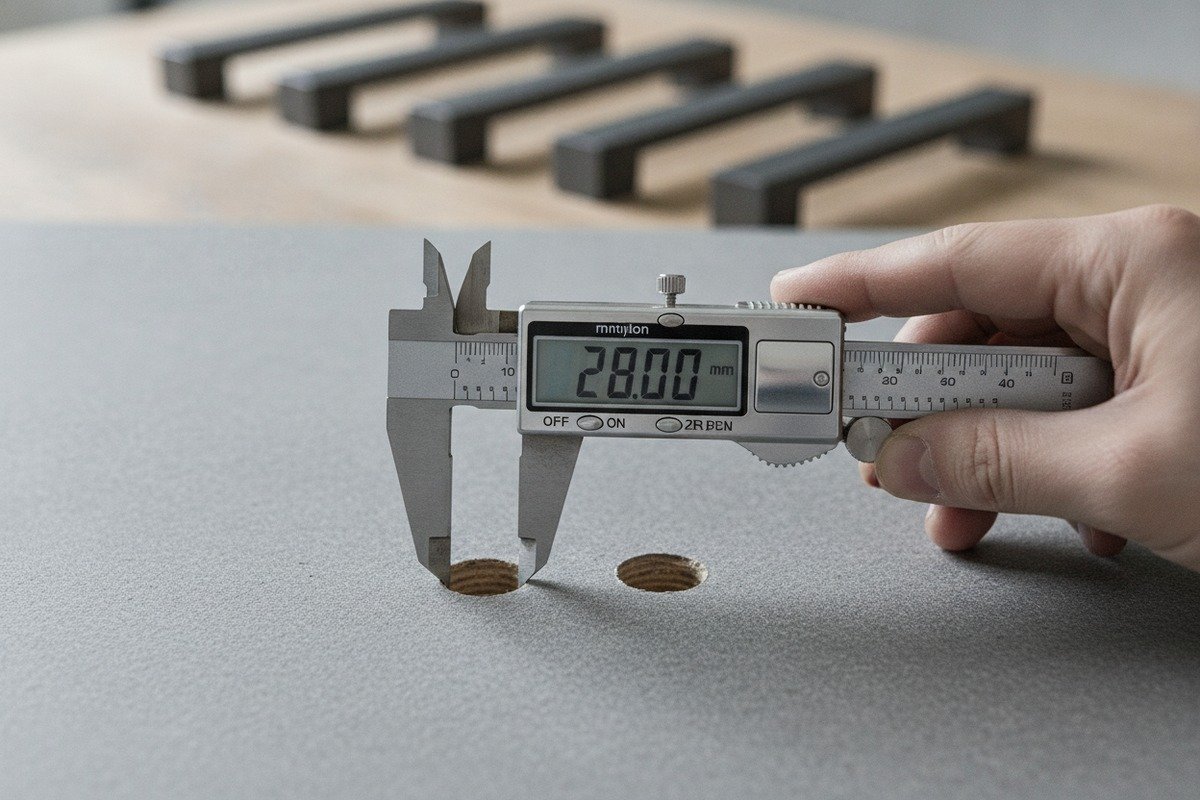
To accurately measure center-to-center distance, remove the existing handle, identify the exact center of each screw hole, and measure the distance between those two center points using a metric ruler or digital caliper. Always record the result in millimeters for the highest precision.
Why Center-to-Center Is the Only Measurement That Matters
When we ship handles to furniture factories in Vietnam and the Middle East, the specification they check first is always hole spacing — also called CTC, spread, or hole centers. These terms all mean the same thing: the distance from the center of one mounting hole to the center of the other.
The handle's overall length can be 20 mm or even 50 mm longer than the hole spacing. That extra material is the overhang on each side. It looks nice, but it does not affect the fit. If the CTC is wrong by even 2 mm, the screws will not line up.
Step-by-Step Measurement Process
- Remove the old handle. Unscrew it completely so both holes are fully visible.
- Mark the center of each hole. Use a pencil or a fine marker. If the hole is round, the center is easy to find. For elongated slots, mark the midpoint of the slot's length and width.
- Use a metric measuring tool. A digital caliper 1 is best. A steel ruler with millimeter markings also works. Avoid cloth tape measures — they flex and stretch.
- Measure from center to center. Place one end of the caliper at the center mark of the first hole. Extend to the center mark of the second hole. Read the number in millimeters.
- Repeat twice more. Take the measurement three times. If the numbers differ, use the most frequent result.
Common Mistakes to Avoid
Do not measure from the edge of one hole to the edge of the other. This gives you a number that is either too large or too small, depending on hole diameter. Do not measure the old handle itself from end to end — that tells you the overall length, not the CTC.
Standard Hole Spacing Sizes You Will Encounter
From our production data, here are the most common CTC sizes ordered by furniture factories worldwide:
| CTC (mm) | Approximate Inches | Common Use |
|---|---|---|
| 64 mm | 2-1/2" | Small cabinet knobs and pulls |
| 96 mm | 3-3/4" | Standard kitchen and bathroom cabinets |
| 128 mm | 5" | Medium drawers and doors |
| 160 mm | 6-1/4" | Large drawers |
| 192 mm | 7-1/2" | Wide cabinet doors |
| 256 mm | 10" | Wardrobe doors |
| 320 mm | 12-5/8" | Tall wardrobe and pantry doors |
Notice that many "inch" sizes are actually rounded conversions of metric standards. A handle listed as 3-3/4 inches is really 96 mm. If you measure in inches and round incorrectly, you may order the wrong size. Millimeters remove this ambiguity.
Why Millimeters Beat Inches for This Task
Metric measurements 2 are more precise for hardware. The difference between 95 mm and 96 mm matters. In fractional inches, that 1 mm gap gets lost. Our engineering team always recommends millimeters to our B2B clients because it prevents costly order mistakes on bulk shipments.
Can I customize the hole spacing of aluminum handles if my furniture design requires non-standard dimensions?
When you are designing new furniture — not replacing old handles — you have total control over hole placement. But what happens when your design calls for a hole spacing that does not match any catalog listing?
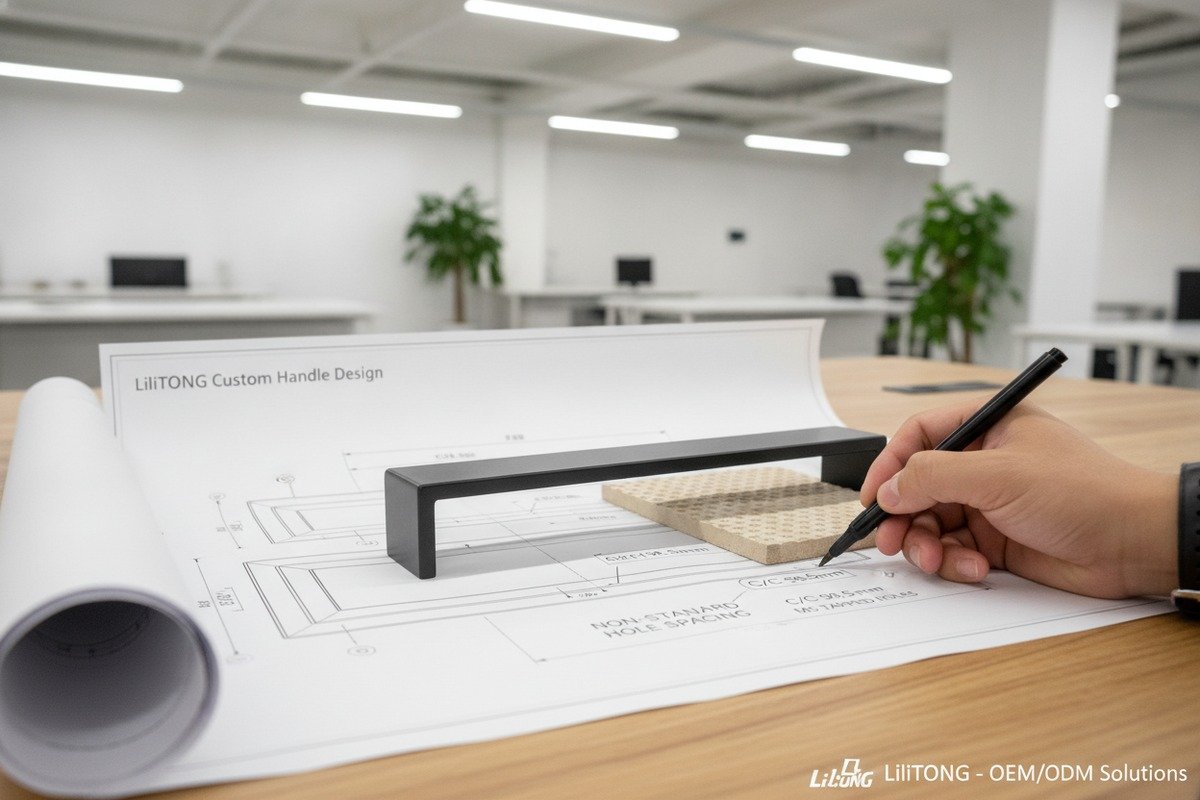
Yes, aluminum handles can be manufactured with custom hole spacing. Reputable suppliers with in-house extrusion and CNC drilling capabilities can produce handles in virtually any CTC dimension, typically with a 3–7 day turnaround for custom orders and reasonable minimum order quantities.
When Standard Sizes Don't Work
Standard sizes like 96 mm, 128 mm, and 160 mm cover most kitchen and bathroom cabinets. But custom furniture often breaks those rules. We regularly receive requests from furniture factories building oversized wardrobes, unique vanity units, or commercial display cases. These designs may need 110 mm, 140 mm, 200 mm, or even 450 mm hole spacing. None of those are standard catalog items.
How Custom Hole Spacing Works in Production
At our Foshan facility, the aluminum handle body is extruded in long lengths. The hole spacing is determined during the secondary machining stage — CNC drilling 3. This means changing the CTC is a programming adjustment, not a tooling change. Here is a simplified overview of the process:
| Production Stage | What Happens | Impact on Custom CTC |
|---|---|---|
| Extrusion | Aluminum alloy 4 is pushed through a die to form the handle profile | No impact — profile shape is independent of hole spacing |
| Cutting | Extruded profile is cut to the desired overall length | Determines handle length, not CTC directly |
| CNC Drilling | Mounting holes are drilled at precise positions | This is where custom CTC is set — fully adjustable |
| Surface Finishing | Anodizing, powder coating, or other treatments applied | No impact on hole spacing |
| Quality Inspection | Dimensions verified against specification | CTC is measured and confirmed at this stage |
Because the CTC is set during CNC drilling, custom spacing adds very little cost. There is no need for a new extrusion die 5. This is important for wholesalers who need flexibility without paying for expensive tooling.
What You Need to Provide for a Custom Order
When you contact us — or any supplier — for custom hole spacing, have these details ready:
- Exact CTC in millimeters. Not approximate. Not "about 5 inches." Give us the number.
- Handle profile or style reference. Send a photo or drawing of the profile shape you want.
- Overall handle length. This determines how much overhang extends beyond the holes.
- Screw hole diameter. Most furniture handles use M4 screws 6 (4 mm holes), but confirm this.
- Finish. Anodized, powder-coated, brushed, matte, or polished.
- Quantity. Custom orders have MOQ requirements. Ours start lower than many competitors.
Turnaround Expectations
For standard profiles with custom CTC, our turnaround is 3 to 7 working days. If the handle profile itself is custom (requiring a new extrusion die), lead time extends to 15–25 days. The difference is significant, so always clarify whether you need a custom profile or just custom hole spacing on an existing profile.
A Note on Samples
Before committing to a bulk custom order, request samples. We always recommend this. A single sample confirms the fit, the feel, and the finish. It costs a fraction of what a mismatched bulk shipment would cost to return or rework.
What should I do if my furniture factory's pre-drilled holes don't match standard aluminum handle sizes?
This is one of the most frustrating situations in furniture hardware sourcing. The cabinets are already drilled. The handles you want come in 128 mm CTC. But your holes measure 125 mm. What now?
If pre-drilled holes don't match standard handle sizes, you have three options: source a custom-spaced handle from a flexible manufacturer, fill the old holes and re-drill at the correct spacing, or use a handle with a backplate that covers the misaligned holes while mounting at a corrected position.
Option 1: Source a Handle with the Exact CTC You Need
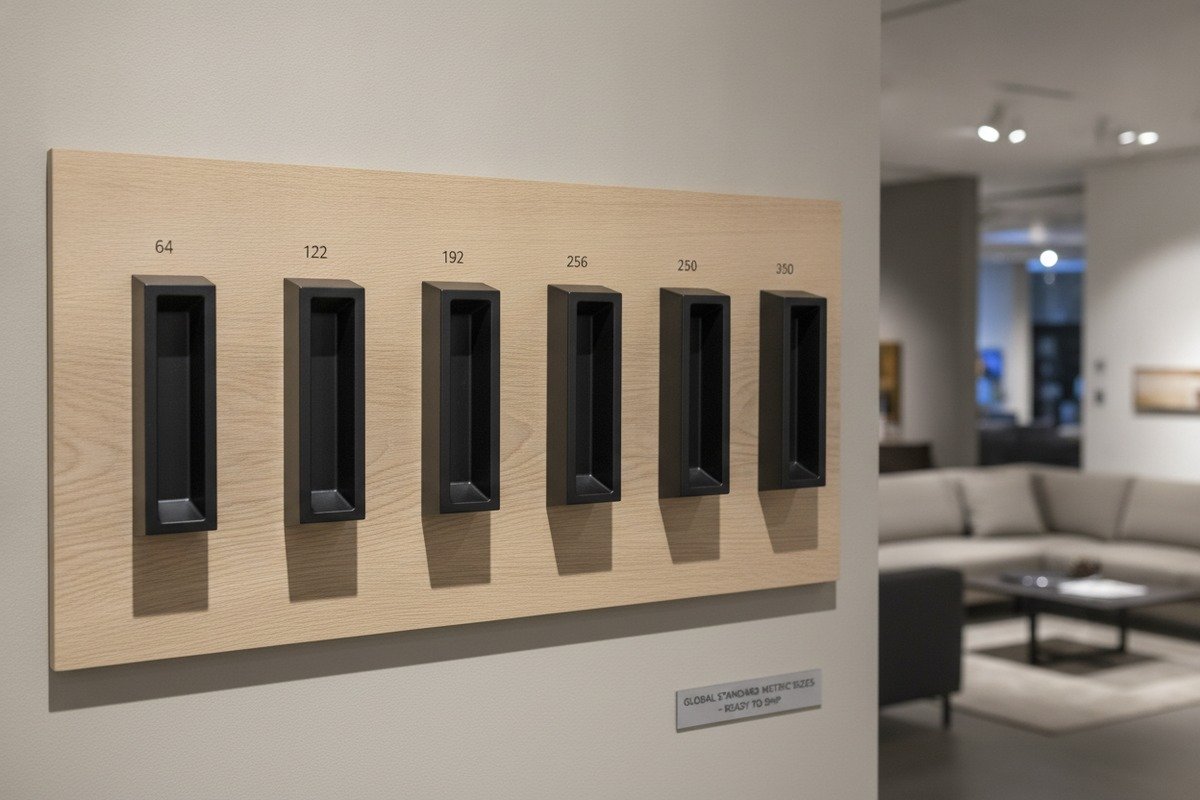
This is the cleanest solution. As discussed above, manufacturers like us can drill holes at any spacing. If your cabinets have 125 mm holes, we can make handles with 125 mm CTC. The result is a perfect fit with no rework on the furniture.
The catch is lead time. If you need handles tomorrow, custom drilling takes a few days. If you are planning ahead, this is the best path.
Option 2: Fill the Old Holes and Re-Drill
When the furniture is already assembled and delivered, sometimes you cannot wait for custom handles. In that case, you can:
- Fill the existing holes with wood filler, dowel plugs, or epoxy (depending on material).
- Let the filler cure completely.
- Drill new holes at the correct CTC for the standard handle you have in hand.
- Mount the new handle.
This works, but it has drawbacks. The patched area may be visible if the furniture has a wood grain finish. On laminated or painted surfaces, the patch is easier to hide. On glass or metal-faced cabinets, filling is often not practical.
Option 3: Use a Backplate Handle
Some aluminum handle designs come with a decorative backplate — a flat plate that sits between the handle and the cabinet surface. The backplate is larger than the handle's footprint and can cover old holes that are slightly off. The new mounting holes for the backplate can be drilled in the correct position.
This approach is popular with renovation projects where you want a fresh look without visible patches.
Decision Guide: Which Option to Choose
| Situation | Best Option | Why |
|---|---|---|
| New production run, holes not yet drilled | Custom CTC handle | Drill cabinet holes to match the handle |
| Holes already drilled, time available | Custom CTC handle | Handle is made to match existing holes |
| Holes already drilled, handles already in stock | Fill and re-drill | Adapt the furniture to the handle |
| Renovation, old holes visible | Backplate handle | Covers old holes elegantly |
| Slight mismatch (1–2 mm) | Elongated slot handle | Some handles have slotted mounting holes that allow minor adjustment |
A Word About Slotted Mounting Holes
Some handle designs feature elongated or oval screw slots instead of round holes. These slots allow 2–4 mm of adjustment along the length of the handle. If your mismatch is small, this type of handle can absorb the difference. When we design handles for clients who serve the renovation market, we often suggest this feature. It dramatically reduces returns caused by slight misalignment.
Prevention Is Cheaper Than Correction
The best strategy is to confirm hole spacing before drilling the furniture. If you are a furniture factory, coordinate with your hardware supplier early. Share the handle specification with your production team so the CNC router drills the cabinet holes at the correct CTC. If you are a wholesaler supplying both handles and cabinets, align the specs at the quoting stage.
We have seen projects where a 3 mm mismatch led to thousands of cabinets needing rework. That cost far more than a quick phone call to confirm the CTC before production started.
How can I verify that the bulk order of aluminum handles will maintain consistent hole spacing across all units?
Ordering 500 or 5,000 handles is very different from buying one. A single sample can be perfect. But will every unit in the shipment be just as precise? This question keeps procurement managers up at night.
To verify consistent hole spacing across a bulk order, request a pre-production sample for approval, require the manufacturer to share CNC machining tolerances, ask for in-process quality inspection reports, and conduct random sampling with caliper measurements upon delivery to confirm CTC uniformity.

Understanding Manufacturing Tolerances
No machining process produces absolutely identical parts. There is always a tolerance — an acceptable range of variation. For CNC-drilled aluminum handles, the industry standard tolerance for hole spacing is typically ±0.1 mm to ±0.3 mm. At our facility, we hold ±0.15 mm on CTC dimensions. That means a 128 mm handle will measure between 127.85 mm and 128.15 mm. This range is tight enough that the screws align perfectly every time.
Ask your supplier what tolerance they hold. If they cannot answer, that is a warning sign.
Quality Control Steps You Should Request
Here is a practical quality assurance checklist for bulk handle orders:
| QC Step | When It Happens | What to Ask For |
|---|---|---|
| Pre-production sample | Before mass production begins | Physical sample shipped to you for measurement and approval |
| First article inspection | After the first 10–20 units are produced | Dimensional report with CTC measurements of initial units |
| In-process inspection | During production at regular intervals | Photos and measurement data at 25%, 50%, 75% completion |
| Final random inspection | After production is complete, before packing | AQL sampling with caliper checks on CTC, screw hole diameter, and overall length |
| Incoming inspection (your side) | When goods arrive at your warehouse | Spot-check 5–10% of units with your own caliper |
What Is AQL Sampling?
AQL stands for Acceptable Quality Level 7. It is a statistical sampling method used in manufacturing. Instead of checking every single handle, you check a random sample from the batch. If the defect rate in the sample is below the AQL threshold, the batch passes. For dimensional accuracy on hardware, an AQL of 1.0 or 1.5 is common. This means you accept the batch if fewer than 1.0% to 1.5% of sampled units are out of tolerance.
We apply AQL 1.0 to all our B2B shipments by default. If a client requires tighter inspection, we accommodate that.
Beyond Hole Spacing: Other Dimensions to Check
Consistent hole spacing is critical, but don't forget these related measurements:
- Screw hole diameter. Should be uniform so screws fit snugly without wobbling.
- Handle projection. The distance the handle sticks out from the cabinet face. Inconsistent projection means some handles look different from others on a row of cabinets.
- Overall length. Even if CTC is correct, handles cut to different lengths look uneven when installed side by side.
- Surface finish uniformity. Color variation between batches of anodized aluminum 8 is possible. Request a color reference sample.
The Value of Long-Term Supplier Relationships
When you work with the same supplier over multiple orders, consistency improves. We keep records of every client's specifications — profile dimensions, CTC, finish, screw size, packaging requirements. When a reorder comes in, we do not start from scratch. We pull the existing spec sheet, confirm nothing has changed, and produce to the same standard. This institutional memory is one of the biggest advantages of a stable supplier partnership.
For new suppliers, always order a small trial batch before committing to a large volume. Measure every unit in that trial batch. If the CTC consistency is solid, scale up with confidence.
Protect Yourself with Clear Documentation
Put the CTC specification, tolerance, and inspection requirements in writing — in the purchase order, not just in a WhatsApp message. A written spec gives you grounds for a claim if the delivered goods are out of tolerance. It also gives the factory a clear target to hit. Ambiguity causes errors. Precision in communication leads to precision in production.
Conclusion
Getting the right aluminum furniture handles starts with one simple rule: measure the holes, not the handle. Record the center-to-center distance 10 in millimeters, match it to the product specification, and verify consistency before committing to a bulk order. When standard sizes don't fit, work with a manufacturer who can customize quickly. That single habit — measure first, order second — will save you time, money, and frustration on every project.
Footnotes
1. Provides a comprehensive guide on how to properly use digital calipers for accurate measurements. ↩︎
2. Explains the advantages of metric units, including universality, simplicity, and precision in engineering. ↩︎
3. Explains the CNC drilling process, its types, applications, and high accuracy in manufacturing. ↩︎
4. Explains aluminum alloy definition, types, properties, and their crucial role in modern manufacturing. ↩︎
5. Defines an aluminum extrusion die and explains its crucial role in shaping the aluminum profile. ↩︎
6. Provides a comprehensive overview of M4 screw sizes, specifications, and common applications. ↩︎
7. Provides a comprehensive guide to Acceptable Quality Level (AQL) and its importance in manufacturing quality control. ↩︎
8. Explains the process and benefits of aluminum anodizing, including enhanced corrosion and wear resistance. ↩︎
9. Defines dimensional tolerances and explains their importance in manufacturing for part functionality and assembly. ↩︎
10. Explains the definition and importance of center-to-center measurement for cabinet hardware. ↩︎