
Every week, our sales team in Foshan fields questions from overseas buyers about one topic that causes more confusion than almost anything else: HS codes CN code 1. A wrong code can mean you pay too much duty, face customs delays, or even get hit with penalties. The problem is real, and it costs importers thousands of dollars each year.
To confirm the HS code for aluminum furniture handles from China, classify the product by its material (base metal/aluminum), function (furniture fitting), and form (finished handle or part), then verify that classification against your destination country’s official tariff schedule. Never rely solely on your supplier’s export code.
This guide walks you through every step of the verification process. We will cover how classification works, where to find official rulings, how to calculate landed cost, and how to avoid the most common mistakes importers make. Let’s get into it.
How do I determine the exact HS code for aluminum furniture handles to avoid overpaying on import duties?
Many of the furniture factory owners and wholesalers we work with assume that a handle made of aluminum automatically falls under an aluminum extrusion heading. That assumption can be expensive.
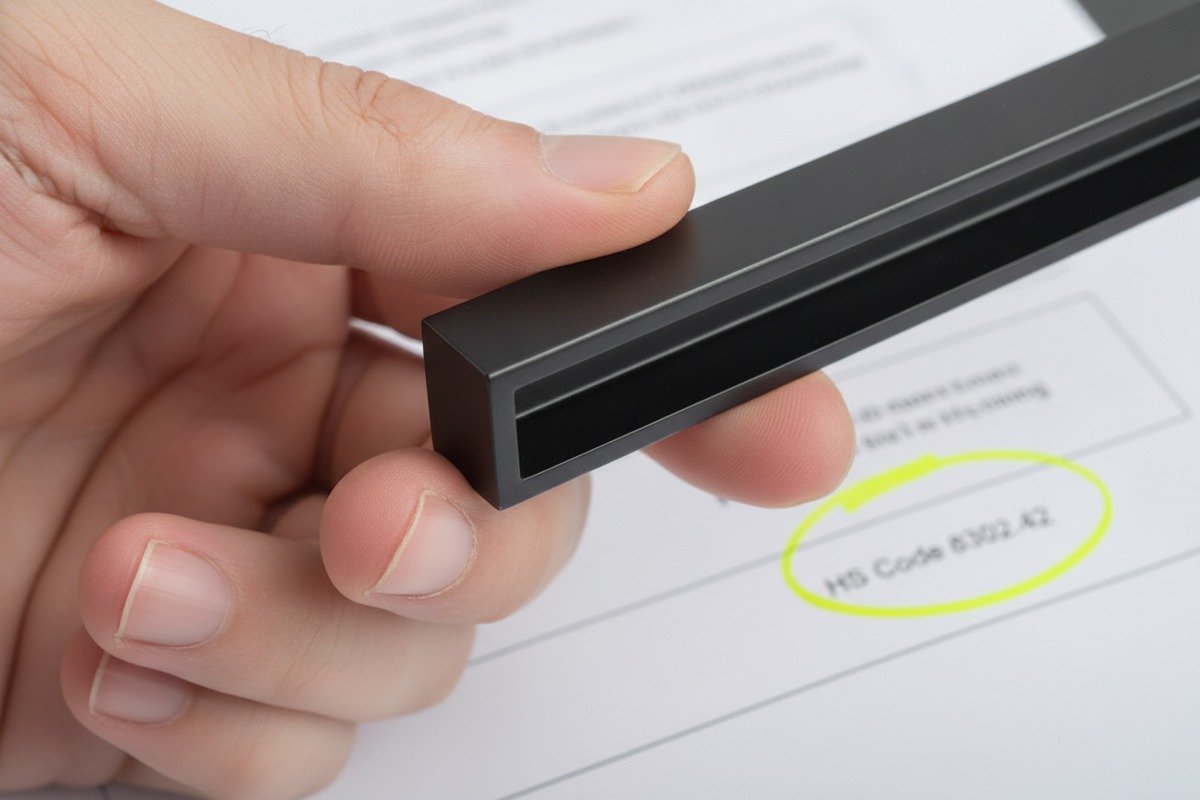
To determine the exact HS code, examine the handle's primary function (furniture fitting), its material (base metal aluminum), and its form (finished article). Aluminum furniture handles typically classify under HS 8302.42 for base-metal mountings and fittings suitable for furniture, not under aluminum profile headings like 7604 or 7610.
What Is an HS Code and Why Does It Matter?
The Harmonized System 2 (HS) is a global product classification framework maintained by the World Customs Organization 3 (WCO). Every product traded internationally gets a numerical code. The first six digits are standardized worldwide. Countries then add extra digits for their own tariff and statistical needs. The United States uses a 10-digit HTS code 4. The EU uses an 8-digit CN code. China uses its own 8-digit or 10-digit extensions for exports.
This code controls three critical things for your shipment:
- The duty rate customs will charge you.
- Whether additional tariffs apply (such as Section 301 or Section 232 in the US).
- Whether any import licenses, quotas, or special documentation are required.
Function Over Material: The Key Classification Principle
Here is where most buyers go wrong. They see "aluminum" and look under Chapter 76 5, which covers aluminum and articles thereof. But customs does not classify products by material alone. Customs classifies by function first. If the item is specifically designed as a furniture fitting, it belongs in Chapter 83 6 (miscellaneous articles of base metal), specifically under heading 8302 7.
| Classification Factor | Chapter 76 (Aluminum Articles) | Chapter 83 / Heading 8302 (Base Metal Fittings) |
|---|---|---|
| Primary basis | Material composition | Function and end use |
| Typical products | Aluminum bars, profiles, tubes, plates | Handles, hinges, locks, knobs for furniture |
| Common HS codes | 7604, 7608, 7610 | 8302.41, 8302.42 |
| When it applies to handles | Raw extrusion sold as a profile, not yet a finished fitting | Finished handle designed for mounting on furniture |
| Duty rate (US example) | Varies, often 2.6%–5% | Often around 3.9% ad valorem |
US Customs and Border Protection 8 (CBP) rulings have repeatedly placed cabinet knobs, pulls, and furniture handles under 8302.42 when the items are base-metal mountings, fittings, and similar articles suitable for furniture. Even though the handle is made entirely of aluminum, the functional classification as a furniture fitting takes priority.
How to Narrow Down the Subheading
Start with heading 8302. Then look at the subheadings:
- 8302.41 — Suitable for buildings (door handles, window fittings).
- 8302.42 — Suitable for furniture.
If your handle is designed for a cabinet, wardrobe, drawer, or kitchen cupboard, 8302.42 is almost certainly the correct 6-digit starting point. From there, check your destination country's tariff schedule for the full national code. In the US, CBP rulings show specific 10-digit HTS extensions under 8302.42 for furniture knobs and pulls.
Do not guess. Open your country's online tariff database, search for 8302.42, and read every line-item description until you find the one that matches your product.
Can my Chinese manufacturer provide the specific HS code documentation I need for my local customs?
When our team prepares export documents for a shipment of recessed cabinet pulls or champagne-gold anodized handles, we always include an HS code on the commercial invoice. But here is something every buyer needs to understand clearly.
Your Chinese manufacturer can and should provide a declared HS code on the commercial invoice and packing list, but this code reflects China's export classification. It may not match your importing country's tariff code exactly. You must independently verify the code against your own country's tariff schedule before entry.
What Documents Should Your Supplier Provide?
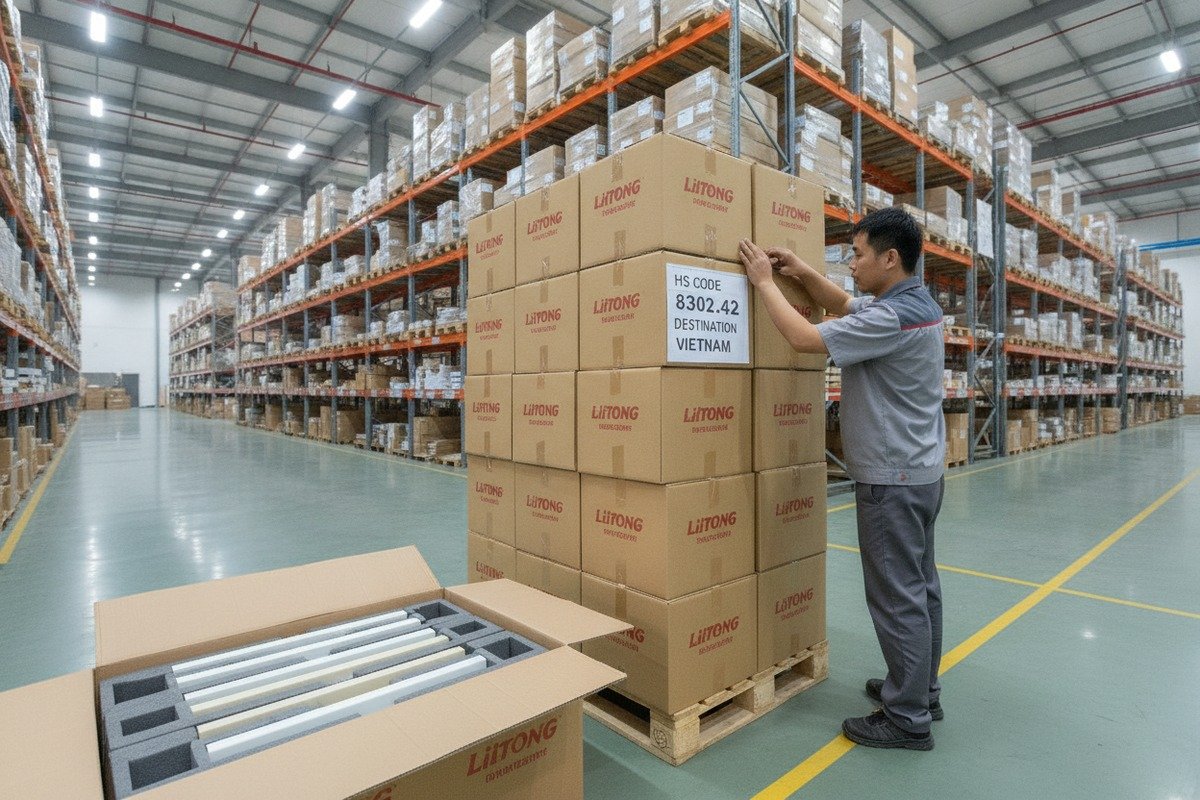
A good supplier will give you a complete documentation package. At our facility, every shipment includes:
- Commercial invoice with product description, material, quantity, unit price, and HS code.
- Packing list with weights and dimensions.
- Product specification sheet covering alloy grade (e.g., 6063-T5), surface finish (anodized, electrophoretic, powder-coated), dimensions, and mounting method.
- Certificate of origin.
- Photos of the actual goods.
All of these documents help your customs broker or customs authority classify the product correctly. The HS code your supplier writes on the invoice is a starting point, not the final answer.
Why the Supplier's Code May Differ From Yours
There are several reasons the export code from China may not match the import code in your country:
- Different national extensions. China's 8-digit code and the US 10-digit HTS code are built on the same 6-digit base, but the extra digits differ.
- Export incentives. In some cases, Chinese exporters may use a code that qualifies for a VAT rebate on the export side. This code may not reflect how your country's customs views the product.
- Classification expertise. Many factories are experts in manufacturing, not in international trade law. The code on their invoice might be what they have always used, not what is technically correct.
- Product ambiguity. A slim, recessed aluminum pull with a geometric channel — like the modern handles we produce — could potentially be viewed as an aluminum profile section (7604) by one classifier and as a furniture fitting (8302.42) by another. The correct answer depends on the product's condition and end use at the time of import.
What to Ask Your Supplier
| Question to Ask | Why It Matters |
|---|---|
| What HS code do you declare on export? | Gives you a starting reference point |
| What aluminum alloy is the handle made from? | Material composition can affect classification |
| Is the handle sold as a finished fitting or a raw profile? | Finished fittings classify differently than raw extrusions |
| Can you provide detailed drawings and mounting instructions? | These prove the product's intended function to customs |
| Do you have test reports or material certificates? | Supports your classification if customs asks questions |
The bottom line: use your supplier's code as a reference, not as gospel. The legal responsibility for correct classification sits with the importer, not the exporter.
How will the HS code classification affect the total landed cost of my aluminum profile shipment?
In our experience shipping handles to the Middle East and Southeast Asia, we have seen the same product attract very different duty rates depending on how it was classified at the border. One client paid 3.9% duty. Another, importing the same style of handle into a different country with a slightly different code, paid nearly 12%. The HS code is not just paperwork. It is money.
The HS code directly determines your base import duty rate, and it also controls whether additional tariffs like anti-dumping duties, Section 301 tariffs, or special safeguard measures apply. A single-digit difference in the code can change your total landed cost by 5% to 25% or more.
Breaking Down the Landed Cost Formula
Your total landed cost is not just the price you pay your supplier. It includes:
- Product cost (FOB or CIF price)
- Freight and insurance
- Import duty (determined by HS code)
- Additional tariffs (Section 301, Section 232, anti-dumping, etc.)
- VAT or sales tax (in many countries, applied on top of duty-inclusive value)
- Customs brokerage and handling fees
The HS code controls the duty and additional tariff lines directly. It also influences whether your product triggers any trade remedy measures.
A Real-World Comparison
Let's say you import 2,000 kg of aluminum furniture handles at a CIF value of $8,000. Here is how the classification choice affects your cost in the US market:
| Cost Component | Classified as 8302.42 (Furniture Fitting) | Classified as 7604 (Aluminum Profile) |
|---|---|---|
| CIF Value | $8,000 | $8,000 |
| Base Duty Rate | 3.9% | 5.0% |
| Base Duty Amount | $312 | $400 |
| Section 301 Tariff (if applicable) | May apply at 25% = $2,000 | May apply at 25% = $2,000 |
| Section 232 Aluminum Tariff | Generally not applicable to finished fittings | May apply at 10% = $800 |
| Total Duty Estimate | $2,312 | $3,200 |
| Difference | — | +$888 per shipment |
This is a simplified example, but the point is clear. Classifying an aluminum furniture handle under a raw aluminum heading could expose you to Section 232 tariffs that would not apply to a finished base-metal furniture fitting. Over a year of regular shipments, that classification error could cost you tens of thousands of dollars.
Hidden Costs of Wrong Classification
Beyond the direct duty difference, wrong classification can trigger:
- Customs holds and inspections, delaying your shipment by days or weeks.
- Retroactive duty assessments, where customs reviews past entries and demands back payment.
- Penalties, which in the US can range from 20% to 40% of the underpaid duties for negligence, and up to 4x the duties for fraud.
- Loss of importing privileges in extreme cases.
Getting the HS code right is not optional. It is a core part of your sourcing cost calculation.
What steps should I take to verify the HS code accuracy before my furniture hardware leaves China?
Before we ship any order from our Foshan warehouse, we encourage every buyer to confirm their import classification independently. We have seen too many cases where a shipment clears Chinese customs smoothly but gets held up at the destination because the buyer did not verify the code on their end.
Before shipment, collect full product specifications from your supplier, compare the item's material, function, and form against your country's tariff schedule, search for customs rulings on similar products, and consult a licensed customs broker or request a binding ruling for any ambiguous classification.

Step 1: Gather Complete Product Evidence
You need a file that fully describes the product. This is what customs will look at if they question your classification. Collect the following:
- Detailed product drawings with dimensions.
- Photos from multiple angles (top, side, cross-section, mounted on furniture).
- Material composition and alloy grade (e.g., aluminum 6063-T5).
- Surface finish type (anodized, powder-coated, electrophoretic).
- Mounting method (screw-fixed, adhesive, clip-on).
- End use description (cabinet handle, wardrobe pull, drawer knob).
- Weight per piece and per carton.
At our factory, we provide all of this in a standard product data sheet. If your supplier does not offer this level of detail, ask for it. You will need it.
Step 2: Walk Through the Classification Decision Tree
Ask yourself these questions in order:
- Is this a finished article or a raw material? If it is a finished handle ready to mount on a cabinet, it is not a raw aluminum profile.
- What is the primary function? If it is designed as a furniture fitting, look at heading 8302.
- What material is it made from? If base metal (including aluminum), 8302 still applies. If it were plastic, you would look elsewhere.
- Is it suitable for furniture specifically? Then 8302.42, not 8302.41 (which is for buildings).
- What is the full national code? Check your country's tariff database for the exact 8-digit, 10-digit, or longer code.
Step 3: Search for Customs Rulings
Most customs authorities publish past classification rulings. In the United States, CBP maintains a searchable database called CROSS (Customs Rulings Online Search System 9). Search for terms like "cabinet handle," "furniture knob," "aluminum pull," or "furniture fitting" and you will find rulings that classify similar products under 8302.42.
These rulings are not binding on your specific product, but they give you strong evidence that your classification is correct.
Step 4: Consult a Customs Broker
If the product is borderline — for example, a minimalist recessed pull that could be described as either a furniture fitting or an architectural trim profile — pay a customs broker to review the classification. A good broker charges a small fee for this service but can save you thousands in incorrect duties or penalties.
Step 5: Request a Binding Ruling (If Needed)
For high-volume imports or ambiguous products, you can request a binding ruling 10 from your country's customs authority. In the US, this is done by filing a ruling request with CBP. The ruling is legally binding and gives you certainty. It typically takes 30 to 90 days, so plan ahead.
Pre-Shipment Verification Checklist
| Step | Action | Status |
|---|---|---|
| 1 | Collect product spec sheet with photos, drawings, and material data | ☐ |
| 2 | Confirm material composition and surface finish | ☐ |
| 3 | Identify end use: cabinet, wardrobe, drawer, or general furniture | ☐ |
| 4 | Compare product to official tariff descriptions in destination country | ☐ |
| 5 | Search customs rulings database for similar items | ☐ |
| 6 | Consult licensed customs broker for classification review | ☐ |
| 7 | Request binding ruling if classification is unclear or value is high | ☐ |
| 8 | Confirm final HS code and calculate expected duty before shipment | ☐ |
Do not skip this process. A few hours of verification before shipment can prevent weeks of delays and thousands of dollars in unexpected costs after arrival.
Conclusion
Getting the HS code right for aluminum furniture handles is not a minor detail — it is the foundation of your entire import cost calculation. Verify the classification yourself using official sources, and never depend on a single party's code alone.
Footnotes
1. Replaced 404 link with an active official European Commission page on the Combined Nomenclature. ↩︎
2. Official WCO page explaining the global product classification framework. ↩︎
3. Official website of the international organization maintaining HS. ↩︎
4. Replaced 403 link with the official Harmonized Tariff Schedule search portal from the U.S. International Trade Commission. ↩︎
5. Official USITC page for the Harmonized Tariff Schedule, containing Chapter 76. ↩︎
6. Official USITC page for the Harmonized Tariff Schedule, containing Chapter 83. ↩︎
7. CBP page for rulings and legal decisions, where heading 8302 is discussed. ↩︎
8. Official website of the primary US border security and trade agency. ↩︎
9. Official CBP database for searching past customs classification rulings. ↩︎
10. Official CBP explanation of the binding ruling program for import classification. ↩︎